Serena’s Review: “Flowerheart”

This post may contain affiliate links for books we recommend.  Read the full disclosure here.
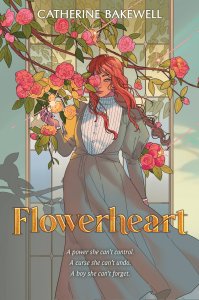
Book: “Flowerheart” by Catherine Bakewell

Publishing Info: HarperTeen, March 2023

Where Did I Get this Book: Edelweiss+

Where Can You Get this Book: Amazon | IndieBound | WorldCat

Book Description: Clara’s magic has always been wild. But it’s never been dangerous. Then a simple touch causes poisonous flowers to bloom in her father’s chest.

The only way to heal him is to cast an extremely difficult spell that requires perfect control. And the only person willing to help is her former best friend, Xavier, who’s grown from a sweet, shy child into a mysterious and distant young man.

Xavier names a terrible price in return, knowing Clara will give anything to save her father. As she struggles to reconcile the new Xavier with the boy she once loved, she discovers their bargain is only one of the heavy secrets he’s hiding. And as she hunts for the truth, she instead finds the root of a terrible darkness that’s taken hold in the queendom—a darkness only Clara’s magic is powerful enough to stop.

Review: This is definitely one of those books that I first looked at because of the cover. It immediately stood out when I was scrolling through Edelweiss+ planning out my spring reading schedule. Tons of books with daggers and swords on the covers, lots of duo characters drawn in that cartoonish style that is so popular right now (not that I dislike this style per se, just there’s a lot of it). This cover’s unique art immediately stood out and had me clicking through to the description. So well done there!

Clara has always struggled to control her magic, so much so that the local leaders have presented her with a terrible ultimatum to prevent her from injuring others. But before she can go through with it, the worst happens and an innocent touch causes her magic to sprout poisonous plants in her father’s chest, dooming him to a painful and slow death. When an old friend offers to help her tame her magic in an attempt to save her father’s life, she doesn’t even hesitate in the face of the steep price he requests. But when it becomes clear that Xavier is caught up in much darker forces than she had previously known, Clara begins to wonder with just whom did she strike her perilous bargain?

One thing that I found interesting when I was looking into this book was that it was marketed as a “cottage core” fantasy novel. What does that even mean? As far as I’m aware “cottage core” is a style of interior decoration. I’m not sure how that translates to a genre of book? Digging deeper, I discovered that there seems to be a recent trend of labeling some books “cozy fantasy,” which I imagine is just a spin-off from the more popular “cozy mystery” subcategory. Based on the latter, I’d guess that a cozy fantasy novel would be a story that avoids darker themes or graphic descriptions. Like cozy mysteries, they would focus on lighter topics and have happy endings, essentially. All of this to say, while I could see how cozy fantasy would apply to this story, I still have no clue about “cottage core.” And honestly, I’m not a fan of that description; interior decoration styles and genres of books are just not the same thing. Sorry, not sorry.

Anyways, that rant aside, I can definitely see how this book could fall into the “cozy” category. Overall, it does stay on the lighter side of things and the plot wraps up with a nice bow at the end. But this book also highlights why a lot of cozy mysteries don’t work for me either. Look, I don’t need tragedy around every corner and tons of graphic violence, but if you paint in only bright colors, without any shades of grey, the entire thing starts to just lose focus and interest. Clara is fine. Xavier is fine. This world and magic are fine. But I didn’t care about any of them.

I also found the magic system and world to be barely fleshed out at all. Towards the second third of the book, we begin to learn about a magical illness that is going around that leaves its victims comatose. This was the first thing to trigger my interest, but even that quickly sank into the quagmire of dullness that I found this read. Nothing was objectively bad, but it all was just so flat feeling that even small points of interest quickly faded away.

There was also an attempt by the author to deal with mental illness, particularly depression and anxiety. And while I applaud the effort, I don’t think it quite hit the mark. At points, it felt incredibly over-simplified and the metaphors heavy-handed. And then Clara has this weird relationship to her own magic where she speaks to it as a living, thinking being using this strange internal dialogue, which I wasn’t a fan of. It turns out that this particular choice plays a larger role later in the story, but that was still too late to save my reading experience through which I had been perpetually annoyed by this.

Overall, this book wasn’t for me. I do think that readers looking for something in the cozy category may enjoy this one more, but I’ve started coming to the conclusion that “cozy” any genre is just not my cup of tea.

Rating 6: Perhaps other readers looking for just a quick, cozy read will enjoy this, but I found everything from the world-building to characterization to be a bit too watered down to enjoy.

Reader’s Advisory:

“Flowerheart” can be found on these Goodreads lists: Books that inspired or are similar to Studio Ghibli / Hayao Miyazaki films and CozySFF

Book Club Review: “The Witch’s Heart”

This post may contain affiliate links for books we recommend.  Read the full disclosure here.

We are part of a group of librarian friends who have had an ongoing book club running for the last several years. Each “season” (we’re nerds) we pick a theme and each of us chooses a book within that theme for us all to read. Our current theme is retellings and re-imaginings.  For this blog, we will post a joint review of each book we read for book club. We’ll also post the next book coming up in book club. So feel free to read along with us or use our book selections and questions in your own book club!

Book: “The Witch’s Heart” by Genevieve Gornichec

Publishing Info: Ace Books, February 2021

Where Did We Get This Book: The library!

Where You Can Get This Book: WorldCat | Amazon | Indiebound

Retelling/Re-imagining: Norse Mythology

Book Description: Angrboda’s story begins where most witches’ tales end: with a burning. A punishment from Odin for refusing to provide him with knowledge of the future, the fire leaves Angrboda injured and powerless, and she flees into the farthest reaches of a remote forest. There she is found by a man who reveals himself to be Loki, and her initial distrust of him transforms into a deep and abiding love.

Their union produces three unusual children, each with a secret destiny, who Angrboda is keen to raise at the edge of the world, safely hidden from Odin’s all-seeing eye. But as Angrboda slowly recovers her prophetic powers, she learns that her blissful life—and possibly all of existence—is in danger.

With help from the fierce huntress Skadi, with whom she shares a growing bond, Angrboda must choose whether she’ll accept the fate that she’s foreseen for her beloved family…or rise to remake their future. From the most ancient of tales this novel forges a story of love, loss, and hope for the modern age.

Kate’s Thoughts

While I have a pretty extensive knowledge of Greek Mythology thanks to an obsession with it in grade school, Norse Mythology is pretty outside of my wheelhouse. I know some of the basic things, and have a general working knowledge of the various Gods and the whole concept of Ragnorak, but it’s sparse when compared to other people I’d imagine. So I was going into “The Witch’s Heart” without much idea of what to expect when it came to our protagonist Angrboda, the witch who eventually gave birth to Loki’s monster children who help usher in the apocalypse myth. But that just made me game to give it a shot, especially since it was getting the “Circe” treatment and retelling a story with a character who doesn’t have as much to do in the original myths. And for the most part, I enjoyed “The Witch’s Heart”, but that may be because I had few expetations.

For one thing, I really liked the emotional exploration of Angrboda as a woman used by powerful men, as well as the emotional exploration of her as a mother to her children, as atypical as they may be. And by atypical I mean a half corpse daughter, a wolf, and a serpent. But I really got a sense of her love for all of them and the way that she was desperate to protect them, while also falling for Loki no matter how dysfunctional that relationship was. The way she was written to me made me believe it, even though sometimes I wanted to shake her and be like ‘SERIOUSLY, THIS GUY?’ (so does her huntress friend Skadi, a character that I also found intriguing though I think I needed more of her. Also, damn you Tom Hiddleston for making Loki so damn likable, because this version, while more true to the myth, was a punk). The relatable emotional bits were what really kept me engaged, as I was deeply invested in her relationship with her kids event though I did know that it would all end in tears because of the myths they are based upon. That being said, I also thought that there were bits where it kind of dragged after abrupt tone shifts that didn’t work as well for me. I was far more interested in her being a mother in the forest as opposed to the end of world action that was inevitably going to take place.

Ultimately I was entertained by “The Witch’s Heart”. I’m still into these outside the box retellings of mythological women, and would love to see more that push beyond the obvious Greek stories, so that made this one all the more enjoyable.

Serena’s Thoughts

I’m fairly familiar with Norse mythology. Not an expert, by any means, but I already knew the story being retold here fairly well, as well as the major players involved. That was both a plus and a minus as far as my reading experience goes. Like Kate, I’m really enjoying this current surge of books being published that reimagine or create stories for lesser known characters, often women, from mythology. I also really like the fact that we are venturing beyond the much more popular Greek pantheon.

Angrboda was almost a perfect character for this sort of retelling. She doesn’t have much as far as the original lore, so there was a lot of room to portray her story. And somehow I think the author both did too much and too little. On one hand, the story was very faithful to the major plot points of the Norse story from which it is derived. But almost too much? I would have liked a few more creative interpretations brought in. Also, like Kate said, I think Angrboda’s character was given some interesting themes to cover, especially with regards to her relationship to her children and to her unhealthy relationship with her husband, Loki. But on the other hand, I felt like she was a bit more passive of a character than I would have expected or hoped for from a woman who has birthed literal monsters!

I also agree with Kate that the pacing of this book felt a bit off. The first half is fairly slow with a lot of time spent with Angrboda hanging out in a cave in the woods. The storytelling was also interrupted by lots of banter from Loki. Which, on one hand, I liked a lot of the dialogue, but I also felt like there were times where the author got rather self-indulgent with it. And then there’s a massive tonal shift in the second half where we’re fulling into the world-shifting dramatics.

Overall, I felt like this book was a bit all over the place. Are my expectations unreasonably high from “Circe?” Probably. But was this the best that could have been done with this story or these characters? I don’t think so.

Kate’s Rating 7: A retelling of a source material I have not so much knowledge of that kept my attention and had some emotional moments, though also some dragging ones.

Serena’s Rating 7: A bit uneven in pacing as well as characterization, but something that will likely appeal to readers who are looking for a different pantheon to explore in their mythological retellings.

Book Club Questions

  1. How familiar are you with Norse Mythology? Could you predict how things were going to go based how much you knew about it?
  2. What did you think of Angrboda as a protagonist? What did you like or dislike about her?
  3. What did you think about Angrboda’s relationships in this story, whether it was Loki, Skadi, or her children?
  4. Did you have any thoughts on how Loki was presented and interpreted in this novel?
  5. There have been a lot of marketing comparisons between this book and Madeline Miller’s “Circe”. What did you think of this marketing choice?
  6. The parts of this book were separated out in very deliberate chunks of time and very deliberate themes. Did you have a part you liked the best?

Reader’s Advisory

“The Witch’s Heart” is included on the Goodreads lists “Hot Girl Mythology Books”, and “Loki: God of Mischief”.

Next Book Club Pick: “Great or Nothing” by Joy McCullough, Caroline Tung Richmond, Tess Sharpe, and Jessica Spotswood

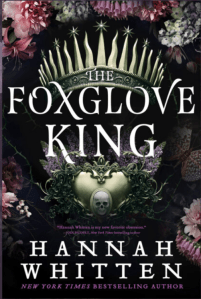
Serena’s Review: “The Foxglove King”

This post may contain affiliate links for books we recommend.  Read the full disclosure here.

Book: “The Foxglove King” by Hannah Whitten

Publishing Info: Orbit, March 2023

Where Did I Get this Book: from the publisher!

Where Can You Get this Book: Amazon | IndieBound | WorldCat

Book Description: When Lore was thirteen, she escaped a cult in the catacombs beneath the city of Dellaire. And in the ten years since, she’s lived by one rule: don’t let them find you. Easier said than done, when her death magic ties her to the city.

Mortem, the magic born from death, is a high-priced and illicit commodity in Dellaire, and Lore’s job running poisons keeps her in food, shelter, and relative security. But when a run goes wrong and Lore’s power is revealed, she’s taken by the Presque Mort, a group of warrior-monks sanctioned to use Mortem working for the Sainted King. Lore fully expects a pyre, but King August has a different plan. Entire villages on the outskirts of the country have been dying overnight, seemingly at random. Lore can either use her magic to find out what’s happening and who in the King’s court is responsible, or die.

Lore is thrust into the Sainted King’s glittering court, where no one can be believed and even fewer can be trusted. Guarded by Gabriel, a duke-turned-monk, and continually running up against Bastian, August’s ne’er-do-well heir, Lore tangles in politics, religion, and forbidden romance as she attempts to navigate a debauched and opulent society.

But the life she left behind in the catacombs is catching up with her. And even as Lore makes her way through the Sainted court above, they might be drawing closer than she thinks.

Review: I really enjoyed Hannah Whitten’s “For the Wolf” duology. The first book came out back in the “summer of ‘Red Riding Hood’ retellings,” as I fondly dubbed it, and I think Whitten’s version was my favorite of the three I read over those months. “For the Throne” was also an excellent sequel, taking the characters and the world in directions that I hadn’t expected. All of this to say, I am fully on board Whitten’s train, and I was super excited when I saw that she was releasing a new book this spring that would be the first in a new series. Let’s dive in!

I’m going to forego my usual summary chapter, and instead talk a bit about the fact that I think the official book’s summary is a bit misleading. It’s not truly important, but I think Lore’s connection to the catacombs is much more complex than “she escaped a cult and is in hiding.” I also think there are simply bits of the few sentences about this aspect of the book in the summary that are just factually wrong. I’m always mildly fascinated when there are discrepancies like these in book summaries. Was there some purpose behind this choice? Did the summary writer only skim the book and this was an accident? Who knows? Beyond this, the rest of the summary seems clear enough.

First, let’s talk about worldbuilding, particularly with regards to the magic and gods of this world. I think it’s interesting that this is now the second series that Whitten has written where her magic system involves magical forces directly interacting with the body, often resulting in mildly horrifying temporary changes to one’s physical self. I mean, I guess if you know what you like in a magic system, just go for it? I just found that interesting.

I will say, however, that it took me a bit to truly understand how this magic works, not only Lore’s abilities but also Mortem itself as used by others in the form of consuming poisonous substances. At a certain point early in the book, I had to consciously choose to stop trying to understand this and just go with it. As I continued reading, some of these details did become more clear, but honestly, I’d still struggle to write down a concise explanation of how it all worked. I’m not sure if this was a failing of the system itself or how it was described, but readers should be prepared to devote some thought and reading time into absorbing this aspect. I do think it is worth it, however, since as the book continued and I felt more comfortable with the concepts, this magical conceit opened up a lot of interesting story lines and theories.

As for the gods, I thought this part of the book was a bit familiar. There are a lot of fantasy books that deal with a religion that has been built up around one god after the destruction of a larger pantheon that came before. So, too, the relationship between a god of life/light and a goddess of darkness/death. The book played its cards pretty close to the chest with these themes, however, leaving a lot of questions still to be answered in this area. But I also feel fairly confident that I know where this is going, and it might read familiar to other readers as well. Who knows though? As I said, we don’t get any clear answers here, so Whitten could still surprise me!

Lastly, the characters and, most importantly, the love triangle between them. Yes, a love triangle and if you skip to the end of the review, you’ll see that I gave this book a good rating, so what’s going on here? Well, I’ll say that the success of this particular love triangle comes down to one key thing: all three of these characters are fully realized individuals with their own arcs and struggles within this book. Yes, it’s mostly Lore’s book. But the story does an excellent job of also setting up Gabriel, a young man who has been shaped by a great tragedy in his past, and now must struggle with dueling loyalties to Lore and to the religion and its leader who gave him refuge during that tragic event. Bastian, too, is a fully realized character, and his story explores themes of responsibility, power, and trust. Truly, the “romance,” such that it is, between all three characters is very much in the background to the growth that they experience as individuals, as various pairs, and as a group of three together.

I’ll also say that the romance plays out in a very non-traditional manner, in some ways. Part of my problem with love triangles is that I always feel as if the true love interest is telegraphed so clearly and so early that the second romantic storyline just feels like rather boring subterfuge. Here, I almost had the opposite problem. At various points in the story, both characters feel as if they are being set up as the end game couple. But then at different points in the story, each does something that I would typically say points to them being ruled them out as the end game partner. I found myself not only confused but intrigued, and I’m now half-wondering if Whitten is pulling a fast one on me and neither character will be a true love interest by the end of the series.

Overall, I really enjoyed this book. I think some aspects of the world-building were a bit confusing, on one hand, and overly familiar, on another. But it’s also clearly the start to a series, so both of these questions could be resolved in follow-up books. I do think the story lives and dies on the strength of its central three characters, and I, for one, was completely sold on them all. If you enjoy character-centric stories and want a more complex look at a love triangle, this is the fantasy novel for you!

Rating 8: Like the book’s own magic, Whitten perfectly balances darkness and light to create a new fantasy world and leading lady that feels both dangerous and opulent, ferocious and soft. An intriguing start!

Reader’s Advisory:

“The Foxglove King” can be found on these Goodreads lists: Most Anticipated Adult Fantasy, 2023 and Poisonous Plant Fiction Titles

Serena’s Review: “Empire of Exiles”

This post may contain affiliate links for books we recommend.  Read the full disclosure here.

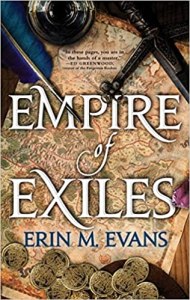
Book: “Empire of Exiles” by Erin M. Evans

Publishing Info: Orbit, November 2022

Where Did I Get this Book: ARC from the publisher!

Where Can You Get this Book: Amazon | IndieBound | WorldCat

Book Description: Twenty-seven years ago, a Duke with a grudge led a ruthless coup against the empire of Semilla, killing thousands. He failed. The Duke was executed, a terrifyingly powerful sorcerer was imprisoned, and an unwilling princess disappeared. 

The empire moved on. 

Now, when Quill, an apprentice scribe, arrives in the capital city, he believes he’s on a simple errand for another pompous noble: fetch ancient artifacts from the magical Imperial Archives. He’s always found his apprenticeship to a lawman to be dull work. But these aren’t just any artifacts — these are the instruments of revolution, the banners under which the Duke lead his coup. 

Just as the artifacts are unearthed, the city is shaken by a brutal murder that seems to have been caused by a weapon not seen since the days of rebellion. With Quill being the main witness to the murder, and no one in power believing his story, he must join the Archivists — a young mage, a seasoned archivist, and a disillusioned detective — to solve the truth of the attack. And what they uncover will be the key to saving the empire – or destroying it again.

Review: I always love some good, old-fashioned political intrigue in my fantasy novels. On top of that, a “seasoned archivist” sounds like a fancy name for a fantasy librarian, so you know I’m going to be all over anything that references librarians. What can I say, we’re easy to please. It’s kind of like how the Oscar nominations always favor movies about Hollywood. Publishers and authors know what us librarians like to read about. Ourselves! But in all seriousness, this sounded like an intriguing book, so I was happy to receive a copy to review from Orbit.

It has been decades since the Duke lead his failed coup, attempting to set up a young princess as the next ruler. He was executed and the world seemed to move on, life going about as usual behind the wall of Salt that surrounds the land to protect those within from the powerful Changelings that linger, ever present beyond. But now, the artifacts of the Duke’s rebellion are being brought out of storage. What possible use could they serve but to reignite that old spark? On top of that, a shocking murder takes place and a group of seemingly disconnected individuals all work to uncover the many secrets that are slowly, slowly creeping back into the light.

This is definitely a book made for true fantasy lovers. By that I mean that it can be intimidating as heck to those who might just pick it up on a whim. You open the book and there you see detailed and complex maps. Then you see a huge cast of characters. And then you start reading and it becomes very apparent that not only do these main characters not understand the full scope of their world, but that the author isn’t about to clue you, the reader, in any time soon either. But this is not a critique! Indeed, all of these things are exactly the kind of meaty aspects that I think many fantasy readers are looking for in a book. We want to be thrown into the deep end and feel as if we’re truly in a new world, one that would in fact be filled with huge casts of characters, need a detailed map to understand, and contain a magic system that goes beyond wand-waving. And this book delivers on all of these things!

Some of it will also be familiar to fantasy fans, which can be a plus and a minus. I didn’t think there was anything truly shocking here, though I may make an exception for the Changelings themselves, as I thought they were a particularly interesting threat. But the magic system, while interesting, will read as familiar to many fantasy readers. Basically, practitioners will have an affinity to certain things (wood, bone, stone) etc. which will influence they way they can perform magic. Hence, the salt wall that surrounds the city gains a certain mystique as it could only be created by a very unique sort of person.

The characters were all good as well, though I can’t say that I was overly attached to any one of them over another. This is probably a good and a bad thing, ultimately. I wasn’t dreading any particular character’s chapter, but I also wasn’t incredibly invested in one of them either. All told, I think the characters themselves served more as aspects of the world and story that were being created than as the driving force of the story itself.

The writing was quite effective right from the start. It felt sure-handed and well-practiced at balancing the myriad of aspects that must go into creating a complicated world and story such as this one. Indeed, on top of setting up an epic-feeling fantasy world, the author adds in a murder mystery. For me, as a fan of mysteries as well, I really enjoyed this combination of genres, and I think it added an extra zest to the overall story.

It did take me a bit to really get into the book. Because we’re thrown in right away, it takes a bit to orient oneself with the players and world at large. This might also be where my lack of immediate attachment to the characters put me at a bit of a disadvantage. Even now, though, I can’t point to exactly why I struggled with this. I have very clear memories of some of the first scenes with certain characters and laughing internally at some of the great dialogue right off the bat. Either way, I think this book will definitely appeal to epic fantasy fans looking for a new world to explore, and I will definitely be keeping an eye out for the next one!

Rating 8: The pinnacle of what one looks for in epic fantasy: a sprawling world, a rich history, a detailed magic system, and an intriguing cast of characters to travel alongside.

Reader’s Advisory:

“Empire of Exiles” can be found on this Goodreads list: Best books of November, 2022

Kate’s Review: “Lore Olympus: Volume 2”


This post may contain affiliate links for books we recommend.  
Read the full disclosure here.

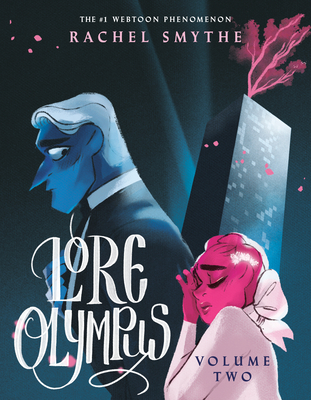
Book: “Lore Olympus: Volume 2” by Rachel Smythe

Publishing Info: Del Rey, July 2022

Where Did I Get This Book: I own it.

Where You Can Get This Book: WorldCat | Amazon | Indiebound

Book Description: Persephone was ready to start a new life when she left the mortal realm for Olympus. However, she quickly discovered the dark side of her glamorous new home—from the relatively minor gossip threatening her reputation to a realm-shattering violation of her safety by the conceited Apollo—and she’s struggling to find her footing in the fast-moving realm of the gods. Hades is also off-balance, fighting against his burgeoning feelings for the young goddess of spring while maintaining his lonely rule of the Underworld. As the pair are drawn ever closer, they must untangle the twisted webs of their past and present to build toward a new future.

This full-color edition of Smythe’s original Eisner-nominated webcomic Lore Olympus features a brand-new, exclusive short story, and brings Greek mythology into the modern age in a sharply perceptive and romantic graphic novel.

Review: We are back for more Greek Mythology soapy romantic goodness, everybody! It has been awhile since I have had a full blown content obsession, but “Lore Olympus” has really snagged me but good. Greek myths! Humor! A favorite ship! LOTS OF PATHOS! It all comes together in this series and we are starting to parse out the various complications that are facing Persephone, Hades, and more Greek Gods and Goddesses in “Volume Two”. Our star crossed would be lovers, Persephone and Hades, are trying to find their footing after their chance meeting has set them both a little off kilter, and while that could just be a lot of pining and wallowing in angst, Rachel Smythe takes the opportunity to build up more backstory and more characterization, and it is for the better. “Volume Two” is keeping the series going strong. But yes, there is still some lovely Hades angst, and given that I LOVE to be emotionally wrecked by fiction, I say bring it on.

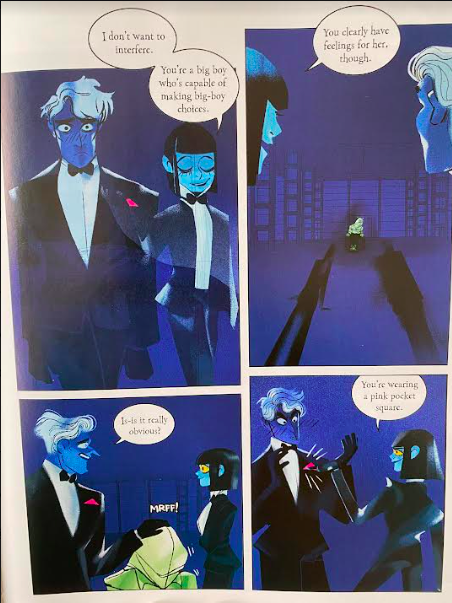
SAD BOYS FOR THE WIIIIIIIN. (source)

One of the most rewarding things about “Lore Olympus” is that Smythe is taking her time to set groundwork, characterizations, and background. We start this volume off with Persephone starting her schooling with her scholarship from The Goddesses of Eternal Maidenhood while silently grappling with the sexual assault she endured at the hands of Apollo. She loves being away from her doting mother’s eyes, but given she’s drawn to Hades she is feeling that perhaps joining TGOEM isn’t what she really wants. Meanwhile, Hades is stewing about his feelings for her and trying to keep his distance, and to make matters worse a tabloid has shown innocuous pictures of them and spinning them to seem scandalous, which threatens Persephone’s reputation. Throw in Hera’s suggestion that Persephone take on an internship in the Underworld (as she secretly wants Hades to be happy and thinks that this would help that), and the two would be lovers are being shoved into some fun forced proximity!

But these very common tropes feel fun and new in this story, and it means that we can carefully explore their budding friendship while also exploring them as individuals who are dealing with a lot of baggage on their own. I thought that Smythe is really careful but also powerful when exploring the aftermath of Persephone’s rape, and does a good job of portraying the shame, the fear, and the apprehension, especially since her abuser is inserting himself in her life vis a vis his clueless sister Artemis, whom Persephone is living with. It’s tackled in a way that feels real, but doesn’t feel melodramatic or exploitative. I’m hoping that it stays that way and isn’t used for man pain or anything like that, but I trust Smythe to continue to be mindful. We also have a lot of other facets to Persephone’s growth as she tries to make sense of what she has been told she wants from life, and what she actually wants from life. There have also been hints about some darkness involving her backstory and her nature, which is VERY interesting to say the least…

Okay now we talk about what I loved most in this book. HECATE IS HERE!!! I’ve talked about how Persephone is my favorite Greek deity, and Hades is definitely number two? Well Hecate, the goddess of witchcraft, is third. I love Hecate. So I was very interested to see how Smythe depicted her, and I was NOT disappointed, as she is Hades’s COO and number two in command, who calls him out on all his nonsense and bullshit while trying to support him in other ways. She is THE BEST, and also very competent at keeping things in the Underworld running. In this the Underworld is a very necessary, non-evil place that has to be run efficiently, and having Hades and Hecate as co-runners feels very Eric and Pam from “True Blood” (without any of the clichéd longing on her part). It’s also really cool to see the depiction of the Underworld here, as we’ve seen the Mortal Realm as fields and vastness, and Olympus as an upperclass city scape. The Underworld feels a bit more hardboiled with a corporate undertone, and I love seeing how it is run, and how the various workers fit in, like Thanatos, who escorts souls to the Underworld, and Minthe the nymph (who just so happens to be in an on again off again/toxic relationship with Hades and she’s also kind of the worst but also seems pretty damaged so she isn’t just a girl to get in the way, HOW REFRESHING!).

And I’m still in love with the artwork. The designs of all these characters are perfection. I mean LOOK AT MY GIRL HECATE!

Source: Random House Worlds

I’m still obsessed with “Lore Olympus”. There isn’t much else to say, I’m head over heels.

Rating 9: Still loving this. What a fresh, soapy, emotional and sometimes hilarious take on Greek Mythology!

Reader’s Advisory:

“Lore Olympus: Volume 2” is included on the Goodreads lists “Greek Mythology Retellings!”, and “Hades and Persephone”.

Previously Reviewed:

“Year of Sanderson”: “Elantris”

This post may contain affiliate links for books we recommend.  Read the full disclosure here.

“Year of Sanderson” is an on-going, monthly series that will post on the last Friday of each month in which I will cover various Brandon Sanderson-related things. This will largely be comprised of book reviews (some from his back catalog and some from the books being released this year), as well as assorted other topics like reviews of the items in the swag boxes that will be coming out as part of Sanderson’s Kickstarted campaign. Frankly, we’ll just have to see what we get from this series, very much like the Kickstarter itself!

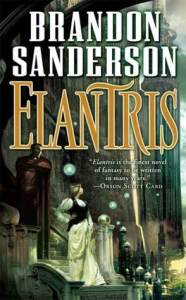
Book: “Elantris” by Brandon Sanderson

Publishing Info: Tor Fantasy, 2006

Where Did I Get this Book:

Where Can You Get this Book: Amazon | IndieBound | WorldCat

Book Description: Elantris was the capital of Arelon: gigantic, beautiful, literally radiant, filled with benevolent beings who used their powerful magical abilities for the benefit of all. Yet each of these demigods was once an ordinary person until touched by the mysterious transforming power of the Shaod. Ten years ago, without warning, the magic failed. Elantrians became wizened, leper-like, powerless creatures, and Elantris itself dark, filthy, and crumbling.

Arelon’s new capital, Kae, crouches in the shadow of Elantris. Princess Sarene of Teod arrives for a marriage of state with Crown Prince Raoden, hoping—based on their correspondence—to also find love. She finds instead that Raoden has died and she is considered his widow. Both Teod and Arelon are under threat as the last remaining holdouts against the imperial ambitions of the ruthless religious fanatics of Fjordell. So Sarene decides to use her new status to counter the machinations of Hrathen, a Fjordell high priest who has come to Kae to convert Arelon and claim it for his emperor and his god.

But neither Sarene nor Hrathen suspect the truth about Prince Raoden. Stricken by the same curse that ruined Elantris, Raoden was secretly exiled by his father to the dark city. His struggle to help the wretches trapped there begins a series of events that will bring hope to Arelon, and perhaps reveal the secret of Elantris itself.

Review: It is only fitting to start out this year’s series on Brandon Sanderson by reviewing his first book, “Elantris.” Like many people, “Elantris” wasn’t the first book I read by Sanderson. Instead, I got on the Sanderson train after reading his “Mistorborn” trilogy as it was released. Then I finished it and, feeling suddenly bereft, I checked out his writing history and low and behold, there was this little stand-alone novel that had been quietly waiting in the background. After reading it, I knew that Sanderson was going to be a “go-to” author for me going forward: not only did I like it as much as the “Mistborn” trilogy, I might have even liked it more!

Elantris was once the golden light of Arelon, not only a beautiful city in and of itself, but populated by the Elantrians, a powerful group of magical individuals who grace those around them with the benefits of their abilities. But then disaster strikes: the city, and its people, crumbles and in the city’s ruined shadow clings the remnants of this once great people. Into this outskirts city, Princess Sarene arrives to marry a prince, only to find he has died, and she has been left a widow. But as she tries to navigate her new existence, she never suspects the truth: the prince is not dead, but banished having become cursed with the same cruel plague that struck down the Elantrians.

While this wasn’t my first experience with Sanderson, I do think that had I read this one first, I would have been even more on-board with his writing than I was after reading the “Mistborn” trilogy. There, Sanderson had three entire books to lay out a complex world, construct multi-layered characters, and depict all the intricate ins and outs of a very complicated magic system. But in “Elantris,” he shows all of these same skills but contained within one novel. Yes, it’s a very long novel, but it’s still one book as compared to three.

As compared to some of his later works, this one has been dinged by other reviewers for lacking the polish of his more recent books. However, in re-reading it for this series, and looking at it purely on its own merits, I don’t think there’s much I can say to that. To me, this book is a pretty perfect example of a solid, stand-alone epic fantasy. It checks off so many boxes without stumbling in any of the three major areas: world-building, characterization, and magic system. Instead, all three come through with flying colors.

In this book, the world-building and the magic system are very closely intertwined. Much of the story surrounds the mystery behind the sudden downfall of the Elantrians and the remaining curse that still randomly strikes individuals in the present day. The curse itself is quite unique, and we explore the lives of those living with it through the eyes of the Crown Prince, Raoden. We learn alongside him of the strange society that now exists within the crumbling city of Elantris where those who are cursed cannot die, but any injury they sustain will never heal, leaving them fragile and susceptible to a never-ending pain that will, eventually, drive them mad.

Outside Elantris’s walls, readers can begin to piece together more of this world-gone-wrong through the eyes of Sarene, a princess who has just arrived in this land only to find her one source of contact, the prince she had been writing, has “died” and she is now widowed and alone. Sarene is exactly the sort of heroic female character I love reading. She’s set up into a situation that is as disempowering as it can get, but she rises against these limitations and plays an integral role in the ultimate solution.

Readers who picked up this book when it was first released probably didn’t realize that they were getting a sneak peak into a toolkit that Sanderson would go on to perfect over the years. Other than his unworldly writing speed, the author is probably best known for his creative magic systems. And here we get a small peak into the beginnings of his abilities in this regard. Not only is the curse that struck the Elantrians incredibly interesting and unique, but the ultimate explanation and solution are as surprising as they are creative. It’s fantasy at its best: fun, exciting, and pushing the boundaries of our expectations.

Overall, “Elantris” is a magnificent novel. And regardless of how others may compare it to Sanderson’s incredible catalog of works, I believe it stands on its own as a near-perfect epic fantasy.

Rating 10: If an alien species came to earth and wanted an example of what “epic fantasy” is all about, “Elantris” would be the go-to pick.

Reader’s Advisory:

“Elantris” can be found on these Goodreads lists: Fantasy Books Written for Adults and Best Stand-Alone Fantasy Book.

Serena’s Review: “The Magician’s Daughter”

This post may contain affiliate links for books we recommend.  Read the full disclosure here.

Book: “The Magician’s Daughter” by H. G. Parry

Publishing Info: Redhook, February 2023

Where Did I Get this Book: from the publisher!

Where Can You Get this Book: Amazon | IndieBound | WorldCat

Book Description: It is 1912, and for the last seventy years magic has all but disappeared from the world. Yet magic is all Biddy has ever known.

Orphaned in a shipwreck as a baby, Biddy grew up on Hy-Brasil, a legendary island off the coast of Ireland hidden by magic and glimpsed by rare travelers who return with stories of wild black rabbits and a lone magician in a castle. To Biddy, the island is her home, a place of ancient trees and sea-salt air and mysteries, and the magician, Rowan, is her guardian. She loves both, but as her seventeenth birthday approaches, she is stifled by her solitude and frustrated by Rowan’s refusal to let her leave. He himself leaves almost every night, transforming into a raven and flying to the mainland, and never tells her where or why he goes.

One night, Rowan fails to come home from his mysterious travels. When Biddy ventures into his nightmares to rescue him, she learns not only where he goes every night, but the terrible things that happened in the last days of magic that caused Rowan to flee to Hy-Brasil. Rowan has powerful enemies who threaten the safety of the island. Biddy’s determination to protect her home and her guardian takes her away from the safety of Hy-Brasil, to the poorhouses of Whitechapel, a secret castle beneath London streets, the ruins of an ancient civilization, and finally to a desperate chance to restore lost magic. But the closer she comes to answers, the more she comes to question everything she has ever believed about Rowan, her origins, and the cost of bringing magic back into the world.

Review: First things first, I absolutely love this book’s cover! It’s so unique and eye-catching. I’m on the record as disliking books using cover-models, and I’m even starting to burn out a little on the cartoonish characters (though there are still versions of this theme I can get behind.) But I think this cover does exactly what a good cover is meant to do: it communicates exactly what kind of book you’re going to get. And here, that would be a book taking place in a historical setting and featuring a fairytale-like tone of fantasy. So, well done cover artist! Let’s get to the book itself, though.

While Biddy understands that a world exists beyond the boundaries of the smile island that she shares with her magician guardian, Rowan, and his rabbit familiar, but all that she knows of it comes from books. Not only has she never seen a city, but while she knows that magic disappeared from the larger world decades ago, for her, growing up, she has been surrounded by it. But soon she sees that there are darker shadows growing in Rowans eyes every time he returns from the mysterious ventures to the outer world he goes on each night. As she finally begins to demand answers to her growing questions, she learns that there is much more going on in the world outside her home than she had ever suspected. And soon she may be needed to play a much larger role in shaping the future than she ever could have imagined.

I absolutely adored this book, as I knew I would almost from the first page of the novel. Of course, things could have always taken a turn for the dire, but the tone and style of the writing was exactly the sort that always appeals to me. The author was direct, and yet whimsical, deftly exploring the world and characters she had created while never falling into the trap of exposition or strange, narrated infodumps. On top of this, the dialogue was witty and had me laughing right from the start, particularly the interactions between Rowan and his familiar, Hutchingson.

But a book cannot live on funny dialogue alone. Indeed, for me, it really comes down to the characters themselves, and as Biddy is the protagonist with whom we travel this story alongside, the book lived and died based on her characterization. She, too, was exactly the sort of leading teenage character I enjoy. It’s a coming of age story where the character is doing exactly that…coming of age. She doesn’t start out as some “best assassin/thief/princess/etc.” and, indeed, the stories she paints about herself are challenged throughout the book. As she comes to understand the world and her own place in it, she must grow into understand the complexities of all the moving pieces and people in it. Rarely is anyone a true hero or true villain. Biddy must come to understand the adults in her life and the stories they, too, have built up around themselves and how they behave in the world and the choices they make. There were strong themes of family, choice, and the duties we have to those around us, both those with whom we are familiar and care for and those stranger who we will never meet but who we understand as humans too who deserve care and kindness as much as the next person.

I also really liked the way that the magic system was used to explore these themes. For what starts as a simple fantasy premise, that magic is leaving/has left the world, the author leverages this topic into deeper conversations about how society responds to emergencies. From what can be well-intentioned decisions going wrong to how those who seek power can take advantage to consolidate wealth into their own pockets at the expense of the many. It was really well done, and the story definitely took some twists and turns towards the last half that really surprised me and left me on the edge of my seat.

Indeed, I really have nothing to criticize about this book! I think it perfectly accomplished everything it set out to do, and it will surely appeal to all fantasy fans who are looking for a great fairytale-esque stand-alone fantasy. I can’t wait to see what the author does next! I’ll definitely be first in line to find out.

Rating 10: Heart-wrenching in all the right ways, this fairytale fantasy deftly explores important themes of individual choice and the responsibilities we have towards the least of those in society.

Reader’s Advisory:

“The Magician’s Daughter” isn’t on any Goodreads lists yet, but it should be on Magicians in Historical Fiction.

Kate’s Review: “Lore Olympus: Volume 1”


This post may contain affiliate links for books we recommend.  
Read the full disclosure here.

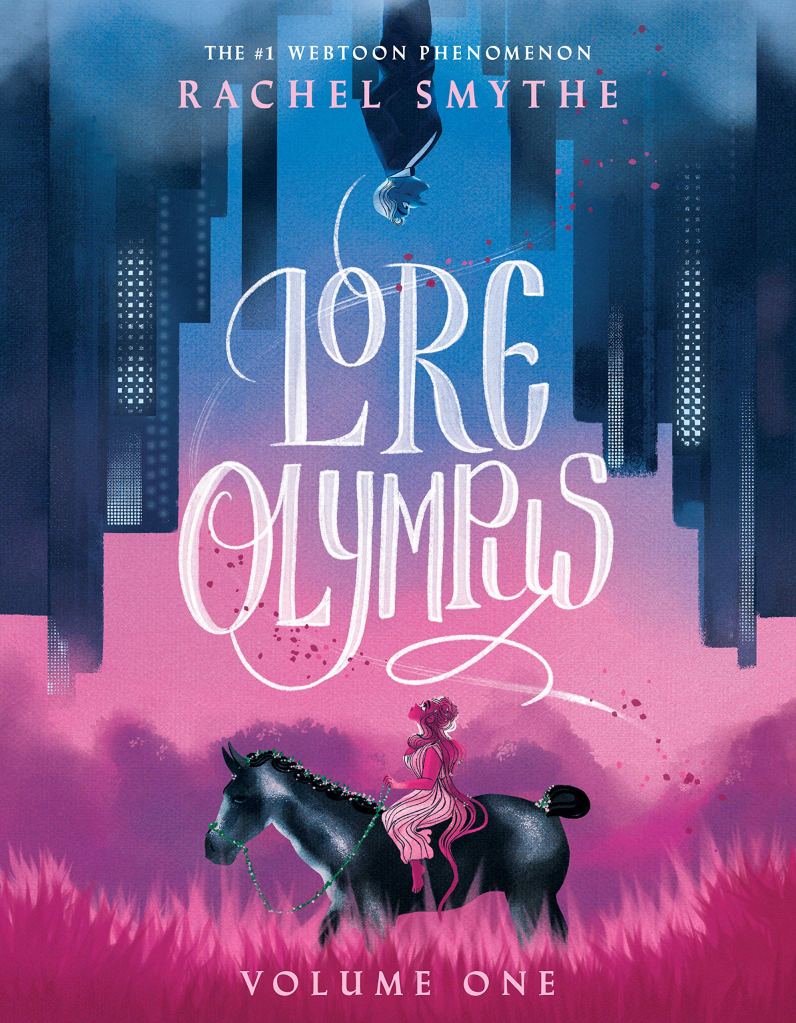
Book: “Lore Olympus: Volume 1” by Rachel Smythe

Publishing Info: Del Rey, November 2021

Where Did I Get This Book: The library!

Where You Can Get This Book: WorldCat | Amazon | Indiebound

Book Description: Experience the propulsive love story of two Greek gods—Hades and Persephone—brought to life with lavish artwork and an irresistible contemporary voice.

Scandalous gossip, wild parties, and forbidden love—witness what the gods do after dark in this stylish and contemporary reimagining of one of mythology’s most well-known stories from creator Rachel Smythe. Featuring a brand-new, exclusive short story, Smythe’s original Eisner-nominated web-comic Lore Olympus brings the Greek Pantheon into the modern age with this sharply perceptive and romantic graphic novel.

Review: It has come up before on this blog, but I absolutely adore the story of Hades and Persephone from Greek Mythology. That said, I am always VERY wary of new and updated takes on this myth, as I am always worried that well meaning creators will take this thousands of years old story and critique it through a modern day lens and decide that it is wholly unacceptable (and to be fair, it’s not like I can blame them because HOO BOY, the optics of it). I am always FAR more interested in adaptations that, instead of making it about grooming, abuse and uneven power dynamics, tap into the very ample potential of a story about a woman discovering her own power and coming into her own on her own terms and with agency… And yeah, it sure doesn’t hurt if there is some steamy romance involved (what can I say, I love a depressive demon nightmare boy and Hades is the originator). So when a Book Club friend asked me if I had heard of “Lore Olympus” and told me what it was, my first question was “okay…. you know my tastes with this story, am I going to like this?” And she said “OH yeah”. So I got “Volume One” from the library, and sat down one night intending to start it. But then I proceeded to finish it and ordered all available volumes to be added to my personal library. Suffice to say, I loved “Lore Olympus: Volume One”.

This is everything I need in a Persephone and Hades story. Everything. (source)

“Lore Olympus” is a long running web comic that takes on the Taking of Persephone with a lot of modern sensibilities, a distinct soap opera attitude, and a slow burn romance between two super different, super complex, and super likable Greek deities. The first is Hades, the sullen and emotionally damaged King of the Underworld. In this Hades is a corporate overlord who lives alone, tolerates his more fun loving brothers Zeus and Poseidon, dotes over his EXTENSIVE dog collection, and buries his past traumas of being a son of Kronos and ALL the baggage that entails. The other is Persephone, the goddess of Spring who has just come into her own, leaving a very sheltered life in the Mortal Realm to be roommates with Artemis on Olympus as she begins her studies and starts a (reluctant) journey to remain a maiden devoted to purity. Through a series of coincidences and the pettiness of other Gods, Hades and Persephone meet, and thus begins a very, very slow burn that brings in not only a VERY lovely romance, but also other well known deities and their nonsense, updated interpretations of various myths, and the start of a story of two people who have a deep, deep connection finding out things about each other as well as themselves. “Volume One” is setting up a lot of the groundwork, introducing us to a huge cast and a lot of settings, and it is done with a lot of heart, a lot of humor, and so many different emotional beats. I loved this start of getting to know both Persephone and Hades, seeing their aspirations and their slowly building friendship and the peeling back of their layers. I love how sad and awkward and brooding Hades is. I love how effervescent and charming and, shall I say, edgy Persephone is. I love that we are getting teasing moments about their characters and what multitudes they contain. I love how Rachel Smythe is being slow and deliberate as she starts to carefully explore the romance that these two will surely have. Because when they interact, it is such a joy.

I also really loved the way that Smythe brings in all sorts of other Greek Mythology players and inserts them into this modernish remix of the lore. You get some fun contemporary interpretations of these characters, like Zeus and Poseidon forcing Hades to attend rowdy brunches with them, or Artemis being a well meaning but condescending roommate, or Eros being a bit of a hot mess romantic (who is dealing with his OWN baggage, with hints to his messy relationship situation with Psyche, YES PLEASE, MY OTHER FAVORITE MYTH). But we also get some darker moments and characterizations, with Smythe turning well known players on their heads and making them more sinister. The most obvious example of this is Apollo, whose Golden Boy reputation hides a personality that oozes with malevolent privilege run amok. But my favorite was Hera, the long suffering wife of Zeus who, in original mythology, is always portrayed as a shrew of sorts. In “Lore Olympus” she definitely has a nasty streak, but you can tell that it is due to a deep unhappiness that she is living with, and not just because of her philandering husband. I really, REALLY love Hera in this series.

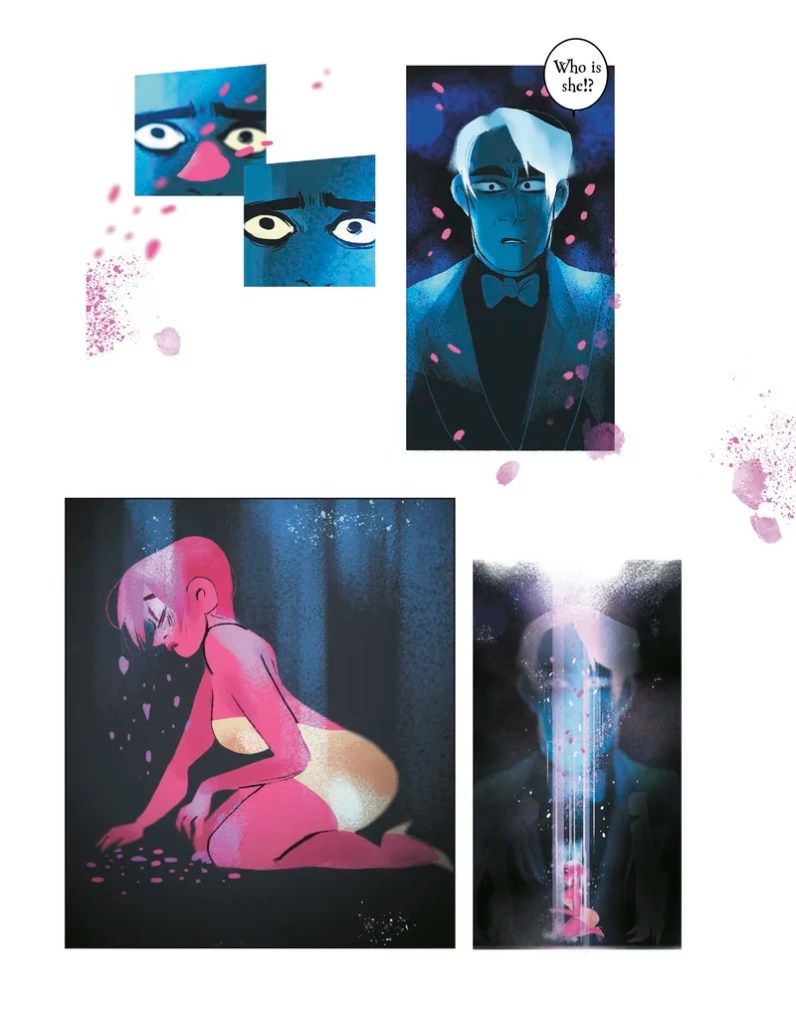
And finally, the artwork is very cute. Smythe has this really easy to connect to style, that can shift on a dime from cartoony and quirky humor to absolutely breathtaking imagery. The use of color is phenomenal and I just love how she has designed all of the characters.

(source)

We are off to a fantastic start in “Lore Olympus: Volume One”. I look forward to seeing how Hades and Persephone grow as a couple and as individuals.

Rating 10: BE STILL MY HADES/PERSEPHONE LOVING HEART. What a fun, emotional, and slow burn take on one of my favorite Greek Myths of all time.

Reader’s Advisory:

“Lore Olympus: Volume One” is included on the Goodreads lists “Greek Mythology Retellings!”, and “Hades and Persephone”.

Serena’s Review: “Emperor of Ruin”

This post may contain affiliate links for books we recommend.  Read the full disclosure here.

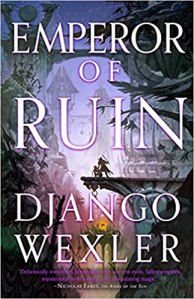
Book: “Emperor of Ruin” by Django Wexler

Publishing Info: Orbit, February 2023

Where Did I Get this Book: from the publisher!

Where Can You Get this Book: Amazon | IndieBound | WorldCat

Book Description: The last surviving Chosen, Ashok has finally risen up and taken control of The Twilight Order. He promises equality and prosperity, but Gyre and Maya know the truth. Only death follows in Ashok’s wake. To take him down, Gyre will have to unite old allies—from all across The Splinter Kingdoms and the depths of Deepfire. And Maya will have to seek out a legendary weapon hidden in the mountains that could turn the tide in their battle for freedom.

Previously Reviewed: “Ashes of the Sun” and “Blood of the Chosen”

Review: I’ve really been enjoying this trilogy so far. It’s not really a surprise, however, as I’ve been on record as a fan of Wexler’s work for quite some time. But there has also been a lot to like specifically about this series. It’s been a wild romp of a ride with two characters who are both sympathetic and wonderfully flawed individuals. I’ve gone back and forth between loving them both and then wanting to smack them each upside the head. But here we are at last with the final book in the trilogy. Will my beloved, broken, estranged siblings finally get their acts together in time to save the world? Let’s find out!

A Chosen has finally returned to the world and with him comes great change. While many see the return of a fabled god-like being, Gyre and Maya know first-hand that Ashok is no one’s savior. Indeed, his monstrous exterior barely hints at the darkness within. Now, not knowing what horrors Ashok has cooked up over his centuries’ long exile, Maya and Gyre must race to not only piece together the mysteries of the past, but cobble together a resistance that can save their world. But even if they succeed, each most grapple with the fact that the world that emerges will look nothing like the one that will now be left behind. And will there be a place for a mythical thief and revolutionary? Or for a powerful, near-Chosen herself?

So, I’ll just get right to it. I think this was my favorite book of the trilogy! In hindsight, maybe I shouldn’t be surprised by this fact. Thinking back on my reactions to the first books, I realize that many of my minor frustrations dealt with the growing pains through which our two main characters were constantly struggling. They’d each keep coming out with these perspectives that were either incredibly naive or supremely narrow-minded, and, at times, it drove me bonkers! So, is it really any wonder then that when we get to the final book, presumably where our two main characters do in fact get their acts in order and temper their instincts, I’m suddenly all in? And don’t let this say anything about the quality of the first two books. Indeed, without those character moments where Maya and Gyre were frustrating and short-sited, we’d never get the true payoff that we see here when each has to come fully into the roles they have chosen for themselves. Roles that are much more nuanced and full of compromise than their former selves could have ever imagined.

But while my sudden increase in appreciation for these two characters may come as no shock, this trilogy also had a lot of surprises in store that I truly wasn’t suspecting. The end of the second book sets up Ashok as your rather typical “big bad” who will come and lay waste to the world unless the ragtag group of resistance fighters come together and dramatically hold him off. And yes, that all did happen, too. But what surprised me was the addition of a third character perspective that layered on an entire new story on top of the one that I thought we had been developing. When I started this book, I’d have said I had a pretty clear understanding of the history and world that had been developed. All that was left was for the grand confrontation. But nope! There was almost more world-building and history in this book alone than in the first books together, and I gobbled it all up! Truly, there were some excellent surprises and twists that I think will please all fans of this series so far.

I also really liked the use of the ever-growing cast of characters. I particularly liked the role that Kit played. Not only do we see her abilities with her constructs used to their full creative powers, but the character was once again allowed to be a fully-fledged character, instead of only the quippy, raunchy, side-kick she’d kind of become in the second book. There were also a few twists towards the end with her that I was particularly happy about, especially with regards to her complicated relationship with Gyre.

There were, however, a few hiccups in pacing that came in the beginning of the story, I felt. There were a few quests and and extra missions that began to feel…well…extra. Not that they weren’t necessary for getting crucial pieces of information or crucial characters all together, but I did struggle a bit with the pacing in the first half of the book due to these various side stories. But once I got to the halfway mark, things picked up and never stopped until the end.

Overall, I really loved this conclusion to the book. Not only did it follow through on the grand confrontations that had been set-up in the first two books, but it added so many new layers to the world and extra twists to the story that it ended up being the best book in the trilogy. I highly recommend this book to fans of the first two books. And now that the trilogy is done, complete with a stellar conclusion, I can universally recommend the series as a whole to practically all science fiction/fantasy fans, especially those who enjoy lots of action in their stories.

Rating 9: Not content to rest on any laurels, this book rose above and beyond the numerous promises made in the first two books to deliver a conclusion that is as epic and enjoyable as the best SFF out there today!

Reader’s Advisory:

“Emperor of Ruin” isn’t on any Goodreads lists yet, but it should be on Can’t Wait Sci-Fi/Fantasy of 2023.

Serena’s Review: “The Scarlet Circus”

This post may contain affiliate links for books we recommend.  Read the full disclosure here.

Book: “The Scarlet Circus” by Jane Yolen

Publishing Info: Tachyon Publications, February 2023

Where Did I Get this Book: Edelweiss+

Where Can You Get this Book: Amazon | IndieBound | WorldCat

Book Description: “The Scarlet Circus,” the fourth volume in Yolen’s award-winning short fiction series brings you passionate treasures and unexpected transformations. This bewitching assemblage, with an original introduction from Brandon Sanderson, is an ideal read for anyone who appreciates witty, compelling, and classic romantic fantasy.

Review: Jane Yolen is a powerhouse in the fantasy genre. She’s written over 400 novels, short stories, poems, and essays. Beyond that, her work has claimed numerous awards over the many decades she’s been writing, not least of which include a Caldecott Medal and numerous Nebula Awards. Such is the case that she’s one of those authors whose backlist is so intimidating that no matter how many books of hers I read, whenever I pick up a recent one, I’m immediately struck with a sense of guilt for not having gotten to more! So I was happy to see that she was releasing a short story collection this year (with a focus on romance, just in time for Valentine’s Day!), as that seemed like an easy, bite-size re-entry point to an author who deserves much more space on this blog.

This is a short story collection, so there’s really no point in including a summary paragraph. I also won’t be going over every single story in this collection. But I will say right here that I’d struggle to rank these stories or try to include any as “least favorites.” So right here at the top, this is a general recommendation for this collection, and any fans of fantasy short stories should definitely check this one out.

The collection covers a wide swatch of fantasy genres, including fairytale retellings (“Alice in Wonderland”), reimaginings of popular tales (like King Auther and “Romeo and Juliet”), time travel, and even a clever take on the footnotes of an essay that has disappeared after being written in invisible ink. Interspersed with all of these tales, Yolen has included her own poetry. While I do think that her prose is stronger than her poems, these were also nice breaks between the stories, and will likely appeal to those who like a bit more variety in their reading experience.

I did have a few favorites, however. While all of the stories focus on love in one way or another (some with happy endings, other with tragic), I did particularly like one of the later stories in the collection, “The Sea Man,” that focuses more on the love of family. The story follows a sea captain who discover the titular sea man. Though their connection is brief, the story explores the deep understanding of family and love that can cross all boundaries, including ones as simple as language to the more complicated kind that delve into the fantastical.

I also really liked “Dark Seed, Dark Stone,” a story that takes place in ancient Britain, focusing on the Picts and their in-fighting. After the death of her father, the shield of the King, Bridei, a young woman wishes to take upon herself that same role. But, of course, her skills with a spear and shield could never compete with the other warriors. Instead, she earns her place through sheer bravery and the ability to take on a threat in a unique way. Again, the love story is a very small part of this story, but I thought it was an interesting new look into this time period and Bridei himself.

Lastly, I really enjoyed “Dragonfield,” a more straight-forward, action-packed fantasy story. As the title suggests, it follows the tale of a brave young woman, a reluctant hero, and their fight to save their town from a rampaging dragon. While this story wasn’t doing anything particularly shocking, it was the sort of solid, familiar fantasy story that I think most authors work years to complete. And here, Yolen seems to whip it out as if it’s nothing. The simplicity of the story itself instead highlights her vast skills at amusing narration and the creation of interesting and sympathetic characters, even with a very limited format.

As I said, this is a thoroughly enjoyable collection of stories. It’s a must read for all fantasy short story fans, and I think it is an excellent choice if you’re looking for a unique take on a love story this Valentine’s season.

Rating 9: Yolen expertly weaves together a tapestry of romance, with the weft made of magic and the warp made of humanity’s joys and tragedies.

Reader’s Advisory:

“The Scarlet Circus” isn’t on any Goodreads lists yet, but it should be on Best Fantasy Short Story Collections.