Kate’s Review: “The Long Walk”

This post may contain affiliate links for books we recommend.  Read the full disclosure here.

Book: “The Long Walk” by Stephen King (writing as Richard Bachman)

Publishing Info: Signet Books, July 1979

Where Did I Get This Book: I own it.

Where You Can Get This Book: WorldCat.org | Amazon | Indiebound

Book Description: Against the wishes of his mother, sixteen-year-old Ray Garraty is about to compete in the annual grueling match of stamina and wits known as The Long Walk. One hundred boys must keep a steady pace of four miles per hour without ever stopping… with the winner being awarded “The Prize”—anything he wants for the rest of his life. But, as part of this national tournament that sweeps through a dystopian America year after year, there are some harsh rules that Garraty and ninety-nine others must adhere to in order to beat out the rest. There is no finish line—the winner is the last man standing. Contestants cannot receive any outside aid whatsoever. Slow down under the speed limit and you’re given a warning. Three warnings and you’re out of the game—permanently

Review: I first read “The Long Walk”, one of Stephen King’s ‘Bachman Books’, in 2015, just a couple of months before we started the blog. So about ten years ago! It had be recommended to me by one of my very closest coworkers at the library I was working at at the time, and I was absolutely enthralled with it. It instantly skyrocketed up to my top 3 Stephen King books (with “The Stand” and “Carrie” along with it). When I saw that they were going to make a movie based on this book I was excited, but nervous. Then I saw the trailer, and was like “I NEEEEEED TO SEEEEEE IT!!!” Serena and I are actually planning on going at some point, and I have plans to see it with other people too. And the time is almost upon us, as the movie comes out this Friday. So I thought that it would be the perfect time for a reread and to finally review it on this blog, since it JUST missed out. And wow. It hit even harder this time around.

Actual footage of me reeling on the couch while reading as the kittens come to see what’s happening…. (source)

I’ve always said that when King was writing as Bachman he felt no need to be hopeful or optimistic. Most of King’s books have some kind of hints at hope even in all the darkness (there ARE exceptions; “Pet Sematary”, “Cujo”, “Carrie” all come to mind), but when he wrote as Bachman he was just fine being a huge bummer. “The Long Walk” basically keeps up with that pattern, as a group of teenage boys participate in an unending walk in hopes of being the last man standing to receive a prize to make their lives better. After all, in “The Long Walk” America has been taken over by cruel authoritarian fascists who value control and violence to maintain it (ughhhhh), and the televised Long Walk competition is entertainment built from children being killed if they stop walking at the speeds they are supposed to be at. Our protagonist is Ray Garraty, who joined like all others thinking that walking at 5 miles per hour is easy and that the money will be his, but as the walk keeps going he and his companions start to break down as they are all picked off one by one (and let me tell you, when I was originally reading this I tried to walk as long as I could at 5mph while on a treadmill at the gym. It was NOT EASY). Garraty and other contestants, like the steadfast and snarky McVries, the antagonistic and crude Barkovitch, and the mysterious Stebbins, enter in and out of each other’s orbits as their companions are killed, they become physically exhausted, and their mental faculties start to break down. It’s tense, it’s awful, and it is relentless. I know that King has said he originally wrote this book when he was in college, when boys he knew were being drafted and sent to Vietnam, and the hopelessness and bleakness definitely harkens to the idea of young men and boys being sent into a meat grinder for a country’s own devices. But as someone who now has a kid of her own this book hit THAT MUCH HARDER, with these children sobbing, screaming, or in some cases dying slowly and painfully before actually being shot for losing (one character contracts pneumonia while walking, and my God it was harrowing as he slips further and further into illness with no ways to rest and heal). There was one moment with a character screaming about his feet for prolonged moments where I couldn’t go any further for a bit. I just had to put it down. It’s an effective and dark dystopian nightmare.

BUT. There are also moments of intimacy and camaraderie between some of the characters, specifically Garraty and McVries, that show that even in the darkest and most terrible times and experiences, if you can find someone, or a community, to hold onto, there will always be bits of hope. The relationship between Garraty and McVries was so, so lovely, as while it has its ups and downs as the contest goes on and their stress, exhaustion, and fear kick in, you can tell that they both have a connection that keeps each other going. There has long been queer subtext speculated about these characters, which is definitely a fair way to interpret it, but what I loved about their friendship is that it’s another example of one of my favorite relationship portrayals: when two people connect to each other and get each other on a level that transcends platonic and romantic and is a whole other thing that isn’t quite definable. It makes them that much more touching and intimate, and that much more tragic as the story goes on. This book isn’t optimistic or hopeful as a whole, but these bits as these boys keep each other going DO have small bright spots in a sea of despair. And it’s a reminder of how important that can be.

“The Long Walk” is still one of my favorite Stephen King novels. It’ll wreck you if you let it. But it’s so, so good.

Rating 10: This is still one of my favorite Stephen King books. Devastating, tense, and bleak, but so incredibly emotional with glimmers of intimacy and camaraderie.

Reader’s Advisory:

“The Long Walk” is included on the Goodreads lists “Dystopia!”, and “Games of Death”.

Kate’s Review: “The Ground That Devours Us”

This post may contain affiliate links for books we recommend.  Read the full disclosure here.

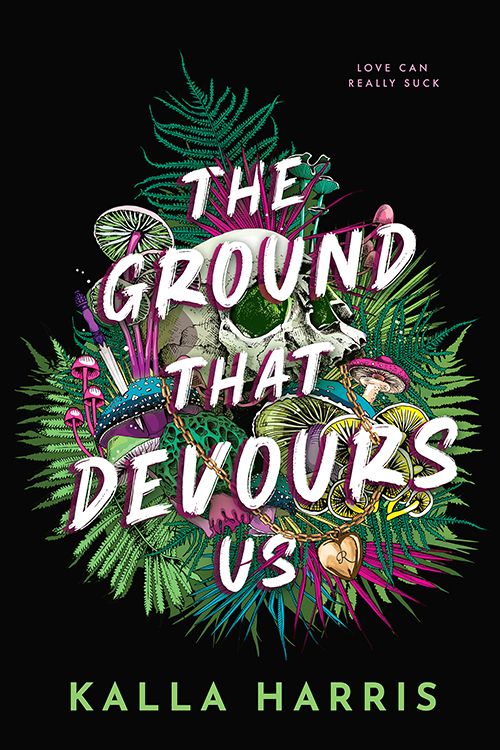
Book: “The Ground That Devours Us” by Kalla Harris

Publishing Info: Entangled Teen, June 2025

Where Did I Get This Book: I received an eARC from the publicist via NetGalley.

Where You Can Get This Book: WorldCat.org | Amazon | Indiebound

Book Description: The world ended ten years ago. Vampires showed up, took over, and turned the whole planet into their personal all-you-can-drink buffet. The president? Bloodsucker. The government? Bloodsuckers. My social life? Absolutely nonexistent.

But hey, at least I had one thing going for me—slayer training. My twin sister, Ripley, and I were about to go pro, officially joining the ranks of the last people on earth who actually do something about the whole “undead overlords” situation.

And then X had to show up. The vampire boogeyman. The worst of the worst. And instead of killing Ripley, like any decent monster would, he turned her. Now she’s technically a vamp, but something tells me my sister is still in there. Which means I can’t slay her.

What can I do? Break every rule. Lie to my friends. Strike a deal with the most dangerous vampire on the planet: X will protect Ripley from everyone else who wants her dead—like, really dead—until I can snag the cure for vampirism. The catch? Risking my own head to help him free his good-for-nothing BFF from the very slayers who taught me everything.

If I want Ripley back, I’m going to have to play nice with the thing that ruined my life. And the worst part? I think he’s enjoying this.

Review: Thank you to Kaye Publicity for sending me an eARC of this novel!

Anyone who has followed my reviews of vampire fiction on this blog can probably tell you that I am VERY particular about the genre, and that in many cases I have a really hard time getting into straight up human/vampire romance. THERE ARE EXCEPTIONS (love Spike and Buffy, I’ve really enjoyed the “My Roommate Is A Vampire” series by Jenna Levine), but overall it’s just not something I like. But when I was sent the description of “The Ground That Devours Us” by Kalla Harris, even though I knew it had romantic elements, I ALSO saw that it was a dystopia. And man I love dystopia. So I threw caution to the wind, hoping that the dystopic angles would outweigh the romantic ones.

This book gave me a mix of general dystopia, the book “The Coldest Girl in Cold Town” by Holly Black, the book/movie “Warm Bodies”, and some sprinkles of various CW vampire shows whether it’s “Buffy” or “The Vampire Diaries” (which was a direct influence according to Harris), and as a whole I found it very enjoyable and to be a well done mish mash. I liked the world that Harris built, with non-vampire survivors training and preparing to try and overtake the bloodsucker threat, while vampires are getting their own stuff in order, bringing more humans into the fold and turning them into vampires. And like with any dystopian stories worth their weight, we have a well established societal system, with our humans in one well guarded sanctuary compound, and our vampires (some sentient, some almost like zombies called ‘bloodwalkers’) outside the walls and living in their own society. I really enjoyed the vampires mythos, with there being more traditional vampires and the zombie-esque ones, and I liked the way that Harris slowly unveils the way that Vaille works, for better or for worse.

I also was a pretty big fan of our cast of characters, finding them all pretty well rounded and fleshed out. Our protagonist is Ruby, and she and her sister Ripley live in the compound Vaille and are training to be vampire slayers under the eye of Barnett, the head of their community. So when Ripley is turned into a vampire by notorious vampire X, Ruby wants to get her sister back because Vaille may be on the verge of a cure. It’s good hook, and Ruby is both an interesting and confounding protagonist, but confounding in a good way. She’s stubborn, bitter, and always on guard and ready to lash out at X, but when she teams up with him in hopes of getting Ripley back on her side, we really start to see her character growth. Especially as her worldview starts to be challenged the community she has put so much faith and devotion into starts to be revealed as not what she thinks. I was surprised by how well done this exploration of clannishness and blind devotion after being flooded with propaganda, and how Ripley has to start deconstructing what she thinks is true about her life in Vaille and being so tied to Barnett. It’s a pretty heavy theme, and Harris clearly trusts her reader to be able to parse out the nuance.

And okay, I probably have to talk about the romance, which was the element that I was the most nervous about. As mentioned above, I am really picky about my vampire romance. But I ended up really enjoying the relationship between Ruby and X. It wasn’t instalove, which is always a plus (and how could it be? He turned her sister into a vampire!), but it was done in a way that actually felt believable, going slowly enough that she could work through her anger, so he could help her understand his position, and so they could connect at a steady and acceptable pace (and there are some mitigating factors, too, but I won’t go into it here). X is a fun foil to Ruby, and I was definitely harkening back to some of the snide banter between Buffy and Spike in earlier seasons of “BTVS”.

I am such a predictable sucker for that kind of thing, take me back to swooning on the phone with my cousin after an episode of especially good Spike and Buffy banter! (source)

So overall, “The Ground That Devours Us” is a unique vampire dystopia tale that I found to be incredibly engaging. If Harris wanted to write more stories in this universe, I would read them for sure.

Rating 8: A unique and entertaining vampire dystopia that goes into some existential meditations on clannishness, blind allegiances, and propaganda. Oh, and vampire romance, too, and it didn’t make me want to pull my hair out.

Reader’s Advisory:

“The Ground That Devours Us” is included on the Goodreads list “YA Novels of 2025”.

Serena’s Review: “Silver Elite”

This post may contain affiliate links for books we recommend.  Read the full disclosure here.

Book: “Silver Elite” by Dani Francis

Publishing Info: Del Rey, May 2025

Where Did I Get this Book: Netgalley!

Where Can You Get this Book: WorldCat.org | Amazon | IndieBound

Book Description: The world is divided. On the Continent, you’re either a Prime—immune to the biotoxin that nearly wiped out the Earth’s population 150 years ago—or a Modified, one who was enhanced by the toxin, developing powerful psychic gifts.

As conflict rages between the two sides, Wren Darlington lives in hiding. Occasionally running the odd op for the rebel Uprising against the Primes’ oppressive rule, she must keep a low profile. After all, if the enemy finds out that she is a Mod with a staggering four psychic abilities, she won’t just be sent to the labor camps. She’ll be executed—immediately and without trial.

When a careless mistake puts Wren in the crosshairs of the Continent’s military, she is taken captive and forced to join their most elite Silver Block. Unwittingly, they’ve handed her the perfect opportunity for the Uprising to strike a devastating blow from inside their ranks. That is, if she can keep her powers hidden, survive training, and prove herself to Cross Redden, her maddeningly cocky commanding officer.

Despite the explosive chemistry between them, Cross doesn’t trust her—even as he seems determined to destroy the remaining shreds of Wren’s self-control. Yet as the war between Primes and Mods escalates, and as Wren and Cross find themselves unable to stay away from each other, they must decide how far they’re willing to go for their secrets—and how much of the Continent is worth saving.

Review: While I love romance and romantasy, it’s always a breath of fresh air to wander into other genres. And while dystopian fiction had its day in the sun, it’s been a while since I’ve seen a title like this! However, my reading experience of this book was highly mixed. There were things I enjoyed for sure, but I also struggled to maintain interest at times.

Largely, I think this comes down to the balance between the romance and the dystopian aspects. This book promotes itself as slow-burn which I think is misleading. Perhaps I’m just a romance snob, but to me, slow-burn isn’t just “how far into the book does the sex scene happen” but instead refers to the slow development of interest/feelings which then leads to intimacy. Here, however, the book leans heavily into lust almost instantly, which very much turned off my slow-burn-loving heart.

It didn’t help that some of the “reveals” around the identity of one of the characters was telegraphed a mile away. I found that once I got further in the book and some of this information had come out, I was able to enjoy the romance more. That said, I never fully recovered from the instalust turn off, so by the end, the romance was solidly in the “meh” category. I also felt there were too many spicey scenes for my taste, leaning more heavily into the smut side of things, especially given some of the weaker aspects of the world-building as a whole.

The writing was approachable, but I also felt that it was a bit simplistic at times. The tone often didn’t seem to match the serious nature of the world that was being describing, coming across as far too unserious for the situations on hand. Similar to the reveals regarding characters, many of the plot points were very familiar. Again, this can be comforting for some readers who are more focused perhaps on the love story than the over-arching plot. But for me, it was a definite let down. Pacing-wise, however, it was fairly steady throughout. And readers who enjoy more straight-forward writing may be less put off by the writing style. For me, it came across as a bit too juvenile for an adult book.

This is a hard one to rate. I personally didn’t have a great time with it, as it felt very derivative and like something I had read many times before. That said, I also think it’s just the sort of story that will appeal to romantasy fans who are more interested in spice and the romantic plot line and who are looking for some more variety in their reading (after picking up the millionth dragon or Fae book). If the latter sounds like you, by all means, check this one out! But if you’re more interested in the world-building or the complexity of a dystopian novel, this might be a bit of a let down.

Rating 7: A bit too predictable in its plotting and its character reveals, but romantasy readers will likely still gobble this one up!

Reader’s Advisory:

“Silver Elite” can be found on this Goodreads list: 2025 Debut Novels.

Kate’s Review: “You Must Take Part in Revolution”

This post may contain affiliate links for books we recommend.  Read the full disclosure here.

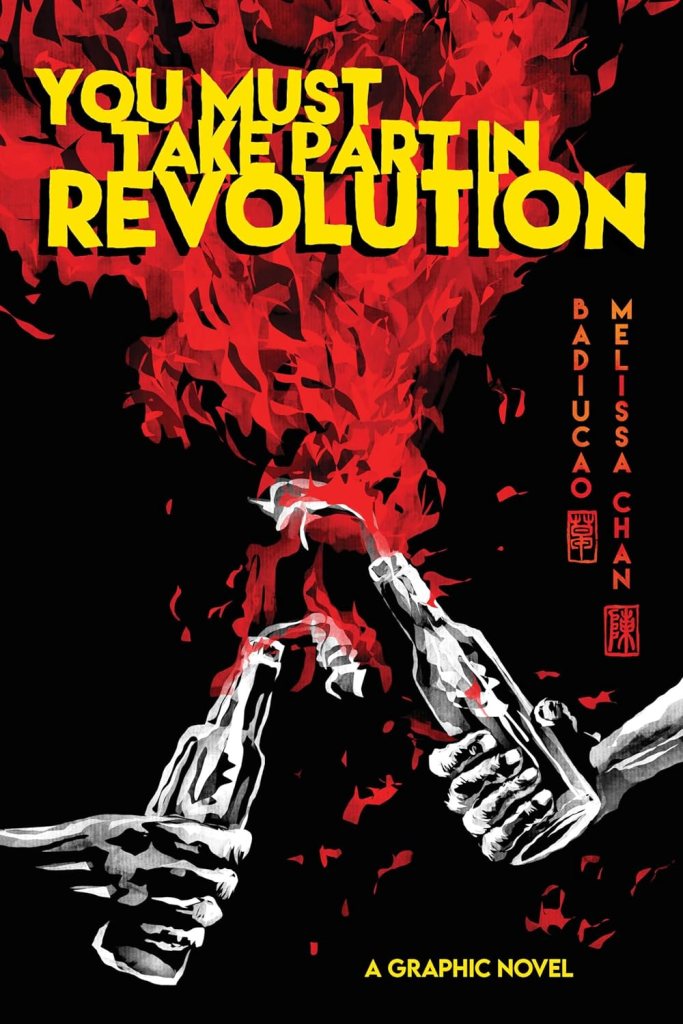
Book: “You Must Take Part in Revolution: A Graphic Novel” by Melissa Chan & Badiucao (Ill.)

Publishing Info: Street Noise Books, March 2025

Where Did I Get This Book: I received an eARC from the publisher.

Where You Can Get This Book: WorldCat.org | Amazon | Indiebound

Book Description: From acclaimed journalist Melissa Chan and esteemed activist artist Badiucao comes a near-future graphic novel dystopia that explores technology, authoritarian government, and the lengths that one will go to in the fight for freedom.

Three idealistic youths, forever transformed by the real-world protests in Hong Kong in 2019, develop diverging beliefs about how to best fight against techno-authoritarian China. As conflict escalates and a nuclear disaster looms, is working with an increasingly fascist and non-democratic United States the answer? Andy, Maggie, and Olivia travel different paths toward transformative change, each confronting to what extent they will fight for freedom, and who they will become in doing so.

A powerful and important book about global totalitarian futures, and the costs of resistance.

Review: Thank you to Street Noise Books for sending me an eARC of this graphic novel!

When I was an undergrad at the U of MN, I had my first library job working in the Annex at Wilson Library. My duties included shelving books all throughout the library, as well as working the desk to pull materials like old journals, microfiche, and newspapers. One of my friends at the time was my coworker Hugo, who was an exchange student from Hong Kong. A few years after graduation he moved back home and we lost touch, but in the summer of 2020 he reached out during the George Floyd protests/the uprising to see how I was doing since he knew I was still living in the area. We chatted a bit, and he told me that he had been a part of the protests in Hong Kong in 2019, and gave some tips to pass on to others who were out protesting. It was interesting hearing him talk about all of that, as I certainly heard about it peripherally, but hearing about it first hand was jarring. I kept thinking about Hugo as I read Melissa Chan’s new graphic novel “You Must Take Part In Revolution”, as it has a start in 2019 Hong Kong, and then delves into a not so distant possible future where autocracy is rising across the world. So….. relevant reading to say the very least.

The first thing you need to know about this book is that it is GRIM. That isn’t meant to be a negative critique, because I think that any book talking about a totalitarian world needs to be grim on some level, and Chan feels no need to hold anything back in this possible future as China has cemented itself as an autocratic world power and a fascist United States starts to push against them in a bid for its own power. We follow three characters, all of whom bonded and became friends during the 2019 Hong Kong protests. We have Andy, who has been trying to keep his head down but has been helping resistance against the CCP in his own ways and finds himself recruited to a rebel paramilitary group . We have Maggie, who went to prison in 2019 for her part in a violent protest tactic that had severe consequences. And we have Olivia, who has some dark secrets that she is hiding after dropping off radar after the protests. One of the greatest strengths of this story is that all of these characters are well drawn out and have many layers, and while the reader could certainly have opinions and feelings about the actions they take, Chan is careful to not label any of them as doing something right or wrong, but all trying to survive in a world that is filled with horrors and complexities.

Both Chan and illustrator Badiucao have backgrounds that can lend first hand to the story being told, as Chan is a journalist and Badiucao is an activist, and their critiques of the autocratic and oppressive CCP are blistering, but they don’t stop there as the United States in this book is ALSO rather villainous. As both countries start to set their sights on Taiwan, and the fallout from that unwinds as the years pass, we see a very scary possibility that our own world could be headed in such a direction. I was chilled to the bone reading this book, and I feel like it is a must read for anyone who may be terrified about the state of things, and who are wanting to find their place in not only a new reality, but also within an urge to resist. That said, let’s go back to the grimness mentioned above. This book makes it VERY clear that there is a stark cost for anyone who wants to fight back. That isn’t to say it’s a condemnation of fighting back, because it is not at all. Chan and Badiucao are very clear that resistance against such things is necessary. But it also has no room for romanticism of revolution against a world of surveillance, greed, and corruption, and the pain and consequences are laid out in full honesty.

And finally the artwork. I was fully unfamiliar with Badiucao before reading this, though apparently he is known as Australia’s answer to Banksy. I really, REALLY liked his art style, as the visuals and unique and jarring and sharp in all the right ways for the story at hand. It brings in glimmers of humanity against a backdrop of oppression and despair.

(source: Street Noise Books)

It’s hard to stomach at times, but “You Must Participate In Revolution” is absolutely necessary reading for the times we are living in. I hope that we heed its warnings.

Rating 9: A stark warning for a possible dark future, “You Must Participate In Revolution” is a call for resistance to authoritarianism. Incredibly relevant reading.

Reader’s Advisory:

“You Must Take Part In Revolution” is included on the Goodreads list “Great Graphic Novels (Released In) 2025”.

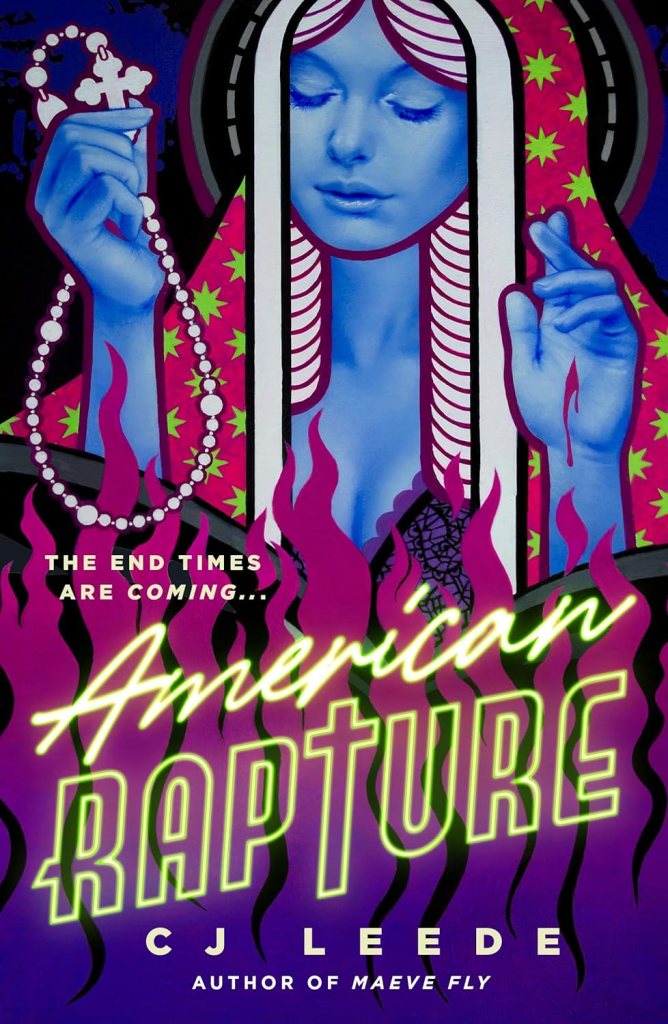
Kate’s Review: “American Rapture”

This post may contain affiliate links for books we recommend.  Read the full disclosure here.

Book: “American Rapture” by C.J. Leede

Publishing Info: Tor Nightfire, October 2024

Where Did I Get This Book: I received an ARC from the publisher at ALAAC24.

Where You Can Get This Book: WorldCat.org | Amazon | Indiebound

Book Description: A virus is spreading across America, transforming the infected and making them feral with lust. Sophie, a good Catholic girl, must traverse the hellscape of the midwest to try to find her family while the world around her burns. Along the way she discovers there are far worse fates than dying a virgin.

Review: Thank you to Tor Nightfire for providing me with an ARC at ALAAC24!

Now that we are no longer in the fully acute stage of the COVID pandemic (not saying we are out of the woods yet, necessarily, as we are just getting out of another big wave here in Minnesota), I am far more able to read end of the world/disease based horror than I was four (or even three) years ago. So when I had to option to get a copy of “American Rapture” by C.J. Leede, an end of the world horror tale about a disease that makes its infected wholly uninhibited and wanting to have sex, and a Catholic teenager trying to survive, I was all in and excited to read it. And it takes place in Wisconsin! Sure, I’m a Minnesota girl, and while I too enjoy a good hearted border battle with our Eastern neighbors, I do really like Wisconsin for a lot of reasons, so that was a bonus.

As an apocalypse story I found “American Rapture” to be a unique take on a sub genre I have enjoyed for a very long time. I will say that I’m not wholly sure as to why I was thinking that the premise was going to be kinda fun when a disease that completely breaks down all inhibitions of an infected person and makes them only want to have sex with anything and anyone at ANY cost is the name of the game (in my defense, there is a tagline that uses the phrase ‘coming’ in a cheeky way and I thought that signaled light heartedness. IT IS NOT, be warned). But I really did enjoy this premise because it made for very intense horror moments as teenager Sophie is trying to survive and find her brother as the world around her crumbles to disease and danger. It felt a bit like the George Romero’s “The Crazies”, and I mean that in the very best way. I also liked how Sophie is wandering through Wisconsin and finding fellow survivors to cling to and lean on, as found family tropes in apocalypse stories always tug at my heartstrings and are one of the things I love most about the sub genre, and Leede really nails the tone, which in turn just raises the stakes even more.

But what made this book stand out even more to me was the fact that one of the major themes within its pages and story was that of religious trauma and religious fundamentalism and its damaging effects on its followers and also greater society. When we meet Sophie she is very clearly very attached to her upbringing and a true believer, though her faith has started to show cracks due to her twin Noah being sent away for being gay even before the outbreak has occurred. We are in her head basically the whole time and we get to see how her doubts and her anxieties about her faith have driven her to this point, and how the horrors that are unfolding are causing even more of a crisis within herself even as she tries to detach herself from the upbringing that has damaged her. Add in some wholly understandable PTSD responses as she interacts with fellow survivors while also trying to come to terms with her repressed upbringing AND the violence surrounding her and it is a wallop of a character arc. And even more chilling (and a bit too real given the way that just a couple weeks ago militias were out to get hurricane aid workers) is how religious fundamentalists from her community have taken up against relief and scientific efforts to try and stop the diseases from spreading, going so far as to commit violence like arson, torture, and murder all in the name of their faith. Leede doesn’t really hold back on the violence, both physical and psychological, and it elevated the horror levels to higher and more disturbing heights.

And with that in mind, I definitely want to make clear that this book has some pretty heavy content warnings attached to it, from religious trauma/abuse to animal death to sexual assault and sexual violence to child death. I didn’t feel like any of it was done in poor taste, but its still good to be mindful.

“American Rapture” is sure to stand the test of time as a new classic in apocalypse horror. I found it gut wrenching and tense, but also in some ways hopeful. I definitely need to check out more stuff by C.J. Leede.

Rating 9: Harrowing, terrifying, too real, and raw. “American Rapture” is a new classic in the end of the world horror sub genre!

Reader’s Advisory:

“American Rapture” is included on the Goodreads list “Horror to Look Forward to in 2024”.

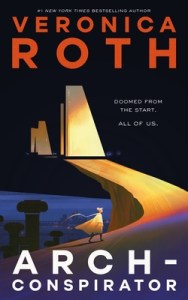
Serena’s Review: “Arch-Conspirator”

This post may contain affiliate links for books we recommend.  Read the full disclosure here.

Book: “Arch-Conspirator” by Veronica Roth

Publishing Info: Tor Books, February 2023

Where Did I Get this Book: Edelweiss+

Where Can You Get this Book: Amazon | IndieBound | WorldCat

Book Description: Outside the last city on Earth, the planet is a wasteland. Without the Archive, where the genes of the dead are stored, humanity will end.

Passing into the Archive should be cause for celebration, but Antigone’s parents were murdered, leaving her father’s throne vacant. As her militant uncle Kreon rises to claim it, all Antigone feels is rage. When he welcomes her and her siblings into his mansion, Antigone sees it for what it really is: a gilded cage, where she is a captive as well as a guest.

But her uncle will soon learn that no cage is unbreakable. And neither is he.

Review: Roth has become a must-read author for me recently. The last few books I’ve read from her have all surprised me with their ability to push the boundaries of their genres and leave me thinking about their stories and themes days later. So I was excited when I saw that she was releasing a dystopia/science fiction version of “Antigone,” knowing that whatever I was in for, it was something I wouldn’t want to miss.

The earth is a radiated hellscape, and humanity has been reduced to one, struggling city where just the effort of avoiding extinction takes up the priorities of almost every aspect of society. Antigone’s parents hoped for more, for themselves, for their children, and for their world. But instead they were met with a violent coup, and now Antigone and her siblings have grown up in the household of Kreon, their power-hungry uncle. As she has grown, so, too, has Antigone’s anger. And when her uncle pushes his power past what can be born, Antigone finds herself facing a world that badly needs to be shaken.

Like many others, I read “Antigone” back in high school and really haven’t thought much more about it since. I do remember lots of tragedy and death all around just so one man could learn the lesson of not being a stubborn ass. Or something like that, at least. So I was curious to see how close to the original Roth stuck with this adaptation and how she would reconstruct a classical Greek story into a science fiction dystopia.

And I think the answers are that while she sticks fairly close to the original story, her abilities to write dystopian fiction should never be doubted, because she found very clever ways of adapting this ancient tale within futuristic and creative trappings all while exploring modern themes of power, science, and religion. Most especially, she finds a very unique way of adapting the central premise of the original story (Antigone attempting to perform banned funeral rites for her dead brother and being punished for this) into something that would raise the stakes of the entire situation. Here, these funeral rites hold much more power and import than as simple ritual acts. I don’t want to get into too many details about the world-building, but suffice it to say, it was a very clever interpretation, I thought.

Roth utilizes a multi-POV tactic with telling this story. While we do get more chapters from Antigone’s perspective than anyone else’s, we also see through her brother’s eyes, her sisters, Kreon’s son (with whom Antigone has an arranged marriage), Kreon’s wife, and even Kreon himself. I really enjoyed what all of these perspectives brought to the story. But as much of the tale is focused on the role that women play in this world and the kinds of power that they wield even while their options are so limited, I found Kreon’s wife and Antigone’s sister to have some of the more powerful sections (other than Antigone herself). Given how short this novella is, I was impressed by how well Roth fleshed out these themes in ways that will strike true to readers.

I also liked the way that the science fiction elements were used. There were a few things that left me questioning if I thought too hard about the mechanics of it all, but for the most part, I was so thoroughly invested in the story itself that I didn’t get too bogged down in these details. I also liked that while Roth remained true to the story as a whole, her story ends with both the necessary tragedy but also a sense of hope. I think this hope is necessary to any good dystopian story, and Roth neatly balances it while not loosing the sense of the original story. Fans of dystopian stories as well as retellings of tales that aren’t fairytales will likely enjoy this book.

Rating 8: Full of tragedy and hope, Roth uses the lens of a classic tale to shine a light on the power of women and the individual.

Reader’s Advisory:

“Arch-Conspirator” can be found on these Goodreads lists: Antigones and Can’t Wait Sci-Fi/Fantasy of 2023

Kate’s Review: “Wayward”


This post may contain affiliate links for books we recommend.  
Read the full disclosure here.

Book: “Wayward” by Chuck Wendig

Publishing Info: Del Rey Books, November 2022

Where Did I Get This Book: I received an eARC from NetGalley.

Where You Can Get This Book: WorldCat | Amazon | Indiebound

Book Description: Five years ago, ordinary Americans fell under the grip of a strange new malady that caused them to sleepwalk across the country to a destination only they knew. They were followed on their quest by the shepherds: friends and family who gave up everything to protect them.

Their secret destination: Ouray, a small town in Colorado that would become one of the last outposts of civilization. Because the sleepwalking epidemic was only the first in a chain of events that led to the end of the world–and the birth of a new one. The survivors, sleepwalkers and shepherds alike, have a dream of rebuilding human society. Among them are Benji, the scientist struggling through grief to lead the town; Marcy, the former police officer who wants only to look after the people she loves; and Shana, the teenage girl who became the first shepherd–and an unlikely hero whose courage will be needed again.

Because the people of Ouray are not the only survivors, and the world they are building is fragile. The forces of cruelty and brutality are amassing under the leadership of self-proclaimed president Ed Creel. And in the very heart of Ouray, the most powerful survivor of all is plotting its own vision for the new world: Black Swan, the A.I. who imagined the apocalypse.

Against these threats, Benji, Marcy, Shana, and the rest have only one hope: one another. Because the only way to survive the end of the world is together.

Review: Thank you to NetGalley for providing me with an eARC of this novel!

So, when I was reading “Wanderers” back in 2019 I felt a mild anxiety that I was constantly trying to write off. ‘A deadly pandemic? Eh, that’s not something you need to be worrying about, Kate. No way.’

Joke’s on me, I guess. (source)

Little did I realize that a year later it would be a reality that was consuming so many of us. Luckily it wasn’t a White Mask level of death, though that doesn’t mean it’s been a cake walk by ANY means. But, now it’s 2022, and while we are still in the midst of this life changing pandemic with death and sickness, I feel more secure than I did two years ago, or even one year ago (thank you, under 5 vaccines and lots and lots of therapy!). So much so that I could actually pick up “Wayward”, Chuck Wendig’s sequel to the pandemic end of world thriller/sci-fi/dystopia “Wanderers”. You probably remember how I couldn’t bring myself to read books about sickness and the world ending for awhile. I guess the fact I read “Wayward” shows how far I’ve come. Though now the worry is that it’s predicting a whole other society altering reality, with it’s huge themes of Christo-fascism and white supremacist violence…. Okay, I’m getting ahead of myself. Let’s dive in.

“Wayward” picks up shortly after “Wanderers” ends, and five years after the White Mask pandemic has wiped out a huge majority of the world population. The surviving ‘Sleepwalkers’ and ‘Shepherds’ are living in the isolated Colorado town of Ouray, where the seemingly benevolent (but actually dangerous) Black Swan AI is continuously running and trying to create a new world. There are familiar faces like Benji, the former scientist who is now a well respected town leader, and Shana, the first ‘shepherd’ who is now pregnant with the first child to be born in the community (who was in stasis for five years like the sleepwalkers were). At the end of “Wanderers” there were hints that this perfect rebuilding community was actually on a precipice, and we get to see that play out as Wendig tinkers with ideas of dangerous AI, and groupthink that can lead to cultlike behavior, unrest, and power grabs. I liked how Wendig did some full exploration of this, because the community that was being envisioned at the end of “Wanderers” felt a little too pat. I also liked revisiting Benji, Shana, et al, because I had forgotten how much I liked them and I liked seeing how they had all changed from the first book up through this book. The changes are believable both as to how they would change due to their circumstances, but also as to how they as characters would have changed with their base personalities in mind. Shana in “Wanderers” is pretty different from Shana in “Wayward”, but she is still Shana, and so forth, and it is clear that Wendig knows his cast inside and out. It is their inherent complexity and goodness that keeps this book from treading too bleak.

Though that isn’t to say that it isn’t bleak at times. Oh soothsayer Chuck Wendig, I must say that I’m a bit on edge that you have put another horrible thing out into the universe, given what happened last time! And that is the theme of Christ-fascist authoritarian groups trying to wipe out those they deem inferior against the backdrop of the end of society. Though I don’t think we spent too much time with white supremacist and totalitarian would be president Ed Creel in “Wanderers”, he has his own perspective chapters in “Wayward”, and good God we are once again getting into too real territory. Creel is a clear Donald Trump analog, but obvious or not it doesn’t make him any less terrifying as he continues to amass a white supremacist and violent following to do his bidding even as he bides his time in an underground bunker for the uberwealthy. “Wanderers” came out during the Trump Presidency when we were seeing these groups like the Proud Boys and Oathkeepers and literal Neo-Nazis sing his praises, and now “Wayward” puts new focus on this in a post January 6 world. It’s all a bit on the nose at times, but that doesn’t make it any less resonant. Sure, the AI run amok themes were also scary, but that was more on the Sci-Fi side of things so it didn’t catch my anxiety as much as this all did. Maybe give it a few years.

But what I love about Wendig’s voice is that even through all this violence, trauma, sadness, and raw devastation, there is always hope. Hope through humor. Hope through love between family and friends. Hope that some places can get through a terrible thing like White Mask through their effort and community strength (I loved the idea of different parts of the world faring better based on factors ranging from environment to cultural aspects). Hope that no matter how bad things get, they can be addressed and salvaged. It’s hard to remember that hope is there, at times. But Wendig reminds us throughout the narrative, and I really liked that.

“Wayward” is a solid follow up to an end of world story that looks at what could come next. Wendig taps into a lot of modern anxieties and fears, but he also knows how to keep the reader hopeful. We need that sometimes.

Rating 8: A melancholy and suspenseful but ultimately hopeful follow up to an apocalypse book that now feels a bit too real, “Wayward” brings us back to Ouray and examines what happens after the world as we know it ends.

Reader’s Advisory:

“Wayward” is included on the Goodreads list “Hugo 2023 Eligible Novels”.

Serena’s Review: “Poster Girl”

This post may contain affiliate links for books we recommend.  Read the full disclosure here.

Book: “Poster Girl” by Veronica Roth

Publishing Info: William Morrow & Company, October 2022

Where Did I Get this Book: Edelweiss+

Where Can You Get this Book: Amazon | IndieBound | WorldCat

Book Description: WHAT’S RIGHT IS RIGHT.

Sonya Kantor knows this slogan–she lived by it for most of her life. For decades, everyone in the Seattle-Portland megalopolis lived under it, as well as constant surveillance in the form of the Insight, an ocular implant that tracked every word and every action, rewarding or punishing by a rigid moral code set forth by the Delegation.

Then there was a revolution. The Delegation fell. Its most valuable members were locked in the Aperture, a prison on the outskirts of the city. And everyone else, now free from the Insight’s monitoring, went on with their lives.

Sonya, former poster girl for the Delegation, has been imprisoned for ten years when an old enemy comes to her with a deal: find a missing girl who was stolen from her parents by the old regime, and earn her freedom. The path Sonya takes to find the child will lead her through an unfamiliar, crooked post-Delegation world where she finds herself digging deeper into the past–and her family’s dark secrets–than she ever wanted to.

With razor sharp prose, “Poster Girl” is a haunting dystopian mystery that explores the expanding role of surveillance on society–an inescapable reality that we welcome all too easily.

Review: While I wasn’t a big “Divergent” fan (I didn’t even finish the trilogy), I’ve really enjoyed the adult/new adult fiction Veronica Roth has written recently. There’s also no denying that, like Margaret Atwood, Roth has a keen eye for producing dystopian works that can feel all too believable. It’s this sort of believability that truly gives dystopian works their chills, and with this book’s focus on technology and the surveillance state, I knew we’d be deep-diving into some uncomfortable ideas. And sure enough, it was uncomfortable and it was great!

For Sonya, time has stopped. After serving as the face of a regime known as the Delegation, after a revolution overturned society, she and other prominent members of the fallen system are now locked in a prison complex with no hope of rejoining society. But when she’s given the change to earn her freedom tracking down a missing girl, Sonya ventures back out into a world very unlike the one she left a decade before. As she digs into her past as well as her present, Sonya discovers dark truths that reorganize everything she once believed.

As I said earlier, in my opinion what makes a great dystopian story is the ability to create a world and society that is believable, thus all the more horrific. Here, with the creation of a society existing beneath an authoritarian regime that monitors and rewards behavior, the path to this destination is obvious. The Aperture, an implant that is placed in the eye that essentially acts like a smart phone that is even more accessible, is very easy to imagine. The story neatly demonstrates how the ease and functionality of a device like this would have a lot of immediate appeal. We see similar choices being made today; the ease and convenience of smart devices already leave many people unaware of how much of their personal information they are giving up for these creature comforts. The turn of this information then being used against the populace is easy to imagine.

Beyond that, it’s also incredibly easy to see this type of authoritarian system of governance grow into existence. What makes it even more compelling is that some of the rationales behind certain “esteemable” behaviors are easy to understand or agree with. Again, a dangerous slippery slope that is very recognizable. I was also impressed by Roth’s ability to side-step current political positions and parties; it was all too easy to go into it trying to paint both the Delegation and the system that came after it onto our current political parties. But neither fits the other perfectly, so there are no easy conclusions to be had.

Sonya was also an interesting character. She grew up as a “success story” to an oppressive system, largely benefiting from a government that hurt countless others. But we are meeting her ten years after the fact, trapped in a prison compound where she and many others expect to live out their days. Through her eyes, we see how various different individuals and groups have dealt with this shift in power and position. As Sonya ventures back into the world, she’s in a unique position to not only reflect on the world that she grew up in, but in the world that replaced it. Like all revolutions, though they may be replacing a great evil, they aren’t often followed with utopias of their own. She also is forced to confront the decisions that she and her family made and benefited from. I really liked her journey, especially the fact that it felt true to character. Nothing is hand-waved away or excused, but it is ultimately a hopeful story for her.

For this world? I’m not so sure. But I think the not knowing is what is important and what forces the reader to reflect on the messages and themes of the story afterwards. This book definitely touched on a lot of current issues we as a society are grappling with. This is just one direction that someone imagines things could go. But through this lens, we’re invited to do our own critical thinking. I know “critical thinking” isn’t the type of fun, exciting endorsement that often gets people galloping to the nearest bookstore. But it’s also a refreshing, unique read that will stick with you long after you’ve finished the last page.

Rating 9: Uncomfortably believable, this story asks readers to reflect on the nature of technology, surveillance, what we give up for convenience; that right and wrong are not as easy of concepts as we may wish them to be.

Reader’s Advisory:

“Poster Girl” isn’t on any relevant lists but it should be on Adult Dystopia.

Book Club Review: “Parable of the Sower”

We are part of a group of librarian friends who have had an ongoing bookclub running for the last several years. Each “season” (we’re nerds) we pick a theme and each of us chooses a book within that theme for us all to read. Our current theme is “Award Winners”, in which we each picked a book that has won an award of some kind.

For this blog, we will post a joint review of each book we read for book club. We’ll also post the next book coming up in book club. So feel free to read along with us or use our book selections and questions in your own book club!

Book: “Parable of the Sower” by Octavia E. Butler

Publishing Info: Four Walls Eight Windows, 1993

Where Did I Get This Book: The library!

Award: New York Times Notable Book of the Year

Book Description: When global climate change and economic crises lead to social chaos in the early 2020s, California becomes full of dangers, from pervasive water shortage to masses of vagabonds who will do anything to live to see another day.

Fifteen-year-old Lauren Olamina lives inside a gated community with her preacher father, family, and neighbors, sheltered from the surrounding anarchy. In a society where any vulnerability is a risk, she suffers from hyperempathy, a debilitating sensitivity to others’ pain.

Precocious and clear-eyed, Lauren must make her voice heard in order to protect her loved ones from the imminent disasters her small community stubbornly ignores. But what begins as a fight for survival soon leads to something much more: the birth of a new faith…and a startling vision of human destiny.

This highly acclaimed post-apocalyptic novel of hope and terror from award-winning author Octavia E. Butler “pairs well with 1984 or The Handmaid’s Tale” (John Green, New York Times)—now with a new foreword by N. K. Jemisin.

Kate’s Thoughts

Back when Trump was elected, I started hearing whispers from my friends and acquaintances about a book called “Parable of the Sower” by Octavia E. Butler. Many of them were saying that “Parable of the Sower” predicted the society in which a person like Trump could be elected, along with the existential crises that come with it. When we were deep in the shit of the Trump Administration, I couldn’t bring myself to read that book, as even though it sounded supremely fascinating, it also sounded too real. A story written in the early nineties that seemed to predict the shitshow of climate change, social inequity, and an incompetent and narcissistic president? On the nose! And therefore too stressful to read. So when someone in book club chose it for our first Award Winners read, I was happy that I finally had a push to read it…. And then I read it, and was sent into an anxiety spiral.

Basically my face during my entire reading experience.

“Parable of the Sower” is a bleak and terrifying dystopia where climate change, vast social and financial disparities, and corporate corruption has created a society where people are either gated in, hoping that they will not fall victim to rampaging violent nomads, or trying their best to survive in a violent and dangerous wasteland. We follow Lauren, a teenager who lives in a gated community who has dreams of a better future for herself, and who starts to develop and discover a new religion/life she calls Earthseed due to her faith and a condition in which she has hyper empathy to those around her. Butler creates a terrifying world where mass violence is always a threat, and it’s only a matter of time until a person faces the bleak and staggering reality of having to survive. I found it to be incredibly well written as well as horrific. It’s told in mostly epistolary devices, with Lauren recording what is going on each day, and I thought that the slow crumbling of her life and then rebuilding in a chaotic and unpredictable landscape to be compelling and very suspenseful. There were so many moments that not only set me on edge, but felt like they could potentially happen if we don’t get a hold on many existential crises that plague our world at the moment. Engaging to be sure, but it also made it hard for me to sleep at night.

I think that if I were a more religious person (in that I’m not at all) I may have connected a little bit more with the aspects of Lauren’s journey that involved ‘discovering’ Earthseed, and her self assurance that everything was going to work out because she was discovering and bringing forth a new religion that would save society. From the Biblical references to some of the blind faith aspects of this book, I didn’t connect as much to the moments where Lauren was creating a whole new belief system. That isn’t to say that it wasn’t intriguing; I definitely found myself enjoying the mythos that Butler was creating in this story, and liked seeing Lauren connect to it. I’m not sure that I have the emotional wherewithal to continue in the series (especially given that it’s incomplete; Butler passed away before she could complete it), but what I saw in this book really hit home how incredibly gifted Butler was for creating complex and horrifying alternate realities while also giving us a little bit of hope to cling to.

“Parable of the Sower” is a rough read, but I definitely think it’s worthwhile. Butler was a true talent, and this showcases the world building, and premonition, that she had as an author.

Serena’s Thoughts:

For being a long-time fan of the science fiction and fantasy genre, it’s kind of crazy that I hadn’t read any of Octavia Butler’s books before this. And I can’t really tell you why! Perhaps, like Kate mentioned above, when her books began coming up more and more in the public consciousness recently, I wasn’t really in a good mental place to dive into this type of story. Margeret Atwood is a similar author for me: I can recognize the supreme talent she is and appreciate her books, but I can only manage to read one every five years or so and inevitably spend those five years half terrified of the “too real”-ness of her stories. But, also like Kate said, I was glad to have the push to read this.

I agree with everything Kate wrote. I, however, come from a more religious family so in that way, I did connect more to the aspects of the story that were focused on the development of a belief system and the role that would play in Lauren’s management of the challenges of this society. Blind faith is a particularly challenging topic, even for those have a religious life. Most who are honest with themselves, I think, would say that faith itself is a constant challenge. It can provide some assurance in the midst of strife and unknown, but it, too, can cause its own form of strife, in that faith, at its core, is not necessarily a comfortable thing. I liked the way that Butler dug into this topic and her use of Biblical references went beyond the usual uses we’ve all seen a million times over.

I do think I’ll eventually read the next book, but like I said above, it will probably follow a pattern similar to my reading of Atwood’s stories. It’s a credit to just how powerful a writer Butler was that her presentation of a future world feels too read to inhabit for overly long without it causing real-world anxiety! If you haven’t checked this one out yet, I definitely recommend it.

Kate’s Rating 8: Terrifying and bleak, but well written and sprinkled with some hope, “Parable of the Sower” is a glimpse into a could be futurescape.

Serena’s Rating 8: Hope wars with terror in a version of the future that feels all-too real at times.

Book Club Questions

  1. The future that Butler paints in this book has a lot of mirrors to a reality that we seem to be nearly living in. Do you think that what happens to society in this book could happen in a similar fashion in real life? Why or why not?
  2. Even though Lauren is living in an unstable society and there is lots of violence and despair, she still seems to want to have kids some day. Why do you think that is?
  3. Does Lauren’s religion or belief system of Earthseed connect to you? Do you see it as a new religion? A cult? Something else?
  4. At one point Lauren says that she isn’t inventing Earthseed, but discovering it. What do you make of that statement?
  5. At one point Lauren and her group pass by the settlement of Hollister, which seems to be pretty stable and safe. What did you think of them continuing on their journey instead of stopping and settling?
  6. What did you think of the concept of hyper-empathy?
  7. What did you think that Butler was saying about religion in this book?

Reader’s Advisory

“Parable of the Sower” is included on the Goodreads lists “Sci-Fi That Will Change The Way You Look At Life”, and “SFF Books by Black Authors”.

Find “Parable of the Sower” at your library using WorldCat!

Next Book Club Book: “The Dark Descent of Elizabeth Frankenstein” by Kiersten White.

Kate’s Review: “Atonement”

Book: “Atonement” (Cerenia Chronicles 3) by Angela Howes

Publishing Info: Fine Tuned Editing, January 2021

Where Did I Get This Book: I received an eARC from the author.

Book Description: They stopped Absalom. They saved the city. But what if recovery isn’t quite so easy? What if there are more monsters lurking inside the city walls? What if the true monster is one of them? In the much-anticipated conclusion to the Phoebe Ray series, Phoebe, Sky, Noah, and the gang must face a new kind of villain, make amends with the past, and learn what it means to truly belong.

Review: Thank you to Angela Howes for sending me an eARC of this novel!

There is a song by The Who called “Won’t Get Fooled Again”, which has the line ‘meet the new boss, same as the old boss’. While I wouldn’t say that it’s an anti-revolutionary ditty, I do think that it brings up a good point of you can’t always know that those you back who have lofty promises of change can be trusted to follow through. I also kind of liken it to how the French Revolution ultimately ended up with Napoleon in charge after all was said and done. In any case, whenever you hear Roger Daltrey yell “YEAAAAAAAAH”, it’s almost guaranteed that it’s from this song, and it’s legendary.

I am so sorry, I had to use this GIF, just pretend he’s yelling YEAAAAAH! (source)

I was thinking a lot about that song as I read “Atonement” by Angela Howes, the final story in the Cerenia Chronicles. After all, at the end of the previous book, “Containment”, our protagonist Phoebe had helped end the dictatorship that was run by Absalom, and Cerenia was on the cusp of a new dawn, as the system of Ones and Twos was finally to be done away with, and Phoebe was going to help rebuild society into something better. But as we soon learn, if only it were THAT easy.

We left “Containment” with Phoebe, boyfriend Sky, ex boyfriend Noah, and her other friends and family dealing with the fallout from Abasalom, the previous leader, being thrown in prison. “Atonement” decides to focus on how Phoebe is trying to change society from within the confines of its power structure, and that is already an interesting take that I haven’t encountered in my YA dystopia literature. Phoebe is confident that she and the Council can rebuild, but it’s pretty clear that it’s not going to be that easy, and that someone else in power likes the idea of a power grab. Our narrative focuses on Phoebe trying to keep everything together, as well as balancing out her relationships, the safety of those she loves, and trying to figure out the best way to rebuild a society that has a lot of damage and long lasting effects that can’t just be done away with so easily. I loved this focus, and I loved seeing her have to see how damn hard it is to fix things even after the corruption is gone. She has to make hard decisions that others don’t necessarily understand, and it gave her more depth and complexity.

Our perspectives expand once again from the last book to this one. While we still have the three main lines of Phoebe, Sky, and Noah, other characters like Phoebe’s sister Violet, fellow councilmember Roderick, and others have been added to the shuffle. I can’t really decide what I think about all the new perspectives, as on one hand I liked having more insight into how all of these other people are adjusting, some of them just felt a little superfluous. I was still mostly interested in Phoebe as she tries to weed out corruption, but it was Sky’s that brought the next most interesting themes, as he is clearly dealing with trauma and PTSD after the events in the previous book. Given that Sky and Phoebe are my favorite characters and I’m invested in their relationship, I was happy(?) to see that one of the central conflicts coming between them wasn’t Noah. Not that trauma is something I WANT for a couple as a hurdle, but it felt more realistic than trotting out a love triangle just for the sake of the drama.

And in terms of plot and pacing, the action and suspense in this book builds slowly and then really amps up the stakes as the story goes on. When things start to spiral, the action just increases, and I found myself very on edge about what was going to happen. There were a good number of twists thrown in too, and throw backs to previous plot points that all come back together for the grand finale. All in all, I was quite satisfied with how things shook out, for better or for worse.

“Atonement” went in a direction that I wasn’t expecting, and I think that it was better for it. We may not see as much dystopian fiction in YA these days, but The Cerenia Chronicles is definitely a worthy series to add to the selection.

Rating 8: A satisfying ending to an enjoyable series.

Reader’s Advisory:

“Atonement” isn’t on any Goodreads lists as of yet, but if you like books like “Divergent”“Matched”, or “The Testing” you will probably find this one fun as well!

“Atonement” isn’t in very many libraries as of now, but you can find it on Amazon.

Previously Reviewed: