Kate’s Review: “Ghoster”

31934011Book: “Ghoster” by Jason Arnopp

Publishing Info: Orbit, October 2019

Where Did I Get This Book: I received an ARC from the publisher.

Book Description: Jason Arnopp – author of acclaimed cult hit The Last Days of Jack Sparks – returns with a razor-sharp thriller for a social-media obsessed world. Prepare to never look at your phone the same way again . . .

Kate Collins has been ghosted. She was supposed to be moving in with her new boyfriend Scott, but all she finds after relocating to Brighton is an empty apartment. Scott has vanished. His possessions have all disappeared. Except for his mobile phone. Kate knows she shouldn’t hack into Scott’s phone. She shouldn’t look at his Tinder, his calls, his social media. But she can’t quite help herself. That’s when the trouble starts. Strange, whispering phone calls from numbers she doesn’t recognize. Scratch marks on the walls that she can’t explain. And the growing feeling that she’s being watched. Kate refuses to leave the apartment – she’s not going anywhere until she’s discovered what happened to Scott. But the deeper she dives into Scott’s digital history the more Kate realizes just how little she really knows about the man she loves.

Review: Thanks to Orbit for sending me an ARC of this novel!

Back in 2017 I was flying back from New Zealand and was totally enthralled by “The Last Days of Jack Sparks” by Jason Arnopp. While I am not usually super into nor affected by possession and exorcist stories, the uniqueness and genuine creepiness of this novel completely blew me away and was one of my favorite reads of the year. I waited anxiously for a new book by Arnopp to drop, and when I saw that he had a new book called “Ghoster” coming out, I was ecstatic. I was fortunate enough to receive an ARC of “Ghoster”, and once I had finished a couple other books that took precedent, I dove right in. “Ghoster” isn’t a possession story. At least, not in the way that we normally think about them. But it is a story about obsession, and how things can seemingly take you over in unexpected, and dangerous ways. 

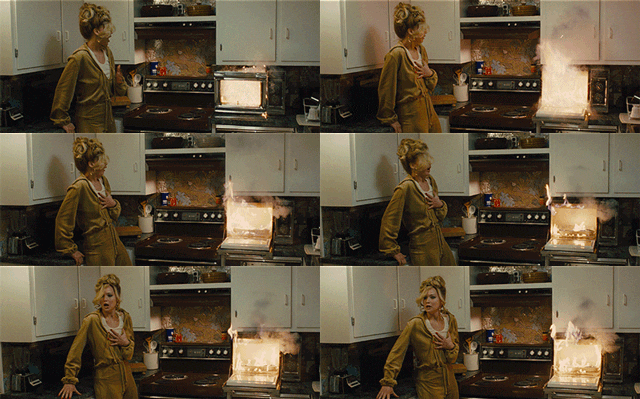
Oh, and we once again get some creepy and unsettling imagery that freaked me the hell out.

giphy-8
Sometimes I just had to step away. (source)

Kate, or protagonist, is a bit of a complex and unreliable character. We know that she has had obsessive issues with social media and romance in the past, and after her lover Scott seemingly disappears on the eve of them moving in together, you wonder if her need to find him is based on worry for his safety, or a dark jealousy that is hinted at from her previous relationships and actions. It’s first person, so we get into her mind and how quirky and obsessive it can be. She is convinced that Scott has left her, or has tricked her, and since it isn’t often that she stops to think that maybe something bad happened to him it makes you question a lot about her mental state. Is she a woman with a legitimate beef, or is she a bit more unstable than she’d like us to think?  It sets a tone that is already uneasy and makes it all the more jarring. I felt bad for Kate, but I also wasn’t sure if I could totally trust her and her perceptions, or the story that she was telling us. It’s true that there were a couple of times where I thought that her strangeness was laid on a little thick, but for the most part it was well done and a great way to make the reader question even more about the story than they already may have been. It also makes it so that when the very strange things start happening, we have to wonder what is real and what isn’t. I wouldn’t say that Kate is likable, but she sure doesn’t have to be. It’s not like Jack Sparks was a likable character, after all, so why can’t Kate also be that way? It didn’t make me any less invested in her story.

The creepy elements and plot of this book aren’t as amped as Arnopp’s previous novel, but they are still there and they are still done in a way that left an impression. As Kate slowly tries to trace Scott’s steps and whereabouts, she finds more and more things that suggest something is afoot. She has his cell phone, and is able to see his browsing history, which implies that he may not have been the person he said he is. There is a missing woman that may have a connection to him. And on top of that, as she stays in Scott’s apartment and her obsession with his phone and social media footprint intensifies, she starts to see things that shouldn’t be possible. I don’t want to go into specifics, but I will say this: one of the things that gets me really freaked out in movies and books are the images and descriptions of people and things moving in ways that they shouldn’t be moving. Be it jerky motions or weird contorted moving, it’s going to mess me up every single time. Arnopp does something like that in this book, and boy did it hit all the nerves. Arnopp has always been very good at describing an incredibly visual medium and making it work on the page and within the reader’s imagination. All that said, I did think that the metaphors about technology and social media having a malevolent hold on people are pretty well played out at this point, so that wasn’t as strong as I had hoped it would be, commentary wise.

“Ghoster” was another satisfying and spooky read from Jason Arnopp. It’s a great one to pick up right in time for Halloween, and now that I’ve read it I’m back to square one and not at all patiently waiting to see what he comes out with next! 

Rating 8: A spine tingling and tense horror story about relationships, social media, and obsession.

Reader’s Advisory:

“Ghoster” is new and isn’t on many relevant/specific Goodreads lists, but I think that it would fit in on “Fiction Involving The Internet”.

Find “Ghoster” at your library using WorldCat!


Serena’s Review: “The Art of Theft”

36510437Book: “The Art of Theft” by Sherry Thomas”

Publication Info: Berkley, October 2019

Where Did I Get this Book: Edelweiss+

Book Description: As “Sherlock Holmes, consulting detective,” Charlotte Holmes has solved murders and found missing individuals. But she has never stolen a priceless artwork—or rather, made away with the secrets hidden behind a much-coveted canvas.

But Mrs. Watson is desperate to help her old friend recover those secrets and Charlotte finds herself involved in a fever-paced scheme to infiltrate a glamorous Yuletide ball where the painting is one handshake away from being sold and the secrets a bare breath from exposure.

Her dear friend Lord Ingram, her sister Livia, Livia’s admirer Stephen Marbleton—everyone pitches in to help and everyone has a grand time. But nothing about this adventure is what it seems and disaster is biding time on the grounds of a glittering French chateau, waiting only for Charlotte to make a single mistake…

Previously Reviewed: “A Study in Scarlet Women” and “A Conspiracy in Belgravia” and “The Hollow of Fear”

Review:  Continuing my week of Sherry Thomas reviews! While “The Magnolia Sword” took me by surprise (I didn’t realize it was coming out until late in the game, and still later figured out the author was Sherry Thomas), I’ve been impatiently waiting for the release of the latest “Lady Sherlock” story. Thanks to Edelweiss+, I had early access to it on my Kindle, and due to a complete lack of willpower, I ended up reading this book a few months ago but still wanted to review it closer to its publication date, so here we are. And while this wasn’t my favorite book in the series, I’m still enjoying the heck out of these stories and, again, am anxiously awaiting the next.

After helping Lord Ingram escape a false murder charge in the last book, Charlotte Holmes once again finds herself at the service of one of her close friends. This time it’s Mrs. Watson who has been contacted by a friend from the past who is now caught up in a mysterious blackmail/art theft situation. But this time, Charlotte and co. must do more than simply unravel the various players in this charade, but now find themselves playing an active role within the events themselves. Now she must not only discover who is at the heart of this conflict, but find a way to walk the narrow line between solving the case and not becoming a criminal herself!

Many of the strengths of the original books are still present here. Charlotte, as always, is a perfectly realized character, now comfortably familiar in both her quirks (her sense of fashion and preference for sweet treats), her strengths (obviously), as well as her weaknesses (challenges with navigating complicated relationships). One of the pleasing things about a long(ish) running series is this solid comfort with a character who is understood and beloved, but it also come with challenges. Here, while Charlotte is still at the heart of untangling the mystery, it feels like she is not the main character in her own book. That is, there is very little ongoing character development or a unique arc that is devoted to her. Much of this character work is picked up by the others in the book, but for a series that is called the “Lady Sherlock” series, this book was the first that did begin to show some signs of not quite knowing where to go from here with its titular character.

Luckily, the series has already set up a good number of side characters in the first several books so a shift of focus to them, while not preferred, also still feels earned. And I was already invested enough to feel that their conflicts were enough to carry much of this story. Mrs. Watson, of course, is at the heart of this story, and I loved learning more about her past and those who played a role in it. We see, again, both the strengths and weaknesses that lead her to where she is today. She also serves as a good mentor for Livia who ends up taking on a much more active role in this story.

Throughout the series, Livia has always played a bit of a strange role. A decent amount of page time is devoted to her, but she’s typically no where near the action and her development has moved at a fairly glacial pace. Here, Livia finally gets to come out of the shadow and play with the big kids. I loved seeing her come out of her shell, even if it was an uncomfortable process for her. Through her, the story also spends a bit exploring, again, the limitations on women in this time period. And, while Livia’s life has by no means been a happy one, she comes to realize the privileges that she has taken for granted.

I did enjoy the mystery itself as well. After the more active role that Charlotte took on in the previous book, it was nice to see that approach used once again here with Charlotte and co. essentially staging a heist. The story has definite “‘Ocean’s 11’ but in Victorian times” vibes, which I thought was a clever change of pace from the other, more typical mysteries of the first books. There were some surprises sprinkled throughout, as well, and, overall, I found the conclusion and explanation satisfying.

However, for all the answers we do get, there were a few too many loose ends left hanging. This was clearly done on purpose, but there were just one or two too many for me not to begin to feel slightly frustrated and anxious. For one thing, these mysteries are complicated. It always takes a bit of thinking on my part to fully put things together and still I’d have a hard time explaining it all later. But to add more unsolved clues on top of all that, clues I can only assume will come into play in a later book and that I will need to recall…it’s a bit too much. For me, I was left feeling a bit worried that I was not only missing things in this book, but will now likely miss even more in some future story.

The book also ends on a bit of a cliffhanger, which I’m not sure was necessary. It’s not the type that gnaws away at you, but more just introduces the topic of the next book. But it seemed liked a strange choice for an established series. It’s the kind of thing you do in book one or two, just to keep readers interested. But here, it was more like an unneeded “coming next week” preview for a well-watched and established TV show. Just leave it out and let the book end on a note relevant to this book’s story. The next book can take care of itself without page time given to it here.

Those quibbles aside, this was another solid entry in the “Lady Sherlock” series. I’m definitely excited for the next book as it seems like it will focus on a character who wasn’t much seen in this story. And I hope that Charlotte’s more active role continues. However, I also hope that she gets a bit more character development and a more defined emotional arc in future stories. I enjoy the side characters, for sure, but I’m mostly here for Charlotte. All of this to say, if you’ve enjoyed this series so far, you’re good to go on this one as well. And never fear, there will be another; it’s all set up right there at the end of this one.

Rating 8: While Charlotte fades a bit into the background and there are a few too many dangling clues, I enjoyed the addition of a heist plot onto another solid mystery.

Reader’s Advisory:

“The Art of Theft” is a newer title, so it isn’t on many Goodreads’ lists, but it is on “Historical Mystery 2019.”

Find “The Art of Theft” at your library using WorldCat!

Kate’s Review: “White Tears”

30780283Book: “White Tears” by Hari Kunzru

Publishing Info: Knopf Publishing Group, May 2017

Where Did I Get This Book: The library!

Book Description: From one of the most talented fiction writers at work today: two ambitious young musicians are drawn into the dark underworld of blues record collecting, haunted by the ghosts of a repressive past.

Two twenty-something New Yorkers. Seth is awkward and shy. Carter is glamorous and the heir to one of America’s great fortunes. They have one thing in common: an obsession with music. Seth is desperate to reach for the future. Carter is slipping back into the past. When Seth accidentally records an unknown singer in a park, Carter sends it out over the Internet, claiming it’s a long lost 1920s blues recording by a musician called Charlie Shaw. When an old collector contacts them to say that their fake record and their fake bluesman are actually real, the two young white men, accompanied by Carter’s troubled sister Leonie, spiral down into the heart of the nation’s darkness, encountering a suppressed history of greed, envy, revenge, and exploitation.

White Tears is a ghost story, a terrifying murder mystery, a timely meditation on race, and a love letter to all the forgotten geniuses of American music.

Review: There has been a strange narrative that has come out lately that I’ve had a hard time swallowing when it comes to the horror genre, and that is the idea of ‘elevating’ horror. While I think that there has been a healthy respect from creators of newer horror movies that manage to gather more from the story than just jump scares or cliches (Jordan Peele, for example), there are others that seem to think that they can ‘improve’ the genre by being more artistic or surrealistic. For example, while I liked aspects of the new “Suspiria”, I definitely felt like it had a very high opinion of itself, and I didn’t enjoy it as much as I had hoped I would because it took itself almost too seriously. It’s not really something you see as much in literature, so I don’t go into horror stories with these worries. But I will say that I was a LITTLE worried about “White Tears” by Hari Kunzru, if only because a few people who I know who really liked it seemed to be saying that this was superior to genre horror specifically because of the literary style. That said, I was definitely interested in the themes of social justice and cultural appropriation and violence, and decided that it was finally time to pick it up. I will admit that the horror elements weren’t very horror based, at least for this fan. But everything else was executed wonderfully.

I will actually start with the weaker points in this review, just to get them out of the way. This is advertised as a horror novel, and while it absolutely has horror themes that involve possession, ghosts, and slow descents into instability, none of these themes or moments really made me feel scared, nor did they instill much dread in me. I think that part of this was the writing style choices that Kunzru made, be it the way the dialog was written or the way that sometimes things would jump around. This made it so that the scares couldn’t build up as much as they might have were the beats written in other ways. I tend to have a harder time with literary horror because of these kinds of things, and while I can appreciate authors experimenting and doing their own thing, it didn’t make the action as exciting or ‘unputdownable’ as I wanted. Even moments that could have felt merely unsettling as opposed to outright scary didn’t quite get to that level.

But honestly, the strengths of this book outweigh those issues, specifically the commentary about cultural appropriation, violence, and racism in American culture and society. Our protagonists are Seth and Carter, two white college students who think that because they study and have a fascination with American Blues that they have ownership over it. Seth isn’t nearly as entitled as Carter, whose wealth and status has really inflated his ego, but Seth definitely shares similar views when it comes to music. It’s an entitlement that is seen in American culture as white audiences consume and repackage facets from Black culture and market it to wider audiences and profit off of it. The idea that these two men think that they create a unique song and performer, only to find out that this person and his music was real, is very reminiscent of this view (even if there is something a bit supernatural about this specific instance within the story). I liked the contrast between Carter and Seth, as while Carter is clearly toxic from the get go, Seth is almost more damaging because he thinks that he is immune to these critiques because he doesn’t think he has the privileges that Carter has. Which is, of course, flagrantly ignoring his White privilege. You see a lot of White entitlement in this story, and when we finally start to see the voices of African American characters, specifically Charlie Shaw, the hypocrisy and scumbaggery of Seth, Carter, and others is highlighted and really punctuates the overall violence that artists like Shaw had to endure. I liked how Kunzru did a good job of applying the ideas of possession and haunting to the idea of cultural appropriation and the damages and injustices that it can foster. This is the kind of ‘horror elevation’ that I greatly enjoy, specifically because horror fiction, be it movies or literature, has always had some political and social commentary elements to it. “White Tears” knows how to weave those messages into this story seamlessly.

While I wish that “White Tears” had done a little bit more to scare me, I really enjoyed it for everything else that it had to offer! I should be more adventurous when it comes to literary horror, because this had some serious chops.

Rating 8: While the story wasn’t as horror centric as I had hoped, the social commentary more than made up for that.

Reader’s Advisory:

“White Tears” is included on the Goodreads lists “Books White People Need To Read”, and “Diversity in Fantasy and Science Fiction”.

Find “White Tears” at your library using WorldCat!

Serena’s Review: “Deathcaster”

39320115Book: “Deathcaster” by Cinda Williams Chima

Publication Info: HarperTeen, March 2019

Where Did I Get this Book: audiobook from the library!

Book Description: SPLINTERED ALLEGIANCE.

Warrior Alyssa ana’Raisa would do anything to protect her home, the Fells, and her legacy, the Gray Wolf Line. But as a prisoner of Empress Celestine, Lyss is forced to turn her fearsome talents as an army commander against her beloved homeland. Refusal would swiftly lead to her death, and her death would end the Gray Wolf Line.

ANCIENT DANGER.

In Lyss’s absence, Fellsmarch Castle swarms with intrigue, deception, and a primordial threat. Destin Karn, a Southern spymaster with a hidden agenda of his own, might be the queendom’s only hope of defeating the forces aligned against the Seven Realms… as well as the enemies within the castle.

THE DEADLY COST OF PEACE.

Review: While so far this series hasn’t lived up to the super high expectations I had from the previous series set in this world, I’ve still be quite enjoying it and looking forward to the conclusion. At the end of the last book, our main characters were all spread out across this world and each faced what seemed like insurmountable odds. There was a lot of ground to cover in this last book, and for the most part, I was pleased with how things were wrapped up!

As Celestine’s forces continue to grow, headed up by the unwilling Lyss, both the northern and the southern realms struggle to set aside their long-lasting war to meet this new threat. Her brother and a gang of fellows set out to rescue her, headed by the pirate lord, Evan, whom no one is sure is even trustworthy. And Jenna and Cas circle in closer, hoping to get their own chance at the Empress who has hunted them for so long. It is left to Hal and the spy master Destin to head off the brewing war on the home front. As their paths twist and cross, it becomes clear that no one really understands Celestine’s long-game and without knowing that, can they defeat her?

Overall, this was a very satisfying conclusion to the story. There were a lot of moving pieces on the board, and while I had predicted some of the resolutions that came to play, there were still quite a few surprises in store, including elements I hadn’t expected at all. The biggest surprise was Celestine herself and the driving force behind her history and quest. Given that this has been the big mystery at the heart of this series, I was gratified that in this area, at least, I hadn’t been able to predict the ending.

I do wish, however, that more time had been given to this reveal once it came about (this will be a recurring complaint). It’s only at the very end of the book that we discover the secret histories of many of our main characters. And then once we do, it all kind of just ends. With a huge mystery like this that has been laid out across four different books now and explains hitherto unknown histories of multiple main characters, I just feel like a bit more time is needed to really settle into what that revelation would even mean. As it stands, we are only in the head of one of the three when the truth comes out. We never really get to see how the other two react to or process this new information. And then the actual action of the climax itself felt very rushed. Again, for the big bad of the entire series, I wanted more than what we got in a few brief pages with a sudden end.

With this action taking up so little page time, much more time was spent on the internal war between the two realms. This isn’t necessarily a complaint, but it wasn’t what I expected. The story had seemed to be going more the dragon/zombie soldier route with Celestine at its heart. Instead, we had much more time spent on the maneuvers of various, vast armies and the internal politics of two different courts. These were all fun enough, but not what I had been expecting. The court politics, especially, went in a direction that I hadn’t anticipated at all. But in this same vein, the story introduced a new force of evil (or at least a new face for it) and that added yet another thing to be dealt with in a limited span of pages, leaving another storyline feeling oddly truncated.

As for our main characters, they were all given much to do and I was satisfied with all of their arcs. People’s views on this will vary depending on which characters interest them the most. I think it’s fairly well balanced, but my favorite few characters did end up with a bit more time and attention than some others. There were a lot of reunions to get through, including three romantic pairings who had been split up for several books now. Again, this is a lot of emotional ground to cover. Each was good enough on its own, but I also wanted more for all of them. In many ways, each of them were still left with pretty big question marks in the end. We get a couple of reunions about halfway through the book, but then never really check back in with them as a couple after events have played out. I’m still not clear on what was going on with another group. And the last, while given a bit more, I think, also had the biggest events hinging on their future, together or separately, and thus, again, needed significantly more time for it to feel resolved.

As you can tell, my biggest complaint about this book was the fact that there was simply too much to get done in a single book. I’m all for succinct writing and not adding bloat to a series, but there also comes a time and place where it’s best to admit that the story is better served by more page time, even if that means an additional book. It’s easy to see how this series would fall into that category. The sheer number of main characters, the scope of the conflicts playing out, and the nature of the villains at the heart of things leaves a lot of ground to cover. It would have been almost impossible to wrap it all up in a satisfying and thorough manner in one book. As it stand, I was still satisfied with the ending; there was just so much potential for it all to be just a bit more.

This is a bit of an aside, but I also found myself increasingly distracted by the fact that this was a YA series. On one hand, it’s great that there are so many fantasy novels being published in YA currently. But I also feel like there are YA fantasty stories that would have been vastly improved for having been, simply, adult fantasy. It almost feels like we’ve entered some strange reality where fantasy is almost always YA, except for a few notable exceptions. But this series? In so many ways, this is very similar to “Game of Thrones” in scope and nature. And given some detail and page length, two things that often come up with adult novels, this story would have been so much better.

Beyond that, it became very distracting trying to reconcile the nature of our characters as presented with the age they are supposed to be. Lyss and Hal are both supposed to be incredibly talented and respected military leaders. And yet they’re both teenagers. There’s no way you cut it that the timing of their age and the years it takes to gain both the skill and notoriety they are said to have can match up. Evan is a notorious pirate lord. Devan is a master spy. And those are just the first examples. It applies to every single one of our characters: given their age, they would not be where they are. Many YA books run into this problem, but it’s easier to ignore if it’s just a main character that is this strange exception (though this was one of my problems with “Throne of Glass,” too, so who knows). But when you have this huge cast of characters and they all play important roles in their various corners of the world, the credibility of it all begins to go down the drain fast. Obviously, this isn’t anything new for this book but for some reason it stood out more for me in this book.

Fans of this series will likely be happy with this book. Depending on who your favorite characters are, you may be a bit more or less happy than others, but I think they are all satisfying in their own ways. I do think the book would have been much better served had it been split into two books; there was just too much plot and too many characters for it all to be covered sufficiently in just the one story. As for the age thing, that was a personal distraction, but will likely not bother others. Overall, I preferred the first series in this world better, but I did end up quite enjoying this one as well and am looking forward to what Williams Chima does next!

Rating 8: Could have been better served with more page time or, better yet, more books, but a fun, satisfying series, in the end!

Reader’s Advisory:

“Deathcaster” isn’t on any relevant Goodreads lists, but the series as a whole should be on “What to read after George R.R. Martin’s Game of Thrones (Song of Ice and Fire)?”

Find “Deathcaster” at your library using WorldCat!

Serena’s Review: “The Gameshouse”

41716946Book: “The Gameshouse” by Claire North

Publishing Info: Orbit, May 2019

Where Did I Get this Book: from the publisher!

Book Description: Everyone has heard of the Gameshouse. But few know all its secrets…

It is the place where fortunes can be made and lost through chess, backgammon – every game under the sun.
But those whom fortune favors may be invited to compete in the higher league… a league where the games played are of politics and empires, of economics and kings. It is a league where Capture the Castle involves real castles, where hide and seek takes place on the scale of a continent.

Among those worthy of competing in the higher league, three unusually talented contestants play for the highest stakes of all…

Review: This book sounded like something altogether different. So different in fact that I wasn’t quite sure what I was getting! Was this a fantasy story? Some type of sci-fi dystopian future ala “The Hunger Games?” Would the said three contestants be fighting against each other? The sheer mystery of all, plus the appropriately creepy cover, was enough for me!

Throughout history disasters have struck, luck has failed one and served another, the slightest change can have lasting effects. It all seems so random. But what if behind many of these grand events lay a sinister and beguiling underworld where grand players used the entire earth as their playing board and kings and countries as their pawns? Who would join such a game? And more importantly, who would win?

Other than the intriguing general description, I didn’t know a whole lot about this book before picking up. Most importantly, I didn’t know that it had previously been released as three separate novellas. Once I realized this, it didn’t hugely change my take on the book, it is a fact worth noting going in, that this isn’t your typical, singe protagonist, linear story that one typically expects to find in novels. But, given the stories it does tell, I think the three separate novellas do fit very well together as a larger collection like this. It would have been interesting reading them individually, but together, you can see a greater progression, especially in the scale of the “games,” as each story unfolds.

That said, while the scale does get grander from the first to the last, I do think I enjoyed the first story the most. The smaller, more intimate setting and stakes somehow made it all feel a bit more personal and lead me to be more invested in the protagonist of that story and its outcome. As the three stories unfold, the fantasy elements begin to take over more completely. The first one felt more grounded as an alternate history with only a smidge of fantasy thrown in.

While the fantasy increased, story by story, I really liked the alternate history and blend of historical ficiton and fantasy that was woven across all three. These stories are definitely global and I liked that we got to deep dive into a few locations and times that aren’t often seen. The second book in particular, with its lush descriptions of early 20th century Thailand, was very interesting. While Venice (the setting of the first book) is always fun, it’s definitely a more common setting for a story. And the third one takes place in modern days and across the entire world. Each of these three had their own strengths, but, setting-wise, I did like the second one best.

The writing was also strong and quirky, living up to all the absurdity of its concept without becoming a mockery of it. There were some clever bit of commentary on identity, order, and chaos that were also slipped in there between the high stakes and increasing fantasy fare. I haven’t read anything else by this author, but this one was pretty darn fun and fans of hers are sure to be pleased. New readers might just find a new author to check out as well!

Rating 8: Three unique stories that seamlessly blend alternative history, fantasy and thrilling adventure!

Reader’s Advisory:

“The Gameshouse” isn’t on any Goodreads lists, but it should be on “Let the (deadly) games begin!”

Find “The Gameshouse” at your library using WorldCat!

Kate’s Review: “Full Throttle”

43801817Book: “Full Throttle” by Joe Hill

Publishing Info: William Morrow, October 2019

Where Did I Get This Book: I received an eARC from NetGalley.

Book Description: In this masterful collection of short fiction, Joe Hill dissects timeless human struggles in thirteen relentless tales of supernatural suspense, including “In The Tall Grass,” one of two stories co-written with Stephen King, basis for the terrifying feature film from Netflix.

A little door that opens to a world of fairy tale wonders becomes the blood-drenched stomping ground for a gang of hunters in “Faun.” A grief-stricken librarian climbs behind the wheel of an antique Bookmobile to deliver fresh reads to the dead in “Late Returns.” In “By the Silver Water of Lake Champlain,” two young friends stumble on the corpse of a plesiosaur at the water’s edge, a discovery that forces them to confront the inescapable truth of their own mortality . . . and other horrors that lurk in the water’s shivery depths. And tension shimmers in the sweltering heat of the Nevada desert as a faceless trucker finds himself caught in a sinister dance with a tribe of motorcycle outlaws in “Throttle,” co-written with Stephen King.

Featuring two previously unpublished stories, and a brace of shocking chillers, Full Throttle is a darkly imagined odyssey through the complexities of the human psyche. Hypnotic and disquieting, it mines our tormented secrets, hidden vulnerabilities, and basest fears, and demonstrates this exceptional talent at his very best.

Review: Thank you to NetGalley for sending my an eARC of this book!

Happy Horrorpalooza 2019 everyone! As you may know, in October I try to stick to books that have horror based or Halloween-y themes, as this is absolutely my favorite time of the year and I like to inundate myself with all things scary and spooky. So how lucky are we that we get to kick off the month with a book from one of my favorite horror authors, Joe Hill. Hill is one of those authors that I will always swear my devotion to, and so when I found out that he had a new short stories collection coming out I was stoked as heck. Granted, I had already read a few of the tales in “Full Throttle”, his new collection, as they had been published previously with other collections or in collaboration with his father, Stephen King. But a majority of the tales were new to me, and I couldn’t wait to tackle them all. As per usual with short stories collections, I’ll talk about my favorites, and then give an overall review of the series as a whole. And I have lots to say about my favorites.

“Dark Carousel”

This story is one of the most blatantly horror-centric tales in the collection, and it has a good amount of winking and nudging towards well loved tropes and stories in the genre. With nods towards “Something Wicked This Way Comes”, I took great delight in this creepy tale. Four friends attend a carnival and take a ride on the carousel. After they accuse the carousel operator of wrongdoing, they decide to have some fun and take their revenge on him. But little do they know that they are being watched by non-human eyes, and that their misdeeds will have dire consequences. I really, really loved this story, from the characterizations of our protagonists to the slow build of dread at the carnival and afterwards, and the come down that has ambiguity and a sense of inevitability. The loving references to “Something Wicked This Way Comes” were fun to spot, and the overall wrongness of the carnival and the carousel made for an eerie and unsettling, yet never over the top, scary story. The story isn’t terribly complicated, but it is very effective in what it is trying to achieve. The best horror story in the collection for me, hands down.

“By The Silver Waters of Lake Champlain”

This was one of the stories I had read previously before picking up this book, but given how much I loved it the first time I was excited (and apprehensive) to read it again. But on a second go through, my love for the story only grew, and it is probably my favorite story in the collection. Friends Gail and Joel are visiting Lake Champlain on vacation, and one lazy Sunday morning the two of them find the body of what looks to be a plesiosaur-like reptile. Convinced it’s the famed lake monster Champ, they have dreams that their discovery will make them rich and famous. But instead of fame and glory, they have to confront the hard truths of growing up, loss, and mortality. I first read this story a few years ago, and it blew me away and left me crying. Reading it this time and knowing how it all ends made the experience all the more bittersweet. Hill has the ability to capture tween and teenage voices in authentic ways, and he also knows how to give hints to his characters realities without being explicit. We can surmise that Gail and Joel are both a bit lonely at home, and that their parents, at least during this story, are more focused on nursing vacation hangovers than on their children and what they are getting up to on a foggy morning by the lake. Gail and Joel are probably friends more based on circumstance than anything else, but that doesn’t make their friendship any less valid, nor does it cheapen the ultimate ending this story has. They are connected by interest in the Lake Champlain Monster as well, and honestly anything that shows weird and funny friendship obsessions with cryptids is going to resonate with me, given my past (and present) fascinations with similar topics. But on top of that, for me this is one of the most emotionally charged stories in the bunch (one of the others will be addressed in a moment). Hill is so good at writing grief and trauma, and the last paragraphs are still haunting and incredibly emotional. This is a story that I would LOVE to see expanded into a novel, where Gail goes back to the lake to try to get answers and closure. And even on the second read through I was left a bit emotionally compromised. Nay, extremely emotionally compromised.

tenor
Actual footage of my emotions at the end. (source)

“Late Returns”

I will wholeheartedly own up to the fact that as a librarian I was no doubt going to be biased towards this story. A new librarian, trying to escape his own grief and loss, takes over the Bookmobile job in hopes of spreading the love of reading to people who can’t necessarily make it into the actual library. As he makes the rounds, he starts to encounter people from other times, who may need to read books that were published after their deaths in order to feel complete. This is one of the less creepy or scary stories from the collection, and the unabashed love of reading and the testament to the power of a book is so sublime and wholesome. Hill also tinkers and plays with the idea of time and space continuums in this story in really unique ways. For example, should one of these ‘late returns’ (the name given to the out of time patrons) pick up a book that was published after their death, it may be indecipherable to them if they shouldn’t be reading it. But it will also morph it’s design to fit the design of the era the person was from. It’s little details like these that feel original and incredibly clever. On top of that, we get more emotional moments for some of the characters, from our protagonist processing his own grief to one late return whose son is fighting in Vietnam, and she doesn’t know if she will ever see him again. Again, while I love the scares and thrills that Hill creates, it’s how he taps into the human condition and all its complexities that makes him stand out.

As for the rest of the collection, most if the stories are strong in their own ways. The two collaborations with his Dad show how well they work together, though I will say that “In The Tall Grass” (another I’d read previously) sort of makes me feel like they were trying to one up each other in the shocks department (and I ultimately didn’t really care for it when all was said and done). It is a good balance of a number of genres, and they all fit together even if they aren’t explicitly connected. At the end he has little background notes about how each came to be written, and I thought that gave them even more context which enhanced the reading experience.

“Full Throttle” is a perfectly compiled collection of Hill’s various offerings, and if you want a taste of what he can do, you have a smorgasbord to choose from.

Rating 8: A solid collection of horror, thriller, and dark fantasy, “Full Throttle” has scares and heart and confirms Joe Hill’s prowess as an author of many genres.

Reader’s Advisory:

“Full Throttle” is included on the Goodreads list “Horror to Look Forward To in 2019”.

Find “Full Throttle” at your library using WorldCat!

Kate’s Review: “The Night Before”

40867676Book: “The Night Before” by Wendy Walker

Publishing Info: St. Martin’s Press, May 2019

Where Did I Get This Book: The library!

Book Description: First dates can be murder. 

Riveting and compulsive, national bestselling author Wendy Walker’s The Night Before “takes you to deep, dark places few thrillers dare to go” as two sisters uncover long-buried secrets when an internet date spirals out of control. 

Laura Lochner has never been lucky in love. She falls too hard and too fast, always choosing the wrong men. Devastated by the end of her last relationship, she fled her Wall Street job and New York City apartment for her sister’s home in the Connecticut suburb where they both grew up. Though still haunted by the tragedy that’s defined her entire life, Laura is determined to take one more chance on love with a man she’s met on an Internet dating site.

Rosie Ferro has spent most of her life worrying about her troubled sister. Fearless but fragile, Laura has always walked an emotional tightrope, and Rosie has always been there to catch her. Laura’s return, under mysterious circumstances, has cast a shadow over Rosie’s peaceful life with her husband and young son – a shadow that grows darker as Laura leaves the house for her blind date. 

When Laura does not return home the following morning, Rosie fears the worst. She’s not responding to calls or texts, and she’s left no information about the man she planned to meet. As Rosie begins a desperate search to find her sister, she is not just worried about what this man might have done to Laura. She’s worried about what Laura may have done to him…

Review: This summer has come and gone, and while I didn’t have a trip where you could find me by the pool with a stack of books, there were a few books I did read that would have been the perfect pool reads. You know the kind, the ones that will suck you in and that you can’t put down. “The Night Before” was one such book. And while I read it in bed as opposed to pool side, all of the elements that I love were there. Wendy Walker has impressed me again.

“The Night Before” is told through two perspectives, the sisters Laura and Rosie. Laura is freshly out of an intense romantic relationship, and her rocky love life has started to take an emotional toll on her. Her arc is first person, and starts the night of the first date she’s had since her last relationship. She’s about to meet a man named Jonathan she met online. She’s nervous but excited to get back in it. The second narrative is Rosie’s which is third person and starts the morning after, when Laura hasn’t come home, and Rosie is worried. While this could be a pretty standard set up for a pretty standard thriller, Rosie’s fear, as it turns out, seems to be more about what Laura is capable of as opposed to the mystery man she was going on a date with. Therefore, our story is about not only finding out what happened to Laura, but if she is less the vulnerable victim and more a dangerous predator. The two perspectives slowly start to unravel Laura’s past, the reasons Rosie may be both worried and perhaps scared of her, and how Laura’s past relationships may influence her actions on the night she goes missing. Walker did a really good job of slowly revealing her cards, and while I had a lot of theories about what was going on, I usually found myself in the wrong, which was great! It goes to show that the mystery was strong and that Walker had complete control of what she wanted to reader to take away from it. I was so invested in finding out what happened that I found myself tearing through this book in a couple of sittings. The suspense builds at a satisfying pace, and by the end it has risen to a breaking point that makes the reader unable to put it down.

I liked Laura and Rosie enough as characters, thought I do wish that we got a little bit more interaction between them in the moment so we weren’t relying as much on telling as opposed to showing. I also felt like that while we got a really good sense of who Laura was as a person when all was said and done, Rosie was relegated to worried older sister, and I wanted more from her. I also felt like one of the big reveals was a little farfetched, or if not farfetched it felt like the weight of it didn’t carry in the way I think it should have. The hints at the set up were there, so that wasn’t a problem, but ultimately it was clear it was just there to aid a red herring as opposed to be a meaningful moment of plot and character development. All that said, the plot and mystery was so strong that I didn’t really mind.

“The Night Before” was a fast paced and fun read with a solid mystery and a lot of good twists. Pool side reading may be over, but if you want a book that you could get lost in, this would be a pick that I recommend!

Rating 8: A gripping and fast paced thriller that kept me guessing, “The Night Before” is a fun read with many twists and turns. While the characters could have been more developed, the plot and mystery made up for it and then some.

Reader’s Advisory:

“The Night Before” is included on the Goodreads lists “Psychological Chillers by Women Authors”, and “The Girl on the Train Readalikes”.

Find “The Night Before” at your library using WorldCat!

Serena’s Review: “The Harp of Kings”

43316755._sy475_Book: “The Harp of Kings” by Juliet Marillier

Publication Info: Ace, September 2019

Where Did I Get this Book: ARC from the publisher

Book Description: Eighteen-year-old Liobhan is a powerful singer and an expert whistle player. Her brother has a voice to melt the hardest heart, and a rare talent on the harp. But Liobhan’s burning ambition is to join the elite warrior band on Swan Island. She and her brother train there to compete for places, and find themselves joining a mission while still candidates. Their unusual blend of skills makes them ideal for this particular job, which requires going undercover as traveling minstrels. For Swan Island trains both warriors and spies.

Their mission: to find and retrieve a precious harp, an ancient symbol of kingship, which has gone mysteriously missing. If the instrument is not played at the upcoming coronation, the candidate will not be accepted and the people could revolt. Faced with plotting courtiers and tight-lipped druids, an insightful storyteller, and a boorish Crown Prince, Liobhan soon realizes an Otherworld power may be meddling in the affairs of the kingdom. When ambition clashes with conscience, Liobhan must make a bold decision and is faced with a heartbreaking choice. . . 

Review: It’s always exciting to receive new books to read. But I have to say, this was the most excited I’ve ever been to receive an advanced copy of a book. Juliet Marillier has been a favorite author of mine for about 15 years and I’ve read every single one of her books and own 90% of them (really, that’s just a reminder that I need to get on top of things and complete collection!). Plus, it’s the first book in a series which always brings with it an extra dose of excitement. Per the usual, I was not let down and was once more caught up in Mariller’s world where fairytales take on new life.

As the children of Blackthorn and Grim, Liobhan and her brother have a multitude of skills. But primarily they each are skilled musicians. Now training to hopefully be recruited as famed Swan Island warriors, they didn’t suspect that this particular skill set would be called upon so early among a band of fighters who often prize secrecy, fighting abilities, and overall efficiency above all else. But now in hiding as court bards, they each begin to discover that no mission is as straight forward as it seems, and their parents’ habit of finding themselves ensnared in magical mysteries seems to be a family trait.

As I said, it’s always exciting to start a new series by a favorite author. Over the years, I know that I can count on Marillier always delivering on a few key points: strong, intriguing main characters, a perfect blend of the fantastical and the historic, and a gorgeous writing that will make you feel as if you, too, are walking through lush woods filled with bird song and mysterious shadows. Here, all of those things were again on point.

As with her “Blackthorn & Grim” trilogy, this book is divided between multiple POVs. We have Liobhan, the headstrong, capable warrior who has more than a hint of her mother’s fiery disposition. Her brother, Brocc, who is the more talented musician between the two and sees a story in all that is around him. And Dau, a fellow trainee, who is determined to be accepted as a Swan Island warrior no matter what, knowing he can never return home.

I enjoyed all three narrators, though I definitely found myself more drawn to Liobhan and Dau. To some extent that is to be expected as each has significantly more chapters and page time than Brocc. And it is definitely Liobhan around whom most of the story and action hinge. I loved seeing elements of Blackthorn’s character in her. And her strong connection to her brother and tenuous, burgeoning friendship with Dau were both excellent. Dau, himself, was also intriguing as his story slowly unfolds and we begin to understand more about his past and what drives him now.

For me, Brocc was the weakest of the three. The way the story unfolds, his chapters are crucial to understanding all of the mystery involved. But I also wonder if there was another way to go about it as the way it stands now, especially towards the end where he essentially disappears from the story for a good chunk and when we return we learn that some rather significant events occurred that we the readers didn’t even get to see. It makes his chapters feel a bit superfluous, as if they’re there to serve the needs of the story, but don’t fully justify Brocc’s needing his own POV based on the character himself. It’s a strange thing to find in a Marillier book. But it was more of a minor mental question mark than a problem for my reading.

Marillier’s real strengths with characters often comes in the ways she writes the relationships between them, the friendships, the family bonds, and the romances. This one definitely focuses on the first two. Brocc and Liobhan’s bond as siblings was lovely and I very much enjoyed the growing friendship that formed between Liobhan and Dau, two characters that started the story very much at odds. I think there’s some strong potential for a developing romance here, and I’m excited to see where it goes. However, there was another romance in the story, and that one I had a bit more trouble with. It was fine, all things considered. But it also felt rushed and much of the connection that is formed happens off page and the reader is only informed of it after the fact. Again, odd to find in a Marillier book. I’m curious to know whether this was a one-off thing or whether we will see more of this relationship in the future.

I very much enjoyed the mystery itself. I was able to put many of the pieces together myself, but the way they played out was still quite enjoyable to read. The “villain” of the piece was quite good and there were some choices made towards the end in this regard that really did surprise me. I also enjoyed all of the Easter eggs to be found in this story. All of this talk about MCU and DCEU, etc. etc., it’s like Marillier has been slowly creating her own “Marillier-universe” and for longtime readers, there’s a lot of good stuff to be gleaned in this one. But it can also just as easily be read by first-timers as well with very little being missed.

I’m so excited for this series (have I mentioned that yet?) and think that this is a solid opener to further adventures. There were a few odd points with Brocc’s reduced number of chapters as compared to the other two and a romance that felt a bit rushed and weirdly off page. Perhaps the natural growing pains of settling in to a new story with new character. But other than these few quibbles, I was still captivated by this story. I enjoyed the mystery at the heart of the story and while much of it is resolved, there are still plenty of question marks left open for further exploration. And Liobhan and Dau, in particular, are both set up to be excellent protagonists. Fans of Marillier’s work should definitely check this out and fantasy fans in general will likely enjoy this book, particularly if you’re drawn to fairytales and the like.

We’re also currently hosting a giveaway for an ARC of this book! Don’t forget to enter here!

Rating 8: Marillier delivers once again with a book where readers will feel like they, too, are lost among the trees and ready to find magic around every corner.

Reader’s Advisory: 

“The Harp of Kings” is a newer title so it isn’t on many relevant Goodreads lists, but it is on “Books with Musical Instruments in the Title.”

Find “The Harp of Kings” at your library using WorldCat!


Kate’s Review: “Laura Dean Keeps Breaking Up With Me”

29981020._sx318_Book: “Laura Dean Keeps Breaking Up With Me” by Mariko Tamaki and Rosemary Valero-O’Connell.

Publishing Info: First Second Books, May 2019

Where Did I Get This Book: The library!

Book Description: Laura Dean, the most popular girl in high school, was Frederica Riley’s dream girl: charming, confident, and SO cute. There’s just one problem: Laura Dean is maybe not the greatest girlfriend.

Reeling from her latest break up, Freddy’s best friend, Doodle, introduces her to the Seek-Her, a mysterious medium, who leaves Freddy some cryptic parting words: break up with her. But Laura Dean keeps coming back, and as their relationship spirals further out of her control, Freddy has to wonder if it’s really Laura Dean that’s the problem. Maybe it’s Freddy, who is rapidly losing her friends, including Doodle, who needs her now more than ever. Fortunately for Freddy, there are new friends, and the insight of advice columnists like Anna Vice to help her through being a teenager in love.

Mariko Tamaki and Rosemary Valero-O’Connell bring to life a sweet and spirited tale of young love that asks us to consider what happens when we ditch the toxic relationships we crave to embrace the healthy ones we need.

Review: Teenage love is rough. True, I married my high school sweetheart and we haven’t really had any rough patches, then or now, but hey, I had my fair share of awkward pining and heartbreak before all that. While romance isn’t really a go to genre for me, when I do read it I like seeing how the love story aspects of a book portray romance and relationships, especially when a book is Young Adult. This brings me to “Laura Dean Keeps Breaking Up With Me” by Mariko Tamaki and Rosemary Valero-O’Connell, a YA graphic novel about the tumultuousness of a teenage romance. I’ve always found Tamaki to be honest and realistic when it comes to her books, and therefore I was very interested in seeing what she was going to do with the story of Freddy and Laura, two teenage girls who keep falling in and out of a relationship.

Like her other stories, Tamaki really knows how to capture realistic and relatable teenage voices. Just about every character in “Laura Dean Keeps Breaking Up With Me” feels like a real teenager, both in how they act in situations and how they don’t always understand how their actions affect other people. Freddy is our protagonist, the lovelorn girlfriend of the fickle and manipulative Laura. When we meet her Freddy has had her heart broken by Laura once again, and is seeking advice from an online advice columnist. Freddy is absolutely being taken advantage of, but at the same time she is so caught up in her own miserable love life she isn’t able to see what is going on with her other, more loyal friends. She is both someone you can’t help but root for, as well as someone you want to shake for being so self absorbed. As a character she’s very well conceived, and her flaws and moments of unlikability make her an even stronger protagonist than I was expecting. Her relationship with Laura is toxic at its heart, as Laura’s interest is only in Freddy when it’s convenient to herself, and because of this you both feel pity for Freddy, as well as frustration. But that was one of the stand out themes of this book, in that toxic relationships, be it between teens or adults, romantic or platonic, don’t only affect those in said relationships, and how we can blind ourselves to the people we become while inside of them. But even if Freddy makes mistakes and can be hard to like at times, she doesn’t compare to Laura, who is just the worst. We don’t really get to see THAT much of Laura when all is said and done, as she flits in and out of Freddy’s life in fickle and self absorbed ways, but you definitely know the kind of person she is even in these moments. Tamaki is great at portraying how cruel and mean Laura is without going into heavy handed monologues or speeches, as well as how the toll it takes on Freddy ripples across her other relationships. It’s a great example of showing and not telling, something that is sometimes lost in books written for teens.

I also really liked that this book is very sapphic and LGBTQIA+ in it’s themes. Many of the characters, from Freddy and Laura to their friends groups, are LGBTQIA+, and the normalcy of it all is very evident from the get go. While sometimes these themes did fall more into a telling vs showing trap (a couple of kind of shoe horned in bits of dialogue that didn’t quite fit popped up here and there), I really liked that all of these characters were true to themselves and the majority of the conflict had nothing to do with their identities. Along with this, I liked that this exact normalcy made it so that Laura Dean could be a genuinely terrible person, and that it would be next to impossible to say that she is that way because of her sexual orientation, a them that is sometimes still seen in fiction stories, regrettably. This book also tackles other, harder issues that YA books aren’t always comfortable tackling in empathetic ways. I don’t want to spoil too much, but I will say that there is a side storyline involving abortion that did a really good job of not stigmatizing the procedure or the choice of having one. 

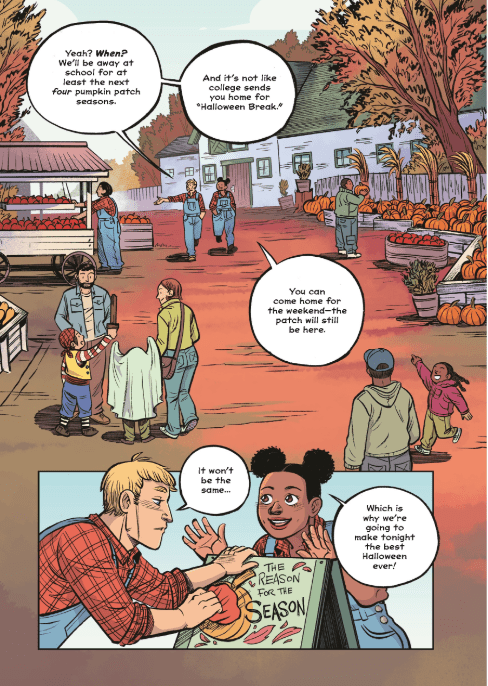
Finally, I really really loved the artwork in this book. It has a muted and subtle quality to it, with some manga-esque traits that still felt unique to the artist, Rosemary Valero-O’Connell. I also liked that while it’s mostly in black and white, there are little splashes of a soft pink throughout the story. It really made the images pop.

data47481171-895ddc
(source)

“Laura Dean Keeps Breaking Up With Me” is a bittersweet and hopeful look at the ups and downs of teenage relationships. If you haven’t checked out anything by Mariko Tamaki yet, I would say that this would be a good place to start.

Rating 8: A bittersweet story about the ups and downs of teenage romance, “Laura Dean Keeps Breaking Up With Me” hits you in the feels when it comes to love and toxic relationships.

Reader’s Advisory:

“Laura Dean Keeps Breaking Up With Me” is included on the Goodreads lists “Lesbian Teen Fiction”, and “Sapphic Graphic”.

Find “Laura Dean Keeps Breaking Up With Me” at your library using WorldCat!

Kate’s Review: “Loki: Where Mischief Lies”

37076222._sx318_Book: “Loki: Where Mischief Lies” by Mackenzi Lee

Publishing Info: Marvel Press, September 2019

Where Did I Get This Book: I received an eARC from NetGalley!

Book Description: Before the days of going toe-to-toe with the Avengers, a younger Loki is desperate to prove himself heroic and capable, while it seems everyone around him suspects him of inevitable villainy and depravity . . . except for Amora. Asgard’s resident sorceress-in-training feels like a kindred spirit-someone who values magic and knowledge, who might even see the best in him.

But when Loki and Amora cause the destruction of one of Asgard’s most prized possessions, Amora is banished to Earth, where her powers will slowly and excruciatingly fade to nothing. Without the only person who ever looked at his magic as a gift instead of a threat, Loki slips further into anguish and the shadow of his universally adored brother, Thor.

When Asgardian magic is detected in relation to a string of mysterious murders on Earth, Odin sends Loki to investigate. As he descends upon nineteenth-century London, Loki embarks on a journey that leads him to more than just a murder suspect, putting him on a path to discover the source of his power-and who he’s meant to be.

Review: Thank you to NetGalley for sending me an eARC of this novel!

Long time readers of this blog might remember that, unlike Serena, I am rather prickly when it comes to the DC and Marvel rivalry. I don’t really go out of my way to read many Marvel things, and when it comes to the MCU I’ve only seen a handful of the films. But the movies within the canon that I have seen multiple times and in a complete arc are the ones that center around Thor. And it probably surprises no one that the biggest factor of this is Loki, the sometimes villain, sometimes anti-hero brother of Thor who is at turns a pain in the neck and other turns a somewhat valuable ally. Because of this, when I saw that Loki was getting his own YA novel that gave him his own adventure and some backstory, I was mildly intrigued. But when I saw that it was being written by Mackenzi Lee, the author of the lighthearted and romantic romp “The Gentleman’s Guide to Vice and Virtue”?

giphy-2
Sign me up post haste! (source)

Lee has always had a real talent for giving voice to snarky, bitchy, and flawed yet likable protagonists, so it’s really no surprise that her version of Loki was spot on. She does a very good job of balancing the complexities of his personality, both the megalomaniac side, and the side that has been emotionally warped by his family life and the ways that his father and brother have failed him. You see him wanting to bring pride and joy to Odin and Thor, but ultimately falling into the easier patterns of being out for himself, in part due to his only friend Amora. Amora is a mysterious character who is the court sorceress’s student, and her magic entices Loki since he, too, is magical. You get the sense that Amora isn’t a great influence on him, but you also completely understand why he would be drawn to her, given that Odin has tried to suppress his magical powers. But while you can definitely understand why Loki lashes out and behaves in the ways that he does, Lee is also very careful not to go to the ‘poor misunderstood baby’ interpretation. Loki’s choices are his own, and while she lets you see why he’d do it, she never lets him off the hook. If anything it makes him all the more tragic, especially when you see him interacting with his family, particularly Thor and their mother Frigga. Given that the reason I can’t totally write of “Thor: The Dark World” is the heartbreaking themes and Frigga and Loki’s relationship, any scenes with these two had me almost in tears. Lee really know how to get to the meat of Loki’s motivations, and that was great to see.

The overall plot was also a delight and a half. While we do spend a large amount of time in Asgard (as well as other realms), a big chunk of the story is spent on Earth in Victorian London. Odin sends Loki to work with a mortal secret society that has found evidence of Asgardian magic being used for bad purposes, and to have the spoiled and vain Loki have to interact with Victorian era humans is QUITE amusing. The secret group, SHARP, consists of a number of societal misfits, much like Loki himself is, and I felt like Lee gave solid backstories to all of them. My favorite of this group was Theo, the earnest and loyal investigator who has to hide his sexuality from the world. Theo acts as a moral compass to Loki, but in ways that don’t come off as condescending or self serving, which tends to be the problem with Thor back in Asgard. This is in contrast to Loki’s other foil, Amora, who tries to pull him more towards his more self serving side, and the two relationships make for high tension and conflicting feelings in Loki. Related to this is that Lee has made Loki the genderfluid and pansexual character that has been long heralded in the fandom, and it really, really works within this narrative. Sweet, sweet romantic agony as you feel like Loki wants to be good enough for Theo, but feels he can only meet Amora’s standards.

giphy-3
All the tears. (source)

Overall, “Loki: Where Mischief Lies” was a super fun interpretation of a beloved Marvel fan favorite. Mackenzi Lee is writing a couple more backstory novels for other Marvel characters, and even if they aren’t my own personal favorites, I may have to give them a go.

Rating 8: A fun backstory for Loki from one of the most fun YA authors of today, “Loki: Where Mischief Lies” gives the morally ambiguous quasi-villain some time to shine and be the (anti)hero of his own story!

Reader’s Advisory:

“Loki: Where Mischief Lies” is included on the Goodreads lists “The Trickster”, and “YA/Middle Grade Comic Book Superhero Novels”.

Find “Loki: Where Mischief Lies” at your library using WorldCat!