Kate’s Review: “American Vampire (Vol. 4)”

This post may contain affiliate links for books we recommend.  Read the full disclosure here.

Book: “American Vampire (Vol.4)” by Scott Snyder, Rafael Albuquerque (Ill.), & Jordi Bernet (Ill.)

Publishing Info: Vertigo, September 2012

Where Did I Get This Book: I own it.

Where You Can Get This Book: WorldCat | Amazon | Indiebound

Book Description: American Vampire flashes back to two very distinct points in American history. The first tale comes from the early 1800’s with the “The Beast in the Cave” featuring art by the legendary Jordi Bernet (Torpedo, Jonah Hex). Learn about the original American Vampire, Skinner Sweet, and his involvement in the brutal Indian Wars, and an ancient evil hidden in the heart of the Old West. Plus, more about the man Skinner used to call his best friend – James Book!

The second tale comes straight from 1950s America, where American Vampire is terrorizing the suburbs with hot rods, teenyboppers and fangs! “Death Race” focuses on ferocious new vampire hunter Travis Kidd – but what is his connection to Skinner Sweet? As the story comes to a violent end, a sworn enemy’s identity is finally revealed, and lots of blood is spilled!

Writer Scott Snyder (Batman, Swamp Thing) and artist Rafael Albuquerque bring together even more threads to the complex tapestry that is the world of American Vampire.

Review: Admittedly as I was going about my read through of “American Vampire”, I picked up “Volume 4” and had an ‘I have no memory of this place’ moment. I had vivid recollections of the previous volume, just as I have recollections of what comes next. But this one didn’t stand out in my mind. So I was eager to dive in and remind myself what this volume had to offer. But as I was reading, I realized that there was probably reason I didn’t remember much. “American Vampire (Vol. 4)” is, unfortunately, the weakest part of the story yet.

But as always, let’s start with what I did like, and that was mostly the story “The Nocturnes”. We follow Calvin, one of the Vassals that was sent on the basically doomed Taipan mission during WWII, who we thought was dead, but actually was turned into a vampire when he was accidentally exposed to some of Pearl’s blood. The good news is he’s still working for the Vassals, and this standalone tale is following him and what he’s been up to. Mostly it’s taxonomy for the organization, categorizing different and new vampire subspecies, and in this story it isn’t a mission that has his interest, but a familial one: once he became a vampire he cut all ties to the living world outside of work, and he just wants to see his brother perform in his singing group. Unfortunately it’s in a sundown town, and also unfortunately, there are vampires afoot. I like Calvin as a character, and I liked seeing this exploration of what you have to give up as a Vassal, as those we have met up until now have been pretty solitary anyway. I also liked the way that it explores Jim Crow racism and sundown towns, and Calvin’s Othering because of his skin as well as his undead status. It’s a perspective we haven’t seen yet in the story and I enjoyed it.

BUT, that said, the other arcs in this collection haven’t aged super well from when they were first published. For one, guess who has once again been relegated to the sidelines: Pearl. She is barely in this book. Felicia Book isn’t in it at all. And we are STILL dwelling on Skinner Sweet, and while I KNEW that he wasn’t actually dead, it’s still frustrating that we didn’t get any kind of breather from him as a character who gets a huge friggin’ spotlight. This story takes us back to when he wasn’t yet a vampire, and we find out that he was actually good friends with James Book of all people, and they fought together during the Indian Wars, and oh boy. OH BOY. For one, the very complex and tragic subject matter at hand just doesn’t really sit well with me these days, given how the U.S. Government has consistently participated in a genocide against Indigenous peoples, and having that as a plot point in this story feels pretty grotesque. For another, we get into what is a well meaning story about the actual first American Vampire, an Indigenous woman named Mimiteh who was attacked by colonizer vampires and staked by the Vassals of the Morning Star as a precaution. After rising from the dead she is worshipped and feared by the Apache peoples that the U.S. Government is trying to overwhelm, and it just feels appropriative. It sure doesn’t help that Mimiteh is stark naked in nearly every encounter we see of her, which makes it feel all the more dehumanizing. And here’s a tip, making James Book, one of the pretty clear cut ‘good guys’ of this series, a participant in colonial driven genocide is probably not a good idea if you want him to remain clean nosed (creepy relationship with Felcia’s mother aside). The other story is about a vampire hunter for the Vassals named Travis Kidd, whose family was killed by a vampire and now he’s trying to take all vampires out. I did like some things about this story, namely that Travis kind of has a Charles Starkweather feel to him, in that when we first meet him he is killing his teenage girlfriend’s family, but they are vampires so it’s not the horrific spree that Starkweather had. It’s a wry reference to be sure. But, SURPRISE SURPRISE, do you know who it is that he ultimately wants his revenge against? You guessed it. SKINNER FREAKING SWEET. So we get very little Pearl in this collection, NO Felicia Book, and we get TWO HUGE STORIES WITH SWEET. SERIOUSLY?!

My feelings towards Skinner Sweet, and I MAY BE THE ONLY ONE?! (source)

Okay, so it was a bit of a stumble, but “American Vampire (Vol. 4)” does set up the next arc with a solid cliffhanger. I feel like Pearl and Felicia get more to do next time around, so onwards I go with higher hopes.

Rating 6: It just hasn’t aged super well. Also, while I knew we weren’t done with Skinner Sweet, I REALLY wish we were done with Skinner Sweet. That said, a story following Calvin is pretty good, and I liked some true crime connection and homages.

Reader’s Advisory:

“American Vampire (Vol. 4)” is included on the Goodreads list “Best Horror Comics/Graphic Novels”.

Previously Reviewed:

Kate’s Review: “The Vicious Circle”

This post may contain affiliate links for books we recommend.  Read the full disclosure here.

Book: “The Vicious Circle” by Katherine St. John

Publishing Info: William Morrow & Company, September 2022

Where Did I Get This Book: I received an ARC from the publisher at ALAAC22.

Where You Can Get This Book: WorldCat | Amazon | Indiebound

Book Description: A perfect paradise? Or a perfect nightmare?

On a river deep in the Mexican jungle stands the colossal villa Xanadu, a wellness center that’s home to The Mandala, an ardent spiritual group devoted to self-help guru Paul Bentzen and his enigmatic wife Kali. But when, mysteriously, Paul suddenly dies, his entire estate–including Xanadu–is left to his estranged niece Sveta, a former model living in New York City.

Shocked and confused, Sveta travels to Mexico to pay her respects. At first, Xanadu seems like a secluded paradise with its tumbling gardens, beautiful people, transcendent vibe, and mesmerizing de-facto leader Kali. But soon the mystical façade wears thin, revealing a group of brainwashed members drunk on false promises of an impossible utopia and a disturbing, dangerous belief system–and leader–guiding them.

As the sinister forces surrounding Sveta become apparent, she realizes, too late, she can’t escape. Frantic and terrified, she discovers her only hope for survival is to put her confidence in the very person she trusts the least.

Review: Thank you to William Morrow & Company for giving me an ARC of this novel!

On that first night of the ALA Annual Conference, there is always a bit of a free for all in the exhibit hall as publishers unleash ARCs of books unto the librarian masses. In the recent times I have gone I always tell myself, ‘be discerning! Don’t grab for the sake of grabbing! You know what books you want, prioritize those!’. And, as one can imagine, that never works, and I end up with many books because panic tells me so. But hey, I’ve found some fun books this way, and that is why I don’t kick myself too hard when I do it. That is how I got “The Vicious Circle” by Katherine St. John: I passed the table, saw the cover, read the back and said to myself ‘IT’S A CULT THRILLER!’ and shoved it in my tote bag. I finally sat down to read it a couple months after the fact, and it was…. a decidedly mixed bag.

In terms of a cult thriller, “The Vicious Circle” is pretty successful if only because it knows what notes to hit and doesn’t stray from it. The details The Mandala pick and choose from a lot of other true life cults; you get a little People’s Temple/Jonestown, you get a little Rajneeshpuram, you get a little NXIVM, with sprinkles of Scientology and Children of God for good measure. It’s a true smorgasbord of cult ideologies, and it was kind of fun for me to be able to be like ‘oh I get that reference’. There is also an effective ‘frog in the pot of boiling water’ pacing as our protagonist Sveta arrives at a compound called Xanadu in the Mexican jungle after getting word that she has inherited a vast fortune from her late uncle Paul. Who just so happened to be an incredibly successful wellness author and icon, influential enough to have a compound called Xanadu in the Mexican jungle. Sveta thinks that it’s going to be easy to settle the estate and everything else with Kali, her uncle Paul’s wife, and then begins to realize that maybe things aren’t what they seem. I always enjoy the ‘oh shit’ moments in a cult thriller, and St. John definitely has many of them coming at a quick pace. It makes for a fun and easy thriller that is, in a way, comforting to a reader who likes these kinds of stories. And I fully realize that ‘comforting’ is a strange word choice given the fact we are talking about a potentially dangerous cult. But it kept me turning the pages to see how it all shook out for Sveta as she goes head to head with the Mandala and its devotees.

I think that some of the more negative aspects are pretty easy traps to fall into in a book like this, mostly because you need them for the story to work if you don’t want to do a lot of difficult literary heavy lifting. The biggest for me is that Sveta feels VERY naive and susceptible to being duped when I’m not quite certain that she would be. I’m not talking about falling for the cult angle, as that isn’t really the issue. It’s more the fact that she has found herself in a very precarious position: isolated in the jungle, newly named as a beneficiary of millions upon millions of dollars, and with a woman who has EVERY reason to want that money, but feels like she can trust said woman. I found it very frustrating that she took everything that Kali said at face value. You met her once for dinner and it was a nice meal. Fine. But your uncle CLEARLY kept her out of his will for a reason, especially since it sounds like his death wasn’t sudden. I understand why the story needs her to be this way, but I kind of needed more reasons for her to be this way. It made Sveta’s motivations feel more there to drive the plot as opposed to trying to make the two work in a cohesive and believable way.

All in all “The Vicious Circle” is entertaining enough and has enough suspense to keep me engaged and interested. It doesn’t really stand out too much from other run of the mill cult thrillers, but as someone who loves a cult thriller that isn’t necessarily a bad thing.

Rating 6: Pretty standard cult thriller reading. Doesn’t reinvent the wheel, but it’s entertaining enough.

Reader’s Advisory:

“The Vicious Circle” isn’t included on many specific Goodreads lists yet, but it would fit in on “Cults and Communes in Fiction”.

Joint Review: “Rules of Engagement”

This post may contain affiliate links for books we recommend.  Read the full disclosure here.

Book: “Rules of Engagement” by Selena Montgomery

Publishing Info: Berkley Books, September 2022

Where Did We Get this Book: ALA!

Where Can You Get this Book: Amazon | IndieBound | WorldCat

Book Description: Dr. Raleigh Foster, an operative for a top-secret intelligence organization, knows that her undercover work has its risks. So she doesn’t hesitate when asked to infiltrate Scimitar, the terrorist group that has stolen lethal environmental technology. But when she’s assigned a partner–brooding, sexy Adam Grayson–to pose as her lover, Raleigh discovers that the most dangerous risk of all…is falling in love.

Adam blames himself for the botched mission that got his best friend killed by Scimitar, and he believes that Raleigh may have contributed to the man’s death. But the closer he works with his alluring partner, the more his suspicions turn to trust–and intense desire. Now, as he and Raleigh untangle a twisted web of secrets and lies, the tension mounts between them…until their masquerade as a couple proves too tempting to resist.

Serena’s Thoughts:

Kate and I nabbed ARCs of this book during a preview panel at ALA. While I don’t typically read this sort of romance novel (I tend to stick within my genres, even with romance and am much more likely to pick up a fantasy or historical romance before a contemporary story), the plot synopsis of this one did stand out to me. Who can not be interested in undercover agents falling in love?

And there were things to enjoy as far as this premise goes. I liked the action scenes and the build up of tension during some of the undercover moments. The story was also written in an approachable, fast-paced manner and I was able to blow through it pretty quickly. I think readers of this sort of romance will likely very much enjoy it.

However, it is also very much of its time (originally published in 2001), and there were far too many times when I became frustrated with the interplay between the main characters, as well as their portrayals as individual characters. The hero, Adam, was probably the biggest issue I had with this book. He was very hot and cold, but not in a sexy way. More like a strangely aggressive obtuse inability to understand that Raleigh was also an under cover agent who would make the decision to keep her own secrets. I was also not a fan of some of the terms that were repeatedly thrown around to describe Raleigh, terms like “childlike,” “vulnerable,” and “fragile.” Ummm…she’s clearly a supremely competent under cover agent, given her success rate and her age. I don’t think “fragile” is the term I’d use to describe this type of person. But, again, much of this just feels more of a different time anything else.

Overall, this book is a bit dated, but I think it will likely still appeal to contemporary romance fans. Especially for romance readers who enjoy political intrigue and under cover operations.

Kate’s Thoughts:

As some one who has been very impressed by and a huge fan of Stacey Abrams, not only for her political maneuvering but also her unabashed geekiness (her perspective on the Buffy/Angel/Spike love triangle is PERFECTION), I was pretty eager to try out her first romance novel when it was presented to us at ALA. And by first I mean this was, as Serena said, a reissue of her debut from 20+ years ago. Even though romance is pretty hit or miss with me, I was more than willing to give this one a go.

And I have to echo a lot of what Serena said. Even though I’m not someone who really enjoys spy stories in general, I liked the espionage shenanigans in “Rules of Engagement”. It felt part Black Ops, part “James Bond”, and I enjoyed seeing Raleigh slip into characters while also balancing her real life, be it dealing with her attraction to Adam, or with her fun best friend Alex. I also mostly liked Raleigh, as her complexity felt real and believable while also fitting into the role of a super spy (who still manages to be SUPER young, but hey, that’s fine!).

But, also like Serena, the biggest downside for this book was the dynamic between Raleigh and Adam. I just didn’t like how he treated her, infantilizing her one moment, raging against her and nearly despising her another moment, then going full on protective star crossed lover ANOTHER moment. Whiplash! Whiplash I say! I agree that it probably worked better twenty years ago, but as a reader today I didn’t find it terribly sexy. And I say this as a person who generally likes enemies to lovers tropes!

It’s fun seeing Stacey Abrams alter ego’s first story in action! I may see if I can find some of her later romances to see how they compare, as “Rules of Engagement” had some pluses, but minuses as well.

Kate’s Rating 6: I liked the espionage stuff and I liked Raleigh for the most part, but the dynamic between her and Adam was not my cup of tea.

Serena’s Rating 6: Not for me, as I disliked the hero and had a negative reaction to some of the descriptions of the heroine as well. But this is also a very subjective opinion and fans of the genre will likely enjoy it!

Reader’s Advisory:

“Rules of Engagement” isn’t on any Goodreads lists, but it should be on Spy Romances.

Serena’s Review: “Night of the Raven, Dawn of the Dove”

This post may contain affiliate links for books we recommend.  Read the full disclosure here.

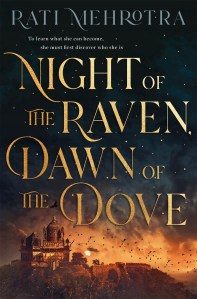
Book: “Night of the Raven, Dawn of the Dove” by Rati Mehrotra

Publishing Info: Wednesday Books, October 2022

Where Did I Get this Book: Edelweiss+

Where Can You Get this Book: Amazon | IndieBound | WorldCat

Book Description: Katyani’s role in the kingdom of Chandela has always been clear: becoming an advisor and protector of the crown prince, Ayan, when he ascends to the throne. Bound to the Queen of Chandela through a forbidden soul bond that saved her when she was a child, Katyani has grown up in the royal family and become the best guardswoman the Garuda has ever seen. But when a series of assassination attempts threatens the royals, Katyani is shipped off to the gurukul of the famous Acharya Mahavir as an escort to Ayan and his cousin, Bhairav, to protect them as they hone the skills needed to be the next leaders of the kingdom. Nothing could annoy Katyani more than being stuck in a monastic school in the middle of a forest, except her run-ins with Daksh, the Acharya’s son, who can’t stop going on about the rules and whose gaze makes her feel like he can see into her soul.

But when Katyani and the princes are hurriedly summoned back to Chandela before their training is complete, tragedy strikes and Katyani is torn from the only life she has ever known. Alone and betrayed in a land infested by monsters, Katyani must find answers from her past to save all she loves and forge her own destiny. Bonds can be broken, but debts must be repaid.

Review: I feel like I’ve read a number of India-inspired fantasy novels over the last few years or so. Most of them have been very good, and it’s always refreshing to see new fantasy world built on the foundation of other cultures, histories, and religions from around the world. This one was particularly interesting when I stumbled across it because it was toted as being inspired by Medieval India, a period that I know even less about that the more recent history of the nation and region. Other than this general point of interest, however, I had very little to go on.

Ever since a forbidden magical intervention was performed to save her life as a child, binding her to the queen of the realm, Katyani has always seen her future as bright and clear. She was worked tirelessly to become the best guardswoman she could be and is in line to become the personal guard of the crown prince. But as persistent assassination attempt goes unthwarted, Katyani’s stable future begins to become shaky. Not only has she been unsuccessful in thwarting this threat, but she is now being sent away from the queen and castle to guard the prince and his cousin as they train in a remote school. And while there, she begins to question more and more in not only her future, but her past.

In a lot of ways, this book felt like it was right on the verge of being a story I’d love. The world-building is interesting, the magic had its moments, and there were some excellent fantasy monsters and creatures. But all of this fell just a little short of being particularly interesting. The world-building had some good moments, but I also never felt fully grounded, often unable to picture anything particularly unique about this world. This left me filling in the blanks. And, unfortunately, when a reader is left to fill in blanks, they’ll do with elements they’re most familiar with, thus completely undermining the goal of being exposed to a world/culture that is completely new.

The magic system was also barely a system, with many things working “just because.” I don’t always need elaborate systems ala Brandon Sanderon, but I do need to feel as if there are some rules around how magic is used and what is and isn’t possible. Without this, magic begins to feel like it could just be a silver bullet for any problem that should ever arise, thus dramatic lowering any and all stakes. But, I will say, the monsters and creatures were definitely the saving grace for fantasy elements. They were all new and interesting, doing most of the work of making this world feel like a unique place and touching on the cultural and mythical Indian elements that I was looking to learn more about.

I also couldn’t connect to the characters at all. The main character was supremely bland, suffering from the all-too-familiar case of a teenage character who is somehow the best everyone’s ever seen at a highly skills based occupation. This is a personal annoyance for me, of course, so others may not be bothered by it. But even personal preferences aside, Katyani didn’t have a lot going for her. She wasn’t annoying or prone to ridiculous dramatics, but she also didn’t have any real character traits that made me care about her personally. Beyond that, all of the characters had as similar sort of blandness which made them even less interesting as they began to blend together.

Lastly, I found a lot of the story highly predictable. From the very first few chapters, it was easy to guess what a few of the “reveals” would be. When you can see all of the twists coming, it’s very hard to feel investing in sticking it out while the characters themselves discover these truths. Ultimately, this book just wasn’t for me. Given that I didn’t particularly enjoy the other duology by this author that I’ve read, I think this is maybe just a sign that I should stick to other writers in the future. Fans of her work, however, might enjoy this, as I do think it was similar to that first duology (in that my annoyances have been the same between them, so if you weren’t bothered by it then, you may be good to go here too!)

Rating 6: Everything felt like it was lacking that certain spark that needs to come together to make a great read.

Reader’s Advisory:

“Night of the Raven, Dawn of the Dove” isn’t currently on any Goodreads list, but it should be on Indian Inspired Fantasy Novels.

Joint Review: “The Witch and the Tsar”

This post may contain affiliate links for books we recommend.  Read the full disclosure here.

Book: “The Witch and the Tsar” by Olesya Salnikova Gilmore

Publishing Info: Ace, September 2022

Where Did We Get This Book: We received eARCs from NetGalley and Edelweiss+.

Where You Can Get This Book: WorldCat | Amazon | Indiebound

Book Description: As a half-goddess possessing magic, Yaga is used to living on her own, her prior entanglements with mortals having led to heartbreak. She mostly keeps to her hut in the woods, where those in need of healing seek her out, even as they spread rumors about her supposed cruelty and wicked spells. But when her old friend Anastasia—now the wife of the tsar, and suffering from a mysterious illness—arrives in her forest desperate for her protection, Yaga realizes the fate of all of Russia is tied to Anastasia’s. Yaga must step out of the shadows to protect the land she loves.

As she travels to Moscow, Yaga witnesses a sixteenth century Russia on the brink of chaos. Tsar Ivan—soon to become Ivan the Terrible—grows more volatile and tyrannical by the day, and Yaga believes the tsaritsa is being poisoned by an unknown enemy. But what Yaga cannot know is that Ivan is being manipulated by powers far older and more fearsome than anyone can imagine.

Olesya Salnikova Gilmore weaves a rich tapestry of mythology and Russian history, reclaiming and reinventing the infamous Baba Yaga, and bringing to life a vibrant and tumultuous Russia, where old gods and new tyrants vie for power. This fierce and compelling novel draws from the timeless lore to create a heroine for the modern day, fighting to save her country and those she loves from oppression while also finding her true purpose as a goddess, a witch, and a woman

Kate’s Thoughts

This was a little bit of a gamble for me, as I knew that it was fantasy, and I knew that it was going to be pretty heavy on Russian mythology for inspiration. And given that I’m not a huge fantasy person, and my book of Russian myths and fairytales has sat on my shelf unopened for years, I was rolling the dice. BUT, it also follows Yaga, a witch, and I DO LOVE WITCHES. So I took a chance on this one, and the bag was… pretty mixed.

The positives are definitely ample! For one, I liked Yaga as our protagonist. She’s a healer who is half immortal and has done her best to keep people around her safe, including her old friend Anastasia who is the Tsar’s wife, and who is being poisoned. Yaga, unfortunately, has to learn that not everyone has the same noble heart, and most of this book is her trying to survive not only against a spiraling Ivan the Terrible (who is doing unthinkable things in Russia; what a time to be reading this, given the guy in charge of Russia right now), but also other immortals and gods and demi gods. I liked how Gilmore subverted some of the mythologies to reflect lies and propaganda that the Orthodox Russian Church was spewing to undercut the non-Christian theologies of the time. I know that the fact Yaga has been de-aged from crone to young woman has frustrated some readers, which I definitely get, but I kind of like the idea of her reputation of being a cruel crone is actually a lie to make people distrust a woman who is actually a midwife, healer, and powerful woman in a community.

But overall, I think that I didn’t have enough working knowledge of the mythology (and even the history! I don’t know much about Russian history, honestly), and that meant that I couldn’t fully appreciate what Gilmore was trying to do. I also thought that it was a little ambling at times as the story went on. It wasn’t really a slog, but I did sometimes find myself skimming a bit to get through specific scenes.

So overall, “The Witch and the Tsar” was an okay read, but I’m not sure I got everything I could have gotten from it. Maybe I need to go grab that unopened book of Russian folklore off my shelf.

Serena’s Thoughts

Me, I’m the reader frustrated by the aged-down Yaga! But before I get to that, let’s start with my general impression. Unlike Kate, everything about this book is directly up my alley, so it was a bit of a no-brainer that I was going to read it either way. But I was happy she suggested we joint review it, since I think that has left us in an interesting position now. Since…the very fact that this was up my alley might be why I wasn’t this book’s biggest fan? More precisely, I feel like I’ve read this book before and better versions of it.

For example, while I generally appreciate the commentary on wise women and healers and how these women were undercut by the incoming Christian church in its various forms, I’ve also read many, many fantasy novels that have covered this very thing. And in very similar, unfortunately better, ways. So for me, many aspects of this book just struck chords that were too familiar to other, better stories, leaving me in a constant state of comparison. A big one was “The Bear and the Nightingale” and that trilogy, a series that is also Russian history/folklore inspired and tackles these same conversion points between Christianity, old world religion, and the demonization of women who were healers or stood out in any other way.

Beyond that, I had a hard time connecting to Yaga. Yes, part of me was simply disappointed that she was a young woman because I’ve read a million and one novels about young women in fantasy and it’s always refreshing to read about different age groups (people over 30 exist! especially older women! things happen to them and there is a unique power and experience to be mined there!). But beyond that, Yaga, while still young-looking, is in fact meant to be quite old. And yet she routinely seemed to be quite naive in a way that I found hard to reconcile with the amount of lived experience she should have under her belt at this point.

I also wish we had gotten a bit more from the Russian folklore, as Kate mentioned. I’m pretty familiar with a lot of it, simply due to the fact that it’s had a bit of a run recently as a go-to in fantasy fiction. But there were certain elements that I felt were just plunked down into the story without much thought or creativity. Like the house with chicken legs just kind of appears? I’ve read some pretty interesting takes on this entire concept (Orson Scott Card’s “Enchantment” probably has the most creative one I’ve seen at this point), but this book just seemed to skip over some of these opportunities.

All in all, my conclusion is the same as Kate’s. This wasn’t a slog of a read by any means, but by the time I finished it, I realized I spent most of the book thinking about other, similar stories and wishing this was more like those.

Kate’s Rating 6: I liked Yaga as a protagonist and I liked the way Gilmore subverted Russian myth and folklore, but it felt ambling at times, and I think I would have gotten more if I were more familiar with the mythology.

Serena’s Rating 6: If you haven’t read much Russian fantasy folklore, this might appeal to you. But there are better examples out there that left this one feeling uncomfortably derivative at times.

Reader’s Advisory:

“The Witch and the Tsar” is included on the Goodreads lists “Mythological Re-Imaginings” and “Wise Women, Witches, Midwives, Healers, and Strong Girls”.

Book Club Review: “The Ten Thousand Doors of January”


This post may contain affiliate links for books we recommend.  
Read the full disclosure here.

We are part of a group of librarian friends who have had an ongoing book club running for the last several years. Each “season” (we’re nerds) we pick a theme and each of us chooses a book within that theme for us all to read. Our current theme is “Book Bingo” where we drew reading challenges commonly found on book bingo cards from a hat and chose a book based on that.  For this blog, we will post a joint review of each book we read for book club. We’ll also post the next book coming up in book club. So feel free to read along with us or use our book selections and questions in your own book club!

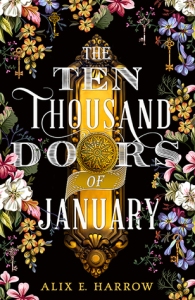
Book: “The Ten Thousand Doors of January” by Alix E. Harrow

Publishing Info: Redhook, September 2019

Where Did I Get This Book: The library!

Where You Can Get This Book: WorldCat | Amazon | Indiebound

Book Bingo Prompt: A book with a misleading title

Book Description: In a sprawling mansion filled with peculiar treasures, January Scaller is a curiosity herself. As the ward of the wealthy Mr. Locke, she feels little different from the artifacts that decorate the halls: carefully maintained, largely ignored, and utterly out of place.

Then she finds a strange book. A book that carries the scent of other worlds, and tells a tale of secret doors, of love, adventure and danger. Each page turn reveals impossible truths about the world and January discovers a story increasingly entwined with her own.

Kate’s Thoughts

We’re back to a familiar statement from me during a Book Club post and discussion: I am not really a fantasy reader outside of a few specific exceptions, be it titles (“The Lord of the Rings”; “The Neverending Story”) or sub-genres (dark fantasy). So going into my review of “The Ten Thousand Doors of January”, you need to take all of this with a grain of salt. Maybe a teaspoon or two. I am almost never going to be able to vet a fantasy title super well because as a genre it’s not my bag, baby (a phrase that was tossed around in book club during the discussion).

What I will say about this book that I did like was the way that Harrow incorporated social issues of the time period into the book. We see the struggles of life in Edwardian-era England for not only women, but also women of color within a certain social stature. While January is somewhat shielded from some of this because of her placement with Locke, she is still kept in a gilded cage, and eventually put in an asylum under guise of hysteria when in actuality she is more inconvenient for Locke and his contemporaries when she becomes a perceived threat. And then once she is more outside of Locke’s ‘protection’ (you can’t REALLY call it that), her race is suddenly something she also has to contend with in a more direct and overt fashion. I also liked the way that Harrow addresses aspects of Imperialism and Colonialism through the character of Jane, a woman born in Africa who was being subjected to a missionary school, and eventually finds a door that helps her find freedom. And really, her door, where she encounters a world with a matriarchal cheetah society, was SUPER interesting! But we didn’t really get to see much of that. We didn’t get to see as many doors as I anticipated.

So yeah, I liked the social aspects of this book, as it’s great to see fantasy address these themes. But it’s still fantasy, which just isn’t my genre. So this is very much a ‘your mileage may vary’ situation.

Serena’s Thoughts

Don’t worry fantasy lovers! As the resident fantasy reader, I am happy to step up to vet titles in this genre. And, all told, I found a lot to like in this book. This is definitely one of those fantasy novels that leans heavily on subgenres like historical and literary fiction. While there is definite magic involved in the story and it is surely a portal fantasy, the pacing and overall feel of the book falls more in line with literary fantasy and historical fiction than anything else. As Kate mentioned, the book focuses a lot on the realities of life in this time period for both women and people of color. Even though there are fantastical doorways into different worlds, there is no magic wand to wave away the very real challenges facing many during this time.

The pacing of this book is also on the slower side, spending much more time developing the overall feel of the story and the realities that January is facing. But to balance this slower pace, the story is broken up into two primary stories: one that of January herself, and the second following another young woman born a few decades before January who also found doorways and used them to redirect the pathway laid before her. I really enjoyed the way these two stories came together. I was also surprised by a few twists and turns that were given a long the way. For all the dire circumstances and reality that makes up so much of January’s life, the story includes a hefty dose of hope right when things could begin to feel a bit too bleak.

Overall, I really liked this book. It’s definitely on the slower side and errs towards the lyrical over the action-packed. Like some book club members pointed out, for a book about a thousand doorways between worlds, the story spends most of its time in our old familiar world. But I think that worked for the balance that was being struck between fantasy story and a larger reflection on this period of history and its people.

Kate’s Review 6: It’s fantasy. I liked some of the social themes presented and the small tastes of some of the worlds. But it’s just not my genre.

Serena’s Review 8: A lyrical fantasy novel that makes up for its slower pacing with its lovely character work.

Book Club Questions

  1. What were your thoughts on January as a protagonist of this book? Did you connect with her as a main character?
  2. Did you find it to be a nice change of pace when the book would transition to the Adelaide story arc?
  3. Which side characters did you find the most compelling in this story? Were there any side worlds through the doors you liked reading about?
  4. What were your thoughts on how this book tackled and addressed various social aspects like imperialism, racism, and sexism?
  5. Were there any moments that stood out in particular in this novel?
  6. Who would you recommend this book to?

Reader’s Advisory

“The Ten Thousand Doors of January” is on these Goodreads lists: Portal Fantasy Books and Best Books with a Month in the Title.

Next Book Club Book: “Old Man’s War” by John Scalzi

Serena’s Review: “The Last of the Talons”

This post may contain affiliate links for books we recommend.  Read the full disclosure here.

Book: “The Last of the Talons” by Sophie Kim

Publishing Info: Entangled: Teen, September 2022

Where Did I Get this Book: ARC from ALA convention!

Where Can You Get this Book: Amazon | IndieBound | WorldCat

Book Description: After the destruction of her entire Talon gang, eighteen-year-old Shin Lina—the Reaper of Sunpo—is forced to become a living, breathing weapon for the kingdom’s most-feared crime lord. All that keeps her from turning on her ruthless master is the life of her beloved little sister hanging in the balance. But the order to steal a priceless tapestry from a Dokkaebi temple incites not only the wrath of a legendary immortal, but the beginning of an unwinnable game…

Suddenly Lina finds herself in the dreamlike realm of the Dokkaebi, her fate in the hands of its cruel and captivating emperor. But she can win her life—if she kills him first.

Now a terrible game of life and death has begun, and even Lina’s swift, precise blade is no match for the magnetic Haneul Rui. Lina will have to use every weapon in her arsenal if she wants to outplay this cunning king and save her sister…all before the final grain of sand leaks out of the hourglass.

Because one way or another, she’ll take Rui’s heart.

Even if it means giving up her own.

Review: So, I mostly grabbed this book at ALA with very little thought other than “oooh, is that a dragon on the cover??” Cuz you all know I’m always down for another dragon book! If I had read the book description more fully I might have been a bit more wary. Let’s just say, me and YA assassins have a bit of a checkered history. Beyond numerous other problems I regular find with this plotline, I’m beginning to question whether the two concepts, “assassin” and “young adult fiction,” aren’t just oxymorons that can never work well together by the very natures of their differences. “Assassin” would lead you to believe that your leading character is pretty morally compromised and things will get bloody. “Young adult fiction,” on the other hand, has at least a passing commitment to keep stories approachable for younger audiences. So….what’s to be done? Let’s see what this book has to say.

Shin Lina had once lived a blessed life, or what she considered one at least. Perhaps most people wouldn’t think making up ones family of gang members and gaining a reputation as the city’s most deadly assassin would count as “blessed,” but to Lina, it was enough. But now that has all been ripped away, and she has been forced to work for the very enemy who massacred this family, all to protect the life of her younger sister. When a job goes bad, however, Lina finds herself at odds with a powerful magical being. But more could be at stake than just her life. Perhaps even her heart.

Well, this book is not the one to disprove the theory I had in my intro paragraph. In fact, it exemplified many of the other factors that I think add to the uncomfortable pairing of assassin characters leading up YA stories. But before we get to that, let’s talk about the positive. If I zoom way, way out, there are the bones of an interesting story here. Unfortunately, any closer look renders these larger strokes pretty unsatisfactory. But the world-building itself had potential, with a fairly intricate political and magical system. And there were some genuinely funny moments with the dialogue, though, admittedly, these were few and far between for me.

However, again, when you dive even shallowly (let alone a deep dive) into how any of this works it begins to get murky. For one thing, because this is YA, Lina is, of course, a teenager herself. And yet, through a series of flashbacks, we see that she only joined the gang and learned her skills to be an assassin when she was an older kid. And then this story starts out several years after the death of everyone in said gang. Soooo, in a period of like 4 years she somehow became the most skilled assassin ever, even more so than the adults who trained her. It’s these time-related things that just really irk me about YA characters who derive their “specialness” through some skillset that is esteemable purely because of the sheer quantity of time and effort needed to excel at it. Not only does it stretch past my ability to suspend disbelief, but it also waters down what makes the skill impressive to begin with, if a regular farm girl can become the absolute best in two years.

Beyond that, we have yet another assassin who doesn’t really kill anyone? I mean, honestly, what’s the point of having a character like that if all we get is a lot of “telling” that they’re some amazing assassin, but no actual evidence of it (both in the actual skills of killing someone or the mental/emotional state of a character who makes a living dealing out death regularly)?

This book adds to the challenge of this particular qualm by the very nature of the main conflict of the story. For absolutely no apparent reason, Rui sets Lina the task of…killing him? In order to spare her life? I’m not going to even get into the weirdness of that situation to begin with and what it says about Rui that this is what he wanted. But it also creates a plotline that sets up our big bad assassin Lina to fail. Obviously, she can’t succeed at killing Rui or it would defeat the entire point of the story. That then leaves us with a character who has been toted as the best assassin ever having to fail again and again to kill someone through the entire book.

I’ll stop venting about this now. But I think the lackluster writing style and very bland leading characters left me with really nothing else to focus on than my annoyances in these areas. I do think there are YA readers who will like this, especially given the popularity of other YA assassin books. But this wasn’t for me. And if you’re looking for anything new in this particular subgenre, I don’t think this is it.

Rating 6: More of the same, with an assassin whose much more talk than action.

Reader’s Advisory:

“The Last of the Talons” can be found on these Goodreads lists: SF/F Assassins! and 2022 Book Releases by Asian Authors.

Kate’s Review: “Mary: An Awakening of Terror”


This post may contain affiliate links for books we recommend.  
Read the full disclosure here.

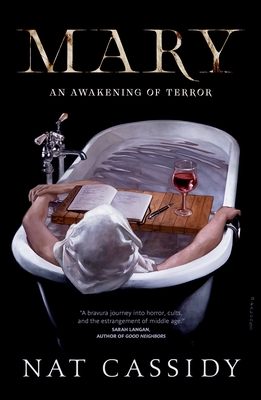
Book: “Mary: An Awakening of Terror” by Nat Cassidy

Publishing Info: Tor Nightfire, July 2022

Where Did I Get This Book: I received an eARC from NetGalley.

Where You Can Get This Book: WorldCat | Amazon | Indiebound

Book Description: Mary is a quiet, middle-aged woman doing her best to blend into the background. Unremarkable. Invisible. Unknown even to herself.

But lately, things have been changing inside Mary. Along with the hot flashes and body aches, she can’t look in a mirror without passing out, and the voices in her head have been urging her to do unspeakable things.

Fired from her job in New York, she moves back to her hometown, hoping to reconnect with her past and inner self. Instead, visions of terrifying, mutilated specters overwhelm her with increasing regularity and she begins auto-writing strange thoughts and phrases. Mary discovers that these experiences are echoes of an infamous serial killer.

Then the killings begin again.

Mary’s definitely going to find herself

Review: Thank you to NetGalley for providing me with an eARC of this novel!

I’m a little reluctant to give a concrete number as to the amount of ARCs I got at ALA Annual in June, as the number is staggering and a little out of control. And yet in spite of these numbers I won’t disclose, there were a few books I was hoping I’d pick up but were unable to obtain either because they weren’t there or the timing was off. So I ran to NetGalley and grabbed the titles I wanted that way, which works out just as well (and far more compact in terms of storage, really). One of those books was “Mary: An Awakening of Terror” by Nat Cassidy. I had my eye on it for awhile, as it touts being in similar veins as “Carrie” and “Midsommar”, which catch my eye for varying reasons. And really, look at that cover. Just disturbing as hell right from the jump. By the time I was fully submerged in the story, however, I was a little adrift, feeling like perhaps I had bitten off a little more than I could chew, thematics wise…

First, what I did like about it. And there is a lot to like about this book! Firstly, I liked how Cassidy really wanted to give a unique voice in a horror novel the spotlight. Our main character Mary Mudgett is a middle aged woman who feels invisible, who is experiencing perimenopause, and who is pretty alone in the world. She returns to her hometown after a decades long absence, a bit nervous to return to a place where she was so tormented by her peers and her aunt Nadine. I thought that Cassidy really brought forth the voice of a middle aged woman who feels left behind and forgotten about, and how he tapped into the horrors of societal expectations of aging, misogyny, and isolation and anxiety so authentically. I also thought that a lot of the aspects he explored in this book in terms of plots, from reincarnation to small town secrets to body horror were all very well done, and came together in unique ways that really got his story across. Also, major props to him for addressing his choice to give a middle aged woman a voice when he himself is a younger cishet man, and how he tried his best to be authentic in her voice and experiences. Also, he clearly has a lot of love for “Carrie”, as in his author’s note he explains that Mary is a reimagining of a woman like Carrie who does make it past the night of Prom, and what that would look like.

But here is the thing. Like many fans of horror (and really all kinds of genres), I am someone who has topics and themes that really work for her, and other topics and themes that really don’t. And “Mary: An Awakening of Terror” is incredibly brutal in a lot of ways, and brutality heaped upon me over and over again can wear me down a bit. I was really happy that Cassidy put a thorough content warning before the story began, because I was able to prepare myself a bit before digging in, but even with the content warning I still had moments where I just had to put the book down for a bit. I won’t spoil anything, but there were three vivid moments where I was fairly put off by what I was reading on the page, and one in particular where I almost stopped reading altogether. At the end of the day, this book was a bit too brutal for me. So we’re kind of in the midst of a review that may be more based on preference than actual content. But one thing to keep in mind is that I’m someone who can tolerate a fair amount of horror nonsense in her reading and consuming of other media. It’s rare that I find myself almost abandoning something because of its brutality. So this book may be too brutal for others as well.

Overall, I really liked the voice that Nat Cassidy gave Mary Mudgett, and I liked some of the creative and scary aspects of the novel as well. But at times it wasn’t an experience I was enjoying in the moment because of the content. Your mileage may vary.

Rating 6: Scary and brutal, but perhaps a bit too much so for this reader.

Reader’s Advisory:

“Mary: An Awakening of Terror” is included on the Goodreads list “Anticipated 2022 Horror/Thriller Releases”.

Serena’s Review: “Relic and Ruin”

This post may contain affiliate links for books we recommend.  Read the full disclosure here.

Book: “Relic and Ruin” by Wendii McIver

Publishing Info: Wattpad Books, June 2022

Where Did I Get this Book: Edelweiss+

Where Can You Get this Book: Amazon | IndieBound | WorldCat

Book Description: The Banshee and the Wraith. They have the power to save the world―or destroy it.

In a place unlike any other, two brothers set off an ancient, epic, and never-ending battle. This world is controlled by the Necromancers and Reapers―one side pulls people back up through the earth, and the other cuts them down again. One ancient family, the Laheys, have been tasked again and again with keeping the balance between the worlds. And Nyx Lahey, born a Necromancer, but raised a Reaper, is on the front lines. Lately, though, Nyx is wrestling with her identity as she’s thrown into an adventure filled with prophecies and the kind of danger you can cut down with a giant scythe.

While chasing a creature that’s killing young girls, Nyx runs headlong―and gun drawn―into Erebus Salem. A hunter who has the ability to turn into a raven to escape danger, Erebus also harbors a secret: he’s not alive. He lives in Dewmort, a world in-between, where the souls of the dead reside, and where memory is all but erased. With no memory of who he is, his only connection to the past is a locket which ends up in Nyx’s hands. Determined to get it back, Erebus and his friends set watch on the Laheys, but they aren’t the only ones.

Other beings are lurking in the shadows. They know the truth about Erebus and Nyx. They know that the pair are the Relics, the only two powerful beings in the world capable of taking down the greatest evils known to any kind. Soon, Nyx and Erebus become the hunted, and must try and escape the evil plans of the war lord, Bellum.

Bellum wants the Relics for his own purposes. He needs them to raise his father, the original Necromancer, Neco. With his father by his side, Bellum believes he can rule the world―all of them―and destroy the Reapers once and for all.

Can Nyx and Erebus master their new found powers, and even if they do, can they survive?

Review: So, this was a bit of an impulse request on my part. On one hand, the idea of two groups, Reapers and Necromancers, battling across the centuries is very interesting. On the other hand, the main character’s name is Nyx… Which sounds much too close to the specific type of YA leading lady that I don’t enjoy. Yes, I will stereotype based only on a name! But never say that I am ruled by those stereotypes, since here I am reading and reviewing this book.

Though born a Necromancer, Nyx and her family has a long history of working with the Reapers to contain the undead horrors the Necromancers bring into the world. On what seems like a routine job, Nyx stumbles across the gruesome murder of a young girl and what looks like the beginning of the spree of a madman. At the same time, she runs across Erebus, a young man with more mysteries than she can imagine. But what seems as random chance becomes much more when the two discover they are what is known as Relics, powerful magical beings.

I’m always happy to be proven wrong in my more shallow initial assessments. However, I can’t say that this is one of those times. Indeed, this book mostly lived up to almost every YA stereotype I associate with the type of teen fantasy story that features a main character named “Nyx.” But, while I didn’t enjoy this book, there are some bare bones here that I want to praise, since there will definitely be readers who can enjoy this book.

First off, I still think the concept of the Reapers and Necromancers is an interesting starting platform. The book starts out really well, in fact, with a history of the two brothers whose fight lead to this ages-old war. The plot and writing is also quick and fast-paced so readers who do find themselves getting sucked in will likely breeze through this book quickly. It also is a dark (ish) YA fantasy, which will surely appeal to YA fantasy readers who are tired of dragons and swords.

One of my first problems with the book, however, is that while the initial fantasy concept and world-building is interesting, there’s never enough information given to make it actually understandable to the reader. Unless you are caught up in the fast pace of the story, when you stop to actually think about what’s going on, all you find are more questions. There are such a thing as “in-betweeners” mentioned early in the book. But I could never really figure out what these were or how they they fit in with all the various creatures that we run into along the way. In this way, the fast pace of the story began to make the book feel rushed and unclear more than anything else.

I also couldn’t get on board with our main characters. Nyx comes from a ginormous family, all of who have various different abilities which are listed off for the reader in an exhausting fashion. But with this large cast of characters, it was hard to latch on to any actual arch on Nyx’s part. And then Erebus falls into that increasingly unappealing zone (for me at least) of the love interest who is centuries old but still falls in a love with a teenager. Obviously this is completely subjective, but I find myself way less annoyed by the age difference trope in romances if the centuries-old being is at least falling in love with a full adult. I just can’t buy it, otherwise. Not to say that Erebus doesn’t seem like a teenager himself, but that’s its own problem (or just problem for me, since seeming like a teenager is probably, largely, a win for a YA book!). So, because of this, I struggled to become invested in either of them individually or the romance in general.

Unfortunately, this book wasn’t for me. I enjoyed the first few chapters, but once the story actually settled into what it was going to be about, I found myself getting bored and skimming ahead. I’m sure some YA fantasy readers will enjoy this, but it might be more of a struggle for adult readers of YA fantasy.

Rating 6: Some clumsy world-building and flat main characters made this book a bit of a chore for me.

Reader’s Advisory:

“Relic and Ruin” isn’t on any Goodreads lists, but it should be on Indie YA Paranormal Romance.

Kate’s Review: “Just Like Home”

This post may contain affiliate links for books we recommend.  Read the full disclosure here.

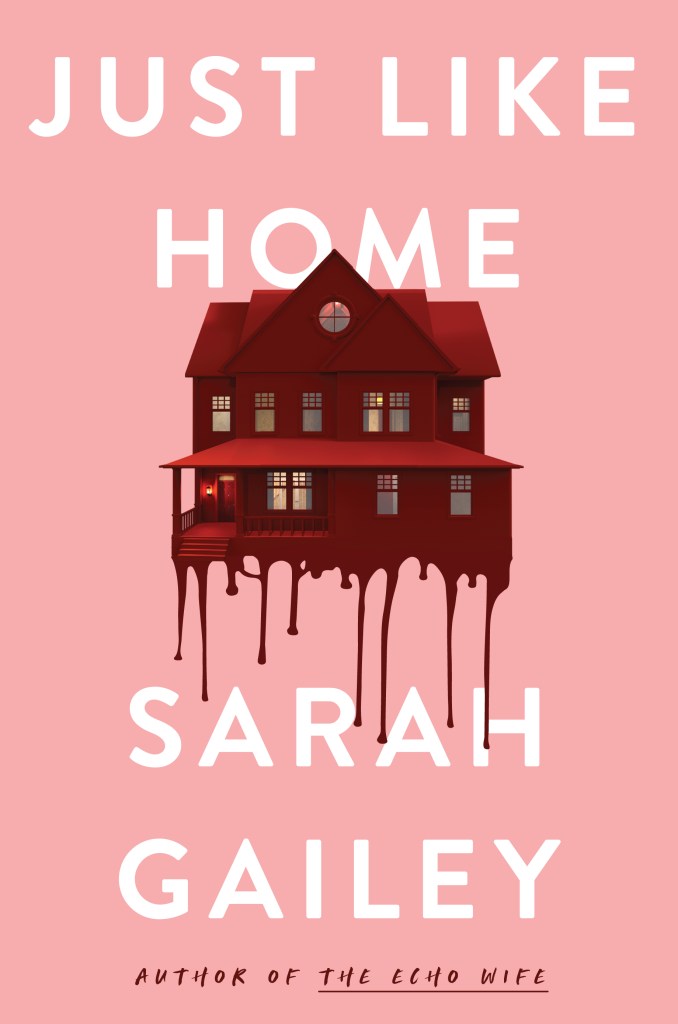
Book: “Just Like Home” by Sarah Gailey

Publishing Info: Tor Books, July 2022

Where Did I Get This Book: I received an eARC from NetGalley.

Where You Can Get This Book: WorldCat | Amazon | Indiebound

Book Description: “Come home.” Vera’s mother called and Vera obeyed. In spite of their long estrangement, in spite of the memories — she’s come back to the home of a serial killer. Back to face the love she had for her father and the bodies he buried there.

Coming home is hard enough for Vera, and to make things worse, she and her mother aren’t alone. A parasitic artist has moved into the guest house out back, and is slowly stripping Vera’s childhood for spare parts. He insists that he isn’t the one leaving notes around the house in her father’s handwriting… but who else could it possibly be? There are secrets yet undiscovered in the foundations of the notorious Crowder House. Vera must face them, and find out for herself just how deep the rot goes.

Review: Thank you NetGalley for providing me with an eARC of this novel!

I’ve heard the name pop up now and then, but I am pretty certain that until I picked up “Just Like Home”, I hadn’t read anything by Sarah Gailey. I’ve been tempted by a couple of their titles like “The Echo Wife”, but I just haven’t made the leap in spite of the fact that they have some buzz around them. But when I read about this newest book, a horror novel involving a woman who is returning to her childhood home, which also happens to be the site that her father committed numerous murders, I decided that it was time to finally jump in. And, to my slight dismay, as I was reading, I wasn’t really getting into it in the way that the description implied I would.

But I will start with the good, as per usual. I will say that Gailey has a very clear vision as to how they want to portray the very real complexities of loving someone who is, without a doubt, a fucking monster. Vera’s childhood relationship with her father, who turned out to be a serial killer who was torturing men in the family home’s basement, is one that was very fulfilling for her as a child. He clearly loved her very much, always made her feel special, and knew exactly how to prop her up when she was down. We know that Vera’s father is a psychopath, and we see the brutal descriptions of his work, as it were. But we also completely understand how Vera has a hard time reconciling that truth with the other seeming truth of how much he loved her. It’s something that always feels sticky, when loved ones of horrible people who cause damage and pain and violence upon others have a hard time unpacking their experience from that reality, and I thought that that aspect of Vera felt pretty spot on, as well as the ways that she has been warped because of it. And yes, there are plenty of really upsetting and unsettling moments not only because of this stark relationship exploration, but also in terms of the horror elements themselves. It’s a VERY weird and unnerving book, and it goes in directions I wasn’t expecting, and a lot of it reminded me of the movie “Frailty”, which is ANOTHER weird and unnerving story.

But that’s the flip side, in a way: it almost got to be too weird. I can’t even really tell you why, exactly, the rest of this story didn’t connect with me, but it just goes to places that I didn’t enjoy as much as I was hoping I would. We take a VERY sharp turn late in the game in terms of reveals and twists, and it just threw me more than anything else. I have to be careful in how I talk about this, as my biggest issue would be considered a pretty big spoiler, but what I will say is this: I understand the symbolism and metaphor that Gailey was going for here, and I think that it could have been achieved if approached a different way. But as it was, it felt like the metaphor got a bit OVERextended, and got to a place that felt clunky and strange and really threw off the rest of the book for me. This very well may just be me, so I encourage people who are interested to give it a go. But it just didn’t land in the way that I had hoped that it would.

This was a solidly mixed bag for me. I think I would give Sarah Gailey another shot (honestly, bring on “The Echo Wife”), but “Just Like Home” wasn’t the home run I was anticipating. But if you like weirdness, as so many people do, definitely give it a go.

Rating 6: Some good creepiness and some interesting moments about loving someone who is a monster, but the weirdness got a little too weird for me.

Reader’s Advisory:

“Just Like Home” is included on the Goodreads lists “Queer Horror”, and “2022 Horror Written by Women and Non-Binary Femmes”.