Serena’s Review: “The Scarlet Circus”

This post may contain affiliate links for books we recommend.  Read the full disclosure here.

Book: “The Scarlet Circus” by Jane Yolen

Publishing Info: Tachyon Publications, February 2023

Where Did I Get this Book: Edelweiss+

Where Can You Get this Book: Amazon | IndieBound | WorldCat

Book Description: “The Scarlet Circus,” the fourth volume in Yolen’s award-winning short fiction series brings you passionate treasures and unexpected transformations. This bewitching assemblage, with an original introduction from Brandon Sanderson, is an ideal read for anyone who appreciates witty, compelling, and classic romantic fantasy.

Review: Jane Yolen is a powerhouse in the fantasy genre. She’s written over 400 novels, short stories, poems, and essays. Beyond that, her work has claimed numerous awards over the many decades she’s been writing, not least of which include a Caldecott Medal and numerous Nebula Awards. Such is the case that she’s one of those authors whose backlist is so intimidating that no matter how many books of hers I read, whenever I pick up a recent one, I’m immediately struck with a sense of guilt for not having gotten to more! So I was happy to see that she was releasing a short story collection this year (with a focus on romance, just in time for Valentine’s Day!), as that seemed like an easy, bite-size re-entry point to an author who deserves much more space on this blog.

This is a short story collection, so there’s really no point in including a summary paragraph. I also won’t be going over every single story in this collection. But I will say right here that I’d struggle to rank these stories or try to include any as “least favorites.” So right here at the top, this is a general recommendation for this collection, and any fans of fantasy short stories should definitely check this one out.

The collection covers a wide swatch of fantasy genres, including fairytale retellings (“Alice in Wonderland”), reimaginings of popular tales (like King Auther and “Romeo and Juliet”), time travel, and even a clever take on the footnotes of an essay that has disappeared after being written in invisible ink. Interspersed with all of these tales, Yolen has included her own poetry. While I do think that her prose is stronger than her poems, these were also nice breaks between the stories, and will likely appeal to those who like a bit more variety in their reading experience.

I did have a few favorites, however. While all of the stories focus on love in one way or another (some with happy endings, other with tragic), I did particularly like one of the later stories in the collection, “The Sea Man,” that focuses more on the love of family. The story follows a sea captain who discover the titular sea man. Though their connection is brief, the story explores the deep understanding of family and love that can cross all boundaries, including ones as simple as language to the more complicated kind that delve into the fantastical.

I also really liked “Dark Seed, Dark Stone,” a story that takes place in ancient Britain, focusing on the Picts and their in-fighting. After the death of her father, the shield of the King, Bridei, a young woman wishes to take upon herself that same role. But, of course, her skills with a spear and shield could never compete with the other warriors. Instead, she earns her place through sheer bravery and the ability to take on a threat in a unique way. Again, the love story is a very small part of this story, but I thought it was an interesting new look into this time period and Bridei himself.

Lastly, I really enjoyed “Dragonfield,” a more straight-forward, action-packed fantasy story. As the title suggests, it follows the tale of a brave young woman, a reluctant hero, and their fight to save their town from a rampaging dragon. While this story wasn’t doing anything particularly shocking, it was the sort of solid, familiar fantasy story that I think most authors work years to complete. And here, Yolen seems to whip it out as if it’s nothing. The simplicity of the story itself instead highlights her vast skills at amusing narration and the creation of interesting and sympathetic characters, even with a very limited format.

As I said, this is a thoroughly enjoyable collection of stories. It’s a must read for all fantasy short story fans, and I think it is an excellent choice if you’re looking for a unique take on a love story this Valentine’s season.

Rating 9: Yolen expertly weaves together a tapestry of romance, with the weft made of magic and the warp made of humanity’s joys and tragedies.

Reader’s Advisory:

“The Scarlet Circus” isn’t on any Goodreads lists yet, but it should be on Best Fantasy Short Story Collections.
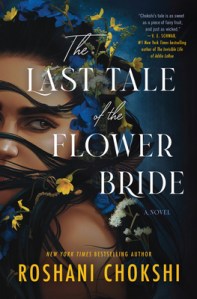
Serena’s Review: “The Last Tale of the Flower Bride”

This post may contain affiliate links for books we recommend.  Read the full disclosure here.

Book: “The Last Tale of the Flower Bride” by Roshani Chokshi

Publishing Info: William Morrow & Company, February 2023

Where Did I Get this Book: Edelweiss+

Where Can You Get this Book: Amazon | IndieBound | WorldCat

Book Description: Once upon a time, a man who believed in fairy tales married a beautiful, mysterious woman named Indigo Maxwell-Casteñada. He was a scholar of myths. She was heiress to a fortune. They exchanged gifts and stories and believed they would live happily ever after–and in exchange for her love, Indigo extracted a promise: that her bridegroom would never pry into her past.

But when Indigo learns that her estranged aunt is dying and the couple is forced to return to her childhood home, the House of Dreams, the bridegroom will soon find himself unable to resist. For within the crumbling manor’s extravagant rooms and musty halls, there lurks the shadow of another girl: Azure, Indigo’s dearest childhood friend who suddenly disappeared. As the house slowly reveals his wife’s secrets, the bridegroom will be forced to choose between reality and fantasy, even if doing so threatens to destroy their marriage . . . or their lives.

Review: Roshani Chokshi is that bewildering kind of author whose work I can sometimes really enjoy, while at other times, I’ll pick up a book from her, DNF it quickly, and swear off her work entirely. Until, that is, the next time she sucks me in with a compelling-looking title (usually within a year of said “swearing off”). That being the case, when I saw that this was going to be the February Adult Fairyloot pick, I knew I wanted to get my hands on a copy early, to know which category it would fall under before deciding whether or not to pause my subscription that month. Well, let me just say now, I will decidedly NOT be pausing this month’s box.

A man and a woman meet. They both love fairytales and myths, so much so that each, to different extents and through different means, have made stories the central part of their lives. Through this bond they fall in love and marry. But, like so many tales, there are secrets hidden within this love story, for the husband has promised never to look into his beautiful bride’s past. So when they are called back to her ancestral home, and he finds himself wandering its mysterious corridors and seeing the leavings of not just the little girl his wife had been when she last lived here, but the tracings of another…he begins to understand the perils of the promise he gave his one true love.

Man, there was a lot to like about this book. At its heart, this is a story about family trauma and the ugly side of love and the belief in fairytales. It’s a story of sisters, though they were born to different families. It’s a story of stories within stories, and how people can use stories as an escape from the ugly reality in which they live. But also how those stories, if fed, can gobble you up if you’re not careful.

The book is broken up into two POVS, the unnamed “Bridgroom” who is telling the modern story and then flashback to Indigo’s childhood, told through the perspective of Azure, her childhood friend who disappeared after graduating highschool. While I did like the Bridegroom’s chapters, particularly the slow reveal about his past and his own missing sibling, his were definitely the weaker chapters of the entire book. We must also mention here that the book is highly marketed as a story about a troubled marriage, centering the tale around the Bridegroom’s discovery of the secrets in his wife’s past. But I don’t think that’s an accurate description of the book at all. As far as actual time goes, the Bridegroom’s arc of discovering his wife has secrets, to breaking his promise not to look into her past, to having to grapple with his new reality all takes place over a very short period of time. This is not a “troubled marriage” book, as the “trouble” is simply the resolution of the primary storyline of this book: the truth of two friends, Indigo and Azure.

And it’s here that the story truly lives and dies, with Indigo and Azure, two childhood friends that grow up in this mysterious and magical house. I was blown away by this tale, particularly the careful handling of many complicated, damaged relationships and how various traumas can weave in and out of one another, creating co-dependencies galore. It was all laid out so carefully, and told in such beautiful language, that it was not only easy to see how Azure was entangled, but it was difficult as a reader not to become equally enamored and ensnared. The darkness reveals itself in layers, like a spider at the center of a web, drawing you closer and closer.

I can’t go in too many details, as I think this is a book best experienced on its own. I will say that there were still moments where Chokshi’s flowery writing jarred me out of the story (mostly with the over-use of similes that I don’t think make any sense). But I’ll also concede that I found her writing to be incredibly elevated here, and I was pleased to see that she didn’t fall into the trap of over-using this sort of flowery language, as I’ve found in the past with her YA work.

Lastly, I’ll note that I did have some confusion trying to place this book within a genre. Was it set completely in this world, where magic is just a myth and the fantastical was an allegory all along? Or were there truly bits of magic at work here? On one hand, I think this question is part of the point of the story, and I appreciate that, and I think it succeeded in that way. But on the other hand, there were a few practicalities that I simply couldn’t wrap my head around. Was I supposed to attribute these disconnects with magic? Or were they legitimate plot holes? I’m not quite sure.

Overall, I was incredibly impressed by this novel. I think it tackled some very challenging themes in a fantastic way, and its main characters, Indigo and Azure, were dynamic, heart-breaking, and nuanced. Fans of gothic fantasy, in particular, are sure to enjoy this book!

Rating 8: With its lush prose and slow-burn sense of foreboding, the reader will be drawn in to a magical world where beauty and pain, love and darkness reside side by side.

Reader’s Advisory:

“The Last Tale of the Flower Bride” can be found on these Goodreads lists: Most Anticipated Adult Fantasy, 2023 and Here comes the………bride.

Serena’s Review: “Arch-Conspirator”

This post may contain affiliate links for books we recommend.  Read the full disclosure here.

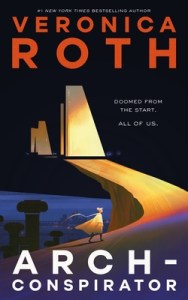
Book: “Arch-Conspirator” by Veronica Roth

Publishing Info: Tor Books, February 2023

Where Did I Get this Book: Edelweiss+

Where Can You Get this Book: Amazon | IndieBound | WorldCat

Book Description: Outside the last city on Earth, the planet is a wasteland. Without the Archive, where the genes of the dead are stored, humanity will end.

Passing into the Archive should be cause for celebration, but Antigone’s parents were murdered, leaving her father’s throne vacant. As her militant uncle Kreon rises to claim it, all Antigone feels is rage. When he welcomes her and her siblings into his mansion, Antigone sees it for what it really is: a gilded cage, where she is a captive as well as a guest.

But her uncle will soon learn that no cage is unbreakable. And neither is he.

Review: Roth has become a must-read author for me recently. The last few books I’ve read from her have all surprised me with their ability to push the boundaries of their genres and leave me thinking about their stories and themes days later. So I was excited when I saw that she was releasing a dystopia/science fiction version of “Antigone,” knowing that whatever I was in for, it was something I wouldn’t want to miss.

The earth is a radiated hellscape, and humanity has been reduced to one, struggling city where just the effort of avoiding extinction takes up the priorities of almost every aspect of society. Antigone’s parents hoped for more, for themselves, for their children, and for their world. But instead they were met with a violent coup, and now Antigone and her siblings have grown up in the household of Kreon, their power-hungry uncle. As she has grown, so, too, has Antigone’s anger. And when her uncle pushes his power past what can be born, Antigone finds herself facing a world that badly needs to be shaken.

Like many others, I read “Antigone” back in high school and really haven’t thought much more about it since. I do remember lots of tragedy and death all around just so one man could learn the lesson of not being a stubborn ass. Or something like that, at least. So I was curious to see how close to the original Roth stuck with this adaptation and how she would reconstruct a classical Greek story into a science fiction dystopia.

And I think the answers are that while she sticks fairly close to the original story, her abilities to write dystopian fiction should never be doubted, because she found very clever ways of adapting this ancient tale within futuristic and creative trappings all while exploring modern themes of power, science, and religion. Most especially, she finds a very unique way of adapting the central premise of the original story (Antigone attempting to perform banned funeral rites for her dead brother and being punished for this) into something that would raise the stakes of the entire situation. Here, these funeral rites hold much more power and import than as simple ritual acts. I don’t want to get into too many details about the world-building, but suffice it to say, it was a very clever interpretation, I thought.

Roth utilizes a multi-POV tactic with telling this story. While we do get more chapters from Antigone’s perspective than anyone else’s, we also see through her brother’s eyes, her sisters, Kreon’s son (with whom Antigone has an arranged marriage), Kreon’s wife, and even Kreon himself. I really enjoyed what all of these perspectives brought to the story. But as much of the tale is focused on the role that women play in this world and the kinds of power that they wield even while their options are so limited, I found Kreon’s wife and Antigone’s sister to have some of the more powerful sections (other than Antigone herself). Given how short this novella is, I was impressed by how well Roth fleshed out these themes in ways that will strike true to readers.

I also liked the way that the science fiction elements were used. There were a few things that left me questioning if I thought too hard about the mechanics of it all, but for the most part, I was so thoroughly invested in the story itself that I didn’t get too bogged down in these details. I also liked that while Roth remained true to the story as a whole, her story ends with both the necessary tragedy but also a sense of hope. I think this hope is necessary to any good dystopian story, and Roth neatly balances it while not loosing the sense of the original story. Fans of dystopian stories as well as retellings of tales that aren’t fairytales will likely enjoy this book.

Rating 8: Full of tragedy and hope, Roth uses the lens of a classic tale to shine a light on the power of women and the individual.

Reader’s Advisory:

“Arch-Conspirator” can be found on these Goodreads lists: Antigones and Can’t Wait Sci-Fi/Fantasy of 2023

Serena’s Review: “The Fiery Crown”

This post may contain affiliate links for books we recommend.  Read the full disclosure here.

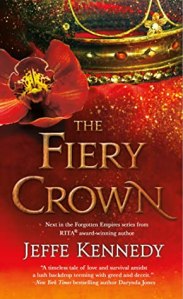
Book: “The Fiery Crown” by Jeffe Kennedy

Publishing Info: St. Martin’s Press, May 2020

Where Did I Get this Book: NetGalley!

Where Can You Get this Book: Amazon | IndieBound | WorldCat

Book Description: Conri and Lia’s marriage of convenience has turned into an uneasy alliance. If only the two leaders could agree on something. Driven by revenge, Conri wants to attack Emperor Anure before the tyrant gets to them first. But Lia needs to keep Calanthe safe, and refuses to sacrifice her kingdom. Their ongoing battle for control has built up tension they’re both more than happy to release in bed, the only place where they find common ground. But Conri and Lia are developing deeper feelings for each other that are complicating matters. In the second book in the Forgotten Empires trilogy, Conri and Lia find their loyalties torn, and with Emperor Anure’s threat growing, will they be able to risk everything with each other before it’s too late?

Previously Reviewed: “The Orchid Throne”

Review: While I was late getting around to it, I really enjoyed “The Orchid Throne.” But I’ll be honest, one of the reasons I finally picked it up was because of the growing guilt from my NetGalley shelf glaring at me with this book, the sequel, continuously sitting there as a request I placed waaaaaay back in 2020 that I still hadn’t read or reviewed. Lucky for me, the first book was good enough that it was quite easy to jump back into this world with only a small reading break between novels.

While Conri has technically “claimed the hand that wears the Orchid Ring” by marrying the queen of Calanthe, Lia, he doesn’t feel any closer to his goal of killing the cruel emperor Anure. Instead, he feels bogged down and trapped on a beautiful island where no one seems to be taking the threat of war seriously. Little does he know that no one takes the threat of war more seriously than Calanthe’s queen, Lia. Calanthe holds secrets, and as Conri begins to learn more about the land he now co-rules and the woman he’s now married to, he begins to see that his own view of the world and its priorities may, in fact, be what was misordered all along.

This story picks up immediately where “The Orchid Throne” leaves off. Meaning, Lia and Conri are still only about a week into their new marriage, and as such, are still very much struggling to understand each other and the shifting dynamics that make up their relationship. I really liked everything we got from these two and this marriage of convenience. For one thing, I appreciated the conversation that was had about the fact that attraction and chemistry, while great, do not on their own make a match made in heaven. Indeed, while Conri and Lia both appreciate the sparks in the bedroom, this compatibility makes it all the more bemusing when they butt heads again and again in other arenas. Particularly, I enjoyed the continued look at how both Conri and Lia approach leadership and their conflicting priorities. We also see how easy it is to misunderstand another person’s motives and motivations, especially when we switch perspectives between the two and see one scene interpreted very differently between them both.

I also liked their individual stories. For Lia, she must grapple with the balance between strength and vulnerability, private and public, and how to navigate ruling a land and planning a way with a man she only halfway trusts. For Conri, we see his ongoing struggles to continue a mission that he had created his entire self of sense around while at the same time grappling with the idea that his approach, to care about nothing but the mission, may not be the strength he thought it was, but instead, a weakness.

I was also surprised by the second act of this book. While the first half is concerned with a lot of this character work that I’ve been describing, the second one really gets going on the action front. The first book was pretty light on this stuff, and I had gone into this one not expecting much conflict until the third and final book in the trilogy. Boy, oh, boy was I wrong! We have battles, we have blood, we have, yes, even death. It was pretty non-stop there at the end, and I enjoyed it all.

I really have very few qualms about this story. I don’t know if it’s doing anything particularly masterful, but then again, why should it? It’s a thoroughly enjoyable fantasy story with two very sympathetic leading characters. This book also set up a lot of pretty big world events that will need to be dealt with in the third book, and I’m very excited to see how this all gets wrapped up. If you enjoyed the first book in this trilogy, this is definitely a solid sequel that’s sure to please.

Rating 8: An intriguing look into the intricacies of a new marriage, where the person you love most can also be the person you least understand.

Reader’s Advisory:

“The Fiery Crown” can be found on this Goodreads list: Upcoming 2020 SFF with female leads or co-leads

Serena’s Review: “Swift the Storm, Fierce the Flame”

This post may contain affiliate links for books we recommend.  Read the full disclosure here.

Book: “Swift the Storm, Fierce the Flame” by Meg Long

Publishing Info: Wednesday Books, January 2024

Where Did I Get this Book: Edelweiss+

Where Can You Get this Book: Amazon | IndieBound | WorldCat

Book Description: After a mission gone awry two years ago, Remy Castell has been desperately searching across worlds to find the friend she failed to save—the friend who changed her life by helping her overcome the brainwashing she was subjected to as a genetically engineered corporate agent.

Since then, she’s been chasing the only lead she has: fellow genopath Kiran Lore, the same secretive ex-squadmate who left her for dead when she compromised that mission. She nearly caught up to him on Tundar before joining the infamous sled race alongside outcast Sena and her wolf companion Iska. Now, all three of them have tracked Kiran back to Maraas, the jungle planet where Remy lost everything. But nothing on Maraas is how it was two years ago. Syndicates and scavvers alike are now trying to overthrow a megalomaniac corpo director, which Remy wants nothing to do with; fighting against corpos is as useless as trying to stay dry in the middle of the giant hellstorm that encircles the planet. But the storm—and the rebellion—are growing stronger by the minute.

When Remy finds Kiran, he doesn’t run away like she expects. Instead, he offers her a deal: help with the revolution and he’ll reunite her with her friend. But can she really trust the boy who betrayed her once before? With the entire planet on the edge of all-out war, Remy will have to decide just how far she’s willing to go to save one girl before the impending storm drowns them all.

Previously Reviewed: “Cold the Night, Fast the Wolves”

Review: I really liked “Cold the Night, Fast the Wolves” when I read it last January. Not only is January the perfect time to hole up inside next to a fire and read about someone else suffering the elements, but who can say no to a book that has a central relationship between a girl and her half-feral wolf? No one, that’s who. That book also introduced us to Remy, a side character who we learn is on the run from the corporation that made her. So I was thrilled when I saw that the author was releasing a companion novel that would focus on Remy’s story.

Remy has been on the run for two years after her ex-squadmate betrayed her and cost her everything she held dear. While running from the corporation that created her, she’s traced her away across the universe to hunt down the man who destroyed the fragile sense of self she had been building. Now, with her friend Sena and Sena’s wolf companion Iska alongside, Remy returns to the planet where it all began. But what she finds is a world transformed from the one she left behind. Still, in the midst of ongoing political and social strife, Remy is hopeful she can finally put her past to rest.

I won’t beat around the bush: I didn’t enjoy this book nearly as much as the first. Which was really too bad. But I can still see the bones of a good book and the strength of the writing that drew me to the first novel. The author is clearly skilled at creating interesting, alternative world environments, complete with their own weather systems, creatures, and societies. This one was just as interesting as the first. Whereas before we explored a brutal tundra world, here we dive into the sticky, hot, humidity of a jungle planet. Even more interesting, the planet is plagued by a massive storm system that circumnavigates the entire world every two weeks or so. This creates a very interesting culture and society where everything in the city is under a constant state of destruction and repair. We also see how this mindset influences who lives where (more protected areas vs less) and what materials they have access to for their construction, affecting how durable the buildings are in any certain community. This was all super interesting, and I really enjoyed everything we got with regards to the world building.

Further, I liked the politics and mystery at the heart of the story with regards to these dynamics. When we get to the motivations of the bad actors, it was all very believable and relatable, touching on some important themes and commentary about class and the environment in our own world. And, while I don’t think it is absolutely necessary to read “Cold the Night, Fast the Wolves” before you read this one, having read that one, I appreciated how the author further fleshed out the role of local syndicates and the interesting balance they strike between their own world’s population and the power of the corporations that essentially rule the universe.

But it all broke down for me with the main character and the love interest. I don’t really think it’s a spoiler to say that said ex-squadmate who “betrayed” her probably has more going on. But if you don’t want more details, suffice it to say that I found Remy’s understanding of this character to be so poor as to be almost laughable. For more details, continue reading!

Basically, this just comes down to a case of telling and not showing. From the beginning, Remy goes on repeated internal rants about her ex-squadmate who was controlling, always putting himself forward and making her look bad on their missions. The problem comes when we are shown flashbacks that make it painfully obvious what is going. Again and again, all we see is a man who clearly loves Remy and is protecting her in every way he can. In one case, he directly takes the blame for something Remy does and ends up in a torture session over it. And somehow…Remy not only doesn’t pick up on these super obvious clues, but spends large chunks of the book telling the reader how bad of a guy Kiran is. And that’s just not a recipe for success. I get having an unreliable narrator. But you have to have a reason for why they’re misleading the reader. And if that reason turns out to be “the protagonist is kind of a dunderhead and oblivious to the point of disbelief” that’s not good look for the protagonist or is incredibly frustrating for the reader.

Unfortunately, some of this obliviousness on Remy’s part showed up in many different ways. Not only is she repeatedly unable to understand how her actions impact others, but she also misreads many other characters’ motivations. It was tough to read, as I thought that Remy’s portrayal in the first book was so solid and interesting. But here, she immediately started to fall into some predictable YA female protagonist stereotypes. And this wasn’t helped by having Sena hanging around through a lot of it, reminding readers of just how likable a main character she was in her book.

Overall, this was kind of a mixed bag for me. My experience of this book really lived and died by my reaction to Remy as a main character. The world-building, writing, and themes were still incredibly strong. I just was too frustrated by Remy through much of it to truly enjoy my read. If you were a fan of the first book, however, I still might recommend a read through here. Your tastes may vary for a main character, and the author still had a lot of good story and commentary to offer with this book.

Rating 7: Excellent world-building and important themes regarding environmentalism and class were undermined by a rather frustrating main character.

Reader’s Advisory:

“Swift the Storm, Fierce the Flame” can be found on this Goodreads list: Upcoming 2023 SFF Books With Female Leads or Co-Leads

A Brief History of Brandon Sanderson and the Introduction of My “Year of Sanderson” Series

This post may contain affiliate links for books we recommend.  Read the full disclosure here.

“Year of Sanderson” is an on-going, monthly series that will post on the last Friday of each month in which I will cover various Brandon Sanderson-related things. This will largely be comprised of book reviews (some from his back catalog and some from the books being released this year), as well as assorted other topics like reviews of the items in the swag boxes that will be coming out as part of Sanderson’s Kickstarted campaign. Frankly, we’ll just have to see what we get from this series, very much like the Kickstarter itself!

General History

(source)

Brandon Sanderson first popped up on the fantasy book scene back in 2003 when he published his first novel “Elantris” through Tor publishing. He went on to write the “Mistborn” trilogy, which is his earliest best known work. From there he continued to pump out books at a prodigious rate, especially as an author who lived up to the stereotype of fantasy writers producing massive, multiple hundreds of pages long tomes. While most of his work has been for adult readers, he’s also ventured into middle grade and YA fantasy as well with series like “Alcatraz Versus the Evil Librarians” (middle grade) and “Steelheart” (YA).

His name likely first became known to general readers outside of the fantasy genre in 2007 when he was selected to complete Robert Jordan’s massively popular “Wheel of Time” series. He wrote the final three novels in this series, which were well-received by fans and cemented his place as a powerhouse in the modern fantasy genre.

He has won numerous awards over the years, including the Hugo Award in 2013 for his novella “The Emperor’s Soul.” His books have also been on the New York Times Best-Seller list 15 times, speaking to the long-lasting popularity of his writing across several series. While “Wheel of Time” has been produced as a streaming show on Amazon Prime, it is still early in its run and nowhere near the seasons that would depict Sanderson’s entries to the series. However, DMG Entertainment has optioned his entire Cosmere universe for potential future projects. Speaking of the Cosmere…

Cosmere

(source)

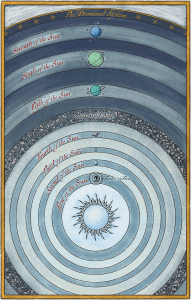
Brandon Sanderon is also known for his unique approach to many of his fantasy books, both stand-alones and series. Like the Marcel Cinematic Universe, Sanderson has created a larger “universe” in which many of his books take place. Currently, none of his books from other series need to be read before jumping into a different, unconnected book or series, but there are many Easter Eggs left for the devoted fan who has read much of his work. Particularly, there are a few sort of “god level” characters who world-jump and will appear in multiple different books and series.

Sanderson is also well known for creating detailed and interesting magic systems. While all of the magic systems presented in his many fantasy novels are unique to themselves, books that take place within the Cosmere do feature systems that seem to operate on similar principles and are organized in similar fashions. Beyond this, Sanderson has mentioned that all worlds within the Cosmere feature the same creation myth.

The books that currently make up the Cosmere are “Elantris,” “Mistborn,” “Warbreaker,” “The Stormlight Archive,” “White Sand,” and anything from “Arcanum Unbounded.” While books like “Elantris” and “Warbreaker” are currently standalones (there is a “Warbreaker” sequel in the works), “Mistborn” and “The Stormlight Archive” are each long works that add hundreds upon thousands of pages to the ever-growing Cosmere. “The Stormlight Archives” is Sanderson’s current signature epic fantasy, comprised of four massive books (the most recent book, “Rhythm of War,” topped out at 1232 pages.)

Kickstarter Campaign

Back in the spring of 2022, Brandon Sanderson surprised fans by starting up a Kickstarter campaign. Per the usual for the fast-writing author, while other authors expressed struggles with writers block during the Covid pandemic, Sanderson managed to whip together four entirely new novels, and it was these four novels that comprised the heart of the campaign. However, the author didn’t stop there. While the four books would ship out on a quarterly basis starting in January of 2023, funders could also back the project further to receive monthly swag boxes over the entire 12 month period of 2023.

While this particular type of campaign (swag boxes, etc.) was a first for Sanderson, the author already had a foot firmly in the self-publishing field. Indeed, Sanderson already had his own publishing company, Dragonsteel Entertainment; previous to the Kickstarter, Dragonsteel was largely used to publish collector versions of Sanderson’s previously published works.

When the Kickstarter first went up, Sanderson’s goal was to hit $1 million, the amount estimated to produce and distribute the four books he wrote during the pandemic. He ended up breaking all of the records, ultimately topping out at $41 million dollars. According to an article by USA Today, “The campaign is the biggest project in Kickstarter history by pledge volume and is more than double the previous record holder. It also set a record for both the most money raised in the first 24 hours ($15.4 million) as well as the most funding and backers for the same time period.” Sanderson went on to pay it forward, donating to almost every other Kickstarter with a publishing focus that was currently running while his own was live.

My Fandom

I’ve been a fan of Brandon Sanderson almost from the beginning. While I didn’t catch “Elantris” when it was first published, I read the original “Mistborn” trilogy as it released. I’ve read almost everything else by the author to date (though I haven’ read all of his middle grade or YA fantasy). I own copies of most of his books, including said massive “Stormlight Archives” tomes, and even a few of the leather bound collector versions that were produced by Dragonsteel Entertainment. To this day, I point my husband in this direction if he’s looking for a last minute gift idea for me.

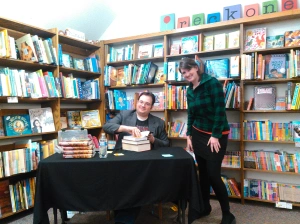
I got to meet Sanderson at an author event at the St. Paul children’s bookstore, “The Red Balloon.” It is a small space, but it was absolutely jam packed for this event, and for good reason. When listening to him speak, it’s impossible not to catch the infectious joy that he has not only for reading and writing, but for fantasy and fandom as well. After seeing that level of energy on display, it’s less difficult to understand his rate of publication.

When I saw that Sanderson had a Kickstarter up and running, I knew that I would have to join. I dithered for about a day over the kind of insane price of going the “swag box” route, but in the end, I decided “hey, what are credit card points for if not off-setting the ridiculous price of things you’d never ordinarily buy??” As I don’t know exactly what is coming in these swag boxes or much about the four books either (there are details out there for the books, but I’d rather just be surprised), I can’t say exactly what this post series will contain over the next year. Instead, it will be a fun surprise for us all! I hope you enjoy the ride with me!

Sources

Brandon Sanderon Website

Stormlight Archive

Kickstarter Campaign

Brandon Sanderson YouTube Channel

Tor.com

USA Today article about the Kickstarter campaign

Serena’s Review: “Queen Among the Dead”

This post may contain affiliate links for books we recommend.  Read the full disclosure here.

Book: “Queen Among the Dead” by Lesley Livingston

Publishing Info: Zando Young Readers, January 2023

Where Did I Get this Book: Edelweiss+

Where Can You Get this Book: Amazon | IndieBound | WorldCat

Book Description: In the kingdom of Eire, banshees chill the air, and water-wights lurk in the rivers. But magic is outlawed by the king, and jealously hoarded by his Druid priests.

Neve is the youngest daughter of the king, and Ronan is a Druid’s apprentice-turned-thief, making a living by selling stolen spells. They should be enemies, but their shared hatred of the Druids-and a dark magic that has marked them both-makes them unlikely, if uneasy, allies.

When Eire is threatened by a power struggle, Neve must seize the chance to take her rightful place on her family’s throne, with the help of Ronan and the realm’s most dangerous outcasts. Their journey takes them to the outskirts of Eire where magic still runs free . . . and where an outlaw and a warrior princess might carve out a future with spells and swords.

Review: Anyone who is familiar with this blog knows that I am a huge Juliet Marillier fan. I mean, I devoted an entire years-long running series to re-reading all of her books and reviewing them here. So it will come as no surprise that all it would take for me to request a book might be the barest hint of a book sounds similar to Marillier’s work. And such was the case here!

Long ago, Neve, the younger daughter of the king of Eire, met a strange boy and they fought a powerful and dangerous demon, only barely escaping with their lives. Through this experience, both have now grown to distrust the powerful Druid order that both outlawed magic but also hoarded it to themselves. When they meet again as adults, seeming enemies in the grand scheme of their society, they find that this similar distrust and their own hopes for their country tie them more closely together than they ever could have imagined. And when a powerful darkness begins to seep across the land, they find that, together, they possess a rare and powerful magic that is just what is needed to re-shape the future.

There was a lot to like about this book right from the very start. For one thing, it was apparent that the writing was excellent from the first page. It perfectly fit the tone of a historical fantasy story, being both lyrical but also clear enough to depict a world and culture that has one foot in the world we’re familiar with, but another foot clearly placed in a realm of magic and mystery. It’s a difficult balance, to capture both the historical tone and the whimsical. I also really liked the dialogue. Especially when we first see Neve and Ronan interacting as adults. It was funny and yet still felt natural to the characters, again balancing modern sensibilities of humor alongside a sort of pseudo-historical vocabulary.

Ronan and Neve were also very interesting characters in their own right. I enjoyed the duel mysteries regarding their different natures. It’s one thing to pull off one character with a “strange past,” but quite another to do it with both of your protagonists without one of them dropping in quality. I think I particularly liked Neve, however, if I had to choose between the two. Her character had to work through some very interesting family dynamics (even a few that came in the form of a nice twist towards the end), while also grappling with the restrictions on women and the unique history of Eire that lead to some of these restrictions. Ronan’s story is much more straight-forward in this regard, but still very enjoyable.

I will say, however, that the story stumbled when it came to their relationship. I saw this book billed as an “enemies to lovers” romance, and I just don’t think it really fits into that. I was never able to really identify the “enemies” portion of it, rather than a few brief instances where they each decide not to trust the other. Frankly, the primary emotion this relationship inspired was frustration. The characters made fairly random decisions to suddenly not trust one another, but then the very first second this decision would be tested, they’d be right back to working together and having all the feelings. Not only did the wishy-washy-ness feel unrealistic, but it didn’t serve any purpose to the story other than forced conflict (and like I said, even there, there wasn’t any real conflict, just talk of potential conflict that was immediately dismissed in reality).

Overall, while I think the story did have a weak romance and a bit of a pacing problem (there was a decent amount of the middle of the book that felt like it was dragging), I still came away feeling like this was a pretty solid historical fantasy. The mythology, in particular, was very interesting, and I do think it will appeal to readers who like books like those produced by Marilliar or other historical fantasy authors.

Rating 8: A bit rocky in the pacing and romance departments, but saved by its solid writing and interesting mythological history.

Reader’s Advisory:

“Queen Among the Dead” can be found on this Goodreads list: Ancient History Historical Fiction Published in 2023

Serena’s Review: “Things Not Seen”

This post may contain affiliate links for books we recommend.  Read the full disclosure here.

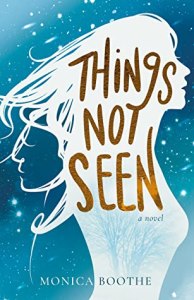
Book: “Things Not Seen” by Monica Boothe

Publishing Info: Peniel Press, January 2023

Where Did I Get this Book: from the author!

Where Can You Get this Book: Amazon | IndieBound | WorldCat

Book Description: 17-year-old Kristin has selective blindness. She can’t see, hear, feel, or smell, her brother. This doesn’t stop them from becoming best friends, turning his unique invisibility into a game, but when the two of them are stranded alone during a blizzard, it doesn’t feel like a game anymore. Kristin will do everything she can to keep her little brother alive, but she’s the least qualified person in the world to do so.

Review: I always enjoy supporting lesser known authors when I get the chance. And after Boothe send me an excerpt to this book, I knew I wanted to check out the entire thing. The concept alone sounds very unique, and it was clear from even the first few chapters that the author had a solid foundation for her main character and the relationship she has to her invisible brother that forms the basis for this story. Add in a snow storm, and you have a primed set! Let’s dive in.

Kristin knows she has a younger brother. She just can’t see, hear, or feel him. But everyone else can, so she has had to find unique ways to connect and exist with this invisible sibling. Through these extra hurdles, however, the two have formed a particularly close relationship largely managed through texts and the small context clues that Kristin uses to locate her brother out and about in the world. But when a snow storm strikes while Kristin and Josh are home alone, an entire new set of circumstances highlights the challenges of their unique relationship.

I really enjoyed this YA novel. As I’ve mentioned before, I really like books that focus on sibling relationships, as I think there are a lot of interesting dynamics to be mined there. Here, we see two very close siblings, but their relationship is largely defined by the challenges of Kristin not being able to see, here or feel Josh. As the story is told from her perspective, we see how this loss has shaped her every thought and action. Everyone else around her can see Josh, and it is decided that she as what is called “selective blindness” where he is concerned. The book wisely doesn’t get too far into the weeds on this condition, but instead uses it mostly as a platform for the plot and the character work.

For Kristin’s part, we see how this condition has lead her to increased levels of anxiety about the dangers she could pose to her brother. But equally, we see how defined her life has become by this relationship, especially considering the extra work that has been necessary to create and maintain their connection. As she faces decisions about college, these anxieties and changes to how she must order and center her new life would be very relatable to many teen readers, regardless of the fantastical circumstances of the invisible brother.

I also really liked that we got to understand a bit more about how this relationship has affected Josh. For him, it is largely like having a deaf and blind sister. But as the story is told from Kristin’s POV, these realizations, that her condition affects Josh just as much as it does her, are slow to come and hard won.

As I’ve just spent two paragraphs talking about the characters and their relationships, I think it will come as no surprise when I say that the strength of this story really comes down to how well-drawn these characters are. Kristin’s voice is very approachable and relatable. And I fully drawn in to the complexities and turmoil of this sibling dynamic. It all felt very real and natural (or as much as it can with an invisible character at play!).

When it came down to some of the more factual bits of the story, I struggled a bit more. I grew up in northern Idaho and currently live in Minnesota. So I’m very familiar with blizzards and large quantities of snow. A central portion of this story is defined by Kristin and Josh trying to deal with a blizzard and a power outage. And…I just really struggled with some of the details here. Blowing snow, yes, can make visuals difficult and reduce sight lines. But unless you’re in a completely new location, this isn’t going to have much of an affect on travelling short distances. In this book, Kristin is walking (not even driving at any kind of speed where visibility needs to be far reaching) outside her family home. I just couldn’t buy the fact that she would get this disoriented or lost. We are also told at one point the specific amount on the ground (I believe it was around 8 inches or so) and this is just not much at all, in the grand scheme of things. But, again, this probably only stood out to me so much due to my own very specific experiences with snow (let me tell you later about having to snowmobile 3 miles to our house all winter) and also my, admittedly annoying, over-fixation on accuracy in survival situations (re: all the my past reviews of survival stories where I go crazy over the stupidest little details or inaccuracies).

Overall, I think this was a very strong book about the joys and challenges of sibling relationships. I was really impressed by the way the author had thought out the ins and outs of her central premise, that one sibling can’t see/feel/hear the other. Kristin was also a very relatable teenage character, and I think she will speak to a lot of teenage readers. Yes, I struggled with the snow storm stuff. But I still came away from it having really enjoyed my read.

And don’t forget to enter to a win a copy of this book!

Rating 8: An intimate and relatable portrayal of sibling relationships with a a compelling and sympathetic teenage protagonist.

Reader’s Advisory:

“Things Not Seen” isn’t on any Goodreads lists yet, but it should be onYA Contemporary Books with Great Portrayals of Relationships.

Giveaway: “Things Not Seen”

This post may contain affiliate links for books we recommend.  Read the full disclosure here.

Book: “Things Not Seen” by Monica Boothe

Publishing Info: Peniel Press, January 2023

Where Can You Get this Book: Amazon | IndieBound | WorldCat

Book Description: 17-year-old Kristin has selective blindness. She can’t see, hear, feel, or smell, her brother. This doesn’t stop them from becoming best friends, turning his unique invisibility into a game, but when the two of them are stranded alone during a blizzard, it doesn’t feel like a game anymore. Kristin will do everything she can to keep her little brother alive, but she’s the least qualified person in the world to do so.

Giveaway Details: Monica Boothe reached out to me about reviewing her upcoming book “Things Not Seen” a few months ago. After reading the excerpt, I was very excited to check out the entire novel! The voice of the teenage protagonist, Kristin, was immediately catchy and relatable. Add that to a very interesting concept, that of a sibling relationship where the sister has never been able to see/hear/feel her brother, and you have yourself a very compelling novel! Per the usual, my full review (spoiler: I really liked it!) will go live this Friday. Until then, don’t forget to enter to win a copy of “Things Not Seen!” The giveaway is open to U.S. residents only and runs through January 24, 2023.

Enter to win!

Diving Into Sub-Genres: Portal Fantasy

This post may contain affiliate links for books we recommend.  Read the full disclosure here.

We each have our own preferred genres of choice. Kate loves horrors and thrillers, really anything that will keep her up at night! And Serena enjoys escaping through hidden doors into realms of magic and adventure. We also read mysteries, historical fiction, graphic novels, etc. etc. And that’s not even counting the multitude of sub-genres contained within each greater genre. In this series, one of us will present a list of our favorites from within a given sub-genre of one of our greater preferred genres.

Portal family is probably the largest and most popular sub-genre in fantasy fiction. I know that second part is a pretty hefty claim, but even among the most picky of fantasy readers, those who hardly ever read the genre as a whole, there’s a decent chance they hold a special place for some portal fantasy novel or another. It’s unavoidable when some of the biggest titles in fantasy fiction fall under this subgenre; even more so when many of those titles (“Harry Potter,” “The Wizard of Oz”) are also children’s and middle grade fiction, works that many readers will enjoy as kids even if they go on as adults to read very little in the fantasy genre as a whole.

Portal fantasy is also a wide, sprawling sub-genre on its own. It’s definition is simple: it’s a story that involves characters travelling through a “portal” (wardrobe/train platform/tornado/etc.) from our real world into some magical, fantasy realm. Already you can see the huge potential and likely list off a good number of titles that would fall under this category. What’s more, a broad interpretation of this subgenre would just be characters travelling from world to world, none of which need include our real world. For example, the “His Dark Materials” trilogy utilizes both of these options. We have characters travelling from our world to new worlds, like Will in the second book, “The Subtle Knife.” But there are also several characters, like Lord Asriel, who never travel to “our world” at all, but only between different, unique worlds.

The definition of “portal” can also vary. Some would say there needs to be an actual passage way from one distinct world to another unique world; others would count the Daevabad trilogy as a portal fantasy, simply due to the hidden nature of the city itself, unseen and inaccessible by humanity. Portal fantasy is also one of the oldest subgenres of fantasy. Some of Shakespeare’s plays would likely count (“A Midsummer Night’s Dream”) and, of course, there is Mark Twain’s “A Connecticut Yankee in King Arthur’s Court.” Between all of these definitions, and the fact that portal fantasy is a popular subgenre in fantasy fiction for all ages (probably the most popular by far in children’s fantasy), there are a million options to choose from, but here are a few that I particularly enjoy and I think represent the subgenre well.

“The Chronicles of Narnia” by C. S. Lewis

This is probably one of the first books/series that comes to most people’s minds when they think of “portal fantasy.” Not only is it a supremely popular children’s series, but the portal itself holds much of its appeal simply by how ubiquitous it is: what child hasn’t crawled into a closet or wardrobe and wished there was a door way to another world to be found at the end? The titular wardrobe in the first book, “The Lion, the Witch, and the Wardrobe” is the most well-known of the portals found in this story. But if you continue reading, you’ll also find children swept away through a painting and simply by the winds felt on a cliffside.

“Wayward Children” series by Seanan McGuire

Seanan McGuire has created a series that not only features portal fantasies as the primary premise of all of her books, but each book does a deep dive into the types of people who walk through these magical doors. The types of people who look for them, and those who don’t. And she paints a world that holds so many doorways to so many unique worlds that she’s even made a sort of flowchart to diagram the sorts of worlds her characters may come from and travel to. Where does each world fall on a scale of chaos or order? Good or evil? These novellas are all incredibly unique and highlight a lot of the appeal that the portal fantasy subgenre holds for the many readers who enjoy it and wish they, too, could find their door to another world.

“The Fionavar Tapestry” series by Guy Gavriel Kay

This is one of the first adult portal fantasy series that I remember reading as a teenager. Up to that point, for me, portal fantasy was something found in children’s and young adult fiction, but not so much in the stuffy works that made up adult fantasy. The story follows five men and women who find themselves pulled into a fantasy world where they each have important roles to play. And this is definitely adult portal fantasy all around, as Kay dives into some pretty dark themes throughout the series. I remember really enjoying it, but also being rather shocked as a teenage reader by certain scenes. It’s one of those fantasy series that has stuck with me throughout the years, but also one that I need to return to soon as I haven’t ever re-read it.

“The Invisible Library” by Genevieve Cogman

This eight book long series wrapped up recently, back in 2021 and was massively popular during its run. It’s a fairly standard portal fantasy, with its main character, Irene, travelling from realm to realm in her work for a Library that collects fiction from these various worlds. Throughout the series she gathers a group of friends around her and encounters all sorts of wild worlds, including time travel. These are really lovely books, all the more appealing for featuring a heroic librarian as their heroine!

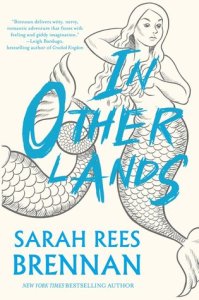
“In Other Lands” by Sarah Rees Brennan

This is another fairly straight-forward portal fantasy, but its quirky take on not only the the magical world and the beings that populate it but on its protagonist make it stand out as a great, modern story. The word “deconstruction” has been used when describing this book’s take on its central trope, but it does so in an interesting and hilarious way, rather than the usual, more pretentious sort of deconstruction. The hero is also a young teenage boy who is just as snotty and irreverent as you’d expect from a boy of that age. And yet you can’t help rooting for him anyway!

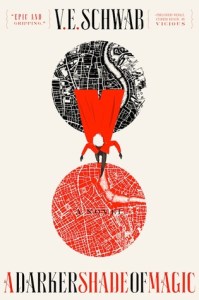
“Shades of Magic” trilogy by V.E. Schwab

Lastly, I’m including one of my favorite portal fantasies of all time. This is also a nice mixture of the two definitions of portal fantasy in that one of our main characters travels in the traditional direction (from our world and into a magical one), but our other main character is from the magical world and travels not only to our world, but also to other, unique worlds beyond. This trilogy not only has unique worlds (varying Londons each with different levels of magic), but I really enjoyed the way the magic system and travel between these works worked. Fans of portal fantasies should definitely check this trilogy out if you haven’t already!

What portal fantasy books are your favorites? Let us know in the comments!