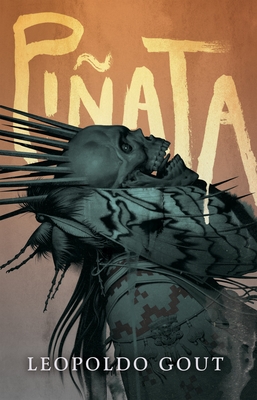
Book Description: A Head Full of Ghosts meets Hereditary in Piñata, a terrifying possession tale by author and artist Leopoldo Gout.
Carmen Sanchez is back in her home country of Mexico, overseeing the renovation of an ancient cathedral into a boutique hotel. Her teen daughters, Izel and Luna, are with her for the summer, and left to fill their afternoons unsupervised in a foreign city.
The locals treat the Sanchez women like outsiders, while Carmen’s contractors openly defy and sabotage her work. After a disastrous accident at the construction site nearly injures Luna, Carmen’s had enough. They’re leaving.
Back in New York, Luna begins acting strange, and only Izel notices the chilling changes happening to her younger sister. But it might be too late for the Sanchez family to escape what’s been awakened…
Piñata is a bone-chilling story about how the sinister repercussions of our past can return to haunt us.
Review: Thank you to NetGalley for providing me with an eARC of this novel!
I love it when a horror novel really gets under my skin. The kind that I can’t really shake while I’m reading it, and the kind that just sits on my consciousness when I’m doing other things or when I have finished it. When I saw “Piñata” by Leopoldo Gout on my various timelines and Goodreads feeds, I decided to request it because it sounded fairly promising. Sure, it was a possession story, which tend to be hit or miss for me, but I do love a good social commentary in my horror, and this one sounded like it had some good potential for thoughtful take downs of colonialism. So I started it, thinking it would be interesting at least. And almost immediately after starting this book, I was deeply, deeply unsettled, and knew I wasn’t going to shake this one for awhile. And it’s not even the supernatural beings in this that did that to me.
For someone who doesn’t usually gel with possession stories, “Piñata” is one of those stories that absolutely works for me because it makes it feel unique, or at least turns it a bit on its head. I really liked following Carmen and her daughters Izel and Luna as they spend time in Mexico, and I loved seeing the slowly building unease as Luna starts to behave strangely after an accident at the Church site on a restoration project that Carmen was working on. From Luna not quite acting right, to weird hallucinations of butterflies and a strange old woman, to ghastly imagery of rage filled demons that torment Carmen and those around her, Gout really knows how to create a visceral horror moment. I also loved the subversion of the more traditional Western possession stories and how it incorporates pre-Columbian folklore and mythology, as it feels less about the Christian idea of demons and more about otherworldly beings with a score to settle.
I’m still very much into reading horror novels that take on greater social themes, and “Piñata” may be one of the more harrowing and upsetting ones that I’ve read. The theme here is that of colonialism, and the way that Indigenous people in Mexico (and the greater Americas) were victimized, abused, and destroyed by Western invaders, and in this book it is specifically the Spanish and the Catholic Church. The prologue alone had me floored and shaking with abject horror and rage, as it really sets up the story of angry spirits in a Mexican church that find themselves awakened and hellbent on revenge. Gout doesn’t shy away from the atrocities that the Spanish and the Church perpetuated against Indigenous groups, and it makes for unrelenting horrors as we see the long lasting effects of the colonizers, not just through a possessed child but also through violence in Mexico, dangerous situations at the border, and racism and colorism. It’s upsetting and it should be upsetting.
The one thing that took me out of this book, however, was the uneven pacing of it. I love a slow burn and slow build in my horror, especially when the slow burn knows how to tap into anxiety and to ratchet up the tension until it is practically at the breaking point. I liked the way that Gout carefully builds up the tension regarding Luna’s possession as well as the visions that our characters are seeing. The problem is that when it all comes to a head, and a LOT has to come to a head, a great majority of it happens practically in the last fourth of the book. And it feels like a lot of whiplash as all the action starts to barrel forth and almost in an out of control way. It then leads to a wrap up climax that almost felt too quick on top of all the REALLY fast things leading up to it. It doesn’t ruin the story by any means, it just makes it feel disjointed.
Uneven pacing aside, I thought that “Piñata” was a disturbing read with a lot of really good themes about colonization and the damage it has done and continues to do. Gout just devastated me out the gate and found the horrors within history and applied it to a modern story, and I really enjoyed it.
Rating 9: So many intense moments and such great commentary about the destruction that Colonialism brought to the Americas. While there are some pacing issues, overall “Piñata” is scary and mesmerizing.
We are part of a group of librarian friends who have had an ongoing book club running for the last several years. Each “season” (we’re nerds) we pick a theme and each of us chooses a book within that theme for us all to read. Our current theme is retellings and re-imaginings.For this blog, we will post a joint review of each book we read for book club. We’ll also post the next book coming up in book club. So feel free to read along with us or use our book selections and questions in your own book club!
Book: “The Witch’s Heart” by Genevieve Gornichec
Publishing Info: Ace Books, February 2021
Where Did We Get This Book: The library!
Where You Can Get This Book: WorldCat | Amazon | Indiebound
Retelling/Re-imagining: Norse Mythology
Book Description: Angrboda’s story begins where most witches’ tales end: with a burning. A punishment from Odin for refusing to provide him with knowledge of the future, the fire leaves Angrboda injured and powerless, and she flees into the farthest reaches of a remote forest. There she is found by a man who reveals himself to be Loki, and her initial distrust of him transforms into a deep and abiding love.
Their union produces three unusual children, each with a secret destiny, who Angrboda is keen to raise at the edge of the world, safely hidden from Odin’s all-seeing eye. But as Angrboda slowly recovers her prophetic powers, she learns that her blissful life—and possibly all of existence—is in danger.
With help from the fierce huntress Skadi, with whom she shares a growing bond, Angrboda must choose whether she’ll accept the fate that she’s foreseen for her beloved family…or rise to remake their future. From the most ancient of tales this novel forges a story of love, loss, and hope for the modern age.
Kate’s Thoughts
While I have a pretty extensive knowledge of Greek Mythology thanks to an obsession with it in grade school, Norse Mythology is pretty outside of my wheelhouse. I know some of the basic things, and have a general working knowledge of the various Gods and the whole concept of Ragnorak, but it’s sparse when compared to other people I’d imagine. So I was going into “The Witch’s Heart” without much idea of what to expect when it came to our protagonist Angrboda, the witch who eventually gave birth to Loki’s monster children who help usher in the apocalypse myth. But that just made me game to give it a shot, especially since it was getting the “Circe” treatment and retelling a story with a character who doesn’t have as much to do in the original myths. And for the most part, I enjoyed “The Witch’s Heart”, but that may be because I had few expetations.
For one thing, I really liked the emotional exploration of Angrboda as a woman used by powerful men, as well as the emotional exploration of her as a mother to her children, as atypical as they may be. And by atypical I mean a half corpse daughter, a wolf, and a serpent. But I really got a sense of her love for all of them and the way that she was desperate to protect them, while also falling for Loki no matter how dysfunctional that relationship was. The way she was written to me made me believe it, even though sometimes I wanted to shake her and be like ‘SERIOUSLY, THIS GUY?’ (so does her huntress friend Skadi, a character that I also found intriguing though I think I needed more of her. Also, damn you Tom Hiddleston for making Loki so damn likable, because this version, while more true to the myth, was a punk). The relatable emotional bits were what really kept me engaged, as I was deeply invested in her relationship with her kids event though I did know that it would all end in tears because of the myths they are based upon. That being said, I also thought that there were bits where it kind of dragged after abrupt tone shifts that didn’t work as well for me. I was far more interested in her being a mother in the forest as opposed to the end of world action that was inevitably going to take place.
Ultimately I was entertained by “The Witch’s Heart”. I’m still into these outside the box retellings of mythological women, and would love to see more that push beyond the obvious Greek stories, so that made this one all the more enjoyable.
Serena’s Thoughts
I’m fairly familiar with Norse mythology. Not an expert, by any means, but I already knew the story being retold here fairly well, as well as the major players involved. That was both a plus and a minus as far as my reading experience goes. Like Kate, I’m really enjoying this current surge of books being published that reimagine or create stories for lesser known characters, often women, from mythology. I also really like the fact that we are venturing beyond the much more popular Greek pantheon.
Angrboda was almost a perfect character for this sort of retelling. She doesn’t have much as far as the original lore, so there was a lot of room to portray her story. And somehow I think the author both did too much and too little. On one hand, the story was very faithful to the major plot points of the Norse story from which it is derived. But almost too much? I would have liked a few more creative interpretations brought in. Also, like Kate said, I think Angrboda’s character was given some interesting themes to cover, especially with regards to her relationship to her children and to her unhealthy relationship with her husband, Loki. But on the other hand, I felt like she was a bit more passive of a character than I would have expected or hoped for from a woman who has birthed literal monsters!
I also agree with Kate that the pacing of this book felt a bit off. The first half is fairly slow with a lot of time spent with Angrboda hanging out in a cave in the woods. The storytelling was also interrupted by lots of banter from Loki. Which, on one hand, I liked a lot of the dialogue, but I also felt like there were times where the author got rather self-indulgent with it. And then there’s a massive tonal shift in the second half where we’re fulling into the world-shifting dramatics.
Overall, I felt like this book was a bit all over the place. Are my expectations unreasonably high from “Circe?” Probably. But was this the best that could have been done with this story or these characters? I don’t think so.
Kate’s Rating 7: A retelling of a source material I have not so much knowledge of that kept my attention and had some emotional moments, though also some dragging ones.
Serena’s Rating 7: A bit uneven in pacing as well as characterization, but something that will likely appeal to readers who are looking for a different pantheon to explore in their mythological retellings.
Book Club Questions
How familiar are you with Norse Mythology? Could you predict how things were going to go based how much you knew about it?
What did you think of Angrboda as a protagonist? What did you like or dislike about her?
What did you think about Angrboda’s relationships in this story, whether it was Loki, Skadi, or her children?
Did you have any thoughts on how Loki was presented and interpreted in this novel?
There have been a lot of marketing comparisons between this book and Madeline Miller’s “Circe”. What did you think of this marketing choice?
The parts of this book were separated out in very deliberate chunks of time and very deliberate themes. Did you have a part you liked the best?
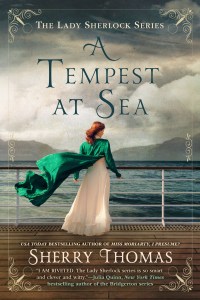
Book Description: After feigning her own death in Cornwall to escape from Moriarty’s perilous attention, Charlotte Holmes goes into hiding. But then she receives a tempting offer: Find a dossier the crown is desperately seeking to recover, and she might be able to go back to a normal life.
Her search leads her aboard the RMS Provence, sailing from Southampton for the eastern hemisphere. But on the night Charlotte makes her move to retrieve the dossier, in the midst of a terrifying storm in the Bay of Biscay, a brutal murder also takes place on the ship.
Instead of solving the crime, as she is accustomed to doing, Charlotte must take care not to be embroiled in this investigation, lest it become known to those who harbor ill intentions that Sherlock Holmes is abroad and still very much alive.
Review: I’m always so excited when I see another book coming out in Sherry Thomas’s “Charlotte Holmes” series. While I’ve had favorites throughout the series so far, I’ve never disliked any books in this series. They’ve all been smart, and Charlotte Holmes always comes through with the insightful goods. But I was especially looking forward to this book given the way the previous one ended with Charlotte faking her own death to escape Moriarty. Where would this next book go if Charlotte has to be in hiding?
Life in hiding is not the life for her, Charlotte Holmes as quickly decided. So when she’s offered protection from Moriarty if she helps locate a missing piece of information, she jumps at the opportunity. Soon enough, her mission finds her book passage on a ship alongside several friends and foes alike. What seems like a simple enough mission to search a few cabins and locate the dossier quickly becomes overshadowed when a murder takes place on the ship. Now the investigation into the murder could expose Charlotte to the minions of Moriarty unless she can solve the case first.
I always really enjoy closed circle mysteries, that is, those where a murder takes place and all of the suspects are contained within a location that they cannot leave. Not only does it quickly reduce the number of suspects to a small-ish number, but these types of mysteries often involve a lot of complicated relationships between all of these characters as well as the victim. So this book, with its setting of a small, luxury ship is a perfect example of this sort of mystery and Thomas takes full advantage.
I also really liked that this book contains a mystery within a mystery. It starts with what should be a straight-forward search for a missing dossier. But that quickly gets subsumed by the murder mystery that threatens to ruin all of Charlotte and co.’s good work and expose Charlotte to the eyes of the Moriarty minion they are sure is tracing their footsteps. Both mysteries were incredibly clever on their own, but the way that they wove in and out of one another was truly impressive. Because so many people are working different angles with their own very distinct agendas, it’s a constant puzzle trying to piece together who knows what and whose team (or any team!) they are on.
This book also adds an interesting layer by jumping back and forth in time from the ongoing investigation to events that transpired during the night of the murder itself. This tactic worked so well! There were only three or so of these jumps back to the past, but each one, in only a small number of pages, manages to take the entire mystery so far and then turn it at a new angle, making everything suddenly look different with new suspects all around. It was very effective and always added an extra little zing of interest to the story.
I also really liked the small bits that we got from Charlotte and Lord Ingram. Their relationship has always been solidly a second tier plotline to the main mystery, which I think is probably for the best given the complexity of the murder mysteries and the types of characters that Charlotte and Lord Ingram are. However, while we still don’t get a lot of time with them here, there were some very sweet moments between the two. Slowly, slowly, we see this relationship continue to develop as both Charlotte and Lord Ingram grow into this new romance and must grapple with their own emotions.
I really enjoyed this latest installment in this series. I thought all of the side characters were excellent, with a good mixture of “villains” that were fun to hate on and new sympathetic characters you wanted to root for. On top of that, there was a good balance of important moments for our regular cast of characters. This is a solid entry all around, and I think fans of the series will likely be pleased.
Rating: Thomas takes the closed-circle mystery concept and brings in Charlotte Holmes to crack the case wide open!
Book Description: At the turn of England’s century, as the wind whistles in the lonely halls of Rawblood, young Iris Villarca is the last of her family’s line. They are haunted, through the generations, by “her,” a curse passed down through ancient blood that marks each Villarca for certain heartbreak, and death.
Iris forsakes her promise to her father, to remain alone, safe from the world. She dares to fall in love, and the consequences of her choice are immediate and terrifying. As the world falls apart around her, she must take a final journey back to Rawblood where it all began and where it must all end…
From the sun dappled hills of Italy to the biting chill of Victorian dissection halls, The Girl from Rawblood is a lyrical and haunting historical novel of darkness, love, and the ghosts of the past.
Review: Thank you to Poisoned Pen Press for sending me a print copy of this novel!
Even though I hadn’t heard of Catriona Ward until I read “The Last House on Needless Street”, that was hardly her first literary and horror story rodeo. Her actual debut novel is “The Girl from Rawblood”, an award winning Gothic ghost story that is now being re-released. I was fortunate enough to receive a copy of the new edition just in time for an out of country trip that ended up with me sitting on an unplanned layover in Phoenix, as I needed reading material to get through the injustice of it all. I do love going back and seeing previously overlooked debuts of authors I like, as usually it’s fun to see the growth. Well in this case, there wasn’t much growth to be had, and I mean that in the good way. In many ways this doesn’t read like a debut, it reads like a seasoned Gothic author.
The brightest bit was the slow build up and world building of ‘her’, the curse that has been tormenting and killing the Villarca Family of Rawblood for generations. I love a rage filled ghost, and this one was giving me serious “The Haunting of Bly Manor” Lady in the Lake vibes. Ward really does have a talent for really freaky and tragic imagery in her stories, and I really liked just how creepy this curse was, mostly because we do get some is it real or is it not unreliability due to flashbacks of the frantic and frenzied Alonso, Iris’s father who has sheltered her in hopes of saving her, when his isolation of her seems just as terrible in her mind. In true Gothic fashion we are left to wonder if perhaps it’s Alonso’s madness due to generational trauma, romantic loss (more on that soon!) and grief that is the real culprit. But ah, this is Catriona Ward, so ultimately this is, indeed, a haunted house story. But there can be many hauntings, both of the past and ghostly kinds.
There is a lot of time jumping and historical fiction genre exploration in this as well, and that is ultimately what bogged the story down for me just a bit. Firstly, though, the good: I do love a historical Gothic novel with lots of melodrama and angst, and lord knows this book is frothing with it. This is Ward’s debut novel, and in a lot of ways it is a VERY impressive debut, as she has a lot going on and generally knows how to juggle all of it. But it is also a bit bloated, at least for me, in how much we are finding ourselves exploring. We have Iris’s story as she tries to push back against her father’s pleas to never fall in love, but we also go back to see Alonso and his medical school friend/forbidden love interest Charles try to approach this curse as though it is hereditary and more illness based, and see how their relationship grows and deteriorates and ends in, you guessed it, horrible tragedy. And THEN we also jump back to previous Villarcas and family members who have lived in Rawblood and the terrible fates that befell them, and I think that the out of order and abrupt jumps and shifts were a bit too jarring for me.
But having said that, it’s great that “The Girl from Rawblood” is being rereleased, because Ward was showing literary prowess with this as her debut, and prowess as a horror author at that. It all started here.
Rating 7: An eerie premise and an unsettling ghost story, “The Girl from Rawblood” is a chilling historical Gothic tale, though at times the jumps in time dragged a bit.
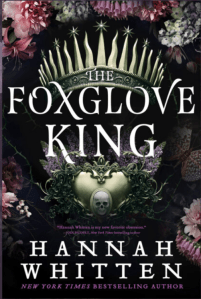
Book Description: When Lore was thirteen, she escaped a cult in the catacombs beneath the city of Dellaire. And in the ten years since, she’s lived by one rule: don’t let them find you. Easier said than done, when her death magic ties her to the city.
Mortem, the magic born from death, is a high-priced and illicit commodity in Dellaire, and Lore’s job running poisons keeps her in food, shelter, and relative security. But when a run goes wrong and Lore’s power is revealed, she’s taken by the Presque Mort, a group of warrior-monks sanctioned to use Mortem working for the Sainted King. Lore fully expects a pyre, but King August has a different plan. Entire villages on the outskirts of the country have been dying overnight, seemingly at random. Lore can either use her magic to find out what’s happening and who in the King’s court is responsible, or die.
Lore is thrust into the Sainted King’s glittering court, where no one can be believed and even fewer can be trusted. Guarded by Gabriel, a duke-turned-monk, and continually running up against Bastian, August’s ne’er-do-well heir, Lore tangles in politics, religion, and forbidden romance as she attempts to navigate a debauched and opulent society.
But the life she left behind in the catacombs is catching up with her. And even as Lore makes her way through the Sainted court above, they might be drawing closer than she thinks.
Review: I really enjoyed Hannah Whitten’s “For the Wolf” duology. The first book came out back in the “summer of ‘Red Riding Hood’ retellings,” as I fondly dubbed it, and I think Whitten’s version was my favorite of the three I read over those months. “For the Throne” was also an excellent sequel, taking the characters and the world in directions that I hadn’t expected. All of this to say, I am fully on board Whitten’s train, and I was super excited when I saw that she was releasing a new book this spring that would be the first in a new series. Let’s dive in!
I’m going to forego my usual summary chapter, and instead talk a bit about the fact that I think the official book’s summary is a bit misleading. It’s not truly important, but I think Lore’s connection to the catacombs is much more complex than “she escaped a cult and is in hiding.” I also think there are simply bits of the few sentences about this aspect of the book in the summary that are just factually wrong. I’m always mildly fascinated when there are discrepancies like these in book summaries. Was there some purpose behind this choice? Did the summary writer only skim the book and this was an accident? Who knows? Beyond this, the rest of the summary seems clear enough.
First, let’s talk about worldbuilding, particularly with regards to the magic and gods of this world. I think it’s interesting that this is now the second series that Whitten has written where her magic system involves magical forces directly interacting with the body, often resulting in mildly horrifying temporary changes to one’s physical self. I mean, I guess if you know what you like in a magic system, just go for it? I just found that interesting.
I will say, however, that it took me a bit to truly understand how this magic works, not only Lore’s abilities but also Mortem itself as used by others in the form of consuming poisonous substances. At a certain point early in the book, I had to consciously choose to stop trying to understand this and just go with it. As I continued reading, some of these details did become more clear, but honestly, I’d still struggle to write down a concise explanation of how it all worked. I’m not sure if this was a failing of the system itself or how it was described, but readers should be prepared to devote some thought and reading time into absorbing this aspect. I do think it is worth it, however, since as the book continued and I felt more comfortable with the concepts, this magical conceit opened up a lot of interesting story lines and theories.
As for the gods, I thought this part of the book was a bit familiar. There are a lot of fantasy books that deal with a religion that has been built up around one god after the destruction of a larger pantheon that came before. So, too, the relationship between a god of life/light and a goddess of darkness/death. The book played its cards pretty close to the chest with these themes, however, leaving a lot of questions still to be answered in this area. But I also feel fairly confident that I know where this is going, and it might read familiar to other readers as well. Who knows though? As I said, we don’t get any clear answers here, so Whitten could still surprise me!
Lastly, the characters and, most importantly, the love triangle between them. Yes, a love triangle and if you skip to the end of the review, you’ll see that I gave this book a good rating, so what’s going on here? Well, I’ll say that the success of this particular love triangle comes down to one key thing: all three of these characters are fully realized individuals with their own arcs and struggles within this book. Yes, it’s mostly Lore’s book. But the story does an excellent job of also setting up Gabriel, a young man who has been shaped by a great tragedy in his past, and now must struggle with dueling loyalties to Lore and to the religion and its leader who gave him refuge during that tragic event. Bastian, too, is a fully realized character, and his story explores themes of responsibility, power, and trust. Truly, the “romance,” such that it is, between all three characters is very much in the background to the growth that they experience as individuals, as various pairs, and as a group of three together.
I’ll also say that the romance plays out in a very non-traditional manner, in some ways. Part of my problem with love triangles is that I always feel as if the true love interest is telegraphed so clearly and so early that the second romantic storyline just feels like rather boring subterfuge. Here, I almost had the opposite problem. At various points in the story, both characters feel as if they are being set up as the end game couple. But then at different points in the story, each does something that I would typically say points to them being ruled them out as the end game partner. I found myself not only confused but intrigued, and I’m now half-wondering if Whitten is pulling a fast one on me and neither character will be a true love interest by the end of the series.
Overall, I really enjoyed this book. I think some aspects of the world-building were a bit confusing, on one hand, and overly familiar, on another. But it’s also clearly the start to a series, so both of these questions could be resolved in follow-up books. I do think the story lives and dies on the strength of its central three characters, and I, for one, was completely sold on them all. If you enjoy character-centric stories and want a more complex look at a love triangle, this is the fantasy novel for you!
Rating 8: Like the book’s own magic, Whitten perfectly balances darkness and light to create a new fantasy world and leading lady that feels both dangerous and opulent, ferocious and soft. An intriguing start!
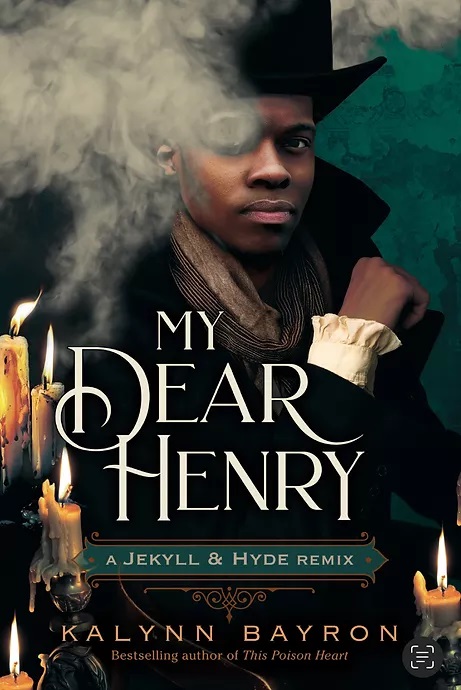
Book Description: London, 1885. Gabriel Utterson, a 17-year-old law clerk, has returned to London for the first time since his life— and that of his dearest friend, Henry Jekyll—was derailed by a scandal that led to his and Henry’s expulsion from the London Medical School. Whispers about the true nature of Gabriel and Henry’s relationship have followed the boys for two years, and now Gabriel has a chance to start again.
But Gabriel doesn’t want to move on, not without Henry. His friend has become distant and cold since the disastrous events of the prior spring, and now his letters have stopped altogether. Desperate to discover what’s become of him, Gabriel takes to watching the Jekyll house.
In doing so, Gabriel meets Hyde, a a strangely familiar young man with white hair and a magnetic charisma. He claims to be friends with Henry, and Gabriel can’t help but begin to grow jealous at their apparent closeness, especially as Henry continues to act like Gabriel means nothing to him.
But the secret behind Henry’s apathy is only the first part of a deeper mystery that has begun to coalesce. Monsters of all kinds prowl within the London fog—and not all of them are out for blood…
Review: Thank you to NetGalley for providing me with an eARC of this novel!
I first read “Strange Case of Dr. Jekyll and Mr. Hyde” in college in my favorite class of all time: “Monsters, Robots, and Cyborgs”. Thank goodness for an unofficial Cultural Studies and Comparative Literature minor! We looked at horror, fantasy, and science fiction stories of the past and present and what they said about cultural and societal anxieties, so of course “Jekyll and Hyde” is ripe for the picking. Think about it: a somewhat obsessive scientist creates a potion that can change him from mild mannered academic to a brutish, cruel, uninhibited psychopath, talk about a great way to talk about the complexities of humankind while creating a suspenseful mystery to explore that. So when I saw that one of the “Remixed Classics” books was going to take on this story, I was VERY excited to see how it was going to be reimagined with newer themes and a more diverse perspective for modern young adult audiences. Suffice to say, “My Dear Henry” by Kalynn Bayron was an anticipated read. And in a lot of ways it lived up to my anticipation.
Bayron reimagines the classic tale of a personified split identity and the calamities that follow, by making our protagonists Henry Jekyll and narrator Gabriel Utterson young adults, Black, and queer, and setting them in a Victorian London that will hold those identities against them. This was immediately resonant and very incisive, and it works so well for the themes of the source material while expanding upon them to make them even more complex. It’s especially clever because there are, indeed, questions as to Robert Louis Stevenson’s sexuality and whether these themes were also hidden in his original “Jekyll and Hyde” idea. To expand upon that and to make Hyde less of a symbol for the uninhibited ‘evil’ of man and instead to make it a symbol of uninhibited ability to be oneself is poignant as hell. As Gabriel and Henry are drawn to each other and fall for each other, the cultural mores at the time makes it so that they have to hide their feelings from others, and when they ARE found out it leads to the path of Jekyll to Hyde, and leads to lots of poignancy and pathos. It makes the “Jekyll and Hyde” story all the more tragic, as this Hyde isn’t a violent madman, he’s a manifestation of love that was criminalized and feared. And to make it even more complex, our main characters are Black, and having Black characters set in Victorian England is a great choice for a few reasons. The first is that it makes the marginalization of Gabriel and Henry even deeper, as the racism in English society has already made them vulnerable, just as it has made their fathers, especially Jekyll Sr. (as he is the one we see more of), all the more intent on stifling their sons because of their already targeted identities. The other is that it is so common to see Black narratives in this time and place ignored or questioned, as if Black people didn’t exist in England during this time period, so to counteract this erasure within this story was really, really enjoyable.
And since it is a remix of an old tale, I do want to talk about how effective of a retelling it was. And I thought that in a lot of ways it succeeded, and in a couple ways it didn’t quite capture it. In terms of successes, it does have the characters and the plot points of the original story, either tweaked, reimagined, or adapted to suit the newer narrative and thematic ideas, and it does this really well. You are definitely reading the Jekyll and Hyde story at the heart of the book, when I’ve seen adaptations that just slap on the idea of a reimagining without actually doing the work to make the new ideas coexist with the old. But I do think that one thing that did let me down about this book was that while it is definitely Jekyll and Hyde, it does give it a whole new flavor that kind of takes the suspense and thrills of the original out of it. It’s very possible that because this story is SO old hat that maybe there aren’t really ways to be held in suspense by it anymore, but I wonder if there could have been a way to make it feel like a thriller and to mine a new kind of suspense? I’m unsure.
Overall, I did enjoy “My Dear Henry” and I liked the directions that Bayron took this classic horror story of identity and repression. It’s an effective reimagining and brings out new ideas from a timeless tale.
Rating 8: A clever remix of “The Curious Case of Dr. Jekyll and Mr. Hyde” that takes on the dualities of identity in a society that doesn’t accept certain people for who they are, though it doesn’t capture the suspense that the original had.
So a lot of people may be able to say that March is a signal towards the beginning of Spring. In like a lion, out like the lamb and all that. Not necessarily so here in Minnesota, as winter really likes to hold on, and on, and on. So while we may have some hope of getting outside at the end of the month and out of our winter hovels, it’s not a guarantee. So we cling to our books, and we both have some anticipated titles this month!
Serena’s Picks
Book: “The Foxglove King” by Hannah Whitten
Publication Date: March 7, 2023
Why I’m Interested: I really enjoyed Whitten’s “For the Wolf” duology, even if the second book, “For the Queen,” was a bit weaker than the first. Either way, Whitten had proven her fantasy chops as far as I am concerned. I also liked the premise of this book as following a young woman named Lore who has some sort of death magic and then, of course, gets caught up into palace schemings and wars between gods. On the other hand, the book description makes no effort to hide the likely love triangle between Lore, the “bad boy” prince, and the “dutiful” monk. I can make some overall predictions, I think, just on those character beats alone. I’m on the record as not enjoying love triangles, but I do think Whitten is a supremely capable author, especially with her characters, so I’m hopeful!
Book: “A Tempest at Sea” by Sherry Thomas
Publication Date: March 14, 2023
Why I’m Interested: Thomas’s “Charlotte Holmes” series is by far my favorite currently running mystery series. While I’ve had favorites, I haven’t had any major problems with any of them. A minor quibble here or there, but nothing to hang your hat on. Instead, her mysteries have been reliable complicated and compelling, and I have enjoyed getting to know the large cast of characters who surround our brilliant detective. What’s more, I’m particularly excited for this book given the dramatic manner in which the last one ended, with Charlotte faking her own death to throw Moriarty off of her trail. How will she handle this going forward? I can’t wait to find out!
Book: “The Fairy Bargains of Prospect Hill” by Rowenna Miller
Publication Date: March 28, 2023
Why I’m Interested: While I have yet to finish “The Unraveled Kingdom” trilogy, I do remember quite enjoying the first book in the series, “Fray.” It was a unique combination of fantasy story and social commentary. So, too, this book sounds like it has a lot to offer, telling the two of a family whose orchard has always shared a boarder with the Fae, with whom they have relied upon for small trades and bargains throughout their tenure. But when two sisters find themselves slamming up against the restraints put upon women of this time, they begin to wonder whether these tried and true bargains can be pushed further. One can imagine where this story will likely go, but I’m also intrigued by this combination of fantasy elements and a historical novel that is focused on some of the issues of the time.
Kate’s Picks
Book: “Piñata” by Leopoldo Gout
Publication Date: March 14, 2023
Why I’m Interested: The cover immediately caught my eye when it showed up on one of my social media feeds. And after looking into it, I realized that “Piñata” by Leopoldo Gout was going to be a searing and uncompromising possession story. Architect Carmen has traveled to Mexico to work on a large project involving a centuries old Church, bringing daughters Izel and Luna with her. But after an accident on site opens a long forgotten room, and Luna is involved in the aftermath, they return home under stress. Once home, Luna starts to act strange, and all of them are plagued with strange and disturbing images and visions. Something in the room is out now, and it is angry. This is the kind of possession story that catches my eye.
Book: “Lone Women” by Victor LaValle
Publication Date: March 28, 2023
Why I’m Interested: While westerns aren’t really a genre I find myself gravitating towards, if Victor LaValle is involved I am going to take a big old chance on a western. I’ve loved his other horror works that not only take on scares, but also contemporary societal issues, and now it’s taking on historical societal issues that undoubtedly have resonance today! In 1914, Adelaide is running from a terrible secret and a terrible background, bringing a locked steamer trunk with her wherever she goes. She decides to try and take advantage of a Government offer of land for anyone who can make a living on it, and heads to Montana in hopes of laying low. But she soon realizes that there are other dangers besides a murky past, and that the secret she’s been keeping may need to come out if she wants to survive. So vague, so of course that just makes me more interested!
Book: “London Séance Society” by Sarah Penner
Publication Date: March 21, 2023
Why I’m Interested: I loved Sarah Penner’s previous novel “The Lost Apothecary” and how she weaved both historical fiction and psychological women’s thriller fiction into one well crafted story. So of course I was interested in her next book, “The London Séance Society”, and what a bonus ghosts and Victorian Spiritualism were! When her younger sister Evie is murdered, Lenna seeks out Vaudeline, a world renowned medium who also happened to be Evie’s former teacher. Lenna becomes a new apprentice, and when Vaudeline gets word that a friend and head of the London Séance Society has been murdered as well, both women seek out the exclusive group to see if they can help solve the crime. Lenna soon realizes that Evie had her own connection to the group, and then the two women wonder just what the London Séance Society may be hiding. Historical intrigue and ghosts, what more could I want?
What books are you looking forward to this month? Let us know in the comments!
Book Description:Twenty-seven years ago, a Duke with a grudge led a ruthless coup against the empire of Semilla, killing thousands. He failed. The Duke was executed, a terrifyingly powerful sorcerer was imprisoned, and an unwilling princess disappeared.
The empire moved on.
Now, when Quill, an apprentice scribe, arrives in the capital city, he believes he’s on a simple errand for another pompous noble: fetch ancient artifacts from the magical Imperial Archives. He’s always found his apprenticeship to a lawman to be dull work. But these aren’t just any artifacts — these are the instruments of revolution, the banners under which the Duke lead his coup.
Just as the artifacts are unearthed, the city is shaken by a brutal murder that seems to have been caused by a weapon not seen since the days of rebellion. With Quill being the main witness to the murder, and no one in power believing his story, he must join the Archivists — a young mage, a seasoned archivist, and a disillusioned detective — to solve the truth of the attack. And what they uncover will be the key to saving the empire – or destroying it again.
Review: I always love some good, old-fashioned political intrigue in my fantasy novels. On top of that, a “seasoned archivist” sounds like a fancy name for a fantasy librarian, so you know I’m going to be all over anything that references librarians. What can I say, we’re easy to please. It’s kind of like how the Oscar nominations always favor movies about Hollywood. Publishers and authors know what us librarians like to read about. Ourselves! But in all seriousness, this sounded like an intriguing book, so I was happy to receive a copy to review from Orbit.
It has been decades since the Duke lead his failed coup, attempting to set up a young princess as the next ruler. He was executed and the world seemed to move on, life going about as usual behind the wall of Salt that surrounds the land to protect those within from the powerful Changelings that linger, ever present beyond. But now, the artifacts of the Duke’s rebellion are being brought out of storage. What possible use could they serve but to reignite that old spark? On top of that, a shocking murder takes place and a group of seemingly disconnected individuals all work to uncover the many secrets that are slowly, slowly creeping back into the light.
This is definitely a book made for true fantasy lovers. By that I mean that it can be intimidating as heck to those who might just pick it up on a whim. You open the book and there you see detailed and complex maps. Then you see a huge cast of characters. And then you start reading and it becomes very apparent that not only do these main characters not understand the full scope of their world, but that the author isn’t about to clue you, the reader, in any time soon either. But this is not a critique! Indeed, all of these things are exactly the kind of meaty aspects that I think many fantasy readers are looking for in a book. We want to be thrown into the deep end and feel as if we’re truly in a new world, one that would in fact be filled with huge casts of characters, need a detailed map to understand, and contain a magic system that goes beyond wand-waving. And this book delivers on all of these things!
Some of it will also be familiar to fantasy fans, which can be a plus and a minus. I didn’t think there was anything truly shocking here, though I may make an exception for the Changelings themselves, as I thought they were a particularly interesting threat. But the magic system, while interesting, will read as familiar to many fantasy readers. Basically, practitioners will have an affinity to certain things (wood, bone, stone) etc. which will influence they way they can perform magic. Hence, the salt wall that surrounds the city gains a certain mystique as it could only be created by a very unique sort of person.
The characters were all good as well, though I can’t say that I was overly attached to any one of them over another. This is probably a good and a bad thing, ultimately. I wasn’t dreading any particular character’s chapter, but I also wasn’t incredibly invested in one of them either. All told, I think the characters themselves served more as aspects of the world and story that were being created than as the driving force of the story itself.
The writing was quite effective right from the start. It felt sure-handed and well-practiced at balancing the myriad of aspects that must go into creating a complicated world and story such as this one. Indeed, on top of setting up an epic-feeling fantasy world, the author adds in a murder mystery. For me, as a fan of mysteries as well, I really enjoyed this combination of genres, and I think it added an extra zest to the overall story.
It did take me a bit to really get into the book. Because we’re thrown in right away, it takes a bit to orient oneself with the players and world at large. This might also be where my lack of immediate attachment to the characters put me at a bit of a disadvantage. Even now, though, I can’t point to exactly why I struggled with this. I have very clear memories of some of the first scenes with certain characters and laughing internally at some of the great dialogue right off the bat. Either way, I think this book will definitely appeal to epic fantasy fans looking for a new world to explore, and I will definitely be keeping an eye out for the next one!
Rating 8: The pinnacle of what one looks for in epic fantasy: a sprawling world, a rich history, a detailed magic system, and an intriguing cast of characters to travel alongside.
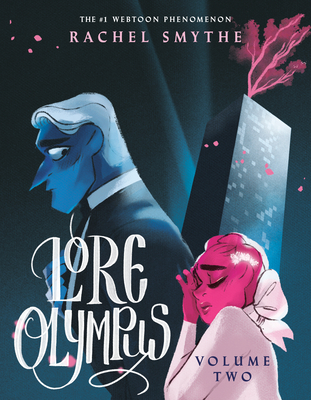
Book Description: Persephone was ready to start a new life when she left the mortal realm for Olympus. However, she quickly discovered the dark side of her glamorous new home—from the relatively minor gossip threatening her reputation to a realm-shattering violation of her safety by the conceited Apollo—and she’s struggling to find her footing in the fast-moving realm of the gods. Hades is also off-balance, fighting against his burgeoning feelings for the young goddess of spring while maintaining his lonely rule of the Underworld. As the pair are drawn ever closer, they must untangle the twisted webs of their past and present to build toward a new future.
This full-color edition of Smythe’s original Eisner-nominated webcomic Lore Olympus features a brand-new, exclusive short story, and brings Greek mythology into the modern age in a sharply perceptive and romantic graphic novel.
Review: We are back for more Greek Mythology soapy romantic goodness, everybody! It has been awhile since I have had a full blown content obsession, but “Lore Olympus” has really snagged me but good. Greek myths! Humor! A favorite ship! LOTS OF PATHOS! It all comes together in this series and we are starting to parse out the various complications that are facing Persephone, Hades, and more Greek Gods and Goddesses in “Volume Two”. Our star crossed would be lovers, Persephone and Hades, are trying to find their footing after their chance meeting has set them both a little off kilter, and while that could just be a lot of pining and wallowing in angst, Rachel Smythe takes the opportunity to build up more backstory and more characterization, and it is for the better. “Volume Two” is keeping the series going strong. But yes, there is still some lovely Hades angst, and given that I LOVE to be emotionally wrecked by fiction, I say bring it on.
One of the most rewarding things about “Lore Olympus” is that Smythe is taking her time to set groundwork, characterizations, and background. We start this volume off with Persephone starting her schooling with her scholarship from The Goddesses of Eternal Maidenhood while silently grappling with the sexual assault she endured at the hands of Apollo. She loves being away from her doting mother’s eyes, but given she’s drawn to Hades she is feeling that perhaps joining TGOEM isn’t what she really wants. Meanwhile, Hades is stewing about his feelings for her and trying to keep his distance, and to make matters worse a tabloid has shown innocuous pictures of them and spinning them to seem scandalous, which threatens Persephone’s reputation. Throw in Hera’s suggestion that Persephone take on an internship in the Underworld (as she secretly wants Hades to be happy and thinks that this would help that), and the two would be lovers are being shoved into some fun forced proximity!
But these very common tropes feel fun and new in this story, and it means that we can carefully explore their budding friendship while also exploring them as individuals who are dealing with a lot of baggage on their own. I thought that Smythe is really careful but also powerful when exploring the aftermath of Persephone’s rape, and does a good job of portraying the shame, the fear, and the apprehension, especially since her abuser is inserting himself in her life vis a vis his clueless sister Artemis, whom Persephone is living with. It’s tackled in a way that feels real, but doesn’t feel melodramatic or exploitative. I’m hoping that it stays that way and isn’t used for man pain or anything like that, but I trust Smythe to continue to be mindful. We also have a lot of other facets to Persephone’s growth as she tries to make sense of what she has been told she wants from life, and what she actually wants from life. There have also been hints about some darkness involving her backstory and her nature, which is VERY interesting to say the least…
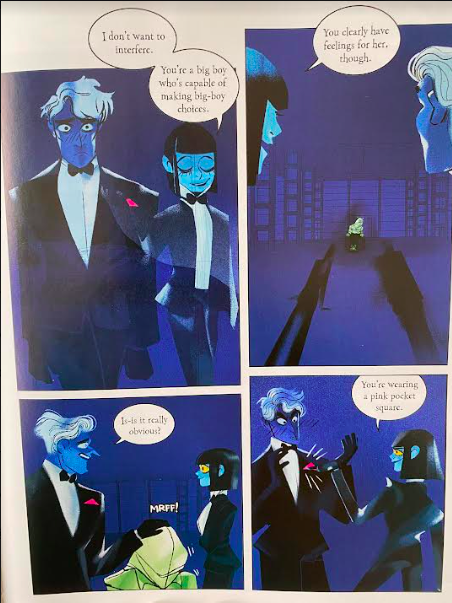
Okay now we talk about what I loved most in this book. HECATE IS HERE!!! I’ve talked about how Persephone is my favorite Greek deity, and Hades is definitely number two? Well Hecate, the goddess of witchcraft, is third. I love Hecate. So I was very interested to see how Smythe depicted her, and I was NOT disappointed, as she is Hades’s COO and number two in command, who calls him out on all his nonsense and bullshit while trying to support him in other ways. She is THE BEST, and also very competent at keeping things in the Underworld running. In this the Underworld is a very necessary, non-evil place that has to be run efficiently, and having Hades and Hecate as co-runners feels very Eric and Pam from “True Blood” (without any of the clichéd longing on her part). It’s also really cool to see the depiction of the Underworld here, as we’ve seen the Mortal Realm as fields and vastness, and Olympus as an upperclass city scape. The Underworld feels a bit more hardboiled with a corporate undertone, and I love seeing how it is run, and how the various workers fit in, like Thanatos, who escorts souls to the Underworld, and Minthe the nymph (who just so happens to be in an on again off again/toxic relationship with Hades and she’s also kind of the worst but also seems pretty damaged so she isn’t just a girl to get in the way, HOW REFRESHING!).
And I’m still in love with the artwork. The designs of all these characters are perfection. I mean LOOK AT MY GIRL HECATE!
Source: Random House Worlds
I’m still obsessed with “Lore Olympus”. There isn’t much else to say, I’m head over heels.
Rating 9: Still loving this. What a fresh, soapy, emotional and sometimes hilarious take on Greek Mythology!
Animorphs Graphix #2: “The Visitor” by K.A. Applegate & Michael Grant, Adapted by Chris Grine
Publishing Info: Graphix, October 2021
Where Did I Get this Book: own it!
Book Description: Rachel is still reeling from the news that Earth is secretly under attack by parasitic aliens, the Yeerks. Now she and her friends are the planet’s only defense — kids who, purely by chance, stumbled onto a downed spacecraft and were given the power to morph into any animals they touch.
The team’s best lead is their assistant principal, Mr. Chapman, who is the human host to a high-ranking Yeerk official. It’s not much, but Rachel’s always been a daredevil, and she volunteers to infiltrate Chapman’s home.
Rachel is tough. She’s fearless. But what she finds inside may be more than even she can handle.
I’m baaaaaaack! Yes, yes, it’s been forever. So long in fact that not only is the second Animorphs graphic novel out, but the third was released last fall as well! What’s my excuse?
Anyways, I was very excited to jump back into the world of the Animorphs and check out what these graphic novels have in mind for the long run. I remember really liking the first one, but having some concerns about the longevity of the series. I was also curious to see how this particular story was handled. “The Invasion” has tons of material to work with, not only in the chock-full plot but also with a lot of important character work introducing all of the teens. But “The Visitor” is a much slower, simpler story. In fact, I’d say it’s probably the weakest story in the introductory first five books. I mean, I still love it, because I love Rachel and Applegate is at the helm in these early books and that’s clear in the general quality of a more “filler” story as compared to the same sorts of stories that we see later in the series that don’t land as well. All of that to say, I was curious to see what the graphic novel had in store for us.
Best Change: I really liked the way the Chapmans were portrayed in this version of the story. There’s a really cool couple of pages that are drawn when Rachel first enters the house. We see Mrs. Chapman in the kitchen, staring straight ahead and chopping up vegetables. We then shift to the living room and see Mr. Chapman sitting on the couch staring at a television set that’s turned off. Creepy enough on its own. But then when Rachel comes back in the second go around, we see the exact same thing: Mrs. Chapman in the kitchen, chopping; Mr. Chapman in the living room, staring. It really hits home how absolutely off and cold this house is and what a horrible hell Melissa is living through. Beyond that, I liked how the way Chapman’s face is drawn changes from scene to scene as his power dynamic shifts. When he’s driving Rachel home, he’s shadowy and threatening. But when he’s talking with Visser Three, he’s depicted as small and cowering. And then, lastly, we see the human side of him when the real Chapman gets control briefly to plead his case to Visser Three. It was all very effective, and I think it does a good job of setting up just how witnessing this horrible home situation would influence and motivate Rachel.
Worst Change: I’m not sure I really have a worst change for this book. Other than a few things here and there which I’ll get to later, this is a pretty faithful adaptation of the original book. I’ll go on (and on and onnnn) about my feelings about the art throughout the book, but I think that’s probably not going to be a specific-to-this-book thing so not really a “change” at all. Speaking of art…
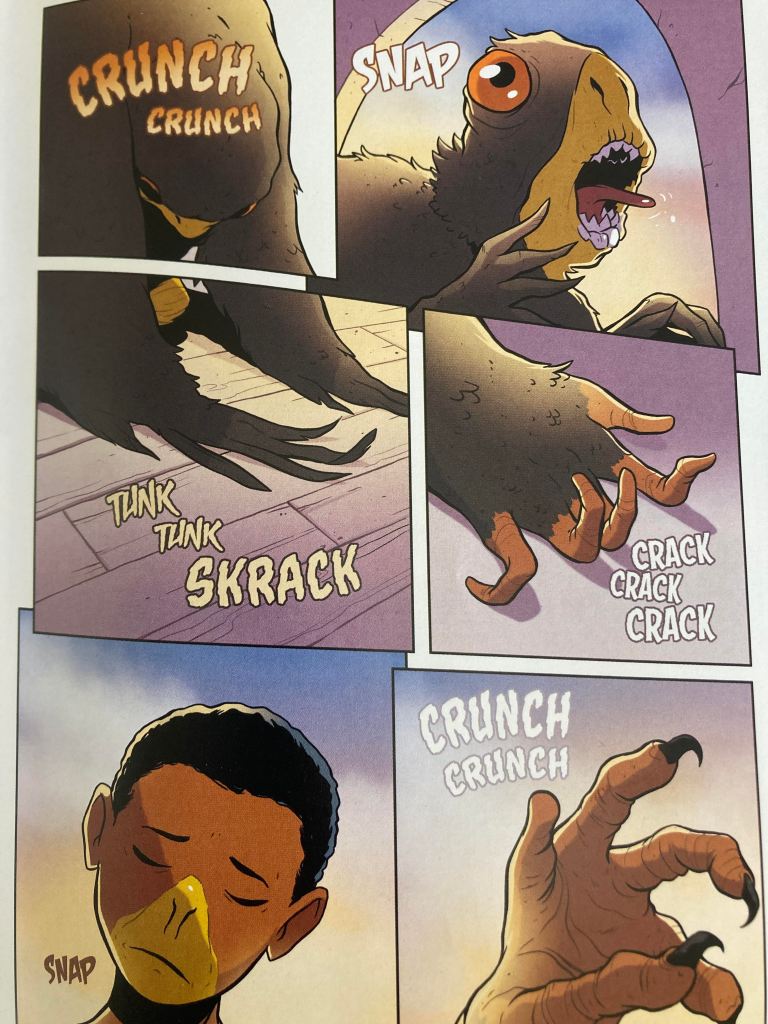
Pretty, Pretty Pictures: I have to say, I’m not coming around on the art style of these books. It’s not a complete loss, but I think there’s a stark difference in quality between the two styles. On one hand, I think the graphics are excellent when done in the more realistic style used for the animals. I also think the larger spreads across two pages and the horror aspects are well done. The descriptions of morphing in the books were always horrific, but when you see it depicted on the page…man, it really captures how truly disgusting this stuff looks. I mean, look at this!
But, I have to say, I’m really not loving the cartoon images of the kids themselves. I wanted to give it more of chance than just the first book, where I didn’t love the fact that Tobias and Rachel looked so similar or the strange choice with the red noses. But this book just confirmed some of my worst fears. If you look at these characters, they all just look exactly the same in the most generic of senses. You wouldn’t even be able to tell who is a boy or who is a girl based on images of just their faces in some of the panels (a picture of Cassie really highlights this at one point where I honestly had to do a double take to remind myself that there wasn’t a random Black boy in this story). This fact is really highlighted early in the story when we first meet Melissa. Here’s the first panel we see her in:
Without the speech bubble, which of these characters is which?? Ultimately, Melissa is given the silly freckles purely to identify and differentiate her later in the book. And that just seems to me to be a failure of the art itself. I mean, I’m still glad these graphic novels are being made so I have a hard time being this critical, but it honestly feels as if the artist either can’t be bothered to draw interesting and unique characters or simply isn’t capable of it while using this cartoonish style. Given the quality of the realistic stuff, I know he’s talented. So it feels like it must be a choice. But it’s the kind of choice that feels as if it’s talking down to its readers: hey, these are just kids and kids are the target audience, why bother making them look like anything other than bobble head cartoons? I don’t know. I’m not a fan.
Our Fearless Leader: Jake is one of the few characters that I think is drawn with a distinct face. His chin is a bit more pointed than the rest, and that difference stood out more and more as I became increasingly frustrated by the other characters. As for the story, there was a nice section in the middle devoted to a conversation between Rachel and Jake about their experiences (nightmares) after morphing frantic-minded prey animals. I like that this much page time was devoted to what can be seen as a pretty small character moment. There’s also an interesting line where Rachel gets a bit defensive saying that Jake is talking down to her because she’s his younger cousin. I can’t remember whether or not we knew that she was the younger of the two from the books? If so, I had forgotten and found it to be an interesting little tidbit here that she’s only a few weeks younger than Jake.
Xena, Warrior Princess: This book is pretty faithful to the original, so there isn’t a lot of new stuff to discuss with regards to Rachel’s experiences in the story. I will say, I really liked seeing Rachel’s mom and sister portrayed on the page. These were nice little moments to get to see one version of what these characters could look like. We get a lot of descriptions of what the main characters looked like in the original text, but we really have basically nothing to go on for any/all side characters. It was also nice to see these moments between Rachel and her mom and Rachel and Jordon to highlight the difference between her own warm, caring family and the cold, prison-like existence that Melissa is suffering through. I really like these sorts of subtle contrasts that the graphic novel can deploy. The book doesn’t come right out and say it, but it’s there all the same.
One thing I didn’t really like was the way the scene was drawn when Rachel is running away from the thugs to morph an elephant in the alley. Granted, again, it’s now been a few years from when I read this book for the original re-read series, but I guess I had it in my mind that Rachel was more annoyed from the very start and never frightened. Whereas here she’s drawn as being legitimately afraid at first, which I think is totally out of character. Rachel wants to take the fight to Visser Three himself, no way is she going to be wincing away from two jerks on the street.
A Hawk’s Life: Not a lot from Tobias. I did like all of the bird action in the very first scene and the way that was all drawn out. Rachel’s outrage about the guys shooting at a bald eagle “a national symbol!!!” is excellent. There were also some lovely images later on of Tobias flying, especially one when he flies away with shrew!Rachel to help give her time to get control of her morph. The way the sky and the silhouettes were drawn was striking.
Peace, Love, and Animals: Given how horrifying the images of the morphing is, I was glad we got to see a panel of Cassie with her raptor wings and Marco’s comment that they all look like freak show contestants while Cassie gets to look like an angel. It was a really nice juxtaposition and a moment that really worked well with the graphic elements. Other than that, Cassie has a pretty subdued go of it. We get some good animal facts from her about the prey mindset and the abilities of cats (there’s a good joke from Marco when Cassie comments that a cat’s eyesight is 8 times better than a humans), but that’s about it.
The Comic Relief: Marco is pretty much the same here as he is in the book. We get more groundwork laid about his home life and why he’s reluctant to fight. His dialogue is by far the funniest and best, per the book’s standard as well. There was one throwaway bit that I thought was odd, however. At one point, a character, I think it was Cassie, compliments Marco on his haircut. From the books, we know this does happen and is commented on but it doesn’t happen until Marco’s second go around as a narrator, all the way through to book number 10. But then the really strange thing is that Marco was depicted with short hair in the first graphic novel, too. Which, honestly, given my comments already about the cartoon style proving challenging to differentiate between male or female characters, I can see the choice to not have him with long hair from the very start. But looking back at the art from the first book, it’s clear that the styling for his hair is slightly different, but if anything, it’s drawn as longer and more shaggy here in the second book, not cut shorter at all. It’s very strange. I don’t think this small of a change really warranted any dialogue at all, but then to write it in as a notable haircut rather than a style change, which is the most that can be said, is strangely incongruent.
E.T./Ax Phone Home: No Ax yet, but boy am I excited to get to him!
Best (?) Body Horror Moment: Beyond what I said above about the disgustingly graphic images of morphing, there was a full page spread devoted to Rachel’s nightmare about being a shrew. Again, this is where the artist’s talents are really on display. I’ve only included half of the spread, but the other side is also covered in maggots swarming in and over an animal skull. I mean, the depiction of the nightmare is going to cause nightmares itself.
Couples Watch!: Sadly, I feel like we got even less from Tobias and Rachel here than we do in the books. We do get the line from Tobias that he doesn’t want anything to happen to her, so there are hints here and there, but for whatever reason, this relationship in particular just felt off. This probably is just due to the nature of the graphic novel format. Since the story relies only on dialogue and images, it’s pretty hard to depict true feelings between a girl and a hawk!boy when you can’t draw them interacting. On the other hand, to highlight this point, we do get this sweet panel coming fairly early in the book for Cassie and Jake:
If Only Visser Three had Mustache to Twirl: Again, since the horror aspects of the art are what work so well, the depictions of Visser Three and the terror he inspires are truly great. Even his Andalite form, which shouldn’t be terrifying in and of itself, is depicted in such a way as to be clearly intimidating. And then the panels showing him morphing the Vanarx and sucking out the Yeerk from a Controller are incredibly creepy and effective. I mean, Visser Three is essentially a cannibal at this point, and that is made pretty clear. And of course, the final battle with Visser Three morphing yet another big bad and chasing after the Animorphs is very well done. More on that below.
Adult Ugly Crying at a Middle Grade Book: Man, the Melissa stuff isn’t any easier when drawn out on the page rather than just described in a book. Plus, now I’m reading these books as a parent myself and boy, rough stuff. Especially the part where she follows Chapman out when he’s carrying cat!Rachel away in the crate. “Oh, I didn’t see you there.” “But daddy…I was crying.” Oooof! Not to sound like a broken record or anything, but again, AGAIN, I think the cartoon style let some of these heart-breaking moments down a bit. The reason this scene hits hard, and the same with the one where Melissa is crying in her bed, is because the writing and dialogue are so strong. The way the characters are drawn, there’s just so little that can be done to express these deep emotions, so it all falls to the writing. I’m having a hard time picturing some of the truly devastating moments that are coming up landing the way they should as shown on the faces of characters with red bubble noses.
What a Terrible Plan, Guys!: I’d say the terrible plan is still the obvious one: where Rachel decides to morph a shrew to lure a tomcat out of a tree. Like Cassie points out, while cats often play with their food, sometimes they just go straight for the kill, too, and there’s really no way of predicting it one way or another. But also, specific to this version of the story, I’ll say that the use of the machinery in the construction site didn’t quite translate here. I can’t remember exactly how it was described in the books, but I felt like there I had a better sense of just how these machines were disrupting Visser Three’s plans. Here, we only see a few small shots of a solitary bulldozer, and it kind of fails to land as to why this would pose any sort of threat or disruption to what the Yeerks are doing.
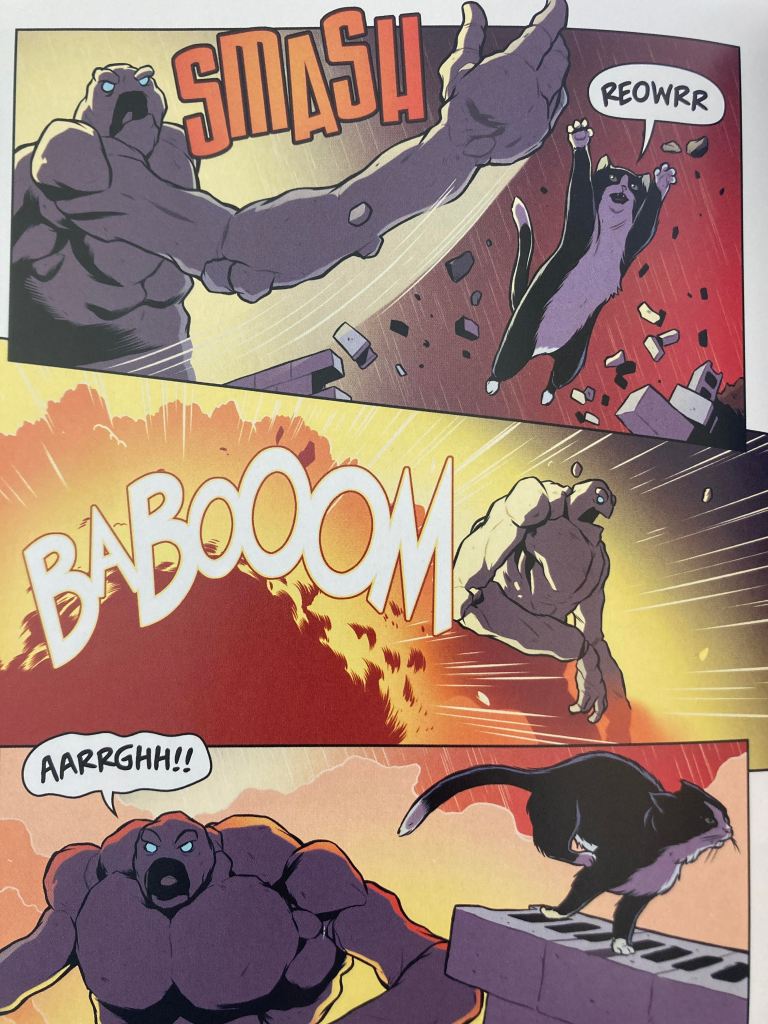
Favorite Page/Panel:
I really liked all of the pages that made up the final conflict between the Animorphs and Visser Three in his alien morph. But this one stood out for the sheer joy of the absurdity of it all. I mean, take that picture out of context. Just look at it. The crazy rock monster. The speech bubbles of the cat growling and alien roaring. The cat’s crazy Superman jump featured prominently in the top right corner. It’s all so whacky and fun, and I think it’s a perfect visual representation of the sheer joy that these books are to read, especially to younger audiences. In no other series of books are you going to get anything remotely like what Animophs has to offer.
Final Thoughts: Overall, I’m still continuing to enjoy reading these graphic novels. I won’t repeat myself about the art, but like I said, too, for all my complaining about that, I’d rather have the graphic novels as they are now than nothing at all. I do hope they continue to make them, but I think there’s room to combine some things going forward. These first six or so books are important enough to have their own adaptations independently, but I think this book specifically also highlights how some future stories could be combined or skipped. Mostly, I just want some adaptation, ANY ADAPTATION, to get to the David trilogy.
Note: I’m not going to rate these books since I can’t be objective at all!










 The Library Ladies