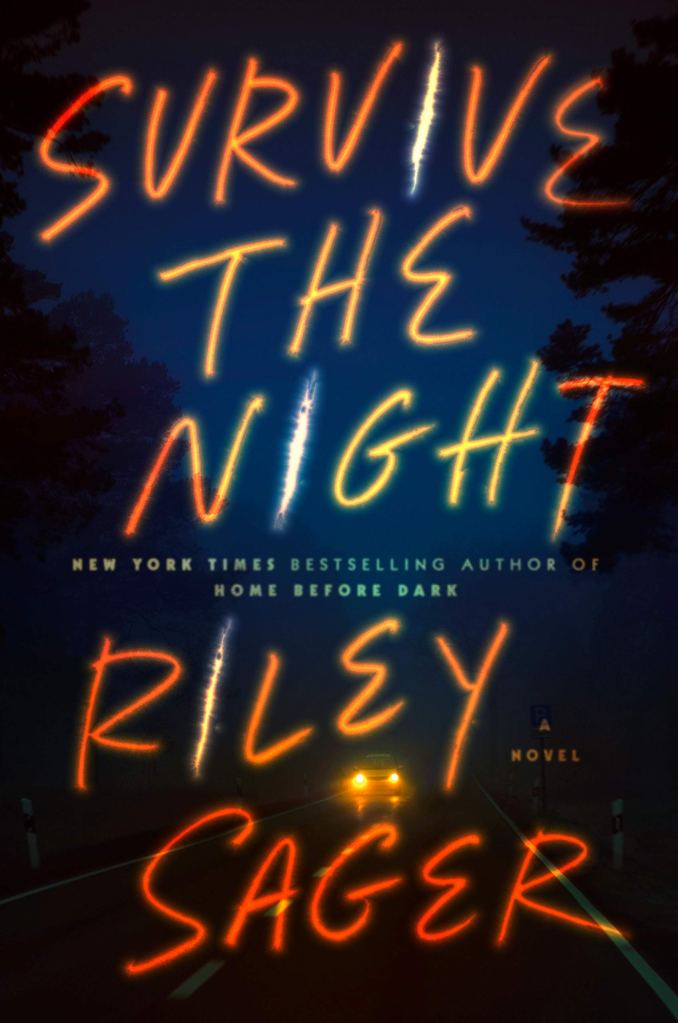
Kate’s Review: “Survive the Night”

Book: “Survive the Night” by Riley Sager

Publishing Info: Dutton Books, June 2021

Where Did I Get This Book: I received an eARC from NetGalley.

Book Description: It’s November 1991. George H. W. Bush is in the White House, Nirvana’s in the tape deck, and movie-obsessed college student Charlie Jordan is in a car with a man who might be a serial killer. Josh Baxter, the man behind the wheel, is a virtual stranger to Charlie. They met at the campus ride board, each looking to share the long drive home to Ohio. Both have good reasons for wanting to get away. For Charlie, it’s guilt and grief over the murder of her best friend, who became the third victim of the man known as the Campus Killer. For Josh, it’s to help care for his sick father. Or so he says. Like the Hitchcock heroine she’s named after, Charlie has her doubts. There’s something suspicious about Josh, from the holes in his story about his father to how he doesn’t seem to want Charlie to see inside the car’s trunk. As they travel an empty highway in the dead of night, an increasingly worried Charlie begins to think she’s sharing a car with the Campus Killer. Is Josh truly dangerous? Or is Charlie’s suspicion merely a figment of her movie-fueled imagination?

What follows is a game of cat-and-mouse played out on night-shrouded roads and in neon-lit parking lots, during an age when the only call for help can be made on a pay phone and in a place where there’s nowhere to run. In order to win, Charlie must do one thing–survive the night.

Review: Thank you to NetGalley for providing me with an eARC of this novel!

One of the things I’ve looked forward to every summer for the past few years is that, like clockwork, Riley Sager has written a new thriller novel. I’ve been reading Sager since his debut, “Final Girls”, and I have genuinely enjoyed every book he has come out with. Sometimes with varying degrees of enjoyment, but enjoyed nonetheless. Sager is a reliable thriller author for me; I know what to expect, I know I will probably like his characters, and I know that he will find ways to surprise me. So, of course, I’ve been looking forward to “Survive the Night” since I first heard of it. I wanted to savor it, saving it on my Kindle for awhile, knowing that it would probably be devoured right up as soon as I began but hoping I’d restrain myself. And I didn’t, really, as I read it in two big chunks over the course of two days. But hey. That’s reliable as well.

The book is mostly from Charlie’s point of view, as while it’s in the third person, it is mostly from her perspective. Charlie is a fairly typical protagonist for a book like this; she has a lot of baggage stemming from childhood trauma, which has been compounded by the fact that her roommate and best friend Maddy was brutally murdered by The Campus Killer, and Charlie blames herself. It’s the kind of thing we’ve seen before, which isn’t necessarily a bad thing, just worn. Adding into this well worn treading into overdone territory is that Charlie’s unreliability as a quasi narrator is partially based in some mental health issues, in that she has hallucinations and dissociative states she calls ‘going to the movies’. So of course, a scene that could be one thing, will end up not being real. There are a lot of things to be said about using mental health as a plot point in this way, and while I don’t necessarily think that it’s damaging or offensive, I do think that it’s something we’ve seen before. I LIKE Charlie, she’s just not really reinventing the wheel. Josh is our other main character, who has a few moments of perspective, but most of what we see is what we get from Charlie, and her paranoia and trauma could make her unreliable when it comes to him. Again, things we’ve seen before. It works out fine, Sager does it well, and I enjoy Josh as a character too. But again. We’ve seen it.

The plot, however, is a true rollercoaster from beginning to end, and Sager sprinkled little clues in here and there that I definitely missed. It could have been a healthy mix of sleight of hand on his part and me being so engaged with wanting to find out what happened next, but missed them I did, and it made some of the surprises all the more fun. I talked above about how using dissociative episodes in fiction to make someone unreliable is a bit old hat and overused, but there were lots of other well done tricks and twists that obfuscated details and solutions that I wasn’t too put off. The cat and mouse elements between Charlie and Josh slowly build and build, and even when one reveal happens a new conflict or danger will start to slowly build almost immediately after, so the release doesn’t last too long. It makes for a very tense and addictive mystery at hand, and it hooked me from start to finish. And while Sager sometimes tends to tread a bit towards outlandish twists nearing the end of the book, I felt that “Survive the Night” never quite overdid itself in that regard. And I’m not going to spoil anything, really, but I will say that the sappy romantic in me who gets invested in fictional relationships had a lot to work with in this story.

Yes, I find ways to swoon in a story with a plot like this, sue me. (source)

So while I thought some of the character choices were slightly underdeveloped or tropey, overall I found “Survive the Night” to be a really fun thriller novel. Riley Sager hasn’t failed me yet, and this is definitely the kind of book you should pick up if you like suspense.

Rating 8: Suspenseful, cinematic, and highly addictive, “Survive the Night” is another entertaining rollercoaster of a book by Riley Sager!

Reader’s Advisory:

“Survive the Night” is included on the Goodreads list “Mystery and Thriller 2021”.

Find “Survive the Night” at your library using WorldCat, or at a local independent bookstore using IndieBound!

Kate’s Review: “Darkness and Grace”

Book: “Darkness and Grace” by Kathryn Schleich

Publishing Info: Self-Published, March 2021

Where Did I Get This Book: I received an eARC from Book Publicity Services

Book Description: Even the strongest of families aren’t immune to malice, betrayal, and deceit. Supportive, loving, and affluent, the Pierson family is delighted to celebrate the marriage of sensitive middle son Paul Pierson and his wife, Pamela. Everyone rejoices that Paul has finally recovered from the tragic loss of his beloved first wife and looks forward to Paul and Pamela’s new life together. But just as family members are celebrating his happiness, they start noticing that his beautiful bride may not be what she seems.

As the strain between siblings and spouses worsens, the Piersons discover that neither their money nor their considerable influence can keep the family safe from one woman’s malicious intent. When the true nature of this family member is revealed, each of the Piersons is confronted with the quandary of human conduct and moral responsibility.

Darkness and Grace is a compelling story of the classic struggle between good and evil, as well as the violent undercurrent running beneath the illusory serenity of a close-knit Midwestern family. 

Review: Thank you to Book Publicity Services for providing me with an eARC of this novel!

It wasn’t until very recently that I saw the Scorsese film “Casino”, which is admittedly strange as it is my husband’s favorite Scorsese feature. I’m sure that he loves it for the Vegas aspect as well as the interesting mob entanglements, but I think that for me the strongest feature is Sharon Stone, who plays Ginger, the narcissistic and potentially psychopathic wife of Robert DeNiro’s Sam. Stone puts in a powerhouse performance of a charming and vivacious woman who slowly turns into a nightmare as she is overtaken by drugs, alcoholism, and her sociopathic tendencies, which makes DeNiro’s life a bit of a nightmare. But Stone also brings a sad bit of vulnerability to Ginger, and even though you absolutely want her to have to face responsibility for her actions, you do feel a little sorry for her. As I was reading “Darkness and Grace” by Kathryn Schleich, I felt like I was reading about Ginger, only taking place in Minnesota, and without any of the vulnerability and empathy.

Our first person protagonist, Kay Pierson-Scott, is telling the story of how her family got entangled with Pamela, her brother Paul’s wife who turns out to be a psychopathic manipulator who runs an emotional mac truck through their happy family. Pamela is relentless, Paul is beaten down, and Kay and her family are running out of patience and the wherewithal to deal with it. As a family drama with a lot of suds to go around, it is entertaining as hell, making my blood pressure rise as Pamela’s manipulations and machinations run amok and Kay becomes more and more harried and the Pierson clan is targeted more and more. I liked Kay as a protagonist, who is a devoted and somewhat doting oldest sister who wants to protect her brother and the rest of her family as best she can. It’s all from her POV, so there are definitely some blind spots as to the other characters, deliberate or not, but she was enjoyable enough that I was okay with focusing on her. Pamela is the other big character in this book, and she is pretty much a cartoony villain in a lot of ways, though that said I know people who have dealt with people like her in their lives. So I’m not about to say that she’s unrealistic. You definitely spend the entire book waiting for her to get what is coming to her, and holding your breath in suspense as to whether or not she will do something REALLY terrible along the way (oh how I was SCARED for her daughter, Kaitlin!). All of this makes the plot easy to consume, and the side of me that lives for this kind of over the top drama was definitely entertained.

One of the hurdles “Darkness and Grace” faces is that the writing style is very simple, almost conversational, as though Kay is telling this story to a person over cocktails or brunch. I do think that this CAN work if done well, but it felt kind of stunted and a bit informal in this case, and therefore distracting. But it’s important to note that this was the first novel from Schleich, and that this is a re-release. Given that the other book of hers I read “Salvation Station”, didn’t have these issues, it’s really just a sign that this is a debut, or at least very early, work for an author who has time to grow and evolve.

And I would be remiss if I didn’t shout out to the numerous, NUMEROUS Minnesota references peppered throughout this book. I know that Schleich is local, and that aspects of this story are loosely based on something her family had to deal with in the 1990s, so it’s not too surprising to see all the MN moments. For me, a Minnesotan born and raised, it was fun to be like “I know what neighborhood that is!” or “I’ve been to that place!”. It may be laid on pretty thick for other readers, but trust me, us Minnesotans LOVE to have our state acknowledged in media, so this was a-okay by me.

“Darkness and Grace” is an entertaining and soapy thriller that kept me interested. It doesn’t reinvent any wheels, but it gets the job done, and sometimes that just what you want in a suspense novel.

Rating 7: The story is engaging and easy to invest in, even if the writing style felt a little rudimentary to me at times. But the Minnesota references were top notch!

Reader’s Advisory:

“Darkness and Grace” isn’t on any Goodreads lists as of yet, but I think it would fit in on “Family Drama Books”.

Find “Darkness and Grace” at Amazon.com.

Kate’s Review: “That Weekend”

Book: “That Weekend” by Kara Thomas

Publishing Info: Delacorte Press, June 2021

Where Did I Get This Book: I received an eARC from NetGalley.

Book Description: Three best friends, a lake house, a secret trip – what could go wrong?

It was supposed to be the perfect prom weekend getaway. But it’s clear something terrible happened when Claire wakes up alone and bloodied on a hiking trail with no memory of the past forty-eight hours. Three went up the mountain, but only one came back. Now everyone wants answers – most of all, Claire. She remembers Friday night, but after that… nothing. And now Kat and Jesse – her best friends – are missing.

That weekend changes everything. What happened on the mountain? And where are Kat and Jesse? Claire knows the answers are buried somewhere in her memory, but as she’s learning, everyone has secrets – even her best friends. And she’s pretty sure she’s not going to like what she remembers.

Review: Thank you to NetGalley for providing me with an eARC of this novel!

Kara Thomas is one of those authors who has never disappointed me. I have genuinely enjoyed and been surprised by all of her books, and she has easily been one of the authors whose works I am guaranteed to read as soon as I possibly can. I admit that the pessimist in me tends to worry whenever I pick up a book by one of these ‘can do no wrong’ authors, as I am always wondering ‘is this the book that is going to disappoint me?’ Thus far, with her newest novel “That Weekend”, Thomas has never done so. Hell, when I was reading this book and I was enjoying it and trying to figure out what was going on, I had an epiphany moment in the tub (when I wasn’t even reading the book) in which I thought that no, THIS was going to be the big reveal that was going to change everything. I wasn’t even mad about it, as it was, to my mind, a great reveal and surely that was what was going to happen because that would be genius.

And then, like she always does, Kara Thomas went and pulled the rug out from under me and my expectations of what was to come.

SHE DID IT AGAIN! (source)

But I am so ahead of myself. “That Weekend” is a YA thriller that could have used some tried and true tropes to tell a pretty familiar story. Thomas is a talented enough writer and mystery weaver that she could have done this and still made it work and feel fresh, but no, instead she takes it to other places that make it all the more interesting and suspenseful. We mostly follow Claire, a girl who went on a camping trip with her best friends Kat and Jesse, and woke up in the wilderness with a head injury, blood on herself, and no memory of what had happened for the past twenty four hours. On top of that, Kat and Jesse are no where to be found. From the jump we are in the weeds as much as Claire is, as she is the perfect unreliable narrator in that she has memory loss AND has some issues with Kat and Jesse that she is only starting to work through (specifically, the fact that they are now a couple, and she has been in love with Jesse for years). The mystery of what happened to Claire and what happened to Kat and Jesse seems pretty straight forward at first, with familiar beats and plot points, but never fear; Thomas has much more in store. What happens next is an engaging and very addictive mystery about friendship, secrets, trauma, and the things we don’t know about the people we love most. I really liked Claire’s storyline trajectory, as she goes from victim of something, to scrutinized potential suspect, to hard boiled amateur detective, all while realistically dealing (or perhaps not dealing) with the horrifically traumatic experience she went through and continues to go through as time moves on. Her characterization felt realistic in it’s messiness, and her resentment and determination was organic and never forced. Because of this, she was easy to root for, even if she was sometimes hard to like. We do get to see into the minds of other characters a little bit, and while they are all done well too, it’s really Claire that shines as a flawed but mostly empathetic protagonist.

And as I was gushing above, the mystery is so well plotted that I was always a few steps behind. Thomas has all the clues laid out so that you can trace everything back, but she knows how to keep them close to the vest. The reveals and surprises are all pretty darn rewarding because of this, and the pacing was such that I found it very hard to put this book down. And even one kind of out there late game twist that could have been seen as overkill was done in a way that I really didn’t hate it. It didn’t necessarily ADD to anything, but it worked well enough that the late revelation wasn’t the cheap moment that it could have been. Thomas also brings up some good, damning points about true crime tourism and media, as not only are there some armchair detectives online who come off as pretty terrible, there is a VERY clear nod to that horrible trauma scavenger Nancy Grace in one of the characters whose only goal is to get ratings by turning the public against literal teenagers. It’s one of the things that the true crime community really needs to reckon with, as people like Grace (and this character) see blood in the water and exploit it for ratings, even if they make chum of innocent people in the process.

“That Weekend” continues the streak that Thomas has had from the get go. It may be my favorite of her books. Thriller fans of all ages should definitely check it out.

Rating 9: Thomas has once again written a suspenseful, engaging, and surprising YA thriller!

Reader’s Advisory:

“That Weekend” is included on the Goodreads list “2021 YA Mysteries and Thrillers”.

Find “That Weekend” at your library using WorldCat, or at a local independent bookstore using IndieBound!

Kate’s Review: “When No One is Watching”

Book: “When No One is Watching” by Alyssa Cole

Publishing Info: William Morrow Paperbacks, September 2020

Where Did I Get This Book: The library!

Book Description: The gentrification of a Brooklyn neighborhood takes on a sinister new meaning…

Sydney Green is Brooklyn born and raised, but her beloved neighborhood seems to change every time she blinks. Condos are sprouting like weeds, FOR SALE signs are popping up overnight, and the neighbors she’s known all her life are disappearing. To hold onto her community’s past and present, Sydney channels her frustration into a walking tour and finds an unlikely and unwanted assistant in one of the new arrivals to the block—her neighbor Theo.

But Sydney and Theo’s deep dive into history quickly becomes a dizzying descent into paranoia and fear. Their neighbors may not have moved to the suburbs after all, and the push to revitalize the community may be more deadly than advertised. When does coincidence become conspiracy? Where do people go when gentrification pushes them out? Can Sydney and Theo trust each other—or themselves—long enough to find out before they too disappear?

Review: While it doesn’t happen often these days, between chores, day to day commitments, and a rambunctious toddler to chase after, there is very little more satisfying, reading wise, than sitting down and reading a book in one go. Being able to consume a book in one sitting can leave my brain a little soupy, but overall I love feeling that engaged with a story, even if I rarely make it happen. When I sat down on a Friday evening with Alyssa Cole’s “When No One is Watching”, I figured I’d probably start it and make may way through it that weekend. What actually happened was that I didn’t put it down until I finished the very last page. So yeah, I guess you could say that this thriller really took me on a ride in all the best ways!

“When No One is Watching” is a suspenseful thriller that uses the genre to make an effective social commentary on the harm and damage that gentrification, corporate greed, and systemic racism has on minority communities, specifically the Black community in Brooklyn. While a lot of people have been comparing it to “Get Out”, I think that a more direct comparison is that of “Vampires vs The Bronx” (though not as funny, but that’s by design). We have two perspectives in this book: Sydney, who is a Black woman who has just moved back to her childhood home after leaving an abusive marriage, and Theo, who is a white man who has just moved into the neighborhood with his white girlfriend Kim (though their relationship is in shambles). Both of them serve their own purposes for the reader besides being two narrative roads. Sydney is experiencing the frustration, anger, and pain that comes with a gentrifying Brooklyn as white people move in, prices go up, and Black residents start to move out for other options (or are they? We’ll get to that). She is also an unreliable narrator as the story starts to have suspense moments, as her former husband was a gaslighting abuser, and now she has anxiety attacks and questions her sanity when seemingly outlandish things start happening. Theo, on the other hand, is the well meaning but clueless and ultimately complicit white guy who doesn’t see himself as a racist, but also has never had to think about what gentrification and White Supremacy do to Black communities, and his own role in those systems. He’s likable enough, and has many lessons to learn as he and Sydney are put together when he volunteers to do the research for her burgeoning Black History of Brooklyn walking tours. But he too has some things from his past that he’s trying to move past, and while Sydney is understandably easily frustrated with his cluelessness, he is also genuine in wanting to learn. Both voices worked well for me, and I was invested in both of them.

In terms of the plot, “When No One Was Watching” has a lot of slow burn build up which I personally liked. I like a steady creep of dread as a story goes on, and as more and more things that just aren’t right keep happening to Sydney, and Theo too, the more suspense I felt until I was ready to break from the tension. Since we have two perspectives, we have two different ways of seeing clues laid out, as well as having a third device of a continuing online conversation on a “Next Door”-like website. As more white businesses and people start to move in, Sydney’s neighbors, some of whom have been there for years, abruptly leave, with rumors of them moving on to other neighborhood after being outpriced, or needing a change of scenery. But the more the story goes on, the more reasons we find to believe that maybe that isn’t really the case. Because no matter how much Sydney doubts her senses, something is very not right. Admittedly, the pacing is a LITTLE stunted, as the slow burns turns into a VERY fast and action heavy finale that feels rushed. But overall, I highly enjoyed the mystery and the big reveal, no matter how bananas some of the reveals felt.

The strongest part of “When No One Is Watching”, however, is the stark social commentary on gentrification, capitalism, and systemic racism in housing in urban settings. White it’s true that this book takes it to conspiracy theory laden extremes, the heart of the problem is very real. Sydney and her Black neighbors have to deal with over-policing, as well as the entitlement of their new white neighbors who deal out micro-aggressions to flat out racist acts. Kim, Theo’s girlfriend, is the main antagonist in this case, as we see a litany of familiar actions from her. Be it complaining about noise, to threatening to call the police on her Black neighbors for any little thing, to using not so coded language when talking about them, she is racist white womanhood at its worst. But we also get to see systemic predatory behavior of real estate companies, to the disparities in healthcare, to the historical racism of Brooklyn in all forms. This book is very much about the dangers of White Supremacy, and as satire it’s biting as well as educational for those who may need to become familiar.

I quite enjoyed “While No One Is Watching”. Fiction can teach readers about very real issues, and this one does that as well as being genuinely thrilling.

Rating 8: The twists and turns are well done and the main characters are likable. The ending is a little bananas, but overall “When No One Is Watching” is a fun, suspenseful read with some good satire and social commentary.

Reader’s Advisory:

“When No One is Watching” is included on the Goodreads lists “Tales of New York City (fiction and nonfiction)”, and “Horror/Thriller Books by Black Authors”.

Find “When No One is Watching” at your library using WorldCat, or or a local independent bookstore using IndieBound!

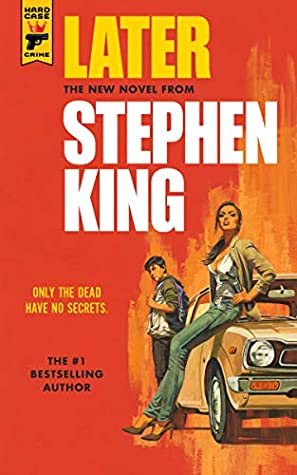
Kate’s Review: “The Other Black Girl”

Book: “The Other Black Girl” by Zakiya Dalila Harris

Publishing Info: Atria Books, June 2021

Where Did I Get This Book: I received an eARC from NetGalley.

Book Description: Get Out meets The Devil Wears Prada in this electric debut about the tension that unfurls when two young Black women meet against the starkly white backdrop of New York City book publishing.

Twenty-six-year-old editorial assistant Nella Rogers is tired of being the only Black employee at Wagner Books. Fed up with the isolation and microaggressions, she’s thrilled when Harlem-born and bred Hazel starts working in the cubicle beside hers. They’ve only just started comparing natural hair care regimens, though, when a string of uncomfortable events elevates Hazel to Office Darling, and Nella is left in the dust.

Then the notes begin to appear on Nella’s desk: LEAVE WAGNER. NOW. It’s hard to believe Hazel is behind these hostile messages. But as Nella starts to spiral and obsess over the sinister forces at play, she soon realizes that there’s a lot more at stake than just her career.

A whip-smart and dynamic thriller and sly social commentary that is perfect for anyone who has ever felt manipulated, threatened, or overlooked in the workplace, The Other Black Girl will keep you on the edge of your seat until the very last twist.

Review: Thank you to NetGalley for providing me with an eARC of this novel!

Satire and horror go together like cheese and crackers as far as I’m concerned, and I’m always looking for some good commentary in the horror stories that I consume. When I came across “The Other Black Girl” by Zakiya Dalila Harris on my Twitter feed, I was immediately interested. Described as a mix of “Get Out” and “The Devil Wears Prada”, I went to see if I had access to a copy on NetGalley, and downloaded it post haste. I’m always one for workplace drama thrillers, but even more important it’s always great to see more diverse voices have space in genres that can feel very white a lot of the time. And if you’re going to say “Get Out” as a descriptor, well, I’m almost certainly in.

“The Other Black Girl” definitely lives up to the pop culture descriptors, though I would also throw in the horror movie “Bad Hair” as well, as “The Other Black Girl” takes on not only racism and microaggressions, but specifically Misogynoir in a work place that doesn’t think it has a racism problem, and weaponized tokenism. Our main character is Nella, an editorial assistant at the prestigious Wagner publishing house, and is the only Black woman in her department. Her job is exhausting enough on its own, and having to maneuver a work place that is filled with seemingly well intentioned white people who are constantly tossing microaggressions her way just makes it all the more isolating and tiring. Harris does a really good job of establishing the work environment and culture of Wagner, and how it bogs Nella down. Nella is a sympathetic and relatable protagonist, who is really hoping for success at Wagner, but is also insecure in her wants and needs to be accepted by a workplace that doesn’t really give her a chance. From the jump, you understand Nella, and her characterization is drawn in a way that her choices down the line make sense.

So when Hazel is hired on, Nella’s relief and excitement is palpable that she may at least have a companion in this difficult sea to navigate. Of course, nothing is ever that easy, and what seems could be a racist and sexist industry making two Black women feel like they have to be pitted against each other, is actually something far more insidious. What that is, we don’t know, but Harris is more than happy to slowly unpack and reveal darker and more far reaching dangers for Nella, all of it satirizing and critiquing white industries and how they treat their Black employees, and how these power structures can in turn make these employees feel the need to outgun each other, or conform to racist mores in order to succeed. Especially if those employees are women. And while these themes may be taken to outlandish places within this story (I’m holding this all close to the vest, though, as I think you need to go in with little idea of where Harris is going to take you), as satire is works really, really well.

And as a thriller novel, I’d even go so far as to say horror novel, “The Other Black Girl” is completely effective. I was totally sucked in right away, wondering who was trying to intimidate Nella, wondering what Hazel’s motivation was, and wondering how everything connected. Especially since early one, we see that there are other players who are a part of this story, some of whom we don’t know how they connect to Nella’s situation. I loved how Harris slowly established settings, timelines, and players, and then carefully and slowly brought them together. While sometimes the structure could be a little confusing (there were moments where we’d go into an extended flashback in the middle of an action point, which caused a little whiplash), overall I felt that all the pieces fall into place when they need to. On top of that, there is also a lot of humor in these pages, most of which comes from Nella’s close friend Malaika, who is a bit more confident and willing to give Nella some hard truths with wit and sarcasm. All of these things make this book not only a biting social commentary, but also super entertaining and a page turner until the very end.

“The Other Black Girl” is a buzz worthy and propelling horror-thriller that has a lot to say about Misogynoir and racism. If you like satire in your horror like I do, absolutely do not miss this.

Rating 9: A suspenseful an satirical horror-thriller about race, identity, and the workplace, “The Other Black Girl” has bite and hard truths, as well as some genuinely funny moments.

Reader’s Advisory:

“The Other Black Girl” is included on the Goodreads lists “Well-Read Black Girl Book Suggestions”, and “Horror/Thriller Books by Black Authors”.

Find “The Other Black Girl” at your library using WorldCat, or at a local independent bookstore using IndieBound!

Kate’s Review: “While Justice Sleeps”

Book: “While Justice Sleeps” by Stacey Abrams

Publishing Info: Doubleday, May 2021

Where Did I Get This Book: I received an eARC from NetGalley.

Book Description: Avery Keene, a brilliant young law clerk for the legendary Justice Howard Wynn, is doing her best to hold her life together–excelling in an arduous job with the court while also dealing with a troubled family. When the shocking news breaks that Justice Wynn–the cantankerous swing vote on many current high-profile cases–has slipped into a coma, Avery’s life turns upside down. She is immediately notified that Justice Wynn has left instructions for her to serve as his legal guardian and power of attorney. Plunged into an explosive role she never anticipated, Avery finds that Justice Wynn had been secretly researching one of the most controversial cases before the court–a proposed merger between an American biotech company and an Indian genetics firm, which promises to unleash breathtaking results in the medical field. She also discovers that Wynn suspected a dangerously related conspiracy that infiltrates the highest power corridors of Washington.

As political wrangling ensues in Washington to potentially replace the ailing judge whose life and survival Avery controls, she begins to unravel a carefully constructed, chesslike sequence of clues left behind by Wynn. She comes to see that Wynn had a much more personal stake in the controversial case and realizes his complex puzzle will lead her directly into harm’s way in order to find the truth. While Justice Sleeps is a cunningly crafted, sophisticated novel, layered with myriad twists and a vibrant cast of characters. Drawing on her astute inside knowledge of the court and political landscape, Stacey Abrams shows herself to be not only a force for good in politics and voter fairness but also a major new talent in suspense fiction.

Review: Thank you to NetGalley for providing me with an eARC of this novel!

Back in November of 2020, when it was clear that Georgia was going to go into a run off for their senate seats in January of 2021, my parents were expressing hesitance that Georgia could possibly go blue. While I didn’t want to get my hopes up, of course, I just kept saying ‘don’t underestimate Stacey Abrams’. I then got to tell them that not only is Abrams a political dynamo, but that she is also a published author of romance novels (as well as a fan fiction writer too, because she is also a great big nerd, which is great). Shortly thereafter, I saw that Abrams had a new book coming out, but this time it was going to be a thriller. I was VERY interested in seeing what that was going to be like, and assumed that at the very least it would be well written and entertaining, as well as a fun read given how well versed in the ups and downs of the political world she is.

Abrams takes it even further than I anticipated, and what I found was a very complex and intricate legal and political thriller. Given that I don’t usually gravitate towards thrillers that involve politics (sometimes I’ll go the legal route, if it’s soapy enough), “When Justice Sleeps” was a fairly new experience for me. I’m glad that it was Abrams’s vision and story that took me down this road, because I think that had it been in anyone else’s hands I may have given up. But the biggest strength for this story for me was our protagonist, Avery Keene. For one, it’s always nice to see a woman protagonist in stories that perhaps have gravitated more towards male characters in the past. For another, Avery is a biracial woman whose merits and talents are sharp just as her personality and personal life have relatable highs and lows. Watching her have to not only deal with her boss and mentor be suddenly thrown into a coma, but also have to deal with the scrutiny of being a young, biracial woman thrown into the spotlight because of being named his power of attorney, was riveting in and of itself. She is very easy to root for, and works well as an entry point for the reader to take on some really complex issues in the legal world, the political world, and the medical world.

In terms of the plot and the mystery that Avery has to take on, it’s a doozy. We have a lot of different components, from corporate mergers to the reaches of the Supreme Court to genetics testing to the White House to chess metaphors. As mentioned above, I wasn’t expecting it to be as complicated as it is, and keeping all of the moving parts in order was, at times a little hard for me to do. But Abrams always veers us back on track, bringing in reveals at the right times and finely connecting all of the puzzle pieces, no matter how far flung they are from each other. For someone like me, who doesn’t usually take on this kind of carefully and masterfully woven conspiracy thriller, it was a lot, and it led to brain overload on more than one occasion. But for someone who loves these kinds of wide reaching and well oiled conspiracy thrillers that dabble in lots of themes (like my Dad, for instance)? This will probably hit all the right notes for that kind of reader. I am considering looking into some of her romance work, because my guess is that it is also super well done, which just solidifies the point that Stacey Abrams is an amazing human being who can really do just about anything.

I definitely recommend giving “While Justice Sleeps” a go if you like political and legal thrillers. If you’re like me and are not as versed, you will still find things to like, even if you have a hard time keeping up. Now which of her romance novels should I try on for size?

Rating 7: A complex and intricately crafted thriller that has a deep conspiracy theme, “While Justice Sleeps” was a little too serpentine for me, but almost assuredly will be a hit for political and legal thriller fans.

Reader’s Advisory:

“While Justice Sleeps” is included on the Goodreads lists “Mysteries/Thrillers by BIPOC Authors”, and “Reading Women Challenge 2021 #17: Women in Politics”.

Find “While Justice Sleeps” at your library using WorldCat, or a local independent bookstore using IndieBound!
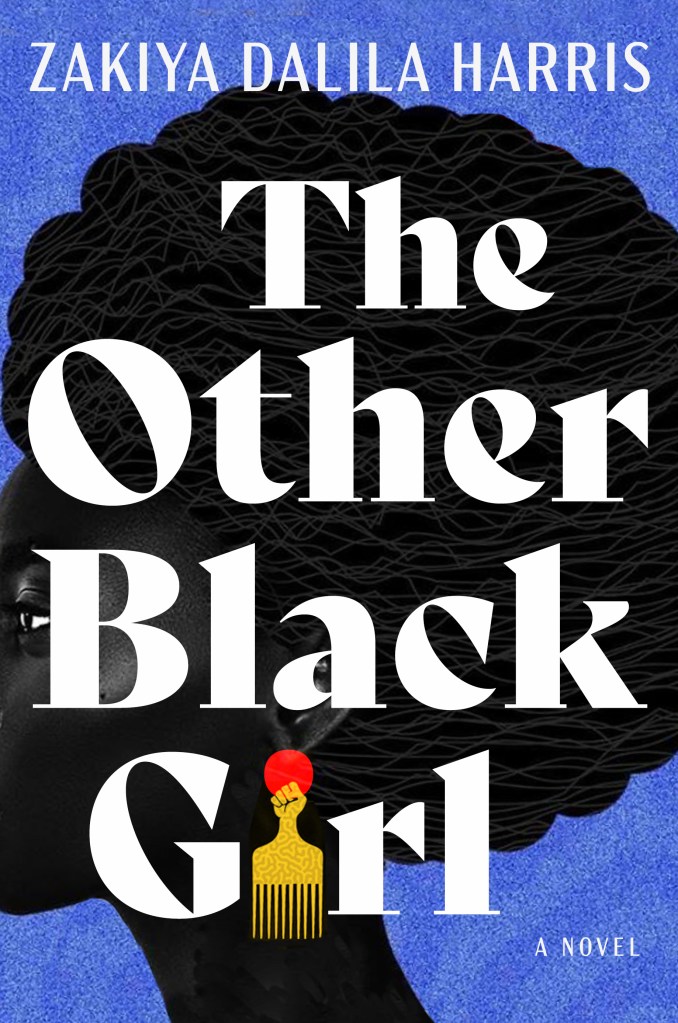
Kate’s Review: “Later”

Book: “Later” by Stephen King

Publishing Info: Hard Case Crime, March 2021

Where Did I Get This Book: The library!

Book Description: The son of a struggling single mother, Jamie Conklin just wants an ordinary childhood. But Jamie is no ordinary child. Born with an unnatural ability his mom urges him to keep secret, Jamie can see what no one else can see and learn what no one else can learn. But the cost of using this ability is higher than Jamie can imagine – as he discovers when an NYPD detective draws him into the pursuit of a killer who has threatened to strike from beyond the grave.

Later is Stephen King at his finest, a terrifying and touching story of innocence lost and the trials that test our sense of right and wrong. With echoes of King’s classic novel IT, Later is a powerful, haunting, unforgettable exploration of what it takes to stand up to evil in all the faces it wears. 

Review: I’ve spent twenty plus years of my life reading Stephen King, and I imagine that I will keep on going for another however many years he continues to write. He rarely lets me down (even when I come across the occasional clunker I still feel like it was generally worth my time), and it’s even MORE exciting when he tries out other genres beyond his usual horror fare. This brings us to “Later”, his most recent work and also his most recent title he’s done with Hard Case Crime, an imprint which tends to focus on gritty crime fiction. Hey, sign me up regardless, but one thing that I can count on when it comes to King is that he is probably going to throw SOME kind of supernatural spin into most of his books. “Later” is no exception, and King melds the hard boiled crime and supernatural horror paths seamlessly.

“Later” is a fast paced crime tale told through the perspective of Jamie Conklin, a young man who has had the ability to see and speak to ghosts ever since he was a kid. This story focuses on his youth, from how he first realized he had this power (told in a gruesome scene involving a dead bicyclist), to how his power scared but also helped his single mother Tia, to how it was exploited by Liz, Tia’s onetime girlfriend and NYPD detective. King has always had a true talent for capturing the minds and personalities of kids, and while narrator Jamie is an adult, the story is his childhood, and boy does it feel realistic in its voice. Like other kids in King’s works, Jamie is slightly precocious but not too forced, and his childhood interactions with his mother, his friends, and the ghosts that he sees range from the charming to the heartbreaking to the terrifying. I’m a true sucker for any story that has to do with people who can speak to the dead, and Jamie’s story really hit all of the notes that I like in this trope. I also liked how we get to know Tia through Jamie’s eyes, with King throwing in enough details about her that their relationship is well thought out and quite lovely. Our antagonists, primarily Liz and a spectre named Therriault (maybe a sly reference to Roch Thériault? SUPER creepy if so!), are menacing in their own ways. For Therriault it’s the obvious, being a malevolent spirit that has started to harass Jamie whose stalking and description will surely send chills up anyone’s spine. But Liz is far more insidious, as she is a corrupt cop who uses her power, her charm, and her authority to manipulate, and hurt, those around her. Her renegade nature could have been used to prop her up as an anti-hero, as some hard boiled detective stories do. But King just shows us what so many of these ‘renegade’ cops are: super, super dangerous.

And as we’ve learned, King has a real delight in calling back to some of his previous works (and also the works of his son, Joe Hill, those easter eggs are especially fun to spot). For some people this may seem hokey, but I eat it up and revel in it whenever it happens. And this time, King pulls out a heavy hitter, one that I didn’t expect from a story that has been published with a crime imprint. SPOILER ALERT HERE!!! Skip to the last paragraph if you don’t want to know! I won’t go into TOO much detail, but if you know, you know (and thanks to a certain recent film franchise, you probably know): One of the characters asks Jamie if he’s ever heard of something called “The Ritual of Chüd”. THIS IS IN THE “IT” UNIVERSE, FOLKS!!!

I can assure you, the amount of excited screeching I did was copious. (source)

Like I said, I don’t want to give too much away, but King takes a concept that feels like it couldn’t work outside of “It”, and applies it to this story without it feeling too forced or hackneyed. I mean, he made a revisit to “It” work in “11/22/63”, so I shouldn’t be surprised that he made it work here as well. And none of this is to say that you have to have read “It” for this entire aspect to work. You don’t. King gets you caught up to speed quickly, and it feels like its own thing in these pages. It totally works.

If there is a qualm I had with this book, there is a quick curveball thrown in at the end that made me go ‘wait, WHAT?’. It doesn’t derail anything or totally throw the entire story out of whack, but it was a momentary blip that felt unnecessary. Superfluous may be the better word. But overall, I found “Later” to be enjoyable and unsettling. For a fast read with a kid who can talk to ghosts, this is the book to check out!

Rating 8: A fast paced and at times very creepy thriller, “Later” has a hard boiled feel to it while harkening back to one of King’s most beloved stories.

Reader’s Advisory:

“Later” is included on the Goodreads lists “I See Dead People”, and “Books About People with Strange Powers”.

Find “Later” at your library using WorldCat, or at a local independent bookstore using IndieBound!

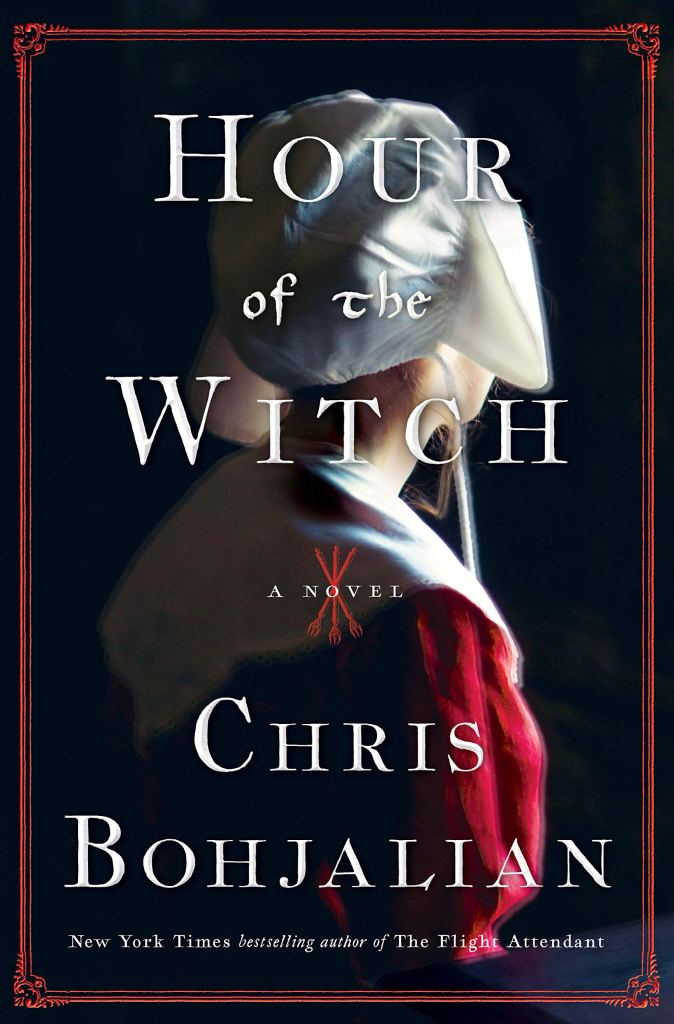
Kate’s Review: “Hour of the Witch”

Book: “Hour of the Witch” by Chris Bohjalian

Publishing Info: Doubleday Books, May 2021

Where Did I Get This Book: I received an eARC from NetGalley.

Book Description: A young Puritan woman–faithful, resourceful, but afraid of the demons that dog her soul–plots her escape from a violent marriage in this riveting and propulsive historical thriller from the #1 New York Times bestselling author of The Flight Attendant.

Boston, 1662. Mary Deerfield is twenty-four-years-old. Her skin is porcelain, her eyes delft blue, and in England she might have had many suitors. But here in the New World, amid this community of saints, Mary is the second wife of Thomas Deerfield, a man as cruel as he is powerful. When Thomas, prone to drunken rage, drives a three-tined fork into the back of Mary’s hand, she resolves that she must divorce him to save her life. But in a world where every neighbor is watching for signs of the devil, a woman like Mary–a woman who harbors secret desires and finds it difficult to tolerate the brazen hypocrisy of so many men in the colony–soon finds herself the object of suspicion and rumor. When tainted objects are discovered buried in Mary’s garden, when a boy she has treated with herbs and simples dies, and when their servant girl runs screaming in fright from her home, Mary must fight to not only escape her marriage, but also the gallows. A twisting, tightly plotted thriller from one of our greatest storytellers, Hour of the Witch is a timely and terrifying novel of socially sanctioned brutality and the original American witch hunt.

Review: Thank you to NetGalley for providing me with an eARC of this novel!

Back in middle school I decided to read “The Crucible” by Arthur Miller, after my drama class chose it as one of the scenes that we’d perform and I was voted to be Mary Warren in said scene. After reading the whole play my thirteen year old self was super indignant, and I basically have had a seething anger deep in my soul for any kind of witchcraft or Satanic Panic fueled hysteria ever since. Because of this, I was eager to snatch up the new historical fiction thriller “Hour of the Witch” by Chris Bohjalian. I’ve enjoyed Bohjalian’s stories in the past, I love me a good historical fiction thriller, and demolishing the Patriarchy in Puritan times? We ALL know how I feel about that!

Yes please. (source)

Now I don’t want anyone thinking that “Hour of the Witch” is a pro-Witchcraft-As-Way-To-Smash-Misogyny kind of tale. Instead, Bohjalian takes the idea of a community turning on a strong minded woman and tries to tell it in a way that would be realistic towards the time and culture. Mary isn’t a woman who ends up turning to Satan because it’s the only clear path to agency in her life. Instead, we get a tale of a woman who dares stand up for herself and wants to advocate for her health and happiness against an abusive husband while still being God fearing and devout, and while also questioning power structures that are hypocritical. I admittedly don’t have as much breadth of knowledge in this part of American history and Puritan times, but from the historical notes in the back it seems like Bohjalian did his very best to make it realistic, and therein I found Mary to be believable. Her story of trying to divorce her abusive husband Thomas, and being the target of scorn and then witchcraft accusations for daring to push against the misogynistic norms, is suspenseful, frustrating, and incredibly readable. I loved Mary as a character, and seeing her fight in the face of powerful and abusive men was both cathartic, but also tense, as we all know how the power structures during the Puritan times could easily cry ‘witch’ and have a person killed (that said, while this story really does a good job of addressing the oppression that women faced, little is noted of the Indigenous groups in the area. I’m not sure how Bohjalian could have tackled such a huge aspect from Mary’s perspective without feeding into paternalistic or oppressive views, but when the groups were mentioned it felt like a nod without doing much work beyond that. Take that as you will).

In terms of plot, “Hour of the Witch” is definitely steeped in suspense, as well as a little bit of mystery. Working against Mary in her endeavors are her husband’s standing in the community, the fact that no one has seen him hurt her as he’s always careful to do it when they are alone, and the fact that some three tined forks were found buried in her yard, which at the time were thought to be ‘the devils tines’ due to the three prongs resembling a pitchfork (side note: when I worked at a historic fort that had a context set during the Georgian period, a dining demonstration did mention the lack of three tined forks in America in spite of the fact they were prevalent in Europe. We didn’t talk about ‘the devils tines’ aspect, however). The questions are 1) is Mary going to be able to escape her husband without being convicted of witchcraft, and 2) who IS the one who is setting her up to look like a witch? Such moments will make you shake with rage, but it also just goes to show that some things never change. Mary is accused of lying for attention, lying to offset the fact she hasn’t been able to have children as of yet, lying because she’s lustful, and lying because she’s a witch. These days, maybe we don’t see as much ‘witch’ stuff, but the rest of those accusations against an abused woman in hopes of painting her as a liar are all too familiar. And as for what is really going on with the buried forks in her yard, I really enjoyed trying to figure out what was going on there, as Bohjalian has a whole SLEW of suspects and possibilities, some one which are not as they seem. I was left on pins and needles worrying about what was going to happen to Mary, as well as wanting to spit nails out of rage when looking at how the men in the community (with a couple exceptions) and some of the women were treating her because of the misogyny that was rife. BE PREPARED TO BE MAD.

Overall, I thought that “Hour of the Witch” was a pretty good read, with a unique setting that felt timeless all the same. It may not be the Satanic feminism that I tend to love, but I still enjoyed it!

Rating 8: Suspenseful and unique in voice and setting, “Hour of the Witch” tells a tale as old as time about misogyny, women, and a society that uses one to keep the other in its place no matter what the outcome.

Reader’s Advisory:

“Hour of the Witch” is included on the Goodreads lists “Witch Hunts in Historical Fiction”, and “2021 Gothic”.

Find “Hour of the Witch” at your library using WorldCat, or a local independent bookstore using IndieBound!
Kate’s Review: “Don’t Tell a Soul”

Book: “Don’t Tell a Soul” by Kirsten Miller

Publishing Info: Delacorte Press, January 2021

Where Did I Get This Book: I received an eARC from NetGalley.

Book Description: People say the house is cursed. It preys on the weakest, and young women are its favorite victims. In Louth, they’re called the Dead Girls.

All Bram wanted was to disappear—from her old life, her family’s past, and from the scandal that continues to haunt her. The only place left to go is Louth, the tiny town on the Hudson River where her uncle, James, has been renovating an old mansion. But James is haunted by his own ghosts. Months earlier, his beloved wife died in a fire that people say was set by her daughter. The tragedy left James a shell of the man Bram knew—and destroyed half the house he’d so lovingly restored.

The manor is creepy, and so are the locals. The people of Louth don’t want outsiders like Bram in their town, and with each passing day she’s discovering that the rumors they spread are just as disturbing as the secrets they hide. Most frightening of all are the legends they tell about the Dead Girls. Girls whose lives were cut short in the very house Bram now calls home.

The terrifying reality is that the Dead Girls may have never left the manor. And if Bram looks too hard into the town’s haunted past, she might not either.

Review: Thank you to NetGalley for providing me with an eARC of this novel!

I decided to pick up “Don’t Tell a Soul” by Kirsten Miller after a Minnesota snow storm, one of the first of the season and no doubt a precursor to a long winter ahead. There is just something about the dead of winter that makes a haunted house story feel all the more ominous, probably the isolation factor (which is amped up by the pandemic we are facing right now), and while my review is just now coming out in the Spring, I will say that had I read it now that feeling would have been different. I hadn’t read anything by Miller before this book, so I had no idea what to expect. All I wanted was something creepy and satisfying to match the atmosphere, as well as a story that would keep me on my toes and tick all the boxes of a genre that I love. And I didn’t really get that from this book, unfortunately.

We will start with what I did like about this book. For one, there were some really creepy moments within the manor house, moments that felt like they could have fit right in in a classic haunted house story. From flashes of someone running across the property at night, to the sense of someone standing just around the doorway but right out of sight, the unsettling moments were crafted and described very well. I also liked how Miller takes the idea of the tragic woman in a Gothic haunted house story and tweaks with it a bit. There was a line I loved in particular, “Ghosts and girls go hand in hand. Why do you suppose that is?” It gave me chills, as so many ghost stories, especially in this subgenre, do have to do with women who were probably victims in one way or another. Instead of running with the outcome as interesting, Miller decides to look at the victimization at hand and show the injustice of that. Many of the women in this story are victims of misogyny and rape culture, and there is a lot of pushback against that, which I appreciated.

But the qualms I had with “Don’t Tell a Soul” skewed my ultimate enjoyment of the novel. For one, while we get a lot of hints about Bram’s tragic backstory, up until the reveals about her circumstances we get a lot of ‘other girls aren’t like me’ and ‘but if they knew who I REALLY was they wouldn’t think that’ kind of malarky that I find frustrating. “I’m Not Like Other Girls” is frustrating when it’s used to make a girl seem cooler, and it’s just as frustrating when it’s used to make a girl seem tragic. By the time we did find out what was going on with her, the build up didn’t match the way that it was just kind of stated and then not explored. It also felt like a lot of the people in her circles were just there to be awful and unsympathetic to bolster her tragic-ness, but it made them feel more two dimensionally villain-y than actual real world problematic people. On top of all that, while I DID like how Miller takes apart the idea of the ‘crazy girl in the haunted manor’ trope we’ve seen many a time before, it was done in a lot of heavy handed ways that felt more like telling as opposed to showing.

My biggest problem, however, was that while “Don’t Tell a Soul” wanted to make good points about misogyny and the dangers that women face, too often was the bad behavior of certain men written off as okay. There were many times where Bram was feeling intimidated by local men in the town, while characters who are supposed to be ‘good’ would tell her that she didn’t have anything to worry about when it came to them. My biggest issue of this was with the character Maisie. Maisie is a local girl who befriends Bram, and is there to be the character that makes you question the ‘crazy woman’ tropes, as she actively pushes back against it in theory, and also has to deal with a mother who has a reputation for being a crazy alcoholic (but is in actuality dealing with trauma). Maisie continuously brings up some really good points, but she herself is toxic in many ways. One of the biggest examples was how she was quick to defend the very clearly abusive and bad behavior of local men (spoilers here: at one point in hopes of ‘saving’ Bram from a situation, she literally gets two local men to kidnap her and tries to write it off as ‘oh their intentions were good you don’t have to worry about the men here’. WHAT THE FUCK). I was fine with the taking down of the privileged wealthy men who were abusing the town and its locals in various ways, but it felt like others who were behaving in other bad ways got more of a pass, and that didn’t sit right.

Overall, I found “Don’t Tell a Soul” mundane and frustrating. There were glimmers here and there, but it missed the mark for me.

Rating 5: Character development felt left behind in favor of messaging, but “Don’t Tell a Soul” brings up some interesting, though not terribly unique, points about misogyny.

Reader’s Advisory:

“Don’t Tell a Soul” is included on the Goodreads list “2021 YA Mysteries and Thrillers”.

Find “Don’t Tell a Soul” at your library using WorldCat, or a local independent bookstore using IndieBound!

Kate’s Review: “Mirrorland”

Book: “Mirrorland” by Carole Johnstone

Publishing Info: Scribner, April 2021

Where Did I Get This Book: I received an ARC from the publisher.

Book Description: With the startling twists of Gone Girl and the haunting emotional power of Room, Mirrorland is a thrilling work of psychological suspense about twin sisters, the man they both love, and the dark childhood they can’t leave behind.

Cat lives in Los Angeles, far away from 36 Westeryk Road, the imposing gothic house in Edinburgh where she and her estranged twin sister, El, grew up. As girls, they invented Mirrorland, a dark, imaginary place under the pantry stairs full of pirates, witches, and clowns. These days Cat rarely thinks about their childhood home, or the fact that El now lives there with her husband Ross.

But when El mysteriously disappears after going out on her sailboat, Cat is forced to return to 36 Westeryk Road, which has scarcely changed in twenty years. The grand old house is still full of shadowy corners, and at every turn Cat finds herself stumbling on long-held secrets and terrifying ghosts from the past. Because someone—El?—has left Cat clues in almost every room: a treasure hunt that leads right back to Mirrorland, where she knows the truth lies crouched and waiting…

A twisty, dark, and brilliantly crafted thriller about love and betrayal, redemption and revenge, Mirrorland is a propulsive, page-turning debut about the power of imagination and the price of freedom.

Review: Thank you to Scribner for sending me an ARC of this novel!

Right before I picked up “Mirrorland” by Carole Johnstone, I gave up on a thriller novel involving twin women, one of whom goes missing off a boat, and the other who finds herself getting closer to her twin’s husband after her sister’s supposed death. I actually ended up giving up on it, and it just wasn’t gelling with me. So imagine my double take when I picked up “Mirrorland”, and found a story about twin women, one of who goes missing off a boat, and the other getting closer to the MIA twin’s husband. Coincidence like whoa! Very “Dante’s Peak” and “Volcano”! All that aside, I did find myself more interested in “Mirrorland”, and didn’t find it hard to finish. But that only gets one so far.

“Mirrorland” has a lot of promise and potential that made me interested to read it, but the execution was a little lackluster. In terms of the good, I loved seeing Cat try to hunt through her old home, finding out piece by piece what someone (could it be El?) has left for her to find. As she slowly peels back the clues and starts to piece together what could have happened to her sister, we get a really fun narrative device that feels like it could also be unreliable. I also liked slowly learning about what Mirrorland’s purpose was for Cat and El, and the slow reveal as to what their home life was like that necessitated a place like Mirrorland. There were genuine surprises to go with it, and some of the big reveals totally caught me off guard.

But that is part of the problem with this book. For a few of the twists and reveals, one in particular that I don’t want to go into too much detail about, we have to really, REALLY do some suspension of disbelief and plot gymnastics for it to work. By the time we got to that big reveal, it was so out of left field that we had to have a character actively sit down and explain it, in the ultimate telling versus showing strategy. It feels a lot like the end of “Psycho”, where we get a stilted monologue about what the heck was going on with Norman Bates kind of offsets the entire film. It doesn’t work very well there, and it doesn’t work very well here either. And really, it’s so farfetched and unbelievable, and the story before it isn’t strong enough to make up for it (unlike “Psycho”). I was kind of flabbergasted that we got all of the wrap up in a monologue, as that feels like a big no no to me.

And to add insult to injury, I really didn’t connect with any of the characters. The only one that we really got to know was Cat, and she didn’t feel like she was reinventing the wheel when it comes to unreliable and tortured protagonists in stories like this one. And everyone else fit into very familiar and well worn tropes we see in the genre without really exploring beyond. Overall, it just felt like more of the same. While I definitely don’t doubt that this book and the book I had given up on previously were complete coincidences when it came to plot details and ideas, the fact remains that there just didn’t feel like there was a lot of originality going on in this book, nor were the characters people I was invested in.

“Mirrorland” was a bit of a letdown. Books don’t always have to reinvent the wheel, but if you’re going to lean into familiar themes and ideas, I want a seamless execution.

Rating 5: Lots of twists and turns, but some real plot gymnastics to make some of them work and not terribly interesting characters makes “Mirrorland” a bit of a letdown.

Reader’s Advisory:

“Mirrorland” is included on the Goodreads list “Mystery & Thriller 2021”.

Find “Mirrorland” at your library using WorldCat, or at a local independent bookstore using IndieBound!