
Monthly Marillier: “Wildwood Dancing”

“Monthly Marillier” is a review series that is, essentially, an excuse for me to go back and re-read one of my favorite author’s back catalog. Ever since I first discovered her work over fifteen years ago, Juliet Marillier has been one of my favorite authors. Her stories are the perfect mixture of so many things I love: strong heroines, beautiful romances, fairytale-like magic, and whimsical writing. Even better, Marillier is a prolific author and has regularly put out new books almost once a year since I began following her. I own almost all of them, and most of those I’ve read several times. Tor began re-releasing her original Sevenwaters trilogy, so that’s all the excuse I needed to begin a new series in which I indulge myself in a massive re-read of her books. I’ll be posting a new entry in this series on the first Friday of every month.
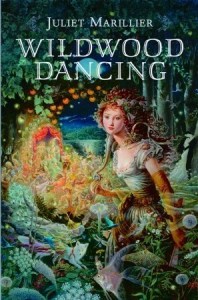
Book: “Wildwood Dancing” by Juliet Marillier

Publishing Info: Alfred A. Knopf, January 2007

Where Did I Get this Book: own it!

Book Description: High in the Transylvanian woods, at the castle Piscul Draculi, live five daughters and their doting father. It’s an idyllic life for Jena, the second eldest, who spends her time exploring the mysterious forest with her constant companion, a most unusual frog. But best by far is the castle’s hidden portal, known only to the sisters. Every Full Moon, they alone can pass through it into the enchanted world of the Other Kingdom. There they dance through the night with the fey creatures of this magical realm.

But their peace is shattered when Father falls ill and must go to the southern parts to recover, for that is when cousin Cezar arrives. Though he’s there to help the girls survive the brutal winter, Jena suspects he has darker motives in store. Meanwhile, Jena’s sister has fallen in love with a dangerous creature of the Other Kingdom–an impossible union it’s up to Jena to stop.

When Cezar’s grip of power begins to tighten, at stake is everything Jena loves: her home, her family, and the Other Kingdom she has come to cherish. To save her world, Jena will be tested in ways she can’t imagine–tests of trust, strength, and true love.

Review: Obviously, I love fairytale re-tellings. But as the genre goes, there are definitely more popular fairytales than others to receive this treatment. For example, there are a million and one stories reimagining “Beauty and the Beast” or “Cinderella.” And just this summer, we’re seeing three separate books coming out retelling variations of “Little Red Riding Hood.” But two of my favorite fairytales, “The Seven Swans” and “The Twelve Dancing Princesses,” definitely fall in the “less likely” category for stories to be rewritten. Luckily for me, one of my favorite authors has written my favorite versions of both of these stories. I’ve already covered “Daughter of the Forest,” so now it’s time for Marillier’s take on “The Twelve Dancing Princesses.”

To others, Jena’s home may seem strange and even possibly dangerous. But she’s always loved the ramshackle castle and the mysterious woods that surround it. Wandering the wilds with her beloved frog, Gogu, Jena know that magic exists in this place. Every full moon, she and her four sisters travel in secret to the land of the fairies where they spend a night dancing and enjoying the revels of that strange world. But when Jena’s father becomes sick and leaves the management of the household to Jena herself, the magic that once made up her life seems to begin to turn dark. With threats looming in both the world of the fairies and in her own, very human world, Jena desperately tries to find the strength within to hold on tight to those she loves.

There are many things to like about this book. For one thing, it’s one of the first YA fantasy stories I read by Marillier. As such, the tone of the story and the trials her characters face are different than her adult books. While the story still has darker moments, overall, the tone of the story is light and bright. The wonders of the full moon balls were probably some of the best scenes of the book, perfectly capturing the magic of these visits with small details about the music, ballgowns, and strange attendees who made up these affairs. It is easy for readers to immediately come down on Jena’s view of this magical world, both the joys it can present but also the dangers that lurk beneath the surface.

I also really liked the side characters in this book. All of Jena’s sister felt distinct and had their own moments and mini arcs/stakes at play throughout the story. I would at turns find myself rooting for each of them and then, conversely, massively rolling my eyes at some of their nonsense. Tati, for example, the eldest sister who falls in love with a young man from the fairy world, is always a struggle for me. “Dying for love” is just not something I can really get behind, especially not in the circumstances given here where Tati’s lack of will to live, essentially, is not only dooming herself but leaving her sisters alone to cope with the very real, very present challenges before them.

I also really enjoyed the various relationships highlighted in this story. Obviously, there’s quite a lot of attention given to sisterhood, espeically as Jena sees her role in regards to her sisters, learning lessons about the difference between loving someone enough to let them make their own way and holding on too tightly. But there’s also a lot of attention given to friendship, that between Jena and her frog, Gogu, as well as the increasingly tense relationship between Jena and her cousin, Cezar. There we see how the choices we make not only change ourselves, but they change the relationships we have with people as well. The romance was also very sweet and original in this story, taking a winding path and drastically veering away from the traditional fairytale’s version.

Jena is also an excellent main character. And part of what makes her excellent is how very frustrating I often found her to be. If there’s on criticism that I’ve leveled the most against Marillier’s books up to this point, it’s that her main characters are a bit too perfect. That is definitely not the case here. Jena is presented as a highly capable young woman, but this same high level of ability is also her greatest weakness throughout the book. Again and again, we see Jena fail to trust those around her to help her deal with the challenges before her. Instead, she attempts to manage things (and people!) that aren’t her responsibility or things she has no right to direct. There are a couple of choices and moments that are very tough to read, as Jena so clearly ignores the common sense and warnings that the reader is picking up on. However, all of this is also very intentionally written in and included in Jena’s overall arch of self-discovery and growth.

This is one of my favorite Marillier books to go back and re-read. I’ve included it in lists in the past as a comfort read type of book, and that it remains. The story is fast-moving, the magic is beautiful and unique, and I love the friendships and romance at the heart of the story.

Rating 8: The best version of “The Twelve Dancing Princesses” that I have yet to find.

Reader’s Advisory:

“Wildwood Dancing” is on these Goodreads lists: Books about Faery and 12 Dancing Princesses Retellings.

Find “Wildwood Dancing” at your library using WorldCat!

Kate’s Review: “Sheets”

Book: “Sheets” by Brenna Thummler

Publishing Info: Oni Press, August 2018

Where Did I Get This Book: The Library!

Book Description: Marjorie Glatt feels like a ghost. A practical thirteen year old in charge of the family laundry business, her daily routine features unforgiving customers, unbearable P.E. classes, and the fastidious Mr. Saubertuck who is committed to destroying everything she’s worked for.

Wendell is a ghost. A boy who lost his life much too young, his daily routine features ineffective death therapy, a sheet-dependent identity, and a dangerous need to seek purpose in the forbidden human world.

When their worlds collide, Marjorie is confronted by unexplainable disasters as Wendell transforms Glatt’s Laundry into his midnight playground, appearing as a mere sheet during the day. While Wendell attempts to create a new afterlife for himself, he unknowingly sabotages the life that Marjorie is struggling to maintain.

Review: Who says that ghost stories need to be scary? I know that when I cover them on this blog, they usually are. But there are also kind and friendly spirits, not just ones that want to make peoples lives miserable. “Sheets” by Brenna Thummler is one such tale, a ghost story for kids, but instead of focusing on scares and bumps in the night, it takes on friendship, loss, and moving on from tragedy. All themes that can fit within a ghost story pretty well. I had high hopes for this story, as ghosts are definitely my jam. “Sheets”, however, didn’t really give me what I wanted from it.

But let’s talk about what I did like first. The themes I mentioned above are all very well done in the narrative. We have two main characters, both of whom are dealing with these themes in different ways. For Marjorie, a thirteen year old girl running the family laundromat, she is still mourning the loss of her mother and adjusting to her new life. Her father has been so depressed that he doesn’t leave his room, and Marjorie is left to care for her brother, the family business, and to take care of herself. On the other side of the coin is Wendell, a ghost who lives in a world of other ghosts (who all wear sheets) who died when he was very young. He doesn’t really feel like he fits in in his new afterlife, and decides to hitch a ghost bus (loved this idea!) back to the living world. Where he finds himself in Marjorie’s laundromat, and their worlds collide. Both characters are dealing with loss and sadness, and I thought that Brennan did a really good job of exploring grief in ways that kids could understand without being condescending or grim. I especially liked her take on what the Ghost world is like, with lots of different designs for a bunch of stereotypical sheet wearing ghosts and some really humorous moments.

My biggest qualms with this story, however, really dock the points that I would have given it. Namely, the complete lack of any empathetic, responsible, and caring adults in Marjorie’s life, bordering on complete criminal negligence. I understand that this is a book written with a kid protagonist, and as such needs to give the protagonist more agency and independence than a regular kid would have in the real world. But I really struggled with it in “Sheets”. Marjorie is a thirteen year old girl who is running the family business herself, as after her mother died her father has been completely overtaken by depression and barely leaves his room. And if that had been the extent of it, I might have been able to swallow it down. Depression can absolutely be completely hobbling, and it’s not unrealistic for him to fail his children and to have Marjorie feel like she needs to pick up the pieces. My BIGGEST problem is that the customers she does have aren’t asking ANY questions as to why this child is running this place! Hell, they even get mad at her when Wendell messes things up, more inconvenienced about their laundry than they are concerned about a child, a CHILD, having to run the business in which they are patronizing! We get a couple adults who do question her life and how she’s doing here and there, but it’s never pursued. Perhaps it is strange for me to be questioning this in a story about literal ghosts, but I couldn’t get past it. It seems really farfetched, and spoiler alert, it isn’t really resolved! We get a deus ex machina at the end and Marjorie is STILL running the darn laundromat instead of, you know, living her life as a child. I’m just not sure about what this tells kids about Marjorie’s circumstances. Because oh man, her Dad really needs to get his act together.

And this could possibly be because of the fact the story itself feels a bit half baked. Marjorie interacts with Wendell here and there, they never really have super in depth moments, but we just kind of have to believe that the way it all wraps up is because of their friendship, which I never felt like was really explored. There is a connection that Marjorie and Wendell share even before he became a ghost, but it feels convenient and twee, and not used enough that it really felt important. Had their connection been stronger, both before and after his death, it would have been a more enjoyable relationship. As it was, it was hard to invest in the two of them as friends.

I did like the artwork though! It’s quite unique, and the designs of the ghosts are pretty darn cute. And as someone who appreciates a nice color scheme, I really liked the palette in this one.

“Sheets” didn’t give me the feel good ghost story I was anticipating, but I absolutely can see myself recommending it to kids who are looking for something ghostly, though maybe not too scary.

Rating 6: A really good examination of different kinds of grief, but ultimately felt half baked and unrealistic (even taking into account we’re dealing with ghosts!).

Reader’s Advisory:

“Sheets” is included on the Goodreads lists “Spooky Graphic Novels for Kids”, and “Friendly Ghosts”.

Find “Sheets” at your library using WorldCat, or at a local independent bookstore using IndieBound!

Serena’s Review: “Whispers of Shadow and Flame”

Book: “Whispers of Shadow and Flame” by L. Penelope

Publishing Info: St. Martin’s Griffin, October 2019

Where Did I Get this Book: NetGalley

Book Description: The Mantle that separates the kingdoms of Elsira and Lagrimar is about to fall. And life will drastically change for both kingdoms.

Born with a deadly magic she cannot control, Kyara is forced to become an assassin. Known as the Poison Flame in the kingdom of Lagrimar, she is notorious and lethal, but secretly seeks freedom from both her untamed power and the blood spell that commands her. She is tasked with capturing the legendary rebel called the Shadowfox, but everything changes when she learns her target’s true identity.

Darvyn ol-Tahlyro may be the most powerful Earthsinger in generations, but guilt over those he couldn’t save tortures him daily. He isn’t sure he can trust the mysterious young woman who claims to need his help, but when he discovers Kyara can unlock the secrets of his past, he can’t stay away.

Kyara and Darvyn grapple with betrayal, old promises, and older prophecies—all while trying to stop a war. And when a new threat emerges, they must beat the odds to save both kingdoms.

Previously Reviewed: “Song of Blood and Stone”

Review: It’s been quite a while since I reviewed the first book in this series. I remember really enjoying it, but I’ll be honest, I had to go back and read my review to really catch up on the world and characters before requesting this one. However, given how positively I’d reviewed that book, I felt fairly confident in this second one, even if, sadly, it was following a separate set of characters than the ones I had grown to love. And while I did find this a quick read, it didn’t really hit home in the same way as that first entry.

Due to the powerful magic within her, Kyara’s life has not been her own. Instead of choosing her own path, she’s been forced to become an assassin, a notorious one at that, known as the Poison Flame. But when her most recent target turns out to be more than he seems, Kyara sees an opportunity to begin reclaiming her own power. For his part, Darvyn is also uniquely powerful, but has begun to sink under the weight of guilt and regret over those he wasn’t able to save. Together, Kyara and Darvyn will uncover truths and mysteries that have long been kept in the shadow. But to make their way forward, they will have to learn to trust each other.

While this book didn’t hit the same sweet spot as the first one, there were still several things to like about it. For one, I still really enjoy the world-building. The last book really delved into the way this world’s history and the magical barrier that has divided it in two has affected the various groups of people living on either side. We explored how history is told by the winner and how the responsibility for the welfare of people expands beyond borders and one’s own patriotism to one’s own homeland. But by the end of that book, that barrier was coming down. That left a lot of interesting new pathways open for this book to explore, and the worldbuilding and continued fleshing out of the various cultures and peoples of this world didn’t disappoint.

I also still really enjoy Penelope’s writing style. It’s quick, clear, and engaging. There are a number of magical elements and, of course, an entirely fictional world. It takes a strong writer to really ground those sorts of unknowns into an understandable and approachable block of text. Even while some parts of this story didn’t work for me, I still blazed through it in a few short days.

Surprising no one, perhaps, where this book stumbled for me was with the characters. Of course, I knew going in that we’d have a new batch of characters, but I was disappointed to not even see our original two in passing. Beyond that, the way the book is summarized leads readers to believe that the book will unfold in a similar way to the first, alternating between two lead characters’ POV. Sadly, no. There were way more characters than that! Somewhere between four and six, I’d say. Not only do I generally not prefer books with large ensemble casts of POV characters (it takes a really master-level hand at writing to make that many characters feel distinct and worthy of a reader’s interest and investment), but it also reduced the page time for the two characters who were still mean to be read as “main” characters. In the first book, there was plenty of time to become attached and invested in our leads. Here, I found myself really struggling to care overly much about either Kyara or Darvyn.

And while the author’s writing is up to the task of creating vast, complicated worlds and systems, it faltered with characterization. The overall tone of writing didn’t change from character to character, leaving Kyara and Darvyn, very different characters not only because of gender but also life experiences, reading almost identically to one another. There was also another character’s POV chapter that was writing in a completely different tense than the reset of the book, a HUGE pet peeve of mine. It always feels overly tricky and rarely is there any payoff for this choice (a notable exception and an excellent example of intentional use of this writing method would be N.K. Jemisin’s Broken Earth trilogy).

So, while I’m still intrigued by the world and the larger-scope conflict that has been brewing, I struggled to enjoy this book as much as I did the first. I’ll likely continue to the third, however, as I’m curious to see how the bigger mysteries will resolve.

Rating 7: Weak characterization let down a book with strong world-building and magical intrigue.

Reader’s Advisory:

“Whispers of Shadow and Flame” is on these these Goodreads lists: Black Women Heroines in Urban Fantasy, Paranormal Romance, and Science Fiction and Best Diverse Speculative Fiction.

Find “Whispers of Shadow and Flame” at your library using WorldCat!

Serena’s Review: “The Stolen Kingdom”

Book: “The Stolen Kingdom” by Jillian Boehme

Publishing Info: Tor Teen, March 2021

Where Did I Get this Book: NetGalley

Book Description: For a hundred years, the once-prosperous kingdom of Perin Faye has suffered under the rule of the greedy and power-hungry Thungrave kings. Maralyth Graylaern, a vintner’s daughter, has no idea her hidden magical power is proof of a secret bloodline and claim to the throne. Alac Thungrave, the king’s second son, has always been uncomfortable with his position as the spare heir—and the dark, stolen magic that comes with ruling.

When Maralyth becomes embroiled in a plot to murder the royal family and seize the throne, a cat-and-mouse chase ensues in an adventure of dark magic, court intrigue, and forbidden love.

Review: I’m always down for some good ole court intrigue, which is why I initially requested this book. Of course, that’s also one of those phrases that book blurbs often use that more often than not simply translates to “unrealistic drama” of the sort that reduces me to eye rolls. Sadly, that was the case here.

Maralyth has grown up helping to run her father’s renown vineyard. Though she is skilled at tending the vines (more so than her family even knows, with a magical ability to help plant flourish), she finds herself minding the kitchen and serving the workers meals after her mother dies, leaving this role vacant. But Maralyth knows there is a bigger future before her. Bigger even that she could have expected, when she is snatched away from this lowly life and finds herself caught up in plots to overthrow the throne. As for Alac, the second son of the king, he, too, is uncomfortable with his lot and life. And when a mysterious young woman shows up in court, he finds he, too, has an unexpected future before him.

Sigh. So, this wasn’t what I had hoped it could be, and I always struggle with these types of reviews. I don’t like to just spend an entire post ragging on a book, but sometimes it really is hard to come up with things I liked about some of these. Perhaps, if you’re appetite for fairly generic YA fantasy (super light on the fantasy and more heavy on the romance), this book could appeal to you. The writing is competent enough, and while the plot is very “write-by-numbers,” is also comfortingly predictable, if that’s what you’re looking for. Unfortunately, it was decidedly not what I was looking for.

The biggest problem for me was the characters. I’m definitely a reader whose experience of a book is largely defined by how I feel about the characters. Of course, I like the magic and mystery, but if the characters feel flat, it’s really hard for me to get past that. And here, there was nothing really going for either of the two leads (another ding against this was the fact that there even were two leads to begin with, as, more and more, I’m growing to dislike these fantasy romance stories that feature both love interest’s perspective). Sadly, each character falls into the worst tropes of the YA genre. The leading lady (dumb name Maralyth) is essentially a special snowflake who is plucked out of her ordinary life to discover that she has a magical and wonderous heritage. The leading man (dumber name/spelling Alac) regularly demeans the looks of the women around him (at one point going so far as to mentally fat shame a young woman) and only falls for Maralyth because she’s “not like other girls.” If you’ve been reading this blog for long, you’ll know that the “not like other girls” motivation for love is probably one of my absolute biggest pet peeves. It’s pretty much a guaranteed “out” for me. That’s not even getting into some of his violent thoughts when he gets angry with Maralyth, a fact that is glossed over and somehow even romanticized.

The world-building and plot were perhaps better in that they weren’t actively enraging, but that’s not saying much. Like I said above, the story follows a fairly predictable path, with many of the character’s choices being easily predicted early in the story. And, while I appreciated that the author wrote a stand-alone story, it also ended up crippling much of the world-building. There is a religion that is included but given very little depth or explanation. Wars and other countries/regions are mentioned, but the story never takes the time to fully flesh any of this out. It left the entire reading experience feeling fairly flat, relying too heavily on its main characters who weren’t up to the task of carrying the story on their own.

This book was a pretty big disappointment. The main characters were incredibly unlikable, proving that some tropes are too persistent to die in the fiery pit from whence they should be thrown. It’s really too bad, especially because stand-alone YA fantasy stories are so hard to find.

Rating 5: The main characters were too rage-inducing for me to focus on much else.

Reader’s Advisory:

“The Stolen Kingdom” is on this Goodreads list: Female fantasy authors – Children’s, YA and adult.

Find “The Stolen Kingdom” at your library using WorldCat!

Serena’s Review: “The Other Side of the Sky”

Book: “The Other Side of the Sky” by Amie Kaufman and Meagan Spooner

Publishing Info: HarperTeen, September 2020

Where Did I Get this Book: NetGalley!

Book Description: Prince North’s home is in the sky, in a gleaming city held aloft by intricate engines, powered by technology. Nimh is the living goddess of her people on the Surface, responsible for providing answers, direction—hope.

North’s and Nimh’s lives are entwined—though their hearts can never be. Linked by a terrifying prophecy and caught between duty and fate, they must choose between saving their people or succumbing to the bond that is forbidden between them. 

Review: While the latest book in the “Lady Janies” series fell flat for me, overall, I’ve enjoyed collaborations between these two authors. Plus, the cover on this book looks amazing! There’s a cat. Yes, that is all it takes to get me to pick up your book; be on notice, publishers. Unfortunately, while the book had some things going for it, it ended up falling in the “less enjoyable” camp for me of books I’ve read by these authors.

Long ago the world split in two. The wealthy and privileged fled the ground to make cities in the sky. This is North’s world, one made up of technological advancements like racing gliders to travel through the clouds and powerful engines to run rail systems between the floating systems. On the ground, those who were left behind have forgotten these advancements. Instead, their religion speaks of the Gods who rose above and they look to the Goddess who always walks among them to show them the way. And in this generation, that role has fallen upon Nimh. When North falls from above in a glider accident, these two worlds collide. Each world has forgotten the other, but together, will Nimh and North be able to merge these two once again?

There are a few things that always stand out in books written by this author collaboration. Firstly, the characters are always interesting and well-rounded. Here, too, Nimh and North were both compelling characters. Perhaps Nimh more than North due to the more strife in her past and the particular challenges of her present. North, as a comparison, felt younger and, for being the one from the more scientifically advanced portion of the world, much less knowledgeable about the challenges of life. However, this made for an interesting clash of worlds when the two meet up together, with his knowledge of science and progress up against her ground-level understanding of human nature and struggle.

However, I also started to fall a bit out of the book when these two met up. The questions began to pile up, and that’s never a good sign for my enjoyment of a book. I wasn’t quite sure how the exact world-building worked. On one hand, it felt like a fairly straight forward “technology being confused for magic” storyline, with North diligently disproving many of the aspects of Nimh’s religion that pointed towards magic as present in her world. But on the other hand, there were more than enough instances where it seemed that the authors were also indicating that there was, in fact, magic involved as well as technolgy.

I also struggled with the messages regarding religion. I wasn’t sure exactly what the authors were getting at here, but it began to feel like a point I didn’t fully understand was still being bashed over my head. Again, North was persistent in attacking and disproving many of Nimh’s beliefs. Part of this makes sense as, yes, he does have a more full understanding of the technological side of the world. But much of religion is based on faith in spite of more obvious explanations. So were the authors debunking religion as a whole? I also began to feel bad for Nimh under this ongoing demonstration. But also, there, I started to become frustrated with her own persistence in the face of some of the more clear examples presented by North that disproved her beliefs. It all was too confusing and any greater point felt muddled and difficult to identify.

The story was still well-paced and a fast read. These authors have worked together many times in the past and their writing style feels well-balanced at this point, playing to each of their different strengths. However, it did begin to feel a bit too childishly YA at times, and I wish the entire thing had been a bit more elevated with a stronger message at its heart. Fans of these authors should probably check it out, since they’re still doing what they do best. But for me it was a bit too little.

Rating 7: Confusing themes and over-arching messages brought down a story with solid characters and an interesting concept.

Reader’s Advisory:

“The Other Side of the Sky” is on these Goodreads lists: Castles/Cities/Islands in the Sky and Young Adult Novels 2020.

Find “The Other Side of the Sky” at your library using WorldCat!

Serena’s Review: “For the Wolf”

Book: “For the Wolf” by Hannah Whitten

Publishing Info: Orbit Books, June 2021

Where Did I Get this Book: ARC from the publisher

Book Description: As the only Second Daughter born in centuries, Red has one purpose-to be sacrificed to the Wolf in the Wood in the hope he’ll return the world’s captured gods.

Red is almost relieved to go. Plagued by a dangerous power she can’t control, at least she knows that in the Wilderwood, she can’t hurt those she loves. Again.

But the legends lie. The Wolf is a man, not a monster. Her magic is a calling, not a curse. And if she doesn’t learn how to use it, the monsters the gods have become will swallow the Wilderwood-and her world-whole.

Review: Here we are with “Red Riding Hood” themed book number two of the month! As I said before, I always get a bit nervous when there are many books coming out around the same time that explore a similar fairytale or theme. They can’t all be good. Right?? Well, second verse same as the first with this one! Except, I think I liked this book even better than “The Wolf and the Woodsman!”

For centuries it has been know: the first daughter is for the throne, the second daughter is for the wolf. It has been many decades since the last second daughter was born and sent duly to her fate in the dangerous Wilderwood. But it is Red’s fate to once again live out this piece of history. While her sister, Neve, the heir to the throne, is aghast at the future before her beloved Red, Red herself is thankful to be locked away from the people she loves, people she fears she may injure with the dark magic growing within her. But once she finally makes her way beneath the shadowy bows of the forest, she begins to learn that the tales have twisted throughout the years and not everything is as she once thought. Neve, for her part, works diligently to save her doomed sister, and between these two, long-sleeping forces will begin to awaken.

Well, that was something else! I really like how this is now the second of these books I’ve read this month and both have had very little to do with the original “Red Riding Hood” tale. Not that I have any problems with that story, but it would have been a challenge to read three re-tellings in a month. So far, I’ve actually read zero retellings! Both of these books have only resembled that story in their use of names and the infamous red coat. Instead, imagine my surprise and joy when I got a bit into this and realized that not only was I not reading a “Red Riding Hood” retelling but I was, in fact, reading a “Beauty and the Beast” adaptation? And, like the best retellings, it was also unique and fully its own.

Much of what made it similar to “Beauty and the Beast” could be found in the basic concept and in the small call-backs littered throughout the story. You have the mysterious, other-worldly love interested, locked away in a gloomy castle, forgotten (or in this case, warped) by history. There’s the unknowing heroine, thrust into this magical world with no compass to guide her, missing a beloved family member back home (this time a sister rather than a father). And then there were small details, like the use of a glass mirror to view other places and the placement of a library as central to much of the interaction between the heroine and hero. So, very much Disney’s “Beauty and the Beast” hints.

But this is not a kid’s fairytale. The woods itself was a character, and a dark, unknowable one at that. The violence of the woods’ history is clear from the beginning and the painful measures that are required to contain it sap the strength from the Wolf, the guardian of this place. Red’s own connection to the woods and the Wolf is no less comfortable. While she begins to understand the toll the woods takes on the Wolf, she sees that any help she has to offer will come with a similar price.

I was also surprised to see that Neve had her own POV chapters in this book. While Red definitely has the majority, Neve has a distinct arch and story of her own. It was equally compelling, if also frustrating in that we, the reader, have more information than Neve does and can see the pitfalls before her. But, as always, I love a book that focuses on a strong sisters relationship, and I like that Neve was not a passive character here, simply accepting her sister’s loss as fact but instead working against it.

The romance was also very sweet. The book took its time to develop this relationship properly, devoting appropriate page time for each party to work through their own personal challenges. The pieces of the puzzle and mystery behind the Wolf and the Wilderwood also only come together slowly as the story plays out. Overall, this slow pacing worked well, balanced out by the high stakes tension that looms in the ever-present danger presented by the woods itself. My one mark against the book, however, is that towards the end, the story seems to come to a head but then regroups and ramps up for what feels like a second ending tacked on. Both are necessary for the story itself, but it just read a little strange, erring a bit too close to feeling resolved to let the reader really easily step back in for heightened action all of a sudden.

I really enjoyed this book. Fans of fairytale re-tellings, particularly “Beauty and the Beast,” should definitely check it out. It’s the first in (I think) a duology, so expect another book to come, but it’s not a killer cliffhanger either.

Don’t forget to enter the giveaway and win an ARC copy of “For the Wolf!”

Rating 9: Dark, twisty, and romantic. Just how I like it!

Reader’s Advisory:

“For the Wolf” is on these Goodreads lists: Adult Sci-Fi/Fantasy of 2021 and Villain/Monster Romance.

Find “For the Wolf” at your library using WorldCat!

Kate’s Review: “Ghosted in L.A. (Vol.3)”

Book: “Ghosted in L.A. (Vol.3)” by Sina Grace & Siobhan Keenan (Ill.)

Publishing Info: BOOM!Box, December 2020

Where Did I Get This Book: I own it.

Book Description: The critically-acclaimed series concludes as Daphne Walters must confront her former roommate Michelle, discover the mystery of just who’s behind that basement door and decide her entire future – this should be totally easy, right?

CRAZY, SUPERNATURAL, LOVE.

Daphne Walters’ life is complicated enough, living at Rycroft Manor with her ghostly friends and trying to figure out why everyone in LA is always 30 minutes late for everything important. So it’s TOTALLY the perfect time for Daphne to lose one of her friends, for the mystery of the ghost behind the basement door to be revealed and for Daphne to decide her entire future, RIGHT? And did we forget to mention that Daphne’s former roommate Michelle just unveiled a scheme to exorcise the friendly ghosts from Rycroft? Yeah, there’s that too.

GLAAD Award-nominated Sina Grace (Iceman) and illustrator Siobhan Keenan (Jem and the Holograms) conclude the acclaimed series that proves true love and friendship never dies!

Review: We find ourselves once again coming to the end of a series, and this time we are saying goodbye to the living and the dead at Rycroft Manor. “Ghosted in L.A.” is a very different beast from “The Sandman”, the other big conclusion in graphics I’ve had as of late, but one of the charms was its simplicity and heart that is content to just be a fun, funny urban fantasy. But that said, even something light and airy still needs to have due diligence done if it wants to end well. And, unfortunately, “Ghosted in L.A. (Vol.3)”, the last volume of the series, stumbles.

We’ll start with the good. As someone who found herself invested in Daphne, Ronnie, and the ghosts of Rycroft Manor, I was mostly happy with how things turned out for all of them. I thought that Daphne’s arc, from aimless young adult to competent ghost friend and in general friend, was well done and realistic within what we know about the character. I liked seeing how she changed and adapted her relationships with her ex boyfriend Ronnie, and how she grows after living with the spirits at Rycroft Manor and learning from them. In terms of how her arc ends, and how the arc of the ghosts and Ronnie and everything else ends, I enjoyed the trajectory and found it to be funny, sweet, and just a nice ending to a nice series. I also appreciated that we did get SOME glimpse into Daphne’s roommate Michelle’s background, as she has mostly been a surly and grumpy foil who is very religious up until this point. This volume tries to show a little bit more to her, and I like that there was some context for her behaviour.

But here is the problem with everything getting wrapped up right now, albeit in a mostly satisfying kind of way. There is SO MUCH GROUND to cover, from plot points to character growth to relationship strife to general conclusions and climaxes, that cramming it all together in this one volume feels stuffed, rushed, and haphazard. Like, what all happened in the last volume that needed to be resolved? Let’s see: Daphne and Kristi had a huge fight; Zola is creating tension in the house; a strange door has started causing issues in the house; Ronnie is feeling caught between his human friends and his ghostly ones; Michelle is starting to get suspicious. That’s just to name a few. I don’t know if this series was cancelled early (as we’ve seen in other graphics reviews on this blog), or if it was always planned to end like this, but “Ghosted in L.A. (Vol. 3)” needs to pull together a lot in just one volume, and it suffers for it. What could have been drawn out mysteries and plot points (specifically the mystery of what is going on behind the mysterious door) end up being explained and solved nearly in succession, which completely undercuts the tension and impact of the story. We also find ourselves a bit cheated out of really getting to know some of the ghosts at Rycroft, as characters like Ricky and Pam are waylaid in favor of Zola since she is now a love interest for Daphne (also thrown together I might add). New conflict is tied up way too fast, and character exploration isn’t given its due. It was supremely disappointing, as I felt like this series has a lot of potential to dig into interesting things, especially given the ghost roster. I don’t want to take off too many points for this kind of thing, as perhaps this was all a bit of a surprise and things just had to be concluded on a shorter timeline. But it definitely made this the weakest of the three volumes.

But the artwork by Siobhan Keenan is still utterly charming. Along with the same designs that we’ve seen in the series, we dabble a bit more into some horror moments in this volume, which are reflected well in the drawings themselves.

I still think that “Ghosted in L.A.” as a whole is worth checking out if you like some lighter ghostly fare. It has humor, an inclusive cast, and a lot of heart. The end may be a bit of a stumble, but the sum of it’s parts is enjoyable.

Rating 6: A mostly satisfying end to the series, though it feels rushed and thrown together.

Reader’s Advisory:

“Ghosted in L.A. (Vol.3)” isn’t on any Goodreads lists as of yet, but it would fit in on  “Paranormal Romance/Urban Fantasy Set in California”.

Find “Ghosted in L.A. (Vol.3)” at your library using WorldCat, or at a local independent bookstore using IndieBound!

Previously Reviewed:

Giveaway: “For the Wolf”

Book: “For the Wolf” by Hannah Whitten

Publishing Info: Orbit, June 2021

Book Description: As the only Second Daughter born in centuries, Red has one purpose-to be sacrificed to the Wolf in the Wood in the hope he’ll return the world’s captured gods.

Red is almost relieved to go. Plagued by a dangerous power she can’t control, at least she knows that in the Wilderwood, she can’t hurt those she loves. Again.

But the legends lie. The Wolf is a man, not a monster. Her magic is a calling, not a curse. And if she doesn’t learn how to use it, the monsters the gods have become will swallow the Wilderwood-and her world-whole.

Giveaway Details: Summer is the season of the wolf! Or so it seems this year, what with three (three on my radar, at least) books coming out with this theme. Fantasy fans will either love this trend or dislike it, but as a fan of fairytale re-tellings, this is definitely one trend I can get behind. Though, of course, when there are trends like this in genres, readers are always left biting their fingernails waiting for the first misstep! Luckily, two books in, I haven’t found it yet!

I really enjoyed “For the Wolf.” I’ll post my full review on Friday, of course, but I can say briefly that this was an even more enjoyable read for me than “The Wolf and the Woodsman” was. It was also a bit of a surprise, as I would say it’s definitely closer to a “Beauty and the Beast” re-telling than any other fairytale. That worked out perfectly for me! And fans of that story should definitely check this one out.

The giveaway is open only to U.S. residents and ends on June 23, 2021.

Enter to win!

Serena’s Review: “The Wolf and the Woodsman”

Book: “The Wolf and the Woodsman” by Ava Reid

Publishing Info: Del Rey, June 2021

Where Did I Get this Book: Edelweiss+

Book Description: In her forest-veiled pagan village, Évike is the only woman without power, making her an outcast clearly abandoned by the gods. The villagers blame her corrupted bloodline—her father was a Yehuli man, one of the much-loathed servants of the fanatical king. When soldiers arrive from the Holy Order of Woodsmen to claim a pagan girl for the king’s blood sacrifice, Évike is betrayed by her fellow villagers and surrendered.

But when monsters attack the Woodsmen and their captive en route, slaughtering everyone but Évike and the cold, one-eyed captain, they have no choice but to rely on each other. Except he’s no ordinary Woodsman—he’s the disgraced prince, Gáspár Bárány, whose father needs pagan magic to consolidate his power. Gáspár fears that his cruelly zealous brother plans to seize the throne and instigate a violent reign that would damn the pagans and the Yehuli alike. As the son of a reviled foreign queen, Gáspár understands what it’s like to be an outcast, and he and Évike make a tenuous pact to stop his brother.

As their mission takes them from the bitter northern tundra to the smog-choked capital, their mutual loathing slowly turns to affection, bound by a shared history of alienation and oppression. However, trust can easily turn to betrayal, and as Évike reconnects with her estranged father and discovers her own hidden magic, she and Gáspár need to decide whose side they’re on, and what they’re willing to give up for a nation that never cared for them at all.

Review: Apparently summer 2021 was the time for all of the publishers to release books with titles/themes derived from “Red Riding Hood.” This is the first of three, yes THREE, books that have something to do with this story and come out within weeks of each other. It’s pretty crazy! This was the first one I picked up, and it definitely started out this run strong.

Growing up in a remote village made up of women who are persecuted for their powers, Evike has grown up as a point of persecution herself for her own lack of power. The daughter of a mother who died when she was young and a father from a different religion and land, Evike has had no place to call her own. But when she’s sacrificed by her own village to be sent to the capitol city as tribute, she finds an unlikely ally in the crown prince, a young man who understands what it means to grow up with your feet in different worlds. Together, they travel to distant corners of the cold, bitter land, attempting to find a magic powerful enough to protect a country that doesn’t want them from the prince’s fanatical brother.

There were a lot of things to like about this book. Strangely, I think one of the things I most appreciated about it was that while the book description could sound very “YA fantasy” (and don’t get me wrong, I still love YA fantasy), the book itself is definitely an adult fantasy novel. Not only are our main characters in their mid-twenties with the life experiences that come along with that, but the story itself was quite dark and brutal at times. The stakes felt appropriately high, and when things went poorly, they went very poorly.

I also enjoyed the seamless merger of pagan beliefs, fairytales (references to Baba Yaga, the fabled firebird, and, of course, the “Red Riding Hood” bit), and the various religions that make up this world. Evike’s village’s background represent pagan beliefs, a belief that is often more centered around feminine power, thus in this story the magical abilities are limited to the women of the village. Evike’s father is Yehuli, a faith and people that clearly represent Judaism, with parallel examples of the type of systemic persecution Jewish people have experienced throughout history, essentially having no land or home of their own and constantly under suspicion where ever they are. The primary religion doesn’t necessarily line up with any one religion, but it does have the general traits of the pitfalls that can fall upon a country when its people begin to only recognize one faith as valid.

I also really enjoyed how the fairytale elements were woven into the story. The monsters were truly scary, and their connections to the more traditional monsters that we think of in fairytales were done in unique, subtle ways that felt clever and interesting. I will say, however, that a few of the portions of the story that dealt with these disparate creatures or events started to feel a bit disjointed from the overall plot. Like, they were almost small, short stories in their own right. I thoroughly enjoyed them, but you could definitely lift a number of them straight out of the book and not even notice. So your appreciation of them really comes down to how much you’re enjoying the main characters and overall style of writing.

Other than some of these extra pieces of story that didn’t necessarily fit in, my only other criticism comes to some of the mid- to late-game decision making of our two main characters. Each seemed at times bizarrely naïve and willing/unwilling to act at strange moments. Evike makes some sense in that she grew up in such a remote location that her ability to evaluate the stakes and situations of the “outside world” could be questionable. But the prince, also, seemed to make strange decisions at times that didn’t really make much sense.

Overall, however, I still enjoyed these two characters, and I particularly appreciated the slow-burn romance that developed between them. There were no short-cuts that got them over the fact that their experiences of life, while similar in some ways, were still miles apart. The end was also very satisfying in that it neatly wrapped up storylines and left our characters in a situation that was pleasing but not perfect. Again, no easy answers to the realities of this world.

Rating 8: Other than a few quibbles regarding pacing and characterization, I really enjoyed this story!

Reader’s Advisory:

“The Wolf and the Woodsman” is on these Goodreads lists: Best Upcoming Fantasy Debuts (2021) and Jewish Inspired SFF.

Find “The Wolf and the Woodsman” at the library using WorldCat!

Monthly Marillier: “Flame of Sevenwaters”

“Monthly Marillier” is a review series that is, essentially, an excuse for me to go back and re-read one of my favorite author’s back catalog. Ever since I first discovered her work over fifteen years ago, Juliet Marillier has been one of my favorite authors. Her stories are the perfect mixture of so many things I love: strong heroines, beautiful romances, fairytale-like magic, and whimsical writing. Even better, Marillier is a prolific author and has regularly put out new books almost once a year since I began following her. I own almost all of them, and most of those I’ve read several times. Tor began re-releasing her original Sevenwaters trilogy, so that’s all the excuse I needed to begin a new series in which I indulge myself in a massive re-read of her books. I’ll be posting a new entry in this series on the first Friday of every month.

Book: “Flame of Sevenwaters” by Juliet Marillier

Publishing Info: Roc Hardcover, November 2012

Where Did I Get this Book: own it!

Book Description: Maeve, daughter of Lord Sean of Sevenwaters, was badly burned as a child and carries the legacy of that fire in her crippled hands. After ten years she’s returning home, a courageous, forthright woman. But while her body’s scars have healed, her spirit remains fragile, fearing the shadows of her past.
 
Sevenwaters is in turmoil. The fey prince Mac Dara is desperate to see his only son, married to Maeve’s sister, return to the Otherworld. To force Lord Sean’s hand, Mac Dara has caused a party of innocent travelers on the Sevenwaters border to vanish—only to allow their murdered bodies to be found one by one.
 
When Maeve finds a body in a remote part of the woods, she and her brother, Finbar, embark on a journey that could bring about the end of Mac Dara’s reign—or lead to a hideous death. If she is successful, Maeve may open the door to a future she has not dared to believe possible…

Review: After the disappointment that was “Seer of Sevenwaters,” I remember wondering if Marillier should just leave well enough alone and not return again to this series. It was just a dud for me that it even took me a bit to want to pick this one up for the first time when it came out. But thank goodness I did! Not only did Marillier come back strong with this third book in the trilogy, but I think it ended up being my favorite of the three! So I was excited to get to read it again for this re-read, and, not surprisingly, I enjoyed it just as much this second time around.

Though a daughter of Sevenwaters, Maeve has grown up across the sea in the household of her Aunt Liadan and her husband, Bran. There, she learned how to adjust to her new life after suffering terrible burns as a child. With limited mobility, Maeve has found a special connection to the animals around her, especially a magnificent stallion. Eventually, she is called back to Sevenwaters, but she find the house in a state of unrest. The Fae world has crept ever closer, playing dangerous games with travelers through the forest. Soon enough, Maeve, who would like nothing more than to tend to her horse and the two stray dogs she finds in the woods, finds herself getting pulled into a feud that will test her as she’s never been tested before.

There are a few things that made this book stand-out in the last trio in Marillier’s “Sevenwaters” series. First of all, the main character felt refreshingly unique and held her own as an individual among the other leading ladies in this series (some of whom can begin to feel repetitive, with an emphasis on women who enjoy homily tasks but are strong of spirit to the shock of those around them). Maeve’s journey in this book is only the last bit of a path she’s been travelling since before the book starts, and that fact is very felt by the reader. Maeve’s narration focuses a lot on the limitations of the injuries she suffered in a house fire when she was a child. These, of course, include the loss of dexterity in her hands, but also a fear of being pitied by those around her and a lack of trust in her own ability to care for the creatures she loves (her beloved dog was lost in the same fire that burnt her). So much of this book is covering not only the strides that Maeve has already taken to accept and move forward through her struggles, but we also see her confronting her own walls that she has put up to her ongoing recovery. It’s a compelling and new storyline for a heroine in this series.

I also really enjoyed the focus on the animals in Maeve’s life. First, her relationship with the beautiful, but high strung, horse that she travels home to accompany. And secondly with the two dogs that she adopts while living there. The dogs, in particular, are a special relationship and particularly challenging to depict given the layers of feelings that were being worked out on Maeve’s side through these animals. Throughout much of the book, these various animals are the biggest relationships in Maeve’s life and stand in for any other human side characters. So it speaks to Marillier’s strength as a writer that each of the three (horse and two dogs) felt like a fully fleshed out character in its own right.

I also really liked how this book wrapped up the over-arching conflict of this second trilogy. It even did so in a manner that wrapped a few loose ends from the original trilogy, as well. The magical elements were also a bit more creepy in this book, lending a stronger sense of fear and danger to the Otherworld that Maeve eventually has to travel through. Some of the mysteries were, perhaps, a bit easy to spot, but that didn’t make the reveals any less satisfying in the end.

Overall, this was probably either my favorite in the last trilogy or, perhaps, tied with the first one. But it was such a massive improvement on the previous book that I think it often feels like the best in a straight read-through of the trilogy. It’s perhaps the lightest on the romance of the three, but the romantic story that it does have is sweet and works well within the framework of what this story is trying to accomplish. That is, it’s greater focus on Maeve’s own personal journey through reclaiming her life. Fans of the “Sevenwaters” series will surely enjoy this conclusion.

Rating 8: A lovely story of finding your own personal strength with a focus on the beautiful bound to be found between people and their animals.

Reader’s Advisory:

“Flame of Sevenwaters” is on these Goodreads lists: Powerful Female Protagonists and Ancient Ireland: Celtic Mythology and Historical Fiction

Find “Flame of Sevenwaters” at your library using WorldCat!