Kate’s Review: “Lore Olympus: Volume 2”


This post may contain affiliate links for books we recommend.  
Read the full disclosure here.
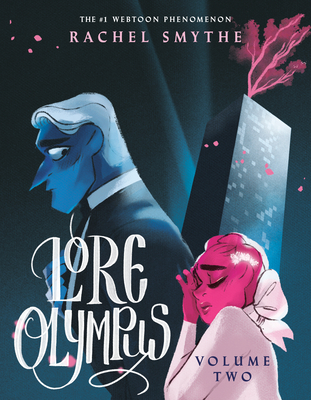
Book: “Lore Olympus: Volume 2” by Rachel Smythe

Publishing Info: Del Rey, July 2022

Where Did I Get This Book: I own it.

Where You Can Get This Book: WorldCat | Amazon | Indiebound

Book Description: Persephone was ready to start a new life when she left the mortal realm for Olympus. However, she quickly discovered the dark side of her glamorous new home—from the relatively minor gossip threatening her reputation to a realm-shattering violation of her safety by the conceited Apollo—and she’s struggling to find her footing in the fast-moving realm of the gods. Hades is also off-balance, fighting against his burgeoning feelings for the young goddess of spring while maintaining his lonely rule of the Underworld. As the pair are drawn ever closer, they must untangle the twisted webs of their past and present to build toward a new future.

This full-color edition of Smythe’s original Eisner-nominated webcomic Lore Olympus features a brand-new, exclusive short story, and brings Greek mythology into the modern age in a sharply perceptive and romantic graphic novel.

Review: We are back for more Greek Mythology soapy romantic goodness, everybody! It has been awhile since I have had a full blown content obsession, but “Lore Olympus” has really snagged me but good. Greek myths! Humor! A favorite ship! LOTS OF PATHOS! It all comes together in this series and we are starting to parse out the various complications that are facing Persephone, Hades, and more Greek Gods and Goddesses in “Volume Two”. Our star crossed would be lovers, Persephone and Hades, are trying to find their footing after their chance meeting has set them both a little off kilter, and while that could just be a lot of pining and wallowing in angst, Rachel Smythe takes the opportunity to build up more backstory and more characterization, and it is for the better. “Volume Two” is keeping the series going strong. But yes, there is still some lovely Hades angst, and given that I LOVE to be emotionally wrecked by fiction, I say bring it on.

SAD BOYS FOR THE WIIIIIIIN. (source)

One of the most rewarding things about “Lore Olympus” is that Smythe is taking her time to set groundwork, characterizations, and background. We start this volume off with Persephone starting her schooling with her scholarship from The Goddesses of Eternal Maidenhood while silently grappling with the sexual assault she endured at the hands of Apollo. She loves being away from her doting mother’s eyes, but given she’s drawn to Hades she is feeling that perhaps joining TGOEM isn’t what she really wants. Meanwhile, Hades is stewing about his feelings for her and trying to keep his distance, and to make matters worse a tabloid has shown innocuous pictures of them and spinning them to seem scandalous, which threatens Persephone’s reputation. Throw in Hera’s suggestion that Persephone take on an internship in the Underworld (as she secretly wants Hades to be happy and thinks that this would help that), and the two would be lovers are being shoved into some fun forced proximity!

But these very common tropes feel fun and new in this story, and it means that we can carefully explore their budding friendship while also exploring them as individuals who are dealing with a lot of baggage on their own. I thought that Smythe is really careful but also powerful when exploring the aftermath of Persephone’s rape, and does a good job of portraying the shame, the fear, and the apprehension, especially since her abuser is inserting himself in her life vis a vis his clueless sister Artemis, whom Persephone is living with. It’s tackled in a way that feels real, but doesn’t feel melodramatic or exploitative. I’m hoping that it stays that way and isn’t used for man pain or anything like that, but I trust Smythe to continue to be mindful. We also have a lot of other facets to Persephone’s growth as she tries to make sense of what she has been told she wants from life, and what she actually wants from life. There have also been hints about some darkness involving her backstory and her nature, which is VERY interesting to say the least…

Okay now we talk about what I loved most in this book. HECATE IS HERE!!! I’ve talked about how Persephone is my favorite Greek deity, and Hades is definitely number two? Well Hecate, the goddess of witchcraft, is third. I love Hecate. So I was very interested to see how Smythe depicted her, and I was NOT disappointed, as she is Hades’s COO and number two in command, who calls him out on all his nonsense and bullshit while trying to support him in other ways. She is THE BEST, and also very competent at keeping things in the Underworld running. In this the Underworld is a very necessary, non-evil place that has to be run efficiently, and having Hades and Hecate as co-runners feels very Eric and Pam from “True Blood” (without any of the clichéd longing on her part). It’s also really cool to see the depiction of the Underworld here, as we’ve seen the Mortal Realm as fields and vastness, and Olympus as an upperclass city scape. The Underworld feels a bit more hardboiled with a corporate undertone, and I love seeing how it is run, and how the various workers fit in, like Thanatos, who escorts souls to the Underworld, and Minthe the nymph (who just so happens to be in an on again off again/toxic relationship with Hades and she’s also kind of the worst but also seems pretty damaged so she isn’t just a girl to get in the way, HOW REFRESHING!).

And I’m still in love with the artwork. The designs of all these characters are perfection. I mean LOOK AT MY GIRL HECATE!
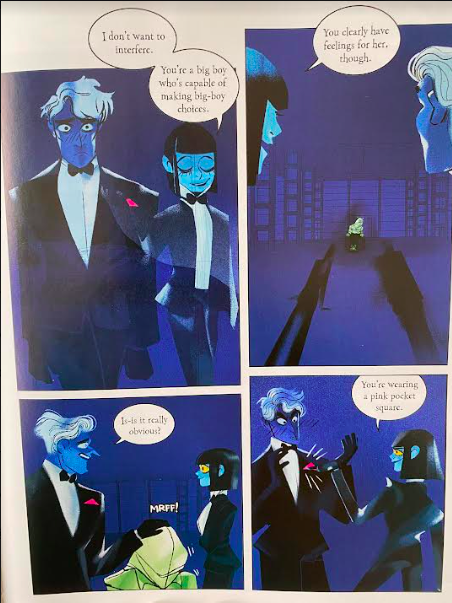
Source: Random House Worlds

I’m still obsessed with “Lore Olympus”. There isn’t much else to say, I’m head over heels.

Rating 9: Still loving this. What a fresh, soapy, emotional and sometimes hilarious take on Greek Mythology!

Reader’s Advisory:

“Lore Olympus: Volume 2” is included on the Goodreads lists “Greek Mythology Retellings!”, and “Hades and Persephone”.

Previously Reviewed:
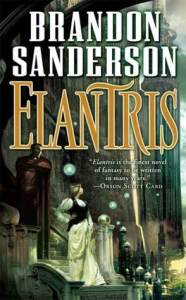
“Year of Sanderson”: “Elantris”

This post may contain affiliate links for books we recommend.  Read the full disclosure here.

“Year of Sanderson” is an on-going, monthly series that will post on the last Friday of each month in which I will cover various Brandon Sanderson-related things. This will largely be comprised of book reviews (some from his back catalog and some from the books being released this year), as well as assorted other topics like reviews of the items in the swag boxes that will be coming out as part of Sanderson’s Kickstarted campaign. Frankly, we’ll just have to see what we get from this series, very much like the Kickstarter itself!

Book: “Elantris” by Brandon Sanderson

Publishing Info: Tor Fantasy, 2006

Where Did I Get this Book:

Where Can You Get this Book: Amazon | IndieBound | WorldCat

Book Description: Elantris was the capital of Arelon: gigantic, beautiful, literally radiant, filled with benevolent beings who used their powerful magical abilities for the benefit of all. Yet each of these demigods was once an ordinary person until touched by the mysterious transforming power of the Shaod. Ten years ago, without warning, the magic failed. Elantrians became wizened, leper-like, powerless creatures, and Elantris itself dark, filthy, and crumbling.

Arelon’s new capital, Kae, crouches in the shadow of Elantris. Princess Sarene of Teod arrives for a marriage of state with Crown Prince Raoden, hoping—based on their correspondence—to also find love. She finds instead that Raoden has died and she is considered his widow. Both Teod and Arelon are under threat as the last remaining holdouts against the imperial ambitions of the ruthless religious fanatics of Fjordell. So Sarene decides to use her new status to counter the machinations of Hrathen, a Fjordell high priest who has come to Kae to convert Arelon and claim it for his emperor and his god.

But neither Sarene nor Hrathen suspect the truth about Prince Raoden. Stricken by the same curse that ruined Elantris, Raoden was secretly exiled by his father to the dark city. His struggle to help the wretches trapped there begins a series of events that will bring hope to Arelon, and perhaps reveal the secret of Elantris itself.

Review: It is only fitting to start out this year’s series on Brandon Sanderson by reviewing his first book, “Elantris.” Like many people, “Elantris” wasn’t the first book I read by Sanderson. Instead, I got on the Sanderson train after reading his “Mistorborn” trilogy as it was released. Then I finished it and, feeling suddenly bereft, I checked out his writing history and low and behold, there was this little stand-alone novel that had been quietly waiting in the background. After reading it, I knew that Sanderson was going to be a “go-to” author for me going forward: not only did I like it as much as the “Mistborn” trilogy, I might have even liked it more!

Elantris was once the golden light of Arelon, not only a beautiful city in and of itself, but populated by the Elantrians, a powerful group of magical individuals who grace those around them with the benefits of their abilities. But then disaster strikes: the city, and its people, crumbles and in the city’s ruined shadow clings the remnants of this once great people. Into this outskirts city, Princess Sarene arrives to marry a prince, only to find he has died, and she has been left a widow. But as she tries to navigate her new existence, she never suspects the truth: the prince is not dead, but banished having become cursed with the same cruel plague that struck down the Elantrians.

While this wasn’t my first experience with Sanderson, I do think that had I read this one first, I would have been even more on-board with his writing than I was after reading the “Mistborn” trilogy. There, Sanderson had three entire books to lay out a complex world, construct multi-layered characters, and depict all the intricate ins and outs of a very complicated magic system. But in “Elantris,” he shows all of these same skills but contained within one novel. Yes, it’s a very long novel, but it’s still one book as compared to three.

As compared to some of his later works, this one has been dinged by other reviewers for lacking the polish of his more recent books. However, in re-reading it for this series, and looking at it purely on its own merits, I don’t think there’s much I can say to that. To me, this book is a pretty perfect example of a solid, stand-alone epic fantasy. It checks off so many boxes without stumbling in any of the three major areas: world-building, characterization, and magic system. Instead, all three come through with flying colors.

In this book, the world-building and the magic system are very closely intertwined. Much of the story surrounds the mystery behind the sudden downfall of the Elantrians and the remaining curse that still randomly strikes individuals in the present day. The curse itself is quite unique, and we explore the lives of those living with it through the eyes of the Crown Prince, Raoden. We learn alongside him of the strange society that now exists within the crumbling city of Elantris where those who are cursed cannot die, but any injury they sustain will never heal, leaving them fragile and susceptible to a never-ending pain that will, eventually, drive them mad.

Outside Elantris’s walls, readers can begin to piece together more of this world-gone-wrong through the eyes of Sarene, a princess who has just arrived in this land only to find her one source of contact, the prince she had been writing, has “died” and she is now widowed and alone. Sarene is exactly the sort of heroic female character I love reading. She’s set up into a situation that is as disempowering as it can get, but she rises against these limitations and plays an integral role in the ultimate solution.

Readers who picked up this book when it was first released probably didn’t realize that they were getting a sneak peak into a toolkit that Sanderson would go on to perfect over the years. Other than his unworldly writing speed, the author is probably best known for his creative magic systems. And here we get a small peak into the beginnings of his abilities in this regard. Not only is the curse that struck the Elantrians incredibly interesting and unique, but the ultimate explanation and solution are as surprising as they are creative. It’s fantasy at its best: fun, exciting, and pushing the boundaries of our expectations.

Overall, “Elantris” is a magnificent novel. And regardless of how others may compare it to Sanderson’s incredible catalog of works, I believe it stands on its own as a near-perfect epic fantasy.

Rating 10: If an alien species came to earth and wanted an example of what “epic fantasy” is all about, “Elantris” would be the go-to pick.

Reader’s Advisory:

“Elantris” can be found on these Goodreads lists: Fantasy Books Written for Adults and Best Stand-Alone Fantasy Book.

Serena’s Review: “The Magician’s Daughter”

This post may contain affiliate links for books we recommend.  Read the full disclosure here.

Book: “The Magician’s Daughter” by H. G. Parry

Publishing Info: Redhook, February 2023

Where Did I Get this Book: from the publisher!

Where Can You Get this Book: Amazon | IndieBound | WorldCat

Book Description: It is 1912, and for the last seventy years magic has all but disappeared from the world. Yet magic is all Biddy has ever known.

Orphaned in a shipwreck as a baby, Biddy grew up on Hy-Brasil, a legendary island off the coast of Ireland hidden by magic and glimpsed by rare travelers who return with stories of wild black rabbits and a lone magician in a castle. To Biddy, the island is her home, a place of ancient trees and sea-salt air and mysteries, and the magician, Rowan, is her guardian. She loves both, but as her seventeenth birthday approaches, she is stifled by her solitude and frustrated by Rowan’s refusal to let her leave. He himself leaves almost every night, transforming into a raven and flying to the mainland, and never tells her where or why he goes.

One night, Rowan fails to come home from his mysterious travels. When Biddy ventures into his nightmares to rescue him, she learns not only where he goes every night, but the terrible things that happened in the last days of magic that caused Rowan to flee to Hy-Brasil. Rowan has powerful enemies who threaten the safety of the island. Biddy’s determination to protect her home and her guardian takes her away from the safety of Hy-Brasil, to the poorhouses of Whitechapel, a secret castle beneath London streets, the ruins of an ancient civilization, and finally to a desperate chance to restore lost magic. But the closer she comes to answers, the more she comes to question everything she has ever believed about Rowan, her origins, and the cost of bringing magic back into the world.

Review: First things first, I absolutely love this book’s cover! It’s so unique and eye-catching. I’m on the record as disliking books using cover-models, and I’m even starting to burn out a little on the cartoonish characters (though there are still versions of this theme I can get behind.) But I think this cover does exactly what a good cover is meant to do: it communicates exactly what kind of book you’re going to get. And here, that would be a book taking place in a historical setting and featuring a fairytale-like tone of fantasy. So, well done cover artist! Let’s get to the book itself, though.

While Biddy understands that a world exists beyond the boundaries of the smile island that she shares with her magician guardian, Rowan, and his rabbit familiar, but all that she knows of it comes from books. Not only has she never seen a city, but while she knows that magic disappeared from the larger world decades ago, for her, growing up, she has been surrounded by it. But soon she sees that there are darker shadows growing in Rowans eyes every time he returns from the mysterious ventures to the outer world he goes on each night. As she finally begins to demand answers to her growing questions, she learns that there is much more going on in the world outside her home than she had ever suspected. And soon she may be needed to play a much larger role in shaping the future than she ever could have imagined.

I absolutely adored this book, as I knew I would almost from the first page of the novel. Of course, things could have always taken a turn for the dire, but the tone and style of the writing was exactly the sort that always appeals to me. The author was direct, and yet whimsical, deftly exploring the world and characters she had created while never falling into the trap of exposition or strange, narrated infodumps. On top of this, the dialogue was witty and had me laughing right from the start, particularly the interactions between Rowan and his familiar, Hutchingson.

But a book cannot live on funny dialogue alone. Indeed, for me, it really comes down to the characters themselves, and as Biddy is the protagonist with whom we travel this story alongside, the book lived and died based on her characterization. She, too, was exactly the sort of leading teenage character I enjoy. It’s a coming of age story where the character is doing exactly that…coming of age. She doesn’t start out as some “best assassin/thief/princess/etc.” and, indeed, the stories she paints about herself are challenged throughout the book. As she comes to understand the world and her own place in it, she must grow into understand the complexities of all the moving pieces and people in it. Rarely is anyone a true hero or true villain. Biddy must come to understand the adults in her life and the stories they, too, have built up around themselves and how they behave in the world and the choices they make. There were strong themes of family, choice, and the duties we have to those around us, both those with whom we are familiar and care for and those stranger who we will never meet but who we understand as humans too who deserve care and kindness as much as the next person.

I also really liked the way that the magic system was used to explore these themes. For what starts as a simple fantasy premise, that magic is leaving/has left the world, the author leverages this topic into deeper conversations about how society responds to emergencies. From what can be well-intentioned decisions going wrong to how those who seek power can take advantage to consolidate wealth into their own pockets at the expense of the many. It was really well done, and the story definitely took some twists and turns towards the last half that really surprised me and left me on the edge of my seat.

Indeed, I really have nothing to criticize about this book! I think it perfectly accomplished everything it set out to do, and it will surely appeal to all fantasy fans who are looking for a great fairytale-esque stand-alone fantasy. I can’t wait to see what the author does next! I’ll definitely be first in line to find out.

Rating 10: Heart-wrenching in all the right ways, this fairytale fantasy deftly explores important themes of individual choice and the responsibilities we have towards the least of those in society.

Reader’s Advisory:

“The Magician’s Daughter” isn’t on any Goodreads lists yet, but it should be on Magicians in Historical Fiction.

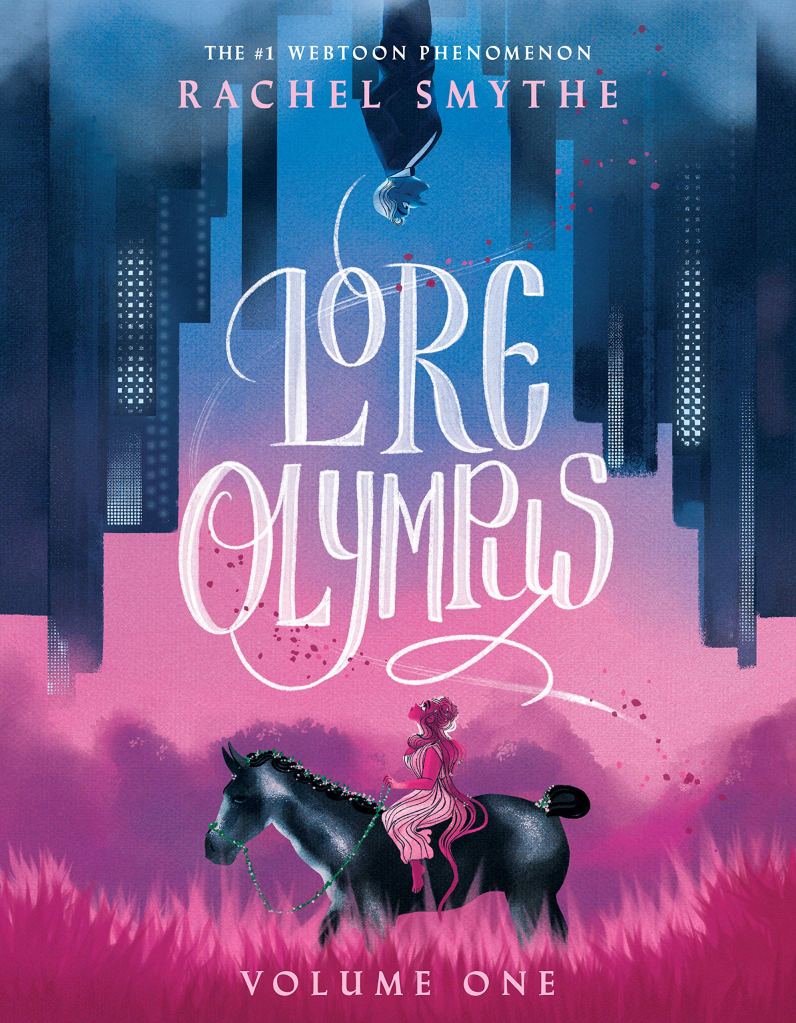
Kate’s Review: “Lore Olympus: Volume 1”


This post may contain affiliate links for books we recommend.  
Read the full disclosure here.

Book: “Lore Olympus: Volume 1” by Rachel Smythe

Publishing Info: Del Rey, November 2021

Where Did I Get This Book: The library!

Where You Can Get This Book: WorldCat | Amazon | Indiebound

Book Description: Experience the propulsive love story of two Greek gods—Hades and Persephone—brought to life with lavish artwork and an irresistible contemporary voice.

Scandalous gossip, wild parties, and forbidden love—witness what the gods do after dark in this stylish and contemporary reimagining of one of mythology’s most well-known stories from creator Rachel Smythe. Featuring a brand-new, exclusive short story, Smythe’s original Eisner-nominated web-comic Lore Olympus brings the Greek Pantheon into the modern age with this sharply perceptive and romantic graphic novel.

Review: It has come up before on this blog, but I absolutely adore the story of Hades and Persephone from Greek Mythology. That said, I am always VERY wary of new and updated takes on this myth, as I am always worried that well meaning creators will take this thousands of years old story and critique it through a modern day lens and decide that it is wholly unacceptable (and to be fair, it’s not like I can blame them because HOO BOY, the optics of it). I am always FAR more interested in adaptations that, instead of making it about grooming, abuse and uneven power dynamics, tap into the very ample potential of a story about a woman discovering her own power and coming into her own on her own terms and with agency… And yeah, it sure doesn’t hurt if there is some steamy romance involved (what can I say, I love a depressive demon nightmare boy and Hades is the originator). So when a Book Club friend asked me if I had heard of “Lore Olympus” and told me what it was, my first question was “okay…. you know my tastes with this story, am I going to like this?” And she said “OH yeah”. So I got “Volume One” from the library, and sat down one night intending to start it. But then I proceeded to finish it and ordered all available volumes to be added to my personal library. Suffice to say, I loved “Lore Olympus: Volume One”.

This is everything I need in a Persephone and Hades story. Everything. (source)

“Lore Olympus” is a long running web comic that takes on the Taking of Persephone with a lot of modern sensibilities, a distinct soap opera attitude, and a slow burn romance between two super different, super complex, and super likable Greek deities. The first is Hades, the sullen and emotionally damaged King of the Underworld. In this Hades is a corporate overlord who lives alone, tolerates his more fun loving brothers Zeus and Poseidon, dotes over his EXTENSIVE dog collection, and buries his past traumas of being a son of Kronos and ALL the baggage that entails. The other is Persephone, the goddess of Spring who has just come into her own, leaving a very sheltered life in the Mortal Realm to be roommates with Artemis on Olympus as she begins her studies and starts a (reluctant) journey to remain a maiden devoted to purity. Through a series of coincidences and the pettiness of other Gods, Hades and Persephone meet, and thus begins a very, very slow burn that brings in not only a VERY lovely romance, but also other well known deities and their nonsense, updated interpretations of various myths, and the start of a story of two people who have a deep, deep connection finding out things about each other as well as themselves. “Volume One” is setting up a lot of the groundwork, introducing us to a huge cast and a lot of settings, and it is done with a lot of heart, a lot of humor, and so many different emotional beats. I loved this start of getting to know both Persephone and Hades, seeing their aspirations and their slowly building friendship and the peeling back of their layers. I love how sad and awkward and brooding Hades is. I love how effervescent and charming and, shall I say, edgy Persephone is. I love that we are getting teasing moments about their characters and what multitudes they contain. I love how Rachel Smythe is being slow and deliberate as she starts to carefully explore the romance that these two will surely have. Because when they interact, it is such a joy.

I also really loved the way that Smythe brings in all sorts of other Greek Mythology players and inserts them into this modernish remix of the lore. You get some fun contemporary interpretations of these characters, like Zeus and Poseidon forcing Hades to attend rowdy brunches with them, or Artemis being a well meaning but condescending roommate, or Eros being a bit of a hot mess romantic (who is dealing with his OWN baggage, with hints to his messy relationship situation with Psyche, YES PLEASE, MY OTHER FAVORITE MYTH). But we also get some darker moments and characterizations, with Smythe turning well known players on their heads and making them more sinister. The most obvious example of this is Apollo, whose Golden Boy reputation hides a personality that oozes with malevolent privilege run amok. But my favorite was Hera, the long suffering wife of Zeus who, in original mythology, is always portrayed as a shrew of sorts. In “Lore Olympus” she definitely has a nasty streak, but you can tell that it is due to a deep unhappiness that she is living with, and not just because of her philandering husband. I really, REALLY love Hera in this series.

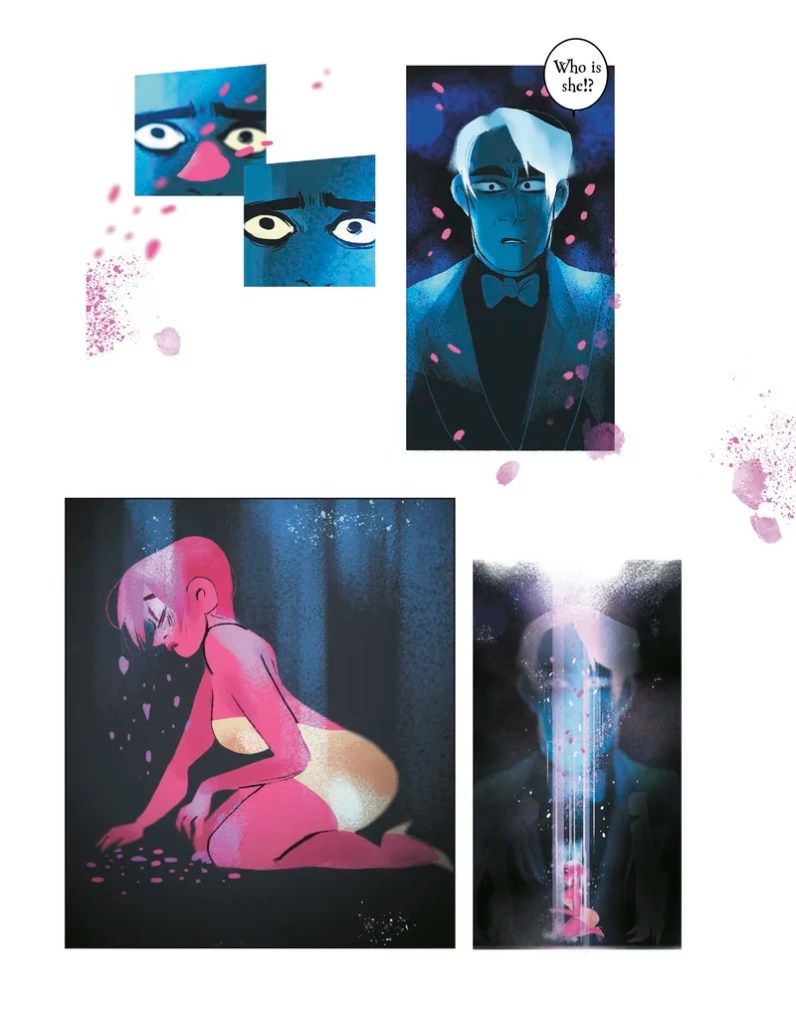
And finally, the artwork is very cute. Smythe has this really easy to connect to style, that can shift on a dime from cartoony and quirky humor to absolutely breathtaking imagery. The use of color is phenomenal and I just love how she has designed all of the characters.

(source)

We are off to a fantastic start in “Lore Olympus: Volume One”. I look forward to seeing how Hades and Persephone grow as a couple and as individuals.

Rating 10: BE STILL MY HADES/PERSEPHONE LOVING HEART. What a fun, emotional, and slow burn take on one of my favorite Greek Myths of all time.

Reader’s Advisory:

“Lore Olympus: Volume One” is included on the Goodreads lists “Greek Mythology Retellings!”, and “Hades and Persephone”.

Serena’s Review: “Emperor of Ruin”

This post may contain affiliate links for books we recommend.  Read the full disclosure here.

Book: “Emperor of Ruin” by Django Wexler

Publishing Info: Orbit, February 2023

Where Did I Get this Book: from the publisher!

Where Can You Get this Book: Amazon | IndieBound | WorldCat

Book Description: The last surviving Chosen, Ashok has finally risen up and taken control of The Twilight Order. He promises equality and prosperity, but Gyre and Maya know the truth. Only death follows in Ashok’s wake. To take him down, Gyre will have to unite old allies—from all across The Splinter Kingdoms and the depths of Deepfire. And Maya will have to seek out a legendary weapon hidden in the mountains that could turn the tide in their battle for freedom.

Previously Reviewed: “Ashes of the Sun” and “Blood of the Chosen”

Review: I’ve really been enjoying this trilogy so far. It’s not really a surprise, however, as I’ve been on record as a fan of Wexler’s work for quite some time. But there has also been a lot to like specifically about this series. It’s been a wild romp of a ride with two characters who are both sympathetic and wonderfully flawed individuals. I’ve gone back and forth between loving them both and then wanting to smack them each upside the head. But here we are at last with the final book in the trilogy. Will my beloved, broken, estranged siblings finally get their acts together in time to save the world? Let’s find out!

A Chosen has finally returned to the world and with him comes great change. While many see the return of a fabled god-like being, Gyre and Maya know first-hand that Ashok is no one’s savior. Indeed, his monstrous exterior barely hints at the darkness within. Now, not knowing what horrors Ashok has cooked up over his centuries’ long exile, Maya and Gyre must race to not only piece together the mysteries of the past, but cobble together a resistance that can save their world. But even if they succeed, each most grapple with the fact that the world that emerges will look nothing like the one that will now be left behind. And will there be a place for a mythical thief and revolutionary? Or for a powerful, near-Chosen herself?

So, I’ll just get right to it. I think this was my favorite book of the trilogy! In hindsight, maybe I shouldn’t be surprised by this fact. Thinking back on my reactions to the first books, I realize that many of my minor frustrations dealt with the growing pains through which our two main characters were constantly struggling. They’d each keep coming out with these perspectives that were either incredibly naive or supremely narrow-minded, and, at times, it drove me bonkers! So, is it really any wonder then that when we get to the final book, presumably where our two main characters do in fact get their acts in order and temper their instincts, I’m suddenly all in? And don’t let this say anything about the quality of the first two books. Indeed, without those character moments where Maya and Gyre were frustrating and short-sited, we’d never get the true payoff that we see here when each has to come fully into the roles they have chosen for themselves. Roles that are much more nuanced and full of compromise than their former selves could have ever imagined.

But while my sudden increase in appreciation for these two characters may come as no shock, this trilogy also had a lot of surprises in store that I truly wasn’t suspecting. The end of the second book sets up Ashok as your rather typical “big bad” who will come and lay waste to the world unless the ragtag group of resistance fighters come together and dramatically hold him off. And yes, that all did happen, too. But what surprised me was the addition of a third character perspective that layered on an entire new story on top of the one that I thought we had been developing. When I started this book, I’d have said I had a pretty clear understanding of the history and world that had been developed. All that was left was for the grand confrontation. But nope! There was almost more world-building and history in this book alone than in the first books together, and I gobbled it all up! Truly, there were some excellent surprises and twists that I think will please all fans of this series so far.

I also really liked the use of the ever-growing cast of characters. I particularly liked the role that Kit played. Not only do we see her abilities with her constructs used to their full creative powers, but the character was once again allowed to be a fully-fledged character, instead of only the quippy, raunchy, side-kick she’d kind of become in the second book. There were also a few twists towards the end with her that I was particularly happy about, especially with regards to her complicated relationship with Gyre.

There were, however, a few hiccups in pacing that came in the beginning of the story, I felt. There were a few quests and and extra missions that began to feel…well…extra. Not that they weren’t necessary for getting crucial pieces of information or crucial characters all together, but I did struggle a bit with the pacing in the first half of the book due to these various side stories. But once I got to the halfway mark, things picked up and never stopped until the end.

Overall, I really loved this conclusion to the book. Not only did it follow through on the grand confrontations that had been set-up in the first two books, but it added so many new layers to the world and extra twists to the story that it ended up being the best book in the trilogy. I highly recommend this book to fans of the first two books. And now that the trilogy is done, complete with a stellar conclusion, I can universally recommend the series as a whole to practically all science fiction/fantasy fans, especially those who enjoy lots of action in their stories.

Rating 9: Not content to rest on any laurels, this book rose above and beyond the numerous promises made in the first two books to deliver a conclusion that is as epic and enjoyable as the best SFF out there today!

Reader’s Advisory:

“Emperor of Ruin” isn’t on any Goodreads lists yet, but it should be on Can’t Wait Sci-Fi/Fantasy of 2023.

Serena’s Review: “The Scarlet Circus”

This post may contain affiliate links for books we recommend.  Read the full disclosure here.

Book: “The Scarlet Circus” by Jane Yolen

Publishing Info: Tachyon Publications, February 2023

Where Did I Get this Book: Edelweiss+

Where Can You Get this Book: Amazon | IndieBound | WorldCat

Book Description: “The Scarlet Circus,” the fourth volume in Yolen’s award-winning short fiction series brings you passionate treasures and unexpected transformations. This bewitching assemblage, with an original introduction from Brandon Sanderson, is an ideal read for anyone who appreciates witty, compelling, and classic romantic fantasy.

Review: Jane Yolen is a powerhouse in the fantasy genre. She’s written over 400 novels, short stories, poems, and essays. Beyond that, her work has claimed numerous awards over the many decades she’s been writing, not least of which include a Caldecott Medal and numerous Nebula Awards. Such is the case that she’s one of those authors whose backlist is so intimidating that no matter how many books of hers I read, whenever I pick up a recent one, I’m immediately struck with a sense of guilt for not having gotten to more! So I was happy to see that she was releasing a short story collection this year (with a focus on romance, just in time for Valentine’s Day!), as that seemed like an easy, bite-size re-entry point to an author who deserves much more space on this blog.

This is a short story collection, so there’s really no point in including a summary paragraph. I also won’t be going over every single story in this collection. But I will say right here that I’d struggle to rank these stories or try to include any as “least favorites.” So right here at the top, this is a general recommendation for this collection, and any fans of fantasy short stories should definitely check this one out.

The collection covers a wide swatch of fantasy genres, including fairytale retellings (“Alice in Wonderland”), reimaginings of popular tales (like King Auther and “Romeo and Juliet”), time travel, and even a clever take on the footnotes of an essay that has disappeared after being written in invisible ink. Interspersed with all of these tales, Yolen has included her own poetry. While I do think that her prose is stronger than her poems, these were also nice breaks between the stories, and will likely appeal to those who like a bit more variety in their reading experience.

I did have a few favorites, however. While all of the stories focus on love in one way or another (some with happy endings, other with tragic), I did particularly like one of the later stories in the collection, “The Sea Man,” that focuses more on the love of family. The story follows a sea captain who discover the titular sea man. Though their connection is brief, the story explores the deep understanding of family and love that can cross all boundaries, including ones as simple as language to the more complicated kind that delve into the fantastical.

I also really liked “Dark Seed, Dark Stone,” a story that takes place in ancient Britain, focusing on the Picts and their in-fighting. After the death of her father, the shield of the King, Bridei, a young woman wishes to take upon herself that same role. But, of course, her skills with a spear and shield could never compete with the other warriors. Instead, she earns her place through sheer bravery and the ability to take on a threat in a unique way. Again, the love story is a very small part of this story, but I thought it was an interesting new look into this time period and Bridei himself.

Lastly, I really enjoyed “Dragonfield,” a more straight-forward, action-packed fantasy story. As the title suggests, it follows the tale of a brave young woman, a reluctant hero, and their fight to save their town from a rampaging dragon. While this story wasn’t doing anything particularly shocking, it was the sort of solid, familiar fantasy story that I think most authors work years to complete. And here, Yolen seems to whip it out as if it’s nothing. The simplicity of the story itself instead highlights her vast skills at amusing narration and the creation of interesting and sympathetic characters, even with a very limited format.

As I said, this is a thoroughly enjoyable collection of stories. It’s a must read for all fantasy short story fans, and I think it is an excellent choice if you’re looking for a unique take on a love story this Valentine’s season.

Rating 9: Yolen expertly weaves together a tapestry of romance, with the weft made of magic and the warp made of humanity’s joys and tragedies.

Reader’s Advisory:

“The Scarlet Circus” isn’t on any Goodreads lists yet, but it should be on Best Fantasy Short Story Collections.

Book Club Review: “This Poison Heart”

This post may contain affiliate links for books we recommend.  Read the full disclosure here.

We are part of a group of librarian friends who have had an ongoing book club running for the last several years. Each “season” (we’re nerds) we pick a theme and each of us chooses a book within that theme for us all to read. Our current theme is retellings and reimagings.  For this blog, we will post a joint review of each book we read for book club. We’ll also post the next book coming up in book club. So feel free to read along with us or use our book selections and questions in your own book club!

Book: “This Poison Heart” by Kalynn Bayron

Publishing Info: Bloomsbury YA, June 2021

Where Did We Get This Book: The library!

Where You Can Get This Book: WorldCat | Amazon | Indiebound

Retelling/Reimagining: “The Secret Garden”

Book Description: Briseis has a gift: she can grow plants from tiny seeds to rich blooms with a single touch.

When Briseis’s aunt dies and wills her a dilapidated estate in rural New York, Bri and her parents decide to leave Brooklyn behind for the summer. Hopefully there, surrounded by plants and flowers, Bri will finally learn to control her gift. But their new home is sinister in ways they could never have imagined–it comes with a specific set of instructions, an old-school apothecary, and a walled garden filled with the deadliest botanicals in the world that can only be entered by those who share Bri’s unique family lineage.

When strangers begin to arrive on their doorstep, asking for tinctures and elixirs, Bri learns she has a surprising talent for creating them. One of the visitors is Marie, a mysterious young woman who Bri befriends, only to find that Marie is keeping dark secrets about the history of the estate and its surrounding community. There is more to Bri’s sudden inheritance than she could have imagined, and she is determined to uncover it . . . until a nefarious group comes after her in search of a rare and dangerous immortality elixir. Up against a centuries-old curse and the deadliest plant on earth, Bri must harness her gift to protect herself and her family.

From the bestselling author of Cinderella Is Dead comes another inspiring and deeply compelling story about a young woman with the power to conquer the dark forces descending around her.

Kate’s Thoughts

When we decided on reimaginings/retellings for our Book Club theme for this new cycle, I jumped into a number of lists trying to figure out what I was going to choose. I wanted to avoid titles that people may have already read, and I wanted to try and find one that would be a more modern take on a classic that was steeped in Western literature. So when I stumbled upon “This Poison Heart” by Kalynn Bayron and that it involved a Black teenage girl with Poison Ivy-esque powers that was based on “The Secret Garden” I was very intrigued. I hadn’t read the book in its entirety, but I was obsessed with the early 90s movie and thought that this was a fun choice. And while it absolutely has some good moments and fun aspects to it, I think that I was let down a bit by this retelling.

First I will talk about the good! I love the concept of a teenage girl who has magical powers that make plants drawn to her, and make her immune to poisonous plants while she can make plants thrive. I really enjoyed the ways that Briseis has to grapple with these powers, and how this kind of magical reality could cause serious problems (what with trees uprooting around you trying to get closer to her and how these issues could affect relationships). I also enjoyed that, when Greek mythology connections start to come through, that Bayron wants to re-examine the character of Medea, the villainous witch that killed her children to get back at her husband Jason. I really love it when there are new takes on old myths like that, especially ones that deconstruct evil women and give them more depth, complexity, and tragedy in their own right. But that kind of leads up to my big issue with this book being called a “Secret Garden” retelling. It doesn’t really feel like that, outside of a mysterious garden on a newly inherited estate. The other themes didn’t feel present, and it did shift a bit more towards Greek Mythology as the story went on. I just think that it takes more than a mysterious garden to be a retelling of the story (that said, I LOVE poison gardens so that was pretty cool).

So while I did like certain parts of “This Poison Heart”, as a retelling it wasn’t as successful as I would have liked it to be. As a fantasy YA novel without that connection it works just fine.

Serena’s Thoughts

I second all of Kate’s thoughts! I, too, really loved the 90s version of “The Secret Garden” and very much enjoyed the book, as well. So I definitely went in to this re-telling with a lot expectations, not only about the themes that would be covered (loneliness, found family, etc.) but also which characters would show up and how they would be reinterpreted. I’ve got to say, by the time I realized there was no Colin equivalent, I was getting pretty bummed.

As Kate said, about halfway through the book the story takes a massive swerve into Greek mythology. I’m on the record as loving “Circe,” so I definitely don’t have anything against this theme. It was more the fact that I had been sold on one story (one I really hadn’t seen before, a retelling of “The Secret Garden”) and ended up reading a very different one (a Greek mythology story, which, frankly, is getting a bit played out recently.)

The characters were also a mixed bag for me. I really liked Briseis herself, and I thought the ways that her plant powers affected her life were interesting and creative. I also really liked that her moms played very active roles in the story, rather than just mysteriously disappearing as is so often the case in YA fiction. But other than that, I struggled. For one thing, I didn’t like the love interest. The romance ticked off two of my pet peeves: one for instalove and two for semi-creepy age discrepancies. Look, we can’t sit here on a high horse and give Edward Cullen all of this flack for being so much older than Bella and then let this romance off the hook just because is f/f. At least, I can’t.

Overall, I didn’t love this book. The first half of it I thought was pretty intriguing and was setting up an interesting story. But halfway through it takes a massive swerve, and I spent the rest of the book dreaming of what could have been.

Kate’s Rating 6: I liked Briseis’s powers and I liked the reinterpretation of a Greek mythology villainess, but this didn’t really feel like a “Secret Garden” retelling.

Serena’s Rating 6: While it had a few redeeming qualities, especially in the first half, I could never get beyond the fact that I’d been sold one thing and was reading something completely different.

Book Club Questions:

  1. How familiar are you with “The Secret Garden”? Did you feel like this was a successful reimagining?
  2. What were your thoughts on the Greek Mythology elements of the story?
  3. Did you like the magical aspects of the story? Did you feel like the magical systems were well thought out?
  4. What did you think of Rhinebeck as a small town setting?
  5. Did any characters stand out to you in particular?
  6. Do you think you will continue on in the series?

Reader’s Advisory

“This Poison Heart” is included on the Goodreads lists “Popsugar 2023 #14: A Modern Retelling of a Classic”, and “Alex’s Sapphic Masterlist”.

Next Book Club Pick: “The Witch’s Heart” by Genevieve Gornichec

Serena’s Review: “The Last Tale of the Flower Bride”

This post may contain affiliate links for books we recommend.  Read the full disclosure here.

Book: “The Last Tale of the Flower Bride” by Roshani Chokshi

Publishing Info: William Morrow & Company, February 2023

Where Did I Get this Book: Edelweiss+

Where Can You Get this Book: Amazon | IndieBound | WorldCat

Book Description: Once upon a time, a man who believed in fairy tales married a beautiful, mysterious woman named Indigo Maxwell-Casteñada. He was a scholar of myths. She was heiress to a fortune. They exchanged gifts and stories and believed they would live happily ever after–and in exchange for her love, Indigo extracted a promise: that her bridegroom would never pry into her past.

But when Indigo learns that her estranged aunt is dying and the couple is forced to return to her childhood home, the House of Dreams, the bridegroom will soon find himself unable to resist. For within the crumbling manor’s extravagant rooms and musty halls, there lurks the shadow of another girl: Azure, Indigo’s dearest childhood friend who suddenly disappeared. As the house slowly reveals his wife’s secrets, the bridegroom will be forced to choose between reality and fantasy, even if doing so threatens to destroy their marriage . . . or their lives.

Review: Roshani Chokshi is that bewildering kind of author whose work I can sometimes really enjoy, while at other times, I’ll pick up a book from her, DNF it quickly, and swear off her work entirely. Until, that is, the next time she sucks me in with a compelling-looking title (usually within a year of said “swearing off”). That being the case, when I saw that this was going to be the February Adult Fairyloot pick, I knew I wanted to get my hands on a copy early, to know which category it would fall under before deciding whether or not to pause my subscription that month. Well, let me just say now, I will decidedly NOT be pausing this month’s box.

A man and a woman meet. They both love fairytales and myths, so much so that each, to different extents and through different means, have made stories the central part of their lives. Through this bond they fall in love and marry. But, like so many tales, there are secrets hidden within this love story, for the husband has promised never to look into his beautiful bride’s past. So when they are called back to her ancestral home, and he finds himself wandering its mysterious corridors and seeing the leavings of not just the little girl his wife had been when she last lived here, but the tracings of another…he begins to understand the perils of the promise he gave his one true love.

Man, there was a lot to like about this book. At its heart, this is a story about family trauma and the ugly side of love and the belief in fairytales. It’s a story of sisters, though they were born to different families. It’s a story of stories within stories, and how people can use stories as an escape from the ugly reality in which they live. But also how those stories, if fed, can gobble you up if you’re not careful.

The book is broken up into two POVS, the unnamed “Bridgroom” who is telling the modern story and then flashback to Indigo’s childhood, told through the perspective of Azure, her childhood friend who disappeared after graduating highschool. While I did like the Bridegroom’s chapters, particularly the slow reveal about his past and his own missing sibling, his were definitely the weaker chapters of the entire book. We must also mention here that the book is highly marketed as a story about a troubled marriage, centering the tale around the Bridegroom’s discovery of the secrets in his wife’s past. But I don’t think that’s an accurate description of the book at all. As far as actual time goes, the Bridegroom’s arc of discovering his wife has secrets, to breaking his promise not to look into her past, to having to grapple with his new reality all takes place over a very short period of time. This is not a “troubled marriage” book, as the “trouble” is simply the resolution of the primary storyline of this book: the truth of two friends, Indigo and Azure.

And it’s here that the story truly lives and dies, with Indigo and Azure, two childhood friends that grow up in this mysterious and magical house. I was blown away by this tale, particularly the careful handling of many complicated, damaged relationships and how various traumas can weave in and out of one another, creating co-dependencies galore. It was all laid out so carefully, and told in such beautiful language, that it was not only easy to see how Azure was entangled, but it was difficult as a reader not to become equally enamored and ensnared. The darkness reveals itself in layers, like a spider at the center of a web, drawing you closer and closer.

I can’t go in too many details, as I think this is a book best experienced on its own. I will say that there were still moments where Chokshi’s flowery writing jarred me out of the story (mostly with the over-use of similes that I don’t think make any sense). But I’ll also concede that I found her writing to be incredibly elevated here, and I was pleased to see that she didn’t fall into the trap of over-using this sort of flowery language, as I’ve found in the past with her YA work.

Lastly, I’ll note that I did have some confusion trying to place this book within a genre. Was it set completely in this world, where magic is just a myth and the fantastical was an allegory all along? Or were there truly bits of magic at work here? On one hand, I think this question is part of the point of the story, and I appreciate that, and I think it succeeded in that way. But on the other hand, there were a few practicalities that I simply couldn’t wrap my head around. Was I supposed to attribute these disconnects with magic? Or were they legitimate plot holes? I’m not quite sure.

Overall, I was incredibly impressed by this novel. I think it tackled some very challenging themes in a fantastic way, and its main characters, Indigo and Azure, were dynamic, heart-breaking, and nuanced. Fans of gothic fantasy, in particular, are sure to enjoy this book!

Rating 8: With its lush prose and slow-burn sense of foreboding, the reader will be drawn in to a magical world where beauty and pain, love and darkness reside side by side.

Reader’s Advisory:

“The Last Tale of the Flower Bride” can be found on these Goodreads lists: Most Anticipated Adult Fantasy, 2023 and Here comes the………bride.

Serena’s Review: “The Fiery Crown”

This post may contain affiliate links for books we recommend.  Read the full disclosure here.

Book: “The Fiery Crown” by Jeffe Kennedy

Publishing Info: St. Martin’s Press, May 2020

Where Did I Get this Book: NetGalley!

Where Can You Get this Book: Amazon | IndieBound | WorldCat

Book Description: Conri and Lia’s marriage of convenience has turned into an uneasy alliance. If only the two leaders could agree on something. Driven by revenge, Conri wants to attack Emperor Anure before the tyrant gets to them first. But Lia needs to keep Calanthe safe, and refuses to sacrifice her kingdom. Their ongoing battle for control has built up tension they’re both more than happy to release in bed, the only place where they find common ground. But Conri and Lia are developing deeper feelings for each other that are complicating matters. In the second book in the Forgotten Empires trilogy, Conri and Lia find their loyalties torn, and with Emperor Anure’s threat growing, will they be able to risk everything with each other before it’s too late?

Previously Reviewed: “The Orchid Throne”

Review: While I was late getting around to it, I really enjoyed “The Orchid Throne.” But I’ll be honest, one of the reasons I finally picked it up was because of the growing guilt from my NetGalley shelf glaring at me with this book, the sequel, continuously sitting there as a request I placed waaaaaay back in 2020 that I still hadn’t read or reviewed. Lucky for me, the first book was good enough that it was quite easy to jump back into this world with only a small reading break between novels.

While Conri has technically “claimed the hand that wears the Orchid Ring” by marrying the queen of Calanthe, Lia, he doesn’t feel any closer to his goal of killing the cruel emperor Anure. Instead, he feels bogged down and trapped on a beautiful island where no one seems to be taking the threat of war seriously. Little does he know that no one takes the threat of war more seriously than Calanthe’s queen, Lia. Calanthe holds secrets, and as Conri begins to learn more about the land he now co-rules and the woman he’s now married to, he begins to see that his own view of the world and its priorities may, in fact, be what was misordered all along.

This story picks up immediately where “The Orchid Throne” leaves off. Meaning, Lia and Conri are still only about a week into their new marriage, and as such, are still very much struggling to understand each other and the shifting dynamics that make up their relationship. I really liked everything we got from these two and this marriage of convenience. For one thing, I appreciated the conversation that was had about the fact that attraction and chemistry, while great, do not on their own make a match made in heaven. Indeed, while Conri and Lia both appreciate the sparks in the bedroom, this compatibility makes it all the more bemusing when they butt heads again and again in other arenas. Particularly, I enjoyed the continued look at how both Conri and Lia approach leadership and their conflicting priorities. We also see how easy it is to misunderstand another person’s motives and motivations, especially when we switch perspectives between the two and see one scene interpreted very differently between them both.

I also liked their individual stories. For Lia, she must grapple with the balance between strength and vulnerability, private and public, and how to navigate ruling a land and planning a way with a man she only halfway trusts. For Conri, we see his ongoing struggles to continue a mission that he had created his entire self of sense around while at the same time grappling with the idea that his approach, to care about nothing but the mission, may not be the strength he thought it was, but instead, a weakness.

I was also surprised by the second act of this book. While the first half is concerned with a lot of this character work that I’ve been describing, the second one really gets going on the action front. The first book was pretty light on this stuff, and I had gone into this one not expecting much conflict until the third and final book in the trilogy. Boy, oh, boy was I wrong! We have battles, we have blood, we have, yes, even death. It was pretty non-stop there at the end, and I enjoyed it all.

I really have very few qualms about this story. I don’t know if it’s doing anything particularly masterful, but then again, why should it? It’s a thoroughly enjoyable fantasy story with two very sympathetic leading characters. This book also set up a lot of pretty big world events that will need to be dealt with in the third book, and I’m very excited to see how this all gets wrapped up. If you enjoyed the first book in this trilogy, this is definitely a solid sequel that’s sure to please.

Rating 8: An intriguing look into the intricacies of a new marriage, where the person you love most can also be the person you least understand.

Reader’s Advisory:

“The Fiery Crown” can be found on this Goodreads list: Upcoming 2020 SFF with female leads or co-leads

Kate’s Review: “One Girl In All The World”

This post may contain affiliate links for books we recommend.  Read the full disclosure here.

Book: “One Girl In All The World” by Kendare Blake

Publishing Info: Disney Hyperion, January 2023

Where Did I Get This Book: I received an eARC from the publisher via NetGalley.

Where You Can Get This Book: WorldCat | Amazon | Indiebound

Book Description: Into every generation, a slayer is born. One girl in all the world . . . maybe.

Frankie Rosenberg is the world’s first slayer-witch, but she doesn’t have that slay-life balance figured out just yet. After all, being the newest slayer means that another slayer had to die. Frankie and the Scooby gang are still reeling from the deadly explosion that rocked the annual slayer retreat―and grappling with new evidence that some slayers may have made it out alive. And even though they defeated bloodthirsty vampire the Countess, it doesn’t mean Sunnydale is free from the forces of evil.

Something has reawakened the Hellmouth―and is calling old friends home. Someone is performing demon magic in the shadows, opening portals between dimensions. Everyone has demons to contend with―of the metaphorical and the very real (occasionally very hot) variety. And an oracle warns of a new evil on its way: the Darkness.

Could this be what attacked the slayers? And is it coming for Frankie?

Review: Thank you to Disney Hyperion for sending me an eARC of this book via NetGalley!

Well after that awesome opportunity we had last week with our blog’s Q & A with Kendare Blake, I am now going to talk about the newest book in her “Buffy the Vampire Slayer” Universe set YA Series, “One Girl In All The World”. It took some willpower to not dive immediately into this one once I had finished “In Every Generation”, as the first book that focuses on Frankie Rosenberg, Slayer-Witch, and her 2nd Generation Scoobies was such a hit for me. But I found the right moment with “One Girl In All The World”, telling myself I wouldn’t take it too fast and would just enjoy my time with Frankie, Hailey, Willow, Spike, and everyone else….. Yeah, then I pretty much read three fourths of it in one sitting. Late into the night. So much for self control.

This could be footage of me sitting up in disbelief after looking at the hotel room clock. (source)

When we left off, Frankie and friends Jake, Hailey, and Sigmund had basically formed Scooby Gang 2.0, with Frankie as the Slayer and her pals as her rag tag gang of fighters and supporters. With Buffy and a number of other Slayers still missing and possibly trapped in another dimension, Frankie is just about it for fighting the forces of darkness, and it is clear that the burden is starting to wear on not only her and her friends, but also on her mother Willow and her Watcher Spike. It doesn’t help that someone has seemingly set a beacon to lure any and all demons back to the Hellmouth, so they are all working overtime and are all VERY stressed. I thought that it was a good idea for Blake to show just how hard this would be for these teenagers to have to deal with, magical powers or not, and I liked that there were some very realistic problems with a supernatural twist (like Frankie’s attraction to Hunter of Thrace Grimlock, a morally grey demon that serves as a broody Angel-esque love interest; teenage romance is so messy even if you’re a Slayer-Witch). And even without super powers at play there are still relatable issues, like Hailey feeling torn between her new friends and her Slayer sister Vi, who has returned and is acting a little cagey, or Jake and his newfound feelings for a fellow athlete named Sam, or Sigmund feeling parental pressure to live up to a role he may not be cut out for. And since I really like all of these kids, the suspense isn’t just about whether or not this so called “darkness” is going to put them in danger, but if they are going to crumble because of this huge responsibility that is just exacerbating built in teenage struggles.

But it’s not just Frankie and her friends who are dealing with the weight of all of this. The first and most obvious old favorite is Willow, who has not only lost her best friend, but is also having to deal with her child being put in constant peril by the very nature of her being a Slayer. Willow remembers what it was like for Buffy when the weight of the world was on her shoulders. Now her daughter is carrying that burden. On top of all of that, Willow knows that her magic is a way that she can help Frankie and also Buffy, but there is the pesky fact that she was once consumed by her magic and almost destroyed the world. Blake really nails this stressful line that Willow has to walk, and the fear of not only losing her child, but also of losing herself. And it’s not just Willow who gets in on the angst. Because oh God how Spike is just ACHING for Buffy in this book. My old shipper heart was breaking over and over again. I am someone who can see Spike with Buffy, or Angel, or Faith (haaa I’ve written fan fiction with ALL of those combinations), but when you have an author like Blake who really gets the complex and undefinable but super intimate relationship that Buffy and Spike had by the end of Season 7, I just die. She just GETS it. She gets Spike, she gets Willow, she gets it all.

And Blake continues to give plenty of fan service to old seasoned “Buffy” fans like myself, and for anyone who has watched the series in full and enjoyed it. For one, there are so many references to old episodes and enemies, be it the return of the Sunnydale Swim Team that turned into aquatic monsters, or a reference to the episode where Giles was turned into a demon by a nemesis (oh my God, this moment had me howling with laughter because Spike, natch, was at the heart of it and it was PERFECT, PERFECT I SAY). Blake obviously loves the show and the canon and the characters, and you can really tell she is having a blast while she writes these new stories as she references the source material. But she also weave it into the story at hand so effortlessly that it doesn’t feel out of place or too twee due to fan service. All of these bits fit in with the various scenarios that Frankie et al are dealing with within this new story, and it’s a true joy to watch it all come together.

I’m still loving this series. I don’t know what I’m going to do while I wait for the conclusion. Frankie Rosenberg, you have earned your place as a kickass Slayer.

Rating 9: “One Girl In All The World” continues to reimagine “Buffy” for a new generation, with great, great success. The characters, old and new alike, are still highly enjoyable, and it feels like I’m a teenager watching my favorite show all over again.

Reader’s Advisory:

“One Girl In All The World” is included on the Goodreads list “Buffy The Vampire Slayer”.