Serena’s Review: “She Who Rides the Storm”

This post may contain affiliate links for books we recommend.  Read the full disclosure here.

Book: “She Who Rides the Storm” by Caitlin Sangster

Publishing Info: Margaret K. McElderry Books, September 2021

Where Did I Get this Book: Edelweiss+!

Where Can You Get this Book: Amazon | IndieBound | WorldCat

Book Description: Long ago, shapeshifting monsters ruled the Commonwealth using blasphemous magic that fed on the souls of their subjects. Now, hundreds of years later, a new tomb has been uncovered, and despite the legends that disturbing a shapeshifter’s final resting place will wake them once again, the Warlord is determined to dig it up.

But it isn’t just the Warlord who means to brave the traps and pitfalls guarding the crypt.

A healer obsessed with tracking down the man who murdered her twin brother.

A runaway member of the Warlord’s Devoted order, haunted by his sister’s ghost.

A snotty archaeologist bent on finding the cure to his magical wasting disease.

A girl desperate to escape the cloistered life she didn’t choose.

All four are out to steal the same cursed sword rumored to be at the very bottom of the tomb. But of course, some treasures should never see the light of day, and some secrets are best left buried…

Review: Honesty time: this book has been languishing on my Edelweiss+ TBR pile for quite some time. Mostly it’s just because I’ve been intimidated by the length and never felt confident that I really had the time to slot this one in. But then I strayed across the sequel that is coming out next month, and I knew that if there was ever a time to make this one happen, now what that time! So let’s dive in to this beast of a book!

History does and will repeat, even in the most diligent of societies. So it is in the Commonwealth where once terrible shapeshifters plagued the land with their disturbing magic that fed on souls. And now when a tomb of one of the most powerful of these shapeshifters is discovered, one would think it would be wise to leave it alone. But the Warlord is determined to dig up the past, and so an unwise venture begins. However, four others are determined to gain the treasure rumored to be hidden in the tomb for themselves, each with their own motives and means.

So, as I mentioned above, this book is definitely living up to the “epic fantasy” standard, coming in at a whopping 608 pages. Now, this can often go two ways. Either that page count is necessary and utilized to its full extent to create a vivid, complicated, lived-in world. Or…it can be squandered and leave the reader slogging through pages of exposition. I’m please to say that this is definitely the former. It is slow moving, however, and takes its time showing its hand. This isn’t a criticism, per se, but a warning to readers who make like a faster plot. The book simply begins, plopping readers down in the midst of this world and only revealing facts about it as they come up naturally in this story. As we have four characters’ POVs to get through, the reader really has to be ready to sit back and let these details slip through slowly.

I also liked all four of our main characters. They all had distinct-sounding voices and very different ways of looking at the world. I particularly enjoyed when we jumped from one character’s perspective directly to another’s and seeing how they interpreted the same event in completely different ways. They weren’t all likeable all the time either, making each feel like fully developed individuals. That being the case, however, I also felt a bit detached from them all at times, as well as frustrated. As a reader, we are primed to expect certain things and to look for certain narrative cues. That being the case, it’s hard to not want to shout at characters when they make decisions that we, the reader, know are going to end up going badly! But I will say, to this book’s credit, at least these bad choices made sense based on each character’s priorities and approach to life and were generally coming from a place of wanting to do good, as frustrating as it was to read at times.

This book also ends with a bang. For all that it can be a bit of a slower read (and those 600 pages are no joke), it did manage to keep up a pretty steady pace throughout and then ratchet up right at the end. Indeed, there were several twists and turns that came right at the end that I definitely wasn’t expecting. And this is one of those situations where my delay in reading this has paid off as I now get to go straight into the second one. I’d say this book is probably a good choice for those fantasy fans who enjoy large amounts of world-building, but the heist plot itself was definitely more of a back-burner element than the description implied.

Rating 7: A solid fantasy novel that manages to balance its four characters and sprawling world deftly, though it’s long page count and slower plot could prove challenging for some readers.

Reader’s Advisory:

“She Who Rides the Storm” isn’t on any Goodreads lists, but it should be on Archeology in Science Fiction and Fantasy.
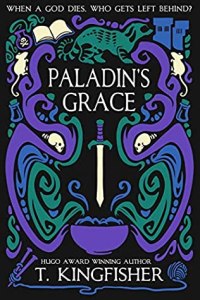
Serena’s Review: “Paladin’s Grace”

This post may contain affiliate links for books we recommend.  Read the full disclosure here.

Book: “Paladin’s Grace” by T. Kingfisher

Publishing Info:  Argyll Production, February 2020

Where Did I Get this Book: from the library

Where Can You Get this Book: Amazon | IndieBound | WorldCat

Book Description: Stephen’s god died on the longest day of the year…

Three years later, Stephen is a broken paladin, living only for the chance to be useful before he dies. But all that changes when he encounters a fugitive named Grace in an alley and witnesses an assassination attempt gone wrong. Now the pair must navigate a web of treachery, beset on all sides by spies and poisoners, while a cryptic killer stalks one step behind…

Review: That’s right, it’s time for another T. Kingfisher book review! I felt that enough time had passed since the last one that I could allow myself to read another. I’m reaaaaally trying to spread out her back catalog and not just binge read them all at once. But I have to tell you, it’s a tough ask. This is the first book in a trilogy, none the less, which will make it all the harder to try out the time between finishing this one and picking up the next. We’ll see how long I can make it, I guess.

After his god died a few years ago, Stephen lost the central core of his existence. His entire life had been built around serving the god as a holy berserker, trusting in his god’s power to keep him from harming innocents while caught up in one of his brutal rages. Without this fail safe, he and his fellow paladins have been eking out a quiet existence serving the White Rat and trying to avoid any trigger that may send them back into a berserking rage. So when he meets a perfumer who starts to stir deeper emotions within him, Stephen is fearful that allowing himself to feel anything for this woman will only lead to more tragedy. For her part, Grace is running from her own past and has only now felt as if she’s re-created a life for herself. But when she’s accused of murder, she can see it all crashing around her once again.

It will come as no surprise that I really enjoyed this book. It has all of the components I’ve come to expect from T. Kingfisher: witty writing, sympathetic main characters, a lovely romance, and, of course, funny animal companions. For the latter, this time we get an adorable weasel/cat hybrid that sounds perfectly cuddly, and I want one now, please and thank you. For the rest, this book is set in the same world as a few of Kingfisher’s previous books, so certain elements of the world will be more familiar to fans who have read those. I don’t think any of them are necessary to read before picking this one up, but there are definitely references to things that took place in other books that are nice to stumble upon as a reader in the know. There’s even the return of a favorite character of mine who we spent a lot of time with in “Swordheart.”

Also per the usual, I really liked both Stephen and Grace. T. Kingfisher does this great thing where she routinely writes characters and romances featuring adults in their 30s and 40s. Now that I am in that age group, I can’t say how refreshing it is to read a romance that features characters who have lived a life up to that point and all that comes with it. Here, Grace has already experienced an ugly romance in her first marriage and is going through the tedious process of starting up her life again later in life. Stephen, too, is grappling with the fact that the life he had drawn out for himself originally is not the one he is currently living. And yet, they find new love and new pathways before them in one another. Don’t get me wrong, I enjoy the typical 20-something romances I read as well, but it’s nice counterbalance to find romances like this that grapple with second loves and the lives and joys that can be found after initial disappointments. In particular, a weird little thing, I liked how this book briefly discussed how people are very different in what they enjoy or feel is romantic. It was just a small thing, but I think it touched on a greater theme to be found across love stories where all individuals are depicted as enjoying such and such thing, while that may not be the case for many people.

I do think the stakes in this book were a bit lower than they were in other stories by this author. I never felt much concern for Grace as she dealt with her murder accusation. And, rightfully, Kingfisher didn’t prioritize this aspect of the story overly much. Instead, the novel focused much more heavily on Grace and Stephen confronting their pasts and then grappling with how they chose to move forward with their lives. There was also a creepy background story that dealt with a “Ripper-esque” murderer going on a decapitation rampage. This subplot took some really surprising turns, and it’s clear by the way this book ended that Kingfisher is setting this plotline up as one that will carry over through this “Paladin” trilogy.

Overall, I really enjoyed this book. There are books by this author I liked more, but I have yet to hit upon one by her that I didn’t like at all. Indeed, other than being able to list one or two absolute favorites, I’m not sure I could rank the rest at all: I simply enjoyed the heck out of them! This book will definitely appeal to fans of this author or for those looking for a solid fantasy romance that isn’t explicit.

Rating 8: Sweet and sympathetic, a fantasy romance that speak to the lives we can rebuild from the ashes of hopes and dreams that may have faltered originally.

Reader’s Advisory:

“Paladin’s Grace” isn’t on any Goodreads lists, but it should be on Fantasy Romance.

Kate’s Review: “Codex Black (Book 1): A Fire Among Clouds”

This post may contain affiliate links for books we recommend.  Read the full disclosure here.

Book: “Codex Black (Book 1): A Fire Among Clouds” by Camilo Moncada Lozano & Angel Di Santiago (Colorist)

Publishing Info: IDW Publishing, April 2023

Where Did I Get This Book: I received an eARC from the publisher.

Where You Can Get This Book: WorldCat | Amazon | Indiebound

Book Description: Navigate through monsters, mysteries, and the will of the gods with two young extraordinary adventurers in fifteenth-century Mesoamerica as they search for a missing father.

Donají is a fearless Zapotec girl who, even though she’s only fifteen, is heralded as a hero by her village. In Codex Black, Donají sets out on an adventure–accompanied by the god that lives inside of her poncho–to find her missing father. Along the way, she meets an 18-year-old winged Mexica warrior named Itzcacalotl, and over time their temporary partnership blooms into an incredible friendship.

The search brings the young pair closer to danger and deeper into mystery than either could have predicted. What exactly was Donají’s father involved with? And how did a simple search for a missing relative lead Donají and Itzcacalotl into a fight with a terrifying bat monster to defend an entire village?!

Review: Thank you to IDW Comics for sending me an eARC of this graphic novel!

I told myself that I was going to try and do more graphic novels this year, as I felt like 2022 was a bit more sparse than it should have been. And with that goal I’ve found some pretty fun reads, some of which have been suggested to me or offered up, and were therein probably not been on my radar without the outside help. And that’s really worked out in my favor! The most recent of these is “Codex Black (Book 1): A Fire Among Clouds”, a young adult fantasy graphic novel that takes place in a pre-Columbian Mesoamerica, and involves two teenagers who have found themselves with magical abilities and powers. The premise alone sounded awesome, and when I saw the artwork I was even more eager to dive in!

“Codex Black: A Fire Among Clouds” is a really enjoyable first volume in the series. It has a lot it has to do in terms of setting up time and place, as well as a cast of characters, AS WELL as building a fantasy world within a historical context. We meet our two protagonists and see where they fit into the story, and Lozano does a great job of not only introducing them and making them connect, we also get a great sense for who they are. The first is Donají, a Zapotec teenage girl from a mountain village, is determined to find her father, a man who left their village and never returned, but did leave behind a poncho that houses the God Chicahualizteotl, who is there to assist her on her journey. The second is Itzcacalotl, a teenage Mexica boy who, while on a caravan with warriors, falls into a cavern and is gifted with crow wings. These two teens eventually come together and begin a journey of fantastical proportions, as Donají looks for her missing father and Itzcacalotl comes along for the ride and stumble upon thieves, monsters, and historical figures. I really loved both Donají and Itzcacalotl and their characterizations, and how Lozano slowly peels back and explores their personalities, strengths, and flaws. Dojaní is feisty and strong willed, while Itzcacalotl is a bit more reserved but also very determined to prove himself, and together they make an endearing team. I loved seeing them start to realize the powers that they both are wielding, be it the protectiveness of Donají’s poncho or Itzcacalotl’s wings, and how they interacted with friends, foes, historical figures (like Cosijoeza, one of the last coquitaos of the Zapotec people), and monsters from Mesoamerican lore and myth.

But what stood out to me most in this graphic novel was the VERY well presented historical context and information that was provided at the back of the book. As a woman who went to an American high school at the turn of the 21st century, I have VERY little working knowledge about Mesoamerican/Pre-Columbian civilizations and cultures (outside of a grade school unit on the Mayans). I’ve learned bits here and there through other books I’ve read, but it’s not extensive. So I LOVE that Lozano has such a great, accessible, and thorough historical notes section at the end of the book. It talks about the various myths of these different groups of people, and also gives historical notes and context to the events that were going on in Mexico during the time of this book before European imperialism started to take over. Given that I had been opening multiple tabs on my browser to look up some of this context, finding a good deal of it at the end of the PDF was really refreshing.

And finally, the artwork. I like Lozano’s style, with clear influence by manga and anime, with all the intricate details that harken to the cultures and styles of the people that the story is about. It’s varied and unique and I really liked it.

(Source: IDW Comics)

I will definitely be going forward in the “Codex Black” series. It’s so unique and filled with so much heart, I really can’t wait to see where it goes next.

Rating 8: Filled to the brim with fantastical mythology, engaging and well presented history, enjoyable characters, and lots of heart to spare, “Codex Black: A Fire Among Clouds” is a great introduction to a fun fantasy adventure!

Reader’s Advisory:

“Codex Black (Book 1): A Fire Among Clouds” would fit in on the Goodreads list “Mesoamerican Mythology in YA and MG Fiction”.

Kate’s Review: “Lore Olympus: Volume 3”

This post may contain affiliate links for books we recommend.  Read the full disclosure here.

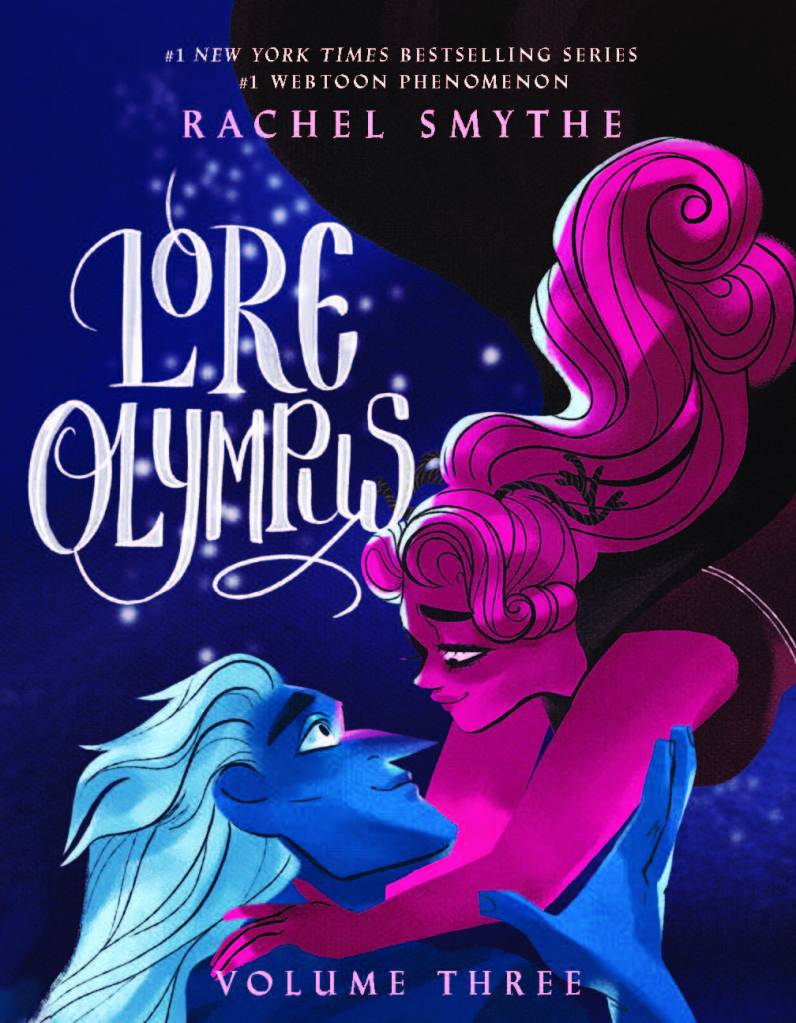
Book: “Lore Olympus: Volume 3” by Rachel Smythe

Publishing Info: Del Rey, October 2022

Where Did I Get This Book: I own it.

Where You Can Get This Book: WorldCat | Amazon | Indiebound

Book Description: All of Olympus–and the Underworld–are talking about the God of the Dead and the sprightly daughter of Demeter. But despite the rumors of their romance, Hades and Persephone have plenty to navigate on their own.

Since coming to Olympus, Persephone has struggled to be the perfect maiden goddess. Her attraction to Hades has only complicated the intense burden of the gods’ expectations. And after Apollo’s assault, Persephone fears she can no longer bury the intense feelings of hurt and love that she’s worked so hard to hide.

As Persephone contemplates her future, Hades struggles with his past, falling back into toxic habits in Minthe’s easy embrace. With all the mounting pressure and expectations–of their family, friends, and enemies–both Hades and Persephone tell themselves to deny their deepest desires, but the pull between them is too tempting, too magnetic. It’s fate.

This full-color edition of Smythe’s original Eisner-nominated webcomic Lore Olympus brings Greek mythology into the modern age in a sharply perceptive and romantic graphic novel.

Review: We are back to my favorite deity filled soap opera/love story “Lore Olympus”, this time diving into the third volume. This story has been taking over our book club as almost everyone has at least started it, and I cannot stop fawning over it because of every single beat it hits that just work for me. And “Volume Three” keeps the streak going, as, once again, I loved this.

Now let’s get into why! THIS IS GOING TO BE LONG! (source)

Both Persephone and Hades have some huge emotional summits they are starting to climb in this volume, and it’s still fairly separate outside of them being at work in the Underworld together. As Persephone has started her first job, Hades is trying to remain professional and emotionally disconnected, and she is trying to find her footing while dealing with a lot of feelings she needs to sort out. We still don’t really know a lot about Persephone’s time in the Mortal Realm before all of this, all we know is that she has been given a scholarship by The Goddesses of Eternal Maidenhood to go study in Olympus so long as she commits to remaining celibate. We finally get to explore how she started this journey in this volume, as we see how she was approached by Hestia, how she got paired up with Artemis as roommates, and how she may be a little hesitant about the whole thing. But then there is something else that is being hinted at. Something about Persephone’s nature, and how there is perhaps something else that she is trying to leave behind, and how Demeter is trying to cover something up. Smythe starts laying out these clues in a more earnest nature this time around, with hints towards a more fiery temperament, hints towards Demeter changing her mind on a dime about Persephone’s place in the mortal realm, and hints about a destiny to be fulfilled. Seeing all of this in tandem with Persephone’s anxieties about fitting in at school, anxieties about working at a strange job, and anxieties about her crush on Hades makes for a VERY compelling character arc, and I just love what Smythe is doing with her.

Hades, too, is dealing with his own inner battles, mostly with trying to avoid Persephone as he feels like his feelings for her are inappropriate and that he’s reading far too much into it. So of course he’s decided to make it official with Minthe, the scheming and manipulative (but also very much hurting and damaged) nymph that works for him and has been is on again, off again girlfriend for a long time. But as Hecate finds more and more reasons to try and push him and Persephone together, he starts to wonder if perhaps he has a connection to her that has been in place even before he saw her at that party. Hades as a guy who is doing his best to not be a creep and doing his best to repress his feelings, because of his fear of hurting her but also because of a hinted at past trauma (if you know the broader mythology you can probably guess it), is a bit refreshing, as it puts a lot of the agency on Persephone, which is a VERY good thing in reimaginings of this tale. He also isn’t left totally off the hook when it comes to how he is probably using Minthe, while also conceding that in some cases BOTH parties can be very, very bad for each other. It all leads to a very heartbreaking sequence for the both of them. Arg, complexity when portraying the character getting in between my ship? How very dare you, Rachel Smythe?!

But the biggest stand out for me this volume was Eros. (There will be mild spoilers here because I need to spoil to talk about why I loved this!) Eros is a figure that happens to be at the center of my second favorite Greek Myth (that of him and Psyche), and while we are getting some hints that we are moving in that direction for his plot, his main function as of now is to be a kick ass and supportive friend to Persephone as she starts to come to terms with her rape by Apollo. I think that it would be an easy out to make Eros a very flamboyant and over the top romance fiend, because Eros, BUT Smythe instead makes him, yes, a bit of a drama llama, but also SO in touch with love and appropriate ways to show love and boundaries. His reaction to Persephone’s reveal was so, so perfect for the character, and it hit me right in the feels. We are also getting a little more insight into his own background and baggage, specifically about Psyche, and how something he did has put Aphrodite into a tenuous position, and it makes him all the more complicated and interesting. I just love the role he’s playing, and very much look forward to seeing his role continue to grow and evolve as the series goes on.

Oh and also there is a lot of interesting Hera stuff here too in that she knows that something happened to Persephone, she thinks she knows that Apollo is involved, and when she tries to investigate further Zeus decides to sweep it all under the rug because PATRIARCHY. I really love what Smythe is doing with Hera too, because again, she could have just been a shrewish wife to Zeus as she seems to be portrayed in the original myths. But in this we get to see why she is so damn frustrated and weary, and it’s because she is having to remain by the side of a man that she doesn’t REALLY like who won’t even give her a modicum of respect, or really any respect to ANY women. I’m always for calling out Zeus, but I especially love it when Hera gets leeway while still being complicated.

So obviously I’m still all about “Lore Olympus” and “Volume Three” is continuing the love. It’s just so well done. I’ve pre-ordered “Volume Four”, so you know that when it comes out this summer I will be back on my fan girl bullshit.

Rating 10: Oh be still my heart, so many feelings this time around. You’re killing me, Greek Gods and Goddesses! In the best, best way.

Reader’s Advisory:

“Lore Olympus: Volume 3” is included on the Goodreads lists “Greek Mythology Retellings!”, and “Hades and Persephone”.

Previously Reviewed:

Serena’s Review: “The Fairy Bargains of Prospect Hill”

This post may contain affiliate links for books we recommend.  Read the full disclosure here.

Book: “The Fairy Bargains of Prospect Hill” by Rowenna Miller

Publishing Info: Redhook, March 2023

Where Did I Get this Book: from the publisher!

Where Can You Get this Book: Amazon | IndieBound | WorldCat

Book Description: There is no magic on Prospect Hill—or anywhere else, for that matter. But just on the other side of the veil is the world of the Fae. Generations ago, the first farmers on Prospect Hill learned to bargain small trades to make their lives a little easier—a bit of glass to find something lost, a cup of milk for better layers in the chicken coop.

Much of that old wisdom was lost as the riverboats gave way to the rail lines and the farmers took work at mills and factories. Alaine Fairborn’s family, however, was always superstitious, and she still hums the rhymes to find a lost shoe and to ensure dry weather on her sister’s wedding day.

When Delphine confides her new husband is not the man she thought he was, Alaine will stop at nothing to help her sister escape him. Small bargains buy them time, but a major one is needed. Yet, the price for true freedom may be more than they’re willing to pay.

Review: While I still haven’t gotten around to reading the second two books in the trilogy, I really enjoyed Rowenna Miller’s fantasy novel “Torn” when I read it several years ago. This is definitely one of those situations where my failure to complete the trilogy is completely due to my own lack of self-control in managing my TBR list and nothing to say about the series itself. That being the case, I was excited to see that the author was releasing a stand-alone fantasy novel this spring. Phew! Can’t drop the ball on a stand-alone!

While the world continues its steady march forward into modernity and industry, the family who owns the orchard on Prospect Hill still understand and honor the old, magical ways. A woven hay wreath for prosperity. A twist of nickel and ribbon for a good harvest. And while these time-tested bargains are reliable and sure, it is understood that the Fae are never to be trusted. But when two sisters find themselves confronting the limitations of a world that sees only limited roles for women, they must chance a new bargain to create a way forward for themselves and their family.

It’s no surprise that this book was a hit with me. There are so many things I like, right there in the description! A story with a historical setting that tackles the culture and challenges of that period of time. A plot that focuses on the softer, wilder side of magic. And two characters who are sisters and must navigate the beauties and pitfalls of that relationship. And Miller came through on all three points!

I really enjoyed the way this book navigated the historical time period during which it is set. Throughout the book, we see Alaine and Delphine come up against the limitations placed on them by a society that doesn’t yet recognize women’s value. But change is also in the air, with many references to the suffragettes who are hard at work fighting for women’s rights. Alaine and Delphine represent the everyday women in this period of time. Neither would label themselves as a suffragettes; indeed, Delphine’s politically-minded husband wants her to have nothing to do with the “radical” movement. However, they are still fully realized characters and women and thus quickly come up against the limitations placed on them. Delphine is interested in art and learning, forming a friendship with another female scholar. And for her part, while Alaine operates a farm and is active in local agriculture decisions, we see her again and again come up against those who would wish to see her fail. I especially liked a conversation and theme that came up towards the end of the book about how if something is a challenge for one person, there’s a good chance it’s a challenge for others. And that’s why it’s important to work towards changes that will benefit society as a whole, rather than just oneself.

I also really liked Alaine and Delphine as characters in their own right. They both felt like complete, fully-fleshed out women, complete with their own unique strengths and their own personal failings. But I particularly appreciated the way they were portrayed as sisters. The story alternates between the two of them, so we very quickly learn to see how each sister is misinterpreting and misunderstanding the other. Here are two women who are as close as you can be, but their relationship is constantly strained by their inability to clearly see the other one for who she truly is without viewing it through their own lens. It was such an honest and relatable portrayal, and I think the most successful depiction of adult sisterhood that I’ve seen in some time.

This is definitely a slower, quieter story. It takes a while for all of the pieces to come into place, so readers must be prepared to spend a good portion of the beginning of the book setting up our characters and their relationships with each other and the world around them. But then about two thirds through the book, the story takes a massive shift in what it’s doing. I wouldn’t say that it ever becomes action-packed, but it definitely went in a direction that I wasn’t expecting, but that I enjoyed the heck out of. Looking back on the read as a whole, this left me feeling as if the pacing of the book felt a bit choppy. But as I enjoyed both halves of the book so much, I’d hardly hold this against it.

Rating 8: Fairy circles and whimsical magic weave in and out of a thoughtful, quiet fantasy story that tackles important themes of sisterhood and feminism.

Reader’s Advisory:

“The Fairy Bargains of Prospect Hill” isn’t on any Goodreads lists yet, but it should be on Everything Fae.

Kate’s Review: “The London Séance Society”

This post may contain affiliate links for books we recommend.  Read the full disclosure here.

Book: “The London Séance Society” by Sarah Penner

Publishing Info: Park Row, March 2023

Where Did I Get This Book: I received an eARC from NetGalley.

Where You Can Get This Book: WorldCat | Amazon | Indiebound

Book Description: 1873. At an abandoned château on the outskirts of Paris, a dark séance is about to take place, led by acclaimed spiritualist Vaudeline D’Allaire. Known worldwide for her talent in conjuring the spirits of murder victims to ascertain the identities of the people who killed them, she is highly sought after by widows and investigators alike.

Lenna Wickes has come to Paris to find answers about her sister’s death, but to do so, she must embrace the unknown and overcome her own logic-driven bias against the occult. When Vaudeline is beckoned to England to solve a high-profile murder, Lenna accompanies her as an understudy. But as the women team up with the powerful men of London’s exclusive Séance Society to solve the mystery, they begin to suspect that they are not merely out to solve a crime, but perhaps entangled in one themselves

Review: Thank you to NetGalley for sending me an eARC of this novel!

I was very enamored with Sarah Penner’s previous novel “The Lost Apothecary”, as it told the story of women who had to take their lives and sense of justice into their own hands during a time when there were so few options granted to them should they be abused by powerful men. Talk about cathartic! So I knew that when she came out with a new historical thriller/mystery I would definitely want to check it out. You can probably guess that when I saw that her new book was called “The London Séance Society”, I was VERY excited. Not only was Penner doing another woman centric historical thriller with a feminist bent, but she was also maybe bringing in GHOSTS! Or at the very least the ideas of ghosts, mediums, and séances from the Victorian Spiritualism movement!

(source)

The thriller and dark fantasy elements of this book worked really well together, branching out from her previous genre that’s steeped in non-supernatural themes and doing so with success. I really loved the mystery as renowned medium Vaudeline and her apprentice Lenna are pulled into the mysterious death of Vaudeline’s friend Mr. Volckman, who was the head of the men’s only spiritualist group The London Séance Society, and how both women have their reasons for wanting to find the truth about him and his group. For Vaudeline, she is trying to keep the reputation of spiritualism untainted, and the LSS is rumored to be a bit suspect. For Lenna, it’s that her sister Evie (a former student of Vaudeline and aspiring medium) was murdered, and Lenna is trying to figure out what happened to her, while realizing that she, too, may have gifts that she doesn’t really believe in.

We had a couple perspectives, the first being a third person perspective of Lenna as she tries to solve her sister’s murder. Lenna is skeptical and grief stricken, but is also finding herself growing more attracted to Vaudeline as they prepare to conduct a séance with the LSS. The other perspective is that of Mr. Morley, one of the high ranking members of the LSS, and his is in the first person and generally in the past. With both these perspectives we get the pieces of the two puzzles, and we start to wonder who can be trusted and what is real and what is not. I did find myself questioning the motives and perspectives of a few of the characters, and I was surprised by a few of the reveals. It’s a well done mystery with some moments of true suspense, as well as some solid supernatural bits and elements that worked well. I liked Lenna enough, I REALLY liked Vaudeline, and most of the characters had interesting moments and felt pretty grounded in reality given the time, the place, and their motives. I also liked that from the jump we know that while Lenna is skeptical, Vaudeline has a very real gift and talent, and that the ghost aspects of this book were leaned into and made for an interesting fantasy angle.

I really do have to gush about the setting of this story, as the Victorian Era has something of a special place in my heart due to the fact I used to work as an interpreter in a Victorian mansion in St. Paul. Penner hits the nail on the head with the historical tidbits when it comes to spiritualism, séances, gender and class divisions, and superstitions of the time period, and uses it all to create a well conceived mystery with it’s fair share of timeless themes. I loved that our protagonists Vaudeline and Lenna are two women mediums who are trying to solve the murders of Volckman and Evie, but are coming up against a men’s only group that has taken the skills of women mediums, twisted them for monetary gains, and has banned women from the group altogether while creating fraudulent practices that endanger the reputations of real spiritualists like Vaudeline. I mean, how freaking typical (and also true! The LSS is based on the actual Ghost Club from that time period, and no, women were NOT allowed even thought it was women who were the pioneers of the spiritualism movement, fraudulent as it was). There is also a very handy historical note at the back of the book that puts a lot of this into context AND has recipes for a couple refreshments of the time period AND has a candle making guide! This is my total jam and it was a fun surprise at the end of the book.

I enjoyed “The London Séance Society”, and Sarah Penner has started a streak of engaging historical thrillers. I cannot wait to see what she comes up with next!

Rating 8: A compelling mystery that puts women mediums at the forefront and explores spiritualism, misogyny, and an obsession with the dead during the Victorian Era.

Reader’s Advisory:

“The London Séance Society” is included on the Goodreads lists “Bone Book Club” and “Can’t Wait Sci-Fi/Fantasy of 2023”.

Serena’s Review: “Flowerheart”

This post may contain affiliate links for books we recommend.  Read the full disclosure here.

Book: “Flowerheart” by Catherine Bakewell

Publishing Info: HarperTeen, March 2023

Where Did I Get this Book: Edelweiss+

Where Can You Get this Book: Amazon | IndieBound | WorldCat

Book Description: Clara’s magic has always been wild. But it’s never been dangerous. Then a simple touch causes poisonous flowers to bloom in her father’s chest.

The only way to heal him is to cast an extremely difficult spell that requires perfect control. And the only person willing to help is her former best friend, Xavier, who’s grown from a sweet, shy child into a mysterious and distant young man.

Xavier names a terrible price in return, knowing Clara will give anything to save her father. As she struggles to reconcile the new Xavier with the boy she once loved, she discovers their bargain is only one of the heavy secrets he’s hiding. And as she hunts for the truth, she instead finds the root of a terrible darkness that’s taken hold in the queendom—a darkness only Clara’s magic is powerful enough to stop.

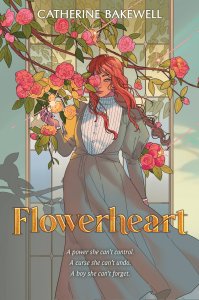
Review: This is definitely one of those books that I first looked at because of the cover. It immediately stood out when I was scrolling through Edelweiss+ planning out my spring reading schedule. Tons of books with daggers and swords on the covers, lots of duo characters drawn in that cartoonish style that is so popular right now (not that I dislike this style per se, just there’s a lot of it). This cover’s unique art immediately stood out and had me clicking through to the description. So well done there!

Clara has always struggled to control her magic, so much so that the local leaders have presented her with a terrible ultimatum to prevent her from injuring others. But before she can go through with it, the worst happens and an innocent touch causes her magic to sprout poisonous plants in her father’s chest, dooming him to a painful and slow death. When an old friend offers to help her tame her magic in an attempt to save her father’s life, she doesn’t even hesitate in the face of the steep price he requests. But when it becomes clear that Xavier is caught up in much darker forces than she had previously known, Clara begins to wonder with just whom did she strike her perilous bargain?

One thing that I found interesting when I was looking into this book was that it was marketed as a “cottage core” fantasy novel. What does that even mean? As far as I’m aware “cottage core” is a style of interior decoration. I’m not sure how that translates to a genre of book? Digging deeper, I discovered that there seems to be a recent trend of labeling some books “cozy fantasy,” which I imagine is just a spin-off from the more popular “cozy mystery” subcategory. Based on the latter, I’d guess that a cozy fantasy novel would be a story that avoids darker themes or graphic descriptions. Like cozy mysteries, they would focus on lighter topics and have happy endings, essentially. All of this to say, while I could see how cozy fantasy would apply to this story, I still have no clue about “cottage core.” And honestly, I’m not a fan of that description; interior decoration styles and genres of books are just not the same thing. Sorry, not sorry.

Anyways, that rant aside, I can definitely see how this book could fall into the “cozy” category. Overall, it does stay on the lighter side of things and the plot wraps up with a nice bow at the end. But this book also highlights why a lot of cozy mysteries don’t work for me either. Look, I don’t need tragedy around every corner and tons of graphic violence, but if you paint in only bright colors, without any shades of grey, the entire thing starts to just lose focus and interest. Clara is fine. Xavier is fine. This world and magic are fine. But I didn’t care about any of them.

I also found the magic system and world to be barely fleshed out at all. Towards the second third of the book, we begin to learn about a magical illness that is going around that leaves its victims comatose. This was the first thing to trigger my interest, but even that quickly sank into the quagmire of dullness that I found this read. Nothing was objectively bad, but it all was just so flat feeling that even small points of interest quickly faded away.

There was also an attempt by the author to deal with mental illness, particularly depression and anxiety. And while I applaud the effort, I don’t think it quite hit the mark. At points, it felt incredibly over-simplified and the metaphors heavy-handed. And then Clara has this weird relationship to her own magic where she speaks to it as a living, thinking being using this strange internal dialogue, which I wasn’t a fan of. It turns out that this particular choice plays a larger role later in the story, but that was still too late to save my reading experience through which I had been perpetually annoyed by this.

Overall, this book wasn’t for me. I do think that readers looking for something in the cozy category may enjoy this one more, but I’ve started coming to the conclusion that “cozy” any genre is just not my cup of tea.

Rating 6: Perhaps other readers looking for just a quick, cozy read will enjoy this, but I found everything from the world-building to characterization to be a bit too watered down to enjoy.

Reader’s Advisory:

“Flowerheart” can be found on these Goodreads lists: Books that inspired or are similar to Studio Ghibli / Hayao Miyazaki films and CozySFF

Book Club Review: “The Witch’s Heart”

This post may contain affiliate links for books we recommend.  Read the full disclosure here.

We are part of a group of librarian friends who have had an ongoing book club running for the last several years. Each “season” (we’re nerds) we pick a theme and each of us chooses a book within that theme for us all to read. Our current theme is retellings and re-imaginings.  For this blog, we will post a joint review of each book we read for book club. We’ll also post the next book coming up in book club. So feel free to read along with us or use our book selections and questions in your own book club!

Book: “The Witch’s Heart” by Genevieve Gornichec

Publishing Info: Ace Books, February 2021

Where Did We Get This Book: The library!

Where You Can Get This Book: WorldCat | Amazon | Indiebound

Retelling/Re-imagining: Norse Mythology

Book Description: Angrboda’s story begins where most witches’ tales end: with a burning. A punishment from Odin for refusing to provide him with knowledge of the future, the fire leaves Angrboda injured and powerless, and she flees into the farthest reaches of a remote forest. There she is found by a man who reveals himself to be Loki, and her initial distrust of him transforms into a deep and abiding love.

Their union produces three unusual children, each with a secret destiny, who Angrboda is keen to raise at the edge of the world, safely hidden from Odin’s all-seeing eye. But as Angrboda slowly recovers her prophetic powers, she learns that her blissful life—and possibly all of existence—is in danger.

With help from the fierce huntress Skadi, with whom she shares a growing bond, Angrboda must choose whether she’ll accept the fate that she’s foreseen for her beloved family…or rise to remake their future. From the most ancient of tales this novel forges a story of love, loss, and hope for the modern age.

Kate’s Thoughts

While I have a pretty extensive knowledge of Greek Mythology thanks to an obsession with it in grade school, Norse Mythology is pretty outside of my wheelhouse. I know some of the basic things, and have a general working knowledge of the various Gods and the whole concept of Ragnorak, but it’s sparse when compared to other people I’d imagine. So I was going into “The Witch’s Heart” without much idea of what to expect when it came to our protagonist Angrboda, the witch who eventually gave birth to Loki’s monster children who help usher in the apocalypse myth. But that just made me game to give it a shot, especially since it was getting the “Circe” treatment and retelling a story with a character who doesn’t have as much to do in the original myths. And for the most part, I enjoyed “The Witch’s Heart”, but that may be because I had few expetations.

For one thing, I really liked the emotional exploration of Angrboda as a woman used by powerful men, as well as the emotional exploration of her as a mother to her children, as atypical as they may be. And by atypical I mean a half corpse daughter, a wolf, and a serpent. But I really got a sense of her love for all of them and the way that she was desperate to protect them, while also falling for Loki no matter how dysfunctional that relationship was. The way she was written to me made me believe it, even though sometimes I wanted to shake her and be like ‘SERIOUSLY, THIS GUY?’ (so does her huntress friend Skadi, a character that I also found intriguing though I think I needed more of her. Also, damn you Tom Hiddleston for making Loki so damn likable, because this version, while more true to the myth, was a punk). The relatable emotional bits were what really kept me engaged, as I was deeply invested in her relationship with her kids event though I did know that it would all end in tears because of the myths they are based upon. That being said, I also thought that there were bits where it kind of dragged after abrupt tone shifts that didn’t work as well for me. I was far more interested in her being a mother in the forest as opposed to the end of world action that was inevitably going to take place.

Ultimately I was entertained by “The Witch’s Heart”. I’m still into these outside the box retellings of mythological women, and would love to see more that push beyond the obvious Greek stories, so that made this one all the more enjoyable.

Serena’s Thoughts

I’m fairly familiar with Norse mythology. Not an expert, by any means, but I already knew the story being retold here fairly well, as well as the major players involved. That was both a plus and a minus as far as my reading experience goes. Like Kate, I’m really enjoying this current surge of books being published that reimagine or create stories for lesser known characters, often women, from mythology. I also really like the fact that we are venturing beyond the much more popular Greek pantheon.

Angrboda was almost a perfect character for this sort of retelling. She doesn’t have much as far as the original lore, so there was a lot of room to portray her story. And somehow I think the author both did too much and too little. On one hand, the story was very faithful to the major plot points of the Norse story from which it is derived. But almost too much? I would have liked a few more creative interpretations brought in. Also, like Kate said, I think Angrboda’s character was given some interesting themes to cover, especially with regards to her relationship to her children and to her unhealthy relationship with her husband, Loki. But on the other hand, I felt like she was a bit more passive of a character than I would have expected or hoped for from a woman who has birthed literal monsters!

I also agree with Kate that the pacing of this book felt a bit off. The first half is fairly slow with a lot of time spent with Angrboda hanging out in a cave in the woods. The storytelling was also interrupted by lots of banter from Loki. Which, on one hand, I liked a lot of the dialogue, but I also felt like there were times where the author got rather self-indulgent with it. And then there’s a massive tonal shift in the second half where we’re fulling into the world-shifting dramatics.

Overall, I felt like this book was a bit all over the place. Are my expectations unreasonably high from “Circe?” Probably. But was this the best that could have been done with this story or these characters? I don’t think so.

Kate’s Rating 7: A retelling of a source material I have not so much knowledge of that kept my attention and had some emotional moments, though also some dragging ones.

Serena’s Rating 7: A bit uneven in pacing as well as characterization, but something that will likely appeal to readers who are looking for a different pantheon to explore in their mythological retellings.

Book Club Questions

  1. How familiar are you with Norse Mythology? Could you predict how things were going to go based how much you knew about it?
  2. What did you think of Angrboda as a protagonist? What did you like or dislike about her?
  3. What did you think about Angrboda’s relationships in this story, whether it was Loki, Skadi, or her children?
  4. Did you have any thoughts on how Loki was presented and interpreted in this novel?
  5. There have been a lot of marketing comparisons between this book and Madeline Miller’s “Circe”. What did you think of this marketing choice?
  6. The parts of this book were separated out in very deliberate chunks of time and very deliberate themes. Did you have a part you liked the best?

Reader’s Advisory

“The Witch’s Heart” is included on the Goodreads lists “Hot Girl Mythology Books”, and “Loki: God of Mischief”.

Next Book Club Pick: “Great or Nothing” by Joy McCullough, Caroline Tung Richmond, Tess Sharpe, and Jessica Spotswood

Serena’s Review: “The Foxglove King”

This post may contain affiliate links for books we recommend.  Read the full disclosure here.

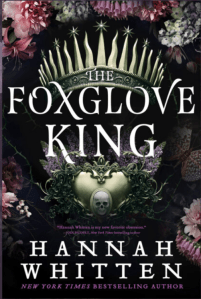
Book: “The Foxglove King” by Hannah Whitten

Publishing Info: Orbit, March 2023

Where Did I Get this Book: from the publisher!

Where Can You Get this Book: Amazon | IndieBound | WorldCat

Book Description: When Lore was thirteen, she escaped a cult in the catacombs beneath the city of Dellaire. And in the ten years since, she’s lived by one rule: don’t let them find you. Easier said than done, when her death magic ties her to the city.

Mortem, the magic born from death, is a high-priced and illicit commodity in Dellaire, and Lore’s job running poisons keeps her in food, shelter, and relative security. But when a run goes wrong and Lore’s power is revealed, she’s taken by the Presque Mort, a group of warrior-monks sanctioned to use Mortem working for the Sainted King. Lore fully expects a pyre, but King August has a different plan. Entire villages on the outskirts of the country have been dying overnight, seemingly at random. Lore can either use her magic to find out what’s happening and who in the King’s court is responsible, or die.

Lore is thrust into the Sainted King’s glittering court, where no one can be believed and even fewer can be trusted. Guarded by Gabriel, a duke-turned-monk, and continually running up against Bastian, August’s ne’er-do-well heir, Lore tangles in politics, religion, and forbidden romance as she attempts to navigate a debauched and opulent society.

But the life she left behind in the catacombs is catching up with her. And even as Lore makes her way through the Sainted court above, they might be drawing closer than she thinks.

Review: I really enjoyed Hannah Whitten’s “For the Wolf” duology. The first book came out back in the “summer of ‘Red Riding Hood’ retellings,” as I fondly dubbed it, and I think Whitten’s version was my favorite of the three I read over those months. “For the Throne” was also an excellent sequel, taking the characters and the world in directions that I hadn’t expected. All of this to say, I am fully on board Whitten’s train, and I was super excited when I saw that she was releasing a new book this spring that would be the first in a new series. Let’s dive in!

I’m going to forego my usual summary chapter, and instead talk a bit about the fact that I think the official book’s summary is a bit misleading. It’s not truly important, but I think Lore’s connection to the catacombs is much more complex than “she escaped a cult and is in hiding.” I also think there are simply bits of the few sentences about this aspect of the book in the summary that are just factually wrong. I’m always mildly fascinated when there are discrepancies like these in book summaries. Was there some purpose behind this choice? Did the summary writer only skim the book and this was an accident? Who knows? Beyond this, the rest of the summary seems clear enough.

First, let’s talk about worldbuilding, particularly with regards to the magic and gods of this world. I think it’s interesting that this is now the second series that Whitten has written where her magic system involves magical forces directly interacting with the body, often resulting in mildly horrifying temporary changes to one’s physical self. I mean, I guess if you know what you like in a magic system, just go for it? I just found that interesting.

I will say, however, that it took me a bit to truly understand how this magic works, not only Lore’s abilities but also Mortem itself as used by others in the form of consuming poisonous substances. At a certain point early in the book, I had to consciously choose to stop trying to understand this and just go with it. As I continued reading, some of these details did become more clear, but honestly, I’d still struggle to write down a concise explanation of how it all worked. I’m not sure if this was a failing of the system itself or how it was described, but readers should be prepared to devote some thought and reading time into absorbing this aspect. I do think it is worth it, however, since as the book continued and I felt more comfortable with the concepts, this magical conceit opened up a lot of interesting story lines and theories.

As for the gods, I thought this part of the book was a bit familiar. There are a lot of fantasy books that deal with a religion that has been built up around one god after the destruction of a larger pantheon that came before. So, too, the relationship between a god of life/light and a goddess of darkness/death. The book played its cards pretty close to the chest with these themes, however, leaving a lot of questions still to be answered in this area. But I also feel fairly confident that I know where this is going, and it might read familiar to other readers as well. Who knows though? As I said, we don’t get any clear answers here, so Whitten could still surprise me!

Lastly, the characters and, most importantly, the love triangle between them. Yes, a love triangle and if you skip to the end of the review, you’ll see that I gave this book a good rating, so what’s going on here? Well, I’ll say that the success of this particular love triangle comes down to one key thing: all three of these characters are fully realized individuals with their own arcs and struggles within this book. Yes, it’s mostly Lore’s book. But the story does an excellent job of also setting up Gabriel, a young man who has been shaped by a great tragedy in his past, and now must struggle with dueling loyalties to Lore and to the religion and its leader who gave him refuge during that tragic event. Bastian, too, is a fully realized character, and his story explores themes of responsibility, power, and trust. Truly, the “romance,” such that it is, between all three characters is very much in the background to the growth that they experience as individuals, as various pairs, and as a group of three together.

I’ll also say that the romance plays out in a very non-traditional manner, in some ways. Part of my problem with love triangles is that I always feel as if the true love interest is telegraphed so clearly and so early that the second romantic storyline just feels like rather boring subterfuge. Here, I almost had the opposite problem. At various points in the story, both characters feel as if they are being set up as the end game couple. But then at different points in the story, each does something that I would typically say points to them being ruled them out as the end game partner. I found myself not only confused but intrigued, and I’m now half-wondering if Whitten is pulling a fast one on me and neither character will be a true love interest by the end of the series.

Overall, I really enjoyed this book. I think some aspects of the world-building were a bit confusing, on one hand, and overly familiar, on another. But it’s also clearly the start to a series, so both of these questions could be resolved in follow-up books. I do think the story lives and dies on the strength of its central three characters, and I, for one, was completely sold on them all. If you enjoy character-centric stories and want a more complex look at a love triangle, this is the fantasy novel for you!

Rating 8: Like the book’s own magic, Whitten perfectly balances darkness and light to create a new fantasy world and leading lady that feels both dangerous and opulent, ferocious and soft. An intriguing start!

Reader’s Advisory:

“The Foxglove King” can be found on these Goodreads lists: Most Anticipated Adult Fantasy, 2023 and Poisonous Plant Fiction Titles

Serena’s Review: “Empire of Exiles”

This post may contain affiliate links for books we recommend.  Read the full disclosure here.

Book: “Empire of Exiles” by Erin M. Evans

Publishing Info: Orbit, November 2022

Where Did I Get this Book: ARC from the publisher!

Where Can You Get this Book: Amazon | IndieBound | WorldCat

Book Description: Twenty-seven years ago, a Duke with a grudge led a ruthless coup against the empire of Semilla, killing thousands. He failed. The Duke was executed, a terrifyingly powerful sorcerer was imprisoned, and an unwilling princess disappeared. 

The empire moved on. 

Now, when Quill, an apprentice scribe, arrives in the capital city, he believes he’s on a simple errand for another pompous noble: fetch ancient artifacts from the magical Imperial Archives. He’s always found his apprenticeship to a lawman to be dull work. But these aren’t just any artifacts — these are the instruments of revolution, the banners under which the Duke lead his coup. 

Just as the artifacts are unearthed, the city is shaken by a brutal murder that seems to have been caused by a weapon not seen since the days of rebellion. With Quill being the main witness to the murder, and no one in power believing his story, he must join the Archivists — a young mage, a seasoned archivist, and a disillusioned detective — to solve the truth of the attack. And what they uncover will be the key to saving the empire – or destroying it again.

Review: I always love some good, old-fashioned political intrigue in my fantasy novels. On top of that, a “seasoned archivist” sounds like a fancy name for a fantasy librarian, so you know I’m going to be all over anything that references librarians. What can I say, we’re easy to please. It’s kind of like how the Oscar nominations always favor movies about Hollywood. Publishers and authors know what us librarians like to read about. Ourselves! But in all seriousness, this sounded like an intriguing book, so I was happy to receive a copy to review from Orbit.

It has been decades since the Duke lead his failed coup, attempting to set up a young princess as the next ruler. He was executed and the world seemed to move on, life going about as usual behind the wall of Salt that surrounds the land to protect those within from the powerful Changelings that linger, ever present beyond. But now, the artifacts of the Duke’s rebellion are being brought out of storage. What possible use could they serve but to reignite that old spark? On top of that, a shocking murder takes place and a group of seemingly disconnected individuals all work to uncover the many secrets that are slowly, slowly creeping back into the light.

This is definitely a book made for true fantasy lovers. By that I mean that it can be intimidating as heck to those who might just pick it up on a whim. You open the book and there you see detailed and complex maps. Then you see a huge cast of characters. And then you start reading and it becomes very apparent that not only do these main characters not understand the full scope of their world, but that the author isn’t about to clue you, the reader, in any time soon either. But this is not a critique! Indeed, all of these things are exactly the kind of meaty aspects that I think many fantasy readers are looking for in a book. We want to be thrown into the deep end and feel as if we’re truly in a new world, one that would in fact be filled with huge casts of characters, need a detailed map to understand, and contain a magic system that goes beyond wand-waving. And this book delivers on all of these things!

Some of it will also be familiar to fantasy fans, which can be a plus and a minus. I didn’t think there was anything truly shocking here, though I may make an exception for the Changelings themselves, as I thought they were a particularly interesting threat. But the magic system, while interesting, will read as familiar to many fantasy readers. Basically, practitioners will have an affinity to certain things (wood, bone, stone) etc. which will influence they way they can perform magic. Hence, the salt wall that surrounds the city gains a certain mystique as it could only be created by a very unique sort of person.

The characters were all good as well, though I can’t say that I was overly attached to any one of them over another. This is probably a good and a bad thing, ultimately. I wasn’t dreading any particular character’s chapter, but I also wasn’t incredibly invested in one of them either. All told, I think the characters themselves served more as aspects of the world and story that were being created than as the driving force of the story itself.

The writing was quite effective right from the start. It felt sure-handed and well-practiced at balancing the myriad of aspects that must go into creating a complicated world and story such as this one. Indeed, on top of setting up an epic-feeling fantasy world, the author adds in a murder mystery. For me, as a fan of mysteries as well, I really enjoyed this combination of genres, and I think it added an extra zest to the overall story.

It did take me a bit to really get into the book. Because we’re thrown in right away, it takes a bit to orient oneself with the players and world at large. This might also be where my lack of immediate attachment to the characters put me at a bit of a disadvantage. Even now, though, I can’t point to exactly why I struggled with this. I have very clear memories of some of the first scenes with certain characters and laughing internally at some of the great dialogue right off the bat. Either way, I think this book will definitely appeal to epic fantasy fans looking for a new world to explore, and I will definitely be keeping an eye out for the next one!

Rating 8: The pinnacle of what one looks for in epic fantasy: a sprawling world, a rich history, a detailed magic system, and an intriguing cast of characters to travel alongside.

Reader’s Advisory:

“Empire of Exiles” can be found on this Goodreads list: Best books of November, 2022