
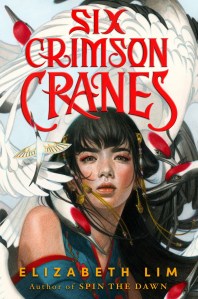
Serena’s Review: “Six Crimson Cranes”

Book: “Six Crimson Cranes” by Elizabeth Lim

Publishing Info: Knopf, July 2021

Where Did I Get this Book: Edelweiss+

Book Description: Shiori, the only princess of Kiata, has a secret. Forbidden magic runs through her veins. Normally she conceals it well, but on the morning of her betrothal ceremony, Shiori loses control. At first, her mistake seems like a stroke of luck, forestalling the wedding she never wanted, but it also catches the attention of Raikama, her stepmother.

Raikama has dark magic of her own, and she banishes the young princess, turning her brothers into cranes, and warning Shiori that she must speak of it to no one: for with every word that escapes her lips, one of her brothers will die.

Penniless, voiceless, and alone, Shiori searches for her brothers, and, on her journey, uncovers a conspiracy to overtake the throne—a conspiracy more twisted and deceitful, more cunning and complex, than even Raikama’s betrayal. Only Shiori can set the kingdom to rights, but to do so she must place her trust in the very boy she fought so hard not to marry. And she must embrace the magic she’s been taught all her life to contain—no matter what it costs her.

Review: Here’s the second “Seven Swans” retelling, right after the fist! What a strange thing. But after seeing three different versions of “Red Riding Hood” this summer, should I really be surprised? This one, however, folds in many other fantasy elements and stories, so while the “Seven Swans” framework is still there, it’s less of a straight-forward thing than “A Rush of Wings.” Let’s dive in!

While once close, Shiori has since fallen out with her mysterious step-mother Raikama. But when Shiori discovers Raikama’s secret, that she, like Shiori, possess a forbidden gift for magic, Shiori finds herself and her brothers cursed. Now, outcast from the comfortable court that was her home, with no voice and no ability to be recognized, Shiori must find a way to return her brothers to their human form, freeing them from the daily transformation to cranes that they must now endure. While struggling in this endeavor, Shiori comes across yet another challenge, uncovering a plot to overthrow her father’s throne. Will her magic, so long hidden, be the thing to save her and her brothers?

While this book had some definite highs and lows, there were a few things it immediately had going for it. I really liked that the author brought together two different fairytales and seamlessly wove them together. We have the obvious “Seven Swans” story with brothers being turned into swans/cranes and one, single sister left voiceless to complete a painful task to save them from this curse. But on top of that, Lim tied in the Japanese folk tale. “Hachikazuki,” a “Cinderella”-like story featuring a beautiful young girl cursed to wear a bowl over her head that disguises her beauty before she is found by a prince. It was really neat seeing how these two different stories were paired up so well. not only does Shiori lose her voice, but the bowl covering her head makes her unrecognizable to everyone around her and disrupts her magical abilities.

Shiori is also a strong main character. We see early on her strength and stubborn mindset, two traits that lead her into some rebellious and rather thoughtless actions. But as the story progresses and she falls to the curse, we also see how these two weaknesses can also turn into her greatest strengths, especially when now paired with the sense of purpose and love for her brothers that the curse has drawn out. I also thought the brothers and love interest were all interesting. I had a decent understanding of all of the brothers as individuals, a difficult task when there are many of them and you only meet them all briefly. The love interest was also fine, though I didn’t find myself overly invested in his story or the romance of the story, overall.

However, the book did have a few points where I began to struggle. First, the pacing felt all over the place. The first half, especially, felt like it played out in a set of fits and starts, strangely broken by supreme lulls in the action. There is one particular chunk that almost felt like it had come from a different draft and didn’t fit in well at all with the rest. There were a few important things that took place during this chunk, but the entire thing felt like a vehicle to get these plot points in, rather than an organic part of the story.

Lastly, while I liked the combination of two different fairytales, there were a lot of other magical elements piled on top of these two stories. We have a bunch of lore and legend about dragons, a history of magic that bas been banned from this land for various reasons, and a rebellion against the king and his court. It all began to feel like a bit too much. The middle part of the book especially began to feel weighted down by all of this. Because there were so many elements at play, I found myself beginning to lose interest in them all together. There were a few twists to the end of the story that paid off some of these storylines, but I still feel like the sheer number of story elements hurt the main thrust of the story.

While I still struggled with portions of this book, I did enjoy it more than “A Rush of Wings” that I read early. So if you’re looking at the two and trying to decide which to go with, I would recommend this one first. There is also a sequel in the works, and I’ll likely check that out.

Rating 7: Pretty ok. Not blowing my mind in any way, but a few clever twists and turns held it together for me.

Reader’s Advisory:

“Six Crimson Cranes” is on these Goodreads lists: Covers by Tran Nguyen and The Wild Swans/The Six Swans Retellings.

Find “Six Crimson Cranes” at the library using WorldCat, or at a local independent bookstore using IndieBound!

Book Club Review: “Front Desk”

We are part of a group of librarian friends who have had an ongoing bookclub running for the last several years. Each “season” (we’re nerds) we pick a theme and each of us chooses a book within that theme for us all to read. Our current theme is “Award Winners”, in which we each picked a book that has won an award of some kind.

For this blog, we will post a joint review of each book we read for book club. We’ll also post the next book coming up in book club. So feel free to read along with us or use our book selections and questions in your own book club!

Book: “Front Desk” by Kelly Yang

Publishing Info: Arthur A Levine Books, May 2018

Where Did We Get This Book: The library!

Award: Asian/Pacific American Award for Children’s Literature

Book Description: Mia Tang has a lot of secrets.

Number 1: She lives in a motel, not a big house. Every day, while her immigrant parents clean the rooms, ten-year-old Mia manages the front desk of the Calivista Motel and tends to its guests.

Number 2: Her parents hide immigrants. And if the mean motel owner, Mr. Yao, finds out they’ve been letting them stay in the empty rooms for free, the Tangs will be doomed.

Number 3: She wants to be a writer. But how can she when her mom thinks she should stick to math because English is not her first language?

It will take all of Mia’s courage, kindness, and hard work to get through this year. Will she be able to hold on to her job, help the immigrants and guests, escape Mr. Yao, and go for her dreams?

Kate’s Thoughts

I don’t usually seek out Middle Grade fiction unless it’s in graphic novel form. There are always exceptions to this, but Young Adult is about as young as I go these days. So when our book club picked “Front Desk” by Kelly Yang, I was interested to see what the Middle Grade landscape was looking like, and it also just so happened that this book was being targeted by angry white adults completely scandalized that a children’s book would dare talk about racism. Talk about timely!

I enjoyed “Front Desk” as a children’s book to be sure! I think that Yang did a really good job of making our protagonist Mia super relatable to her target audience, as Mia has some pretty familiar hang ups and anxieties, all while having to work the front desk at the motel her parents have found themselves working at. It’s definitely true that this book follows a lot of Middle Grade patterns in terms of how certain scenarios set up and play out, and that isn’t a bad thing for the target audience, it still made my reading of this an exercise in suspending my disbelief here and there. But all that said, I thought that Yang also does a great job of tackling the relevant social issues of the difficulties immigrants face, to racism, to exploitative labor practices, to how life in America has a lot of problems for a lot of people. And she does this in a way that makes it very easy to understand for the age group that is going to be reading this book.

“Front Desk” is a good book to give to kids who are starting to learn about certain injustices of the world, as while it doesn’t sugar coat them, it has a hopeful story through Mia, and one that will probably be enjoyable for lots of the kids that do pick it up.

Serena’s Thoughts

Like Kate, Middle Grade isn’t an age-range of books that I read very often. Even in the last few years I’ve noticed my inner curmudgeon coming out more and more with Young Adult, so the prospect of reading even younger was a bit daunting. That said, objectively, I think “Front Desk” succeeds at all it sets out to do and will appeal perfectly to its target audience (as demonstrated by the many very worn-down copies our bookclub members have checked out from the library).

I knew going in that “Front Desk” set out to tackle a lot of important, touch topics. That said, I was surprised by the level of emotion and depth it went into. The work “dark” is too strong for a Middle Grade book like this, but if you tone that word down some, you get to what I’m talking about. The author is definitely setting out to challenge her readers while still creating a safe environment in which to engage with these topics. Mia’s good-hearted, self-starting persistence is just the sort of character strengths that are sure to appeal to middle graders and allow the story to not let any of these bigger topics weight down to the story too much.

As an adult reading this, like Kate mentioned, there was a decent amount of suspension of disbelief needed. Some of the problems seemed to be tidied up much too easily and the solution to many of these situations was often the same. After the first couple of rounds, it began to feel fairly repetitive and predictable. The ending was also a bit too fairytale-like for my taste, especially given the very real challenges the rest of the book tackled. But, again, I think these are the kinds of flaws that stand out to me as an adult reader but will not read as flaws at all to the target audience.

Kate’s Rating 7: A well done children’s book that has enjoyable characters and tackles a lot of good and important issues in a way that kids can understand.

Serena’s Rating 7: The perfect combination of fun characters and important issues, a very good book for middle grade readers. Perhaps less so for an adult.

Book Club Questions

  1. Did you have expectations going into “Front Desk”? If so, were they met as you read the book?
  2. Did you think that Mia was a realistic ten year old?
  3. What did you think about Mia’s parents? Was there anything about their portrayals that stuck out to you?
  4. What were your thoughts on the portrayals of Mr. Yao and Jason?
  5. How did you think Yang did when it came to talking about some themes that are sometimes hard to talk about?
  6. Who would you recommend this book to?

Reader’s Advisory

“Front Desk” is included on the Goodreads lists “Middle Grade Equity, Diversity, and Inclusion”, and “Middle Grade Books Featuring Characters of Color”.

Find “Front Desk” at your library using WorldCat, or at a local independent bookstore using IndieBound!
Next Book Club Book: “Eleanor Oliphant Is Completely Fine” by Gail Honeyman

Monthly Marillier: “Shadowfell”

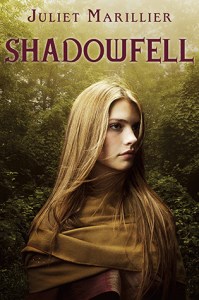
“Monthly Marillier” is a review series that is, essentially, an excuse for me to go back and re-read one of my favorite author’s back catalog. Ever since I first discovered her work over fifteen years ago, Juliet Marillier has been one of my favorite authors. Her stories are the perfect mixture of so many things I love: strong heroines, beautiful romances, fairytale-like magic, and whimsical writing. Even better, Marillier is a prolific author and has regularly put out new books almost once a year since I began following her. I own almost all of them, and most of those I’ve read several times. Tor began re-releasing her original Sevenwaters trilogy, so that’s all the excuse I needed to begin a new series in which I indulge myself in a massive re-read of her books. I’ll be posting a new entry in this series on the first Friday of every month.

Book: “Shadowfell” by Juliet Marillier

Publishing Info: Knopf Books for Young Readers, September 2012

Where Did I Get this Book: own it!

Book Description: Sixteen-year-old Neryn is alone in the land of Alban, where the oppressive king has ordered anyone with magical strengths captured and brought before him. Eager to hide her own canny skill–a uniquely powerful ability to communicate with the fairy-like Good Folk–Neryn sets out for the legendary Shadowfell, a home and training ground for a secret rebel group determined to overthrow the evil King Keldec.

During her dangerous journey, she receives aid from the Good Folk, who tell her she must pass a series of tests in order to recognize her full potential. She also finds help from a handsome young man, Flint, who rescues her from certain death–but whose motives in doing so remain unclear. Neryn struggles to trust her only allies. They both hint that she alone may be the key to Alban’s release from Keldec’s rule. Homeless, unsure of who to trust, and trapped in an empire determined to crush her, Neryn must make it to Shadowfell not only to save herself, but to save Alban.

Review: I remember being really excited when this book was slated to come out. I had mostly read Marillier’s “Sevenwaters” books at this point, so I was excited to see a new world molded under her hands. And I was curious to see how she would translate her work to a YA audience (many of the “Sevenwaters” books tackle some pretty serious subjects). And while it surprised me in many ways, it also fell a bit on middling ground as far as my overall rankings of Marillier’s work.

The land has become a dangerous place for those with anything resembling the uncanny. But there are rumors of those who still fight, hidden away in a place called Shadowfell. It’s there that Neryn sets off in search of, all the while trying to hide her own magical abilities. But as she travels, she gains aid from small, magical folk who are even more at risk than she and hint at a future much greater than one Neryn had ever imagined for herself. With this perilous task ahead of her, Neryn’s world is rocked. She finds herself even more unbalanced when she runs across a young man named Flint whose mysterious origins and loyalties keep her guessing at every turn. Will Neryn make it to Shadowfell? And will this place hold the answers to all of her questions?

“Shadowfell” demonstrates some of the standard strengths and weaknesses of her writing. Her world-building, evocative writing, and well-researched to folktales are just as effective and appealing here as they have been in her previous books. Alba felt unique from the Irish setting that we’ve seen so much of in the “Sevenwaters” series. The tales and songs, from what I could tell, were all based in historically accurate traditions of the area. As well, the magical creatures were distinct from the Fae we’ve seen in her other work. The small, creature-like animals and the land-based beings were all fascinating and immediately compelling. And, like always, her writing is lush and immersive, drawing the reader in to the point where you feel the mists and chills that Neryn so often travels through.

On the other hand, if there’s one complaint I’ve routinely had about Marillier’s work it has been the overwhelming “goodness” of her heroines. The extent to which I enjoy them often depends on whether this goodness is balanced out by other actions that they take on the world (often the more pro-active heroines get a bigger pass from me.) But Neryn ends up being one of the more passive heroines we’ve seen for a while. Not only does she fall into the trope of being essentially a “chosen one,” but she is routinely is incredibly naïve about the world she exists within. Her thoughts turn in what quickly becomes a tiresome circle of worries and renewed determination. On top of that, she spends a significant amount of time ill and needing help from others, effectively making her the most passive of passive characters.

I also struggled with the “romance,” such as it is. Flint’s attachment to Neryn seems to come out of nowhere and is based on next to nothing. For her part, Neryn’s naivete is incredibly frustrating with regards to Flint. He’s obviously an untrustworthy party when she first meets him, and yet she quickly seems to fall in love with him. From there we enter yet another circular train of actions between her distrusting and trusting Flint. It gets old fairly quickly.

This book was a struggle for me when I first read it and a struggle the second time around as well. I can see the strong story at the heart of it, but Neryn’s passive presence and the frustrating treadmill that is her thought process about her mission and/or her feelings towards Flint became very frustrating. But, that said, it’s still a nice YA fantasy and Marillier’s strong writing save it from itself for the most part.

Rating 7: Not the best, but not the worst, “Shadowfell” introduces an interesting new fantasy story but hobbles itself with a passive heroine.

Reader’s Advisory:

“Shadowfell” is on these Goodreads lists: YA Second World Fantasy and Everything Fae.

Find “Shadowfell” at your library using WorldCat, or at a local independent bookstore using IndieBound!

Kate’s Review: “The Seven Visitations of Sidney Burgess”

Book: “The Seven Visitations of Sidney Burgess” by Andy Marino

Publishing Info: Redhook, September 2021

Where Did I Get This Book: I received an ARC from the publisher.

Book Description: From an electrifying voice in horror comes the haunting tale of a woman whose life begins to unravel after a home invasion.

Possession is an addiction.

Sydney’s spent years burying her past and building a better life for herself and her young son. A respectable marketing job, a house with reclaimed and sustainable furniture, and a boyfriend who loves her son and accepts her, flaws and all.

But when she opens her front door, and a masked intruder knocks her briefly unconscious, everything begins to unravel. She wakes in the hospital and tells a harrowing story of escape. Of dashing out a broken window. Of running into her neighbors’ yard and calling the police.

The cops tell her a different story. Because the intruder is now lying dead in her guest room—murdered in a way that looks intimately personal. Sydney can’t remember killing the man. No one believes her.

Back home, as horrific memories surface, an unnatural darkness begins whispering in her ear. Urging her back to old addictions and a past she’s buried to build a better life for herself and her son. As Sydney searches for truth among the wreckage of a past that won’t stay buried for long, the unquiet darkness begins to grow. To change into something unimaginable. To reveal terrible cravings of its own.

Review: Thank you to Redhook for sending me an ARC of this novel!

It isn’t super often that you find a demonic possession story in my book pile when it comes to horror. I’m not against it, really, as I have certainly enjoyed a few stories that involve such things. But there is always an undercurrent of religious fervor that goes hand in hand with possession tales, and I have no problem with that as a concept. It just doesn’t really connect with me. But something about “The Seven Visitations of Sidney Burgess” by Andy Marino caught my eye when it read the description, and I felt compelled to pick it up. It’s been awhile since I’ve read a book with possession at its heart, and one that looks at it through the lens of addiction seemed like a take that I hadn’t encountered before in the subgenre.

I will say that in terms of the possession angle of this story it goes to unpredictable places. In general that is usually a good thing for me, because as a rule I am not as able to connect to traditional possession tales due to a serious lack of belief in demons and devils. If you take that and go to more interesting places, however, be it by examining a priest’s loss of faith a la “The Exorcist”, or a professional skeptic’s slow descent into turmoil a la “The Last Days of Jack Sparks”, I will be more on board. And in this book we go in unexpected and unique territory regarding Sidney’s ‘swimmer’, as she refers to whatever it is that is making her black out and is always lurking at the edges of her consciousness. I don’t want to give anything away, but I will say that the reveal as to what is going on is definitely unexpected, but didn’t quite work for me. Nor did the rapid time jumping and choppy structure. My guess is that it was supposed to add to the confusion and disorientation that Sidney is feeling as she is losing time and memories and then pulling them back out of the ether, but I found it disruptive more than effective.

What did work was how Marino brings the theme of addiction into the story. Sidney has been sober for nine years when we meet her, and as this ‘swimmer’ starts to slowly encroach upon her consciousness, it tempts her to fall back into old and destructive habits. As Sidney starts to lose her grip on what is up and what is down, she starts to lose the will to remain sober. Marino has a lot of dark and uncomfortable moments when it comes to Sidney’s fight against addiction, both in her past and in her present, and it feels raw and relentless in how he portrays the slow slipping back into an addiction spiral. While the theme of ‘addiction as possession’ is kind of obvious (and ultimately, not the biggest issue when it comes to Sidney’s personal possession problems), Marino makes it feel very powerful and emotional. Part of the dread is wondering how badly Sidney is going to fall. There are also some really gnarly moments of body horror in this book. You probably need a bit of that in a possession story, to be honest, and this book has it in spades.

“The Seven Visitations of Sidney Burgess” went to places I wasn’t anticipating. While it didn’t quite break free from my general apathy towards possession stories, the human and very real world emotional notes are great and will leave the reader unsettled.

Rating 7: Intense, strange, and unique on how it looks at ‘possession’ stories, “The Seven Visitations of Sidney Burgess” is a gory slow burn of a horror novel that has some powerful insights on addiction, but a structure problem and some out there revelations.

Reader’s Advisory:

“The Seven Visitations of Sidney Burgess” is not included on any Goodreads lists yet, but I think that it would fit in on “Demonic Possession”.

Find “The Seven Visitations of Sidney Burgess” at your library using WorldCat, or at a local independent bookstore using IndieBound!

Book Club Review: “Furia”

We are part of a group of librarian friends who have had an ongoing bookclub running for the last several years. Each “season” (we’re nerds) we pick a theme and each of us chooses a book within that theme for us all to read. Our current theme is “Award Winners”, in which we each picked a book that has won an award of some kind.

For this blog, we will post a joint review of each book we read for book club. We’ll also post the next book coming up in book club. So feel free to read along with us or use our book selections and questions in your own book club!

Book: “Furia” by Yamile Saed Méndez

Publishing Info: Algonquin for Young Readers, September 2020

Where Did We Get This Book: The library!

Award: Pura Belpré

Book Description: In Rosario, Argentina, Camila Hassan lives a double life. At home, she is a careful daughter, living within her mother’s narrow expectations, in her rising-soccer-star brother’s shadow, and under the abusive rule of her short-tempered father.

On the field, she is La Furia, a powerhouse of skill and talent. When her team qualifies for the South American tournament, Camila gets the chance to see just how far those talents can take her. In her wildest dreams, she’d get an athletic scholarship to a North American university.

But the path ahead isn’t easy. Her parents don’t know about her passion. They wouldn’t allow a girl to play fútbol—and she needs their permission to go any farther. And the boy she once loved is back in town. Since he left, Diego has become an international star, playing in Italy for the renowned team Juventus. Camila doesn’t have time to be distracted by her feelings for him. Things aren’t the same as when he left: she has her own passions and ambitions now, and La Furia cannot be denied. As her life becomes more complicated, Camila is forced to face her secrets and make her way in a world with no place for the dreams and ambition of a girl like her.

Kate’s Thoughts

I am not really a sporty person, though accompanying friends and loved ones to games of most any sport can be fun. I probably go to more soccer games than other sports since my husband loves soccer, so when I saw that “Furia”, this month’s book club book, had a soccer theme I figured I would at least have a vague working knowledge of it. But lucky for me, “Furia”, while having a lot to do with soccer, also tackles other issues, like love, ambition, and misogyny. I thought that it was interesting seeing Camile, aka “Furia”, have to navigate the very narrow and defined expectations that Argentine society (and her mother) heap upon her. I enjoyed seeing the parts that had to do with Camile pushing against these norms, be it when she was trying to interact with her very conservative parents (on top of that her father, a former soccer star who is placing all of his lost dreams onto Camile’s soccer playing brother, is incredibly abusive), or when she is trying to determine if she can have a romance with her old flame Diego (ANOTHER rising soccer star), who has returned to town for a bit before he goes back on the road. I also really liked seeing how Méndez would weave in various realities of living in modern day Argentina, from the way the machismo could both bolster male soccer players and create really loyal ties between players and communities, to how the misogyny could lead to violence towards women (and a lot of society would think that these women deserved it one way or another). All of this worked.

There were some problems with the narrative for me as well. One, I go to soccer games on occasion, but I’m not super interested in it in general, and on the written page that isn’t much different. So the soccer moments I found myself speeding through pretty quickly. And on top of that, I didn’t feel like many of the characters were terribly complex. Camile was able to have depths and layers to her, given that she is the main character and we mostly get into her mind, but I do like seeing other supporting roles have a little more exploration and depth, and we didn’t really get that in this book.

Overall, I enjoyed “Furia” as a contemporary YA novel. It gave me a glimpse into a setting that I don’t see as much in YA books, and it had some emotional beats involving her family.

Serena’s Thoughts

I agree with everything Kate said. Her husband and mine share a love for soccer and have been splitting season tickets for as long as I can remember. What’s more, I probably do enjoy sports more than Kate, in general. But I’ll also say that I probably had a stronger negative reaction to this book’s sports elements than she did. So take from that what you will! While I really like watching sports live and even on TV sometimes, I really have a hard time caring about the “action” when it’s the description of movements of a ball and the players kicking it. It’s not even that I can’t picture it, I can! I just…couldn’t care. So that was a pretty big hinderance to my enjoyment of that aspect of the book.

That said, I agree with what Kate said that, lucky for both of us, there was much more to this book than the sports story. I mostly enjoyed the setting and description of every-day-life in Argentina. I don’t know a lot about this part of the world, and what I do know is mostly based in historical accounts rather than a contemporary look. All of the street-level windows into this culture and part of the world were fascinating. Even more so when we witness the uphill battle Furia faces in the face of the misogyny that still limits so much of what is expected for women. The story also touches on the tragedy of how easily women and young girls can go missing or have other violence inflicted upon them and it will be casually swept under the “she probably deserved it” rug.

Like Kate said, the characters themselves were fairly flat feeling. Even Furia herself, while more nuanced than any of the side characters, felt a bit one-note at times. However, I did like the romance that came into play. The challenges they faced felt natural and the ending was satisfying and heart-warming.

Overall, this wasn’t really the book for me. I think it’s so important, though, to have books that represent different parts of the world AND to have sports books for girls. Just cuz I’m not into them, doesn’t mean that I don’t think this is a wide open hole in YA literature. There’s a bunch of YA sports books for young men (perhaps at the detriment of other genres for them), but young women, on the other hand, don’t see tons of sports books directed towards them.

Kate’s Rating 7: While the soccer parts didn’t speak to me and some characters were flat, I liked the family drama as well as the look into Argentine life and what it’s like for women.

Serena’s Rating 7: I, too, enjoyed the Argentinian setting and the look into the culture, but sports books are never going to be my jam.

Book Club Questions

  1. Was there a character that you most identified with in this story? Was there a plot point that really stood out to you?
  2. What did you think about the themes of the Patriarchy in Camile’s life?
  3. What did you think of Camile’s nickname, La Furia? How does it apply to the story that she is living?
  4. How did you like the soccer parts in this book?
  5. The book sets up two paths for Camile: follow her soccer dreams, or follow the potential for romance. Do you think it has to be one or the other for her?
  6. What were your thoughts on the depictions of day to day life in Argentina?
  7. Did you feel like the ending was realistic? Why or why not?

Reader’s Advisory

“Furia” is included on the Goodreads lists “YA/Children’s Books in Latin America”, and “YA Girls Take On the Patriarchy”.

Find “Furia” at your library using WorldCat, or at a local independent bookstore using IndieBound!
Next Book Club Book: “Front Desk” by Kelly Yang

Kate’s Review: “The Last House on Needless Street”

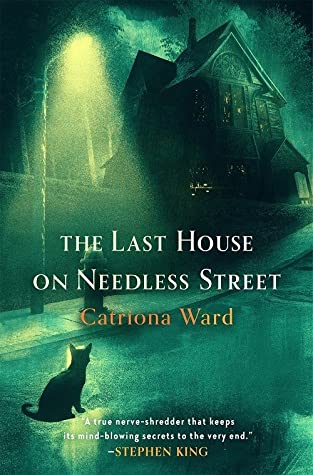
Book: “The Last House on Needless Street” by Catriona Ward

Publishing Info: Tor Nightfire, September 2021

Where Did I Get This Book: I received an eARC from NetGalley.

Book Description: Catriona Ward’s The Last House on Needless Street is a shocking and immersive read perfect for fans of Gone Girl and The Haunting of Hill House.

In a boarded-up house on a dead-end street at the edge of the wild Washington woods lives a family of three. A teenage girl who isn’t allowed outside, not after last time. A man who drinks alone in front of his TV, trying to ignore the gaps in his memory. And a house cat who loves napping and reading the Bible.

An unspeakable secret binds them together, but when a new neighbor moves in next door, what is buried out among the birch trees may come back to haunt them all.

Review: Thank you to NetGalley for providing me with an eARC of this novel!

Welcome to HorrorPalooza 2021!!! I cannot wait to showcase and review all horror, all the time for the month of October, as is tradition, and right off the bat we have one of the most hyped horror novels of the Fall: “The Last House on Needless Street” by Catriona Ward! I had been thinking about this one as a solid HorrorPalooza choice for so long that I completely forgot that it actually came out in September (hence I missed it on my highlights that month), but by no means does that mean I wasn’t eager for it. And I’m here to report that while it was much anticipated by me, it wasn’t as compelling of a story as I expected. But who doesn’t love the idea of a cat being a character with perspective chapters?

“The Last House on Needless Street” follows a man named Ted, who lives a fairly solitary life outside of his cat Olivia and his daughter Lauren. They all live on Needless Street, and Ted is dealing with an angry teenager, as well as an unreliable memory that is causing him some problems. His cat Olivia is constantly watching over him, her devotion true but starting to wane as she starts to see changes in his behavior. And then there is Dee, a new neighbor who has moved to Needless Street with one motivation: she believes that Ted was responsible for her sister Lulu’s disappearance a number of years ago, and wants to find out what he did with her. As Dee tries to untangle what is going on with Ted, Ted seems to be shifting into a more and more unstable emotional state as daughter Lauren comes in and out of his life and Olivia observes. Ted’s chapters are haphazard and have a disjointed and unreliable feel to them, which made for a character that I desperately wanted to know more about, for the good or the bad. Olivia’s are VERY funny and feel super cat-like, with both loyalty to her owner/friend Ted as well as an aloof above it all snark. Dee’s are probably the most linear which kind of tie one of the mysteries into the larger story, which then plays into the rest of the story too. I liked all of the voices and found them varied, especially Olivia’s. I mean, a cat being a narrator of a scary story is just so fun. Ward really gives them their own personalities and they all feel pretty realistic for what they are and what their arcs are like.

The plot itself had some bumps, however. Not the tension or the suspense, that was all on point! Ward really knows how to build up atmosphere and wring out every ounce of creepiness and discomfort, no question. There were multiple scenes that just had me on the edge of my seat. However, one of the things that I was seeing about “The Last House on Needless Street” was that it had really surprising twists and turns. I will certainly agree that it does have a couple of those! One even totally took me by surprise, even though looking back there were hints here and there as to the truth of the matter at hand, and I love finding the hints after the fact. But as for the others, I think that there were some desperately laid red herrings that just screamed out that they were red herrings. And I really don’t want to give anything away in regards to some of the reveals, but to really address one of the twists I feel like I have to get into at least a little of the nitty gritty. So here is your SPOILER ALERT! Skip down past the next paragraph if you don’t want to be spoiled.

So what I will say is that one of our characters has Dissociative Identity Disorder, aka DID, aka Multiple Personality Disorder (though this name is out of favor). Generally those who have DID suffered a horrific trauma and in an effort to cope the mind creates ‘alters’, or other personalities. While I thought that Ward did this in a way that didn’t feel shaming or stigmatizing in a ‘all mentally ill people are dangerous’ kind of way (and even listed a number of sources into the research she did about DID, which was good to see), it’s still a bit of a trope in thriller and horror stories these days, having seen it in “I’m Thinking of Ending Things”, “Fight Club”, “Psycho”, and others. And the problem with turning a mental condition into a ‘twist’ is that, even with the best intentions (and I do think that Ward has them here!), it can come off as gimmicky at best and dehumanizing at worst. I myself don’t think that Ward treads into dehumanizing territory, BUT I also don’t have DID, so I’d bet I’m not the best judge of that.

Overall, “The Last House on Needless Street” has its ups and downs! I didn’t find it to be as excitingly twisty as others have, but I did overall enjoy a fair amount about it. Especially Olivia the Cat!

Rating 7: A creepy and somewhat bittersweet story about a man, his cat, and coming to terms with guilt and trauma. But one that relies on a trope that is a bit overdone and becoming more and more controversial.

Reader’s Advisory:

“The Last House on Needless Street” is included on the Goodreads lists “Brilliant Dark Fiction”, and “Books To Get You in the Halloween Mood”.

Find “The Last House on Needless Street” at your library using WorldCat, or at a local independent bookstore using IndieBound!
Serena’s Review: “Under the Whispering Door”

Book: “Under the Whispering Door” by TJ Klune

Publishing Info: Tor Books, September 2021

Where Did I Get this Book: Edelweiss+

Book Description: When a reaper comes to collect Wallace Price from his own funeral, Wallace suspects he really might be dead.

Instead of leading him directly to the afterlife, the reaper takes him to a small village. On the outskirts, off the path through the woods, tucked between mountains, is a particular tea shop, run by a man named Hugo. Hugo is the tea shop’s owner to locals and the ferryman to souls who need to cross over.

But Wallace isn’t ready to abandon the life he barely lived. With Hugo’s help he finally starts to learn about all the things he missed in life.

When the Manager, a curious and powerful being, arrives at the tea shop and gives Wallace one week to cross over, Wallace sets about living a lifetime in seven days.

Review: First off, props to the publisher for another awesome cover for one of Klune’s books. Does it subtly imply that it’s a sequel to the massively successful “House on the Cerulean Sea” with its similarities? Yes. Is it in fact that? No. However, as it’s still a neat cover in its own right, I’ll give it a pass. The fact that there are so few good standalone adult fantasy novels also supports that pass. Let’s dive in!

Young and successful, Wallace never dreamed the end could be so close. But when a reaper shows up for him, he realizes it must be so. Angry and confused, he meets Hugo, a magical being who helps ferry souls to the beyond. Soon Wallace begins to discover that the life he had thought was fulfilling had been an empty thing, bereft of all that makes life well-lived in the end. With only a few precious days remaining to him, Hugo and Wallace set out to give Wallace that last chance at discovering a true life and his true self.

There was a lot to like about this book, but it also wasn’t the high I had been expecting after enjoying Klune’s previous book so much. To begin with what did work, however, Klune’s flair for comedic moments was on point. In particular, the beginning of the story and the flames thrown towards corporate drones were hilarious and apt. As the book progressed, there were several other laugh-out-loud moments. However, as the story continued, even these sometimes began to feel a bit repetitive.

The characters were also quirky and compelling. This is largely a story of Wallace’s transformation from said corporate drone into an emotionally-realized individual, so nailing his character was key to the book working. And for the most part, this works. His interplay with Hugo is well done, and the two characters and their relationship is heartwarming.

However, as I went along, I kept wanting more. The characters were ok, but really just ok. The romance was sweet, but lacked the true heart that I was looking for. And most disappointingly, the message of the book, that of living one’s best life, felt at times trite and repetitive. There were a few times even when the moralizing fell completely flat, with Klune trotting out platitudes that have been overused many times before. Given the general set-up of the book, I knew what I was getting into. But I had hope that Klune would shine a new light on the topic. Or at least offer up some unique ways of looking at a common topic. Alas, not so.

Overall, the book was by no means bad. It just wasn’t what I had hoped to find. It’s perfectly acceptable in what it sets out to do, but knowing Klune’s previous work, I can’t help thinking he could have done better. There were parts of this book that almost felt phoned in, and the story started to drag towards the middling, struggling to keep up its pacing and momentum. Fans of Klune’s work will be pleased to see his trademark humor and strong characters, but he’s also had stronger outings in the past.

Rating 7: A bit disappointing, relying too heavily on tried and true platitudes instead of carving its own space.

Reader’s Advisory:

“Under the Whispering Door” is on these Goodreads lists: 2021 Queer SFF and 2021 Contemporary/Romance Releases.

Find “Under the Whispering Door” at your library using WorldCat or at a local independent bookstore using IndieBound!
Serena’s Review: “Wildwood Whispers”

Book: “Wildwood Whispers” by Willa Reece

Publishing Info: Redhook, August 2021

Where Did I Get this Book: from the publisher!

Book Description: At the age of eleven, Mel Smith’s life found its purpose when she met Sarah Ross. Ten years later, Sarah’s sudden death threatens to break her. To fulfill a final promise to her best friend, Mel travels to an idyllic small town nestled in the shadows of the Appalachian Mountains. Yet Morgan’s Gap is more than a land of morning mists and deep forest shadows.

There are secrets that call to Mel, in the gaze of the gnarled and knowing woman everyone calls Granny, in a salvaged remedy book filled with the magic of simple mountain traditions, and in the connection, she feels to the Ross homestead and the wilderness around it.

With every taste of sweet honey and tart blackberries, the wildwood twines further into Mel’s broken heart. But a threat lingers in the woods—one that may have something to do with Sarah’s untimely death and that has now set its sight on Mel.

Review: I don’t often much magic realism fiction (or women’s fiction…not sure how I feel about that even being a subgenre category…), but the book description for this book was giving me major “Practical Magic” vibes, so I thought it was worth checking out. The cover art was also beautiful, and my mood fit well for a more quiet, reflective read. This one wasn’t a perfect fit for me, but I think it’s a solid entry for fans of these genres.

Growing up bouncing around in the system, Mel could never find her home. That is until she met Sarah, a young girl who had recently been orphaned. Together, the two made a home for one another in their enduring bond. Years later, Mel once again feels the sand shifting beneath her feet when Sarah dies. To fulfill a promise, she travels to Sarah’s childhood home. There, she discovers there was much more to Sarah than she had understood. And as the dark woods whispers and family secrets swirl through the town’s quiet streets, Mel begins to see a new place for herself.

I liked the idea of this book more than the book itself, in the end. Those familiar with the blog will know that I love a sisters book, which this is. I also really liked the imagery of a small, quiet town in the mountains, having grown up in one myself. There’s something compelling about the quirks and histories that come out in places like this, strange to all but those who have grown up with them. Mel’s exploration of the two, people, and woods was particularly poignant for me in this way.

I also liked Mel herself, especially the brief flash we see of her as a child when she first meets and bonds with Sarah. She was definitely started out on a strong note here, a defiant loner who discovers kinship with a younger girl. But the adult Mel was more difficult for me to handle. The flashes of defiance and strength seemed muted, and there were many early moments between characters that left me scratching my head. Mel comes to the town, a complete stranger, and then strikes up some really bizarre conversations with various locals. I couldn’t figure out what was going on here. Was it poor writing that made these portions of dialogue read as odd? Was it on purpose? Either way, it hurt Mel’s characterization as I couldn’t understand her lack of human reaction to these weird happenings.

I also struggled to identify with several other plot elements. The antagonist was easily spotted from the beginning of the story (even if the motives were left murky for a bit longer). And the romance felt tacked on and, again, unnatural. I didn’t feel any real chemistry between these characters other than the fact that the author simply designed them to be together, so they were. r

I liked the magical elements that were interspersed throughout the book, but was left wanting more. This is a point that is particular to my taste, however, as a lot of magical realism stories are light on the magic. The exploration of grief, family, and home had moments of depth, but, again, never struck any real chords for me. Ultimately, it was a bit too sentimental for me.

Readers who enjoy quiet, thoughtful books and magic realism will likely enjoy this story. If you’re looking for a fast plot, strong romance, or strong characterization, this might be more of a disappointment. I don’t regret reading it, but it’s enough to prove that a little goes a long way for me with this kind of stuff.

Rating 7: Decent for what it is, a sentimental story of a woman processing her grief and discovering a new sense of self and roots.

Reader’s Advisory:

“Wildwood Whispers” is on these Goodreads lists: Fantastic Women’s Fiction with Magical Elements and August 2021 Book Releases.

Find “Wildwood Whispers” at your library using WorldCat or at a local independent bookstore using IndieBound!

Monthly Marillier: “Wolfskin”

“Monthly Marillier” is a review series that is, essentially, an excuse for me to go back and re-read one of my favorite author’s back catalog. Ever since I first discovered her work over fifteen years ago, Juliet Marillier has been one of my favorite authors. Her stories are the perfect mixture of so many things I love: strong heroines, beautiful romances, fairytale-like magic, and whimsical writing. Even better, Marillier is a prolific author and has regularly put out new books almost once a year since I began following her. I own almost all of them, and most of those I’ve read several times. Tor began re-releasing her original Sevenwaters trilogy, so that’s all the excuse I needed to begin a new series in which I indulge myself in a massive re-read of her books. I’ll be posting a new entry in this series on the first Friday of every month.

Book: “Wolfskin” by Juliet Marillier

Publishing Info: Tor Books, August 2004

Where Did I Get this Book: own it!

Book Description: Eyvind can think of no more glorious future than becoming a Wolfskin, a warrior devoted to the service of the mighty war god Thor. His closest friend, Somerled, a strange and lonely boy, has his own very different ambitions – yet a childhood oath, sworn in blood, binds these two in lifelong loyalty. Meanwhile, far away across the water, on the Light Isles, the king’s niece Nessa is beginning to learn the ways of the mysteries – though neither the young priestess nor her people can realize what lies ahead for them.

Eyvind and Somerled seem set to follow very different paths: one becoming a fearless servant of the Warfather, the other a scholarly courtier. Then a voyage of discovery, led by Somerled’s brother Ulf, brings the two friends together again in accompanying a group of settlers to some beautiful islands rumoured to lie across the western sea. However, their good spirits are dampened by a tragedy on board, which Eyvind begins to suspect may not have been an accident.

Ulf’s new settlement begins in harmony with the native islanders, led by King Engus. But one day, on a trip to a holy place of the Folk, a brutal murder occurs and that peace is shattered. It is now that Eyvind begins to feel the restraining ties of his boyhood oath…and to realize what sort of future Somerled had in mind for himself all those years ago.

Review: There really is no rhyme or reason to the order in which I’m picking the books I read for this series. The “Sevenwaters” series was an obvious starting point, but I’ve been jumping around ever since. However, I do remember that this book was the first of her books that I encountered where she used multiple POVs. All of the “Sevenwaters” books, her “Wildwood” YA duology, and a few of the other stand-alone she has are all told from a single, female perspective. So it was kind of a shock to start this one and find more than one narrator. More so that we were ultimately getting both the man and woman’s perspective from the eventual romantic pairing.

Eyvind and Nessa grow up in very different worlds with very different futures. Eyvind trains to be one of the legendary Wolfskin warriors who go out into the world and fight great battles. His reserved friend Somerland also has plans for his future, but they begin to look less and less familiar to Eyvind as they grow. For her part, Nessa leads a quiet life learning the ways of a wise woman, hoping to continue forward on the bright path set before her small community. But the seasons turn suddenly, and both Eyvind and Nessa soon learn that both of the futures they had set before themselves perhaps were not the ones they were meant to find. Soon, each must learn for themselves the great truths to be found in love, loyalty, and friendship.

First off, I really like the cover for this book. It’s sequel, “Foxmask,” has an equally beautiful cover. Both perfectly fit the overall tone and mythic quality of the stories held within. Marillier is also known as a huge dog lover, so it’s only fitting that few canines also great the cover.

Like I said before, this was the first of Marillier’s books that I encountered that featured dual narrators. And, for the most part, I enjoyed it here. Perhaps due to my expectations going in, that it would again be a single, female POV, I did find myself connecting a bit more to Nessa’s character. However, I will also add that in the long, long list of Marillier’s heroines, Nessa is not one of my favorites. Instead, she falls in similar company with Sibeal and Paula, heroines who were fine for the most part, but not particularly unique or likely to stand out in my memory.

I did like the magic that accompanied Nessa’s storyline. While we’ve seen seers plenty before, Nessa’s magic had some unique aspects to it. I enjoyed the connection to the selkie and the legends that surround magical water creatures. The tools she goes on to use as the story begins to wind down were interesting in their history and implementation.

Eyvind was of a bit more interest, perhaps simply because of the novelty of a male POV. But his story also involved a lot more change and a more established arc that covered the entirety of the book. Yes, some parts of it were highly predictable. And yes, those predictable twists and turns did make the early Eyvind a bit hard to tolerate in his naivety and trusting nature. But in some ways this same trusting nature helped draw a stark contrast between him and his friend Somerled. In some ways, I enjoyed the exploration and downfall of this friendship than I did the romantic relationship between Nessa and Eyvind.

Overall, while this isn’t on my list of favorite Marillier works, it does stand well enough on its own. I enjoy the setting, featuring Vikings and northern European myths and legends. Readers who enjoy multiple POV stories might even appreciate this one more than others. I’ve simply always preferred one narrator, so I’m a tough sell on this type of story. That said, it’s still a worthy entry and a solid recommendation for readers who enjoy mythic fantasy stories.

Rating 7: Not a favorite of mine, but a nice change of pace from the Irish setting and magic system.

Reader’s Advisory:

“Wolfskin” is on these Goodreads lists: The Best of Mythic Fiction and Vikings.

Find “Wolfskin” at your library using WorldCat!

Serena’s Review: “Unholy Murder”

Book: “Unholy Murder” by Lynda La Plante

Publishing Info: Zaffre, August 2021

Where Did I Get this Book: BookishFirst!

Book Description: ‘Help me turn the coffin lid over.’ Jane Tennison said, grabbing one end.

‘What you looking for?’ Doctor Pullen asked.

‘I want to see the condition of the interior lining.’

‘The right hand on the body has a broken fingernails, some are worn down to the fingertips.’ Doctor Pullen informed them as they gently turned the lid over. The mouldy white satin lining was torn and hanging loose at the head end. Jane gently brushed it to one side revealing deep fingernail scratch marks on the interior metal.

‘Oh my God,’ Tennison exclaimed. ‘She was buried alive.

In Unholy Murder, Tennison must lift the lid on the most chilling murder case of her career to date . . .

Review: I won this book in a giveaway not really knowing that it was number seven in a series, but, here we are! I was mostly intrigued by the fact that it was a series featuring the character Tennison best known from the TV show. I also like a good crime novel every once in a while (Kate and I both read the “Temperance Brennan” series on and off though we haven’t reviewed them here). So I was excited to find another book in that vein, all the better since I can likely find audiobook versions read by people with lovely British accents, given the location! Let’s dive in.

Jane Tennison is back on the case. This time she arrives to find a recently-discovered coffin at the site of an old convent. Inside, the remains of a nun. But what should be unsurprising is suddenly awful when it becomes clear the nun was buried alive. Now Tennison must work to uncover the truth, attempting to wheedle out the truth from the reluctant Catholic Church, made all the more difficult from her partner’s past connection to the Church. But nothing can put Tennison off the case, and slowly but surely, the past will be unburied.

Like I mentioned earlier, I hadn’t read any other books in this series before picking up this book .Worse, I’ve only seen one or two of the episodes of the original show and none of the new show (didn’t even discover there was a new show until I went down a research rabbit hole). All of that to say, I still did fine without any real previous knowledge of the story. Like many police procedural books, there were perhaps some character connections and histories that I missed out on, but the story itself is started, centered, and concluded around this particular crime.

The crime itself was interesting. Being buried alive, I think, is pretty much anyone’s nightmare, so the horror was already built in right there. It was also a bit timely to be reading this book right now given the ongoing revelations about crimes within the church. I thought the book did a decent job of unpacking the “circling the wagons” nature of the Catholic Church while also not demonizing the entire belief system.

I also really liked both of the characters we had here. DCS Barnes, a completely new character to me, was particularly interesting with his past history with the Church. I liked that La Plante didn’t shy away from showing the biases that are inherent even to investigators who are meant to look at crimes through as objective a lens as possible. It’s simply not possible for a person not to bring their own baggage to some of these scenes, so it was nice to see the author give her characters these natural flaws.

I also enjoyed the time period that this book was set in. For some reason, I had assumed it would be a modern story, but I guess that doesn’t make much sense given the fact that it’s based on a TV show from the 90s I believe. The story itself is set in the early 80s, and I liked how it showed crime investigations going down without the modern tools we’re used to seeing in police procedurals today.

Overall, I really enjoyed this book. It’s been a while since I’ve read a crime procedural, and it was a good addition of a series to return to now and then. The story was definitely slow, and the writing was a bit awkward here and there (perhaps a testament to the author’s original writing experience coming from screenplay work rather than novel-writing). Fans of the series, I’m sure, will enjoy this. And those who enjoy police procedural stories are likely to appreciate it, too.

Rating 7: A bit slow and fumbling at times, but ultimately an enjoyable change of pace for me.

Reader’s Advisory:

“Unholy Murder” is a newer title so it isn’t on any Goodreads lists yet, but it should be on Best Female Crime/Mystery/Thriller Writers.

Find “Unholy Murder” at your library using WorldCat!