Kate’s Review: “The Tea Dragon Festival”

42369064Book: “The Tea Dragon Festival” by Katie O’Neill

Publishing Info: Oni Press, September 2019

Where Did I Get This Book: I received an eARC from NetGalley.

Book Description: Rinn has grown up with the Tea Dragons that inhabit their village, but stumbling across a real dragon turns out to be a different matter entirely! Aedhan is a young dragon who was appointed to protect the village but fell asleep in the forest eighty years ago. With the aid of Rinn’s adventuring uncle Erik and his partner Hesekiel, they investigate the mystery of his enchanted sleep, but Rinn’s real challenge is to help Aedhan come to terms with feeling that he cannot get back the time he has lost.

Review: Thanks to NetGalley for providing me with an eARC of this book!

A couple years ago I stumbled upon a sweet and unique graphic novel called “The Tea Dragon Society”, a charming story about a group of people who raise and care for Tea Dragons. After reading that book I became and instant fan of author Katie O’Neill’s fantasy tales, and when I saw that she had a follow up called “The Tea Dragon Festival”, I immediately requested to read it via NetGalley. I’m still in need of all the dragon positivity I can get in my stories, as dragons are my favorite mythical creatures and any and all positive depictions are going to bring me all kinds of joy. Especially if it means characters get to coexist with dragons peacefully and everything ends happily.
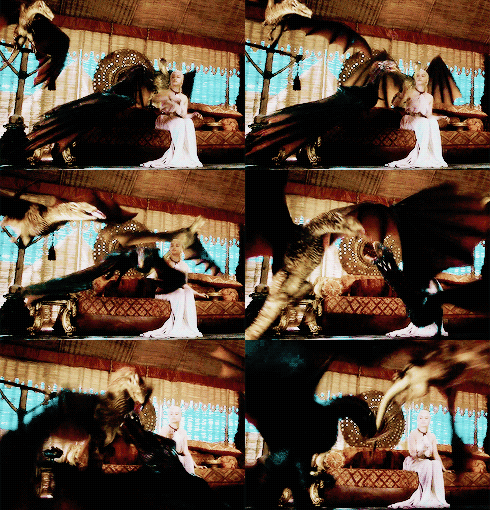
giphy-7
Happier times. (source)

“The Tea Dragon Festival” is something of a peripheral prequel to “The Tea Dragon Society”, but it is able to exist on its own. But this time around, our dragon lore moves beyond the Tea Dragons, and expands it to include wild Dragons. While a mountain town prepares for the annual Tea Dragon Festival, a girl named Rinn discovers a sleeping Dragon named Aedhan. Aedhan was supposed to be the protector of the town, but some kind of forest magic put him to sleep for eighty years. The focus of the story has two aspects. The first is trying to figure out what kind of being put Aedhan to sleep, which brings in the familiar faces of Erik and Hesekiel! In “The Tea Dragon Society”, Erik and Hesekiel have retired and opened a tea shop where they care for Tea Dragons, but in “The Tea Dragon Festival” they are still young and adventuring throughout the lands together. Erik is Rinn’s uncle, and his connection to the town is deftly placed and he and Hesekiel feel right at home in the pages of this story. But the larger focus of the tale is about Aedhan trying to readjust to life after being asleep for so long. Perhaps not as long for a Dragon, but still long enough that he feels like he’s missed out and failed the people he was supposed to look over. I really liked that this was the narrative with the most attention, as it let the characters grow and unfold organically. That isn’t to say that the Erik and Hesekiel storyline was neglected; on the contrary, I also enjoyed the mystery of the magic of the forest, and it was awesome getting a glimpse into their adventuring days while still being overall positive and not succumbing to tropes of wandering adventurers and bounty hunters. They were still true to their characters even in a completely different circumstance.

The new characters were also lovely and endearing. Not only was Rinn a kind and unique protagonist, as she too is trying to find her place in town and what role she has to play, Aedhan and his own background is rewarding and fascinating. He has the ability to shapeshift to look more ‘human’, which is explained as a defense against people who still may want to slay Dragons out of a toxic need to prove themselves as brave and fearless. The friendship that develops between Rinn and Aedhan really reminded me of Chihiro and Haku in “Spirited Away”, as their deep friendship is touching and isn’t really defined by platonic, romantic, or anything else. But they aren’t the only characterizations that were strong and well thought out. From Rinn’s Gramman, who is her mentor in all of her cooking endeavors, to Lesa, one of Rinn’s friends who is Deaf (note on this: I LOVED that not only did O’Neill incorporate a Deaf character into her story, she created a way to denote sign language within her illustrations), to a little girl named Aya who looks up to Rinn, a number of the characters all have their parts to play and feel complex and interesting. And just like in “The Tea Dragon Society”, O’Neill brings in a lot of diverse characters, be they different skin tones, or different sexual orientations, or having different abilities. Both overt diversity and more everyday diversity are very important for kids to see in their stories, and these stories handle both kinds beautifully.

And finally, THE TEA DRAGONS ARE BACK AND THEY ARE ADORABLE! Not only do we see Tea Dragons again, we get new kinds of Tea Dragons because of the different region within the world of the story. That said, O’Neill brings in other fantasy creatures that are just as breathtaking as the Tea Dragons, such as Aedhan’s full Dragon form and some of the forest creatures. The designs are both adorable and gorgeous.

the-tea-dragon-festival-9781620106556.in05
Cuteness overload. (source)

I am so glad that Katie O’Neill decided to revisit her Tea Dragons and their friends with “The Tea Dragon Festival”. It’s a dragon story that stands out from the rest, and while I don’t want to be greedy, I am going to once again hope that she makes more stories within this world!!

Rating 9: Katie O’Neill has once again brought a gentle and calm fantasy story to vibrant life. “The Tea Dragon Festival” lets us revisit the Tea Dragons and other familiar faces, and brings in more delightful characters with rich mythologies.

Reader’s Advisory:

“The Tea Dragon Festival” is included on the Goodreads lists “Dragons”, and “Graphic Novels Featuring LGBTQ Themes”.

Find “The Tea Dragon Festival” at your library using WorldCat!

Previously Reviewed: “The Tea Dragon Society”.

Serena’s Review: “The Bone Houses”

36524503._sy475_Book: “The Bones Houses” by Emily Lloyd-Jones
Publishing Info: Little, Brown Books for Young Readers, September 2019

Where Did I Get this Book: Edelweiss+

Book Description: Seventeen-year-old Aderyn (“Ryn”) only cares about two things: her family, and her family’s graveyard. And right now, both are in dire straits. Since the death of their parents, Ryn and her siblings have been scraping together a meager existence as gravediggers in the remote village of Colbren, which sits at the foot of a harsh and deadly mountain range that was once home to the fae. The problem with being a gravedigger in Colbren, though, is that the dead don’t always stay dead.

The risen corpses are known as “bone houses,” and legend says that they’re the result of a decades-old curse. When Ellis, an apprentice mapmaker with a mysterious past, arrives in town, the bone houses attack with new ferocity. What is it about Ellis that draws them near? And more importantly, how can they be stopped for good?

Together, Ellis and Ryn embark on a journey that will take them deep into the heart of the mountains, where they will have to face both the curse and the long-hidden truths about themselves.

Review: Given that it’s almost October and Halloween is coming up quickly, I thought it was time to keep my eyes out for a fantasy novel that I could point to when asked if I read anything spooky. I’m not up to Kate’s level of horror, but I thought that this mixture of what sounds like a zombie story and a fairytale would do the trick! And boy oh boy was I right! It’s really the best thing when you go into a book with zero expectations and end up with a huge hit on your hands!

Ever since her father disappeared, presumed dead, Ryn has taken up his mantle as the village grave digger, scraping by a meager existence for herself and brother and sister. She cares for them with the respect and peace they deserve, laying them to rest in the warm earth. And she, more than anyone else, is struck by the wrongness when the dead don’t stay that way and begin to roam free. Soon enough the risen dead become more than an occasional nuisance, and Ryn and a young map-maker, Ellis, embark on a dangerous trek through the dead-infested woods to track down the origins of an old curse hoping to give the bone houses the rest they finally deserve.

First things first, whomever wrote this book description did a very poor job. If you haven’t read it already, DON’T! Not only does it get several things wrong, it also spoils a decent-sized reveal that comes up in the book! Luckily for me, I hadn’t read it (or maybe did months ago when I requested an ARC of this book), so I was still surprised, but what were they thinking? Things like this really highlight how often the people writing these descriptions either didn’t read the entire book or skimmed through it so quickly that they didn’t even catch the fact that hey, some of these things are best left discovered by the readers and not blabbed about in your dang blurb! Anyways.

That out of the way, man I loved this book! In many ways it’s a re-imagining of “The Black Cauldron,” down to the precocious animal friend, though this time it’s a goat instead of a pig. The fairytale and quest of the story loosely tie to that tale, but are also unique enough in their own version to remain well and truly separate. It’s kind of like how closely/loosely “Uprooted” was to “Beauty and the Beast.” The barest hints are there, but it is mostly just its own fairytale.

I also loved the messages about family, grief, and wanted-ness at the heart of this story. Ryn’s occupation as a gravedigger isn’t just a passing trait to make her badass or something; it’s a real point of entrance into a larger discussion about how people process, or don’t process, grief. Through out the story, we see many different approaches to managing loss and the story does a lovely job of delving into the challenges of loving someone who will one day leave you. At its heart, we see that love can be both the greatest blessing but also the most painful of curses.

Ryn and Ellis were amazing lead characters as well. Ryn’s bravery and stubbornness were endearing and realistic in a way that is often lost in other YA leading ladies who are also, of course, brave and stubborn (since somehow those have become default traits for heroines in YA). These traits felt based in the story of her life up to the point at which the reader meets her, and we aren’t just told she is these things: we see it again and again, for better or worse. Ellis was also excellent. He deals with chronic pain and I appreciated the way this was handled and discussed. There are some excellent points made about the way he approaches his own life and the challenges of dealing with others and how they perceive him due to it. But this also doesn’t define his character, and his journey is one of self-discovery and sheer determination.

There is a romance in this story as well, though it, too, feels earned and is definitely a slow burn story. I particularly appreciated how when the characters first meet and then part ways, neither thinks anything more of it, each still rightly focused on their own lives and missions. No instalove to be found here.

Obviously, given the bone houses themselves, the story would definitely fall under the category of a darker fantasy story. I really liked how the “zombies,” essentially, were never just big bad monsters. There was always a tinge of sadness and “wrongness” that could be found there that made them feel like more than simple, disposable monsters. This darkness was also balanced out by some unexpectedly funny moments of dialogue that helped lift the story out of what could have been a rather gloomy place.

At its heart, this is a pretty simple, standalone fairytale fantasy story. But it does everything it needed to do and had a lot to say about the ties of love and the challenges of death. The characters were lovely, the adventure was fun, and the romance was sweet and understated. I definitely recommend this book for fans of “Uprooted” and “Sorcery of Thorns.”

Rating 9: A superb fairytale, deftly drawing upon “The Black Cauldron” to bring us an entirely fresh-feeling story of love and grief.

Reader’s Advisory:

“The Bone Houses” is a new title, so it isn’t on many relevant Goodreads lists, but it should be one “Best Standalone Fantasy Books.”

Find “The Bones Houses” at your library using WorldCat!


Kate’s Review: “Bonfire”

33876540Book: “Bonfire” by Krysten Ritter

Publishing Info: Hutchinson, November 2017

Where Did I Get This Book: eAudiobook from the library!

Book Description: Should you ever go back?

It has been ten years since Abby Williams left home and scrubbed away all visible evidence of her small town roots. Now working as an environmental lawyer in Chicago, she has a thriving career, a modern apartment, and her pick of meaningless one-night stands.

But when a new case takes her back home to Barrens, Indiana, the life Abby painstakingly created begins to crack. Tasked with investigating Optimal Plastics, the town’s most high-profile company and economic heart, Abby begins to find strange connections to Barrens’ biggest scandal from more than a decade ago involving the popular Kaycee Mitchell and her closest friends—just before Kaycee disappeared for good.

Abby knows the key to solving any case lies in the weak spots, the unanswered questions. But as Abby tries to find out what really happened to Kaycee, she unearths an even more disturbing secret—a ritual called “The Game,” which will threaten the reputations, and lives, of the community and risk exposing a darkness that may consume her.

With tantalizing twists, slow-burning suspense, and a remote, rural town of just five claustrophobic miles, Bonfire is a dark exploration of the question: can you ever outrun your past?

Review: Many people associate Krysten Ritter with her version of Jessica Jones, but for me she’s always going to be the tragic, manipulative, and doomed drug addict Jane Margolis from “Breaking Bad”. These are two heavy characters, and Ritter has the chops to deliver their stories with a lot of complexity, humanity, and darkness. And now you can add ‘author of a heavy and dark thriller novel’ to her list of accomplishments.

giphy-4
Keep it up, queen! (source)

I knew that she wrote a book called “Bonfire”, but for whatever reason never got around to picking it up. I’m kind of kicking myself now, given that it has a few elements that I really like, such as small town conspiracy, mean girls, and the potential ill doings of the corporate world. That sure sounds like a healthy mix of ‘things that appeal to Kate’. When I saw that it was checked in in eAudiobook form, I downloaded it and dove right in.

“Bonfire” has some set ups that we’ve seen before in these gritty woman-centered thrillers. Our protagonist, Abby Williams, is returning to her small town of Barrens, Indiana that has only given her bad memories. She was tormented by the resident mean girls, her father was a zealous and abusive drunk, and her mother died when she was a kid. You probably won’t be surprised to find out that she’s still fixated on the past, especially on the disappearance of her ex-best friend turn tormenter Casey. Casey made Abby’s life a living hell, but then vanished off the face of the Earth after graduation, leaving everyone to assume she needed to get out of the small town scene but quick.The longer Abby spends in Barrens, the more unhinged and emotionally compromised she gets, a mix of bad memories, trauma, and her assignment being perhaps more than she anticipated. Throw in a vague love triangle with the former high school golden boy and the former high school outcast, and you have pretty standard fare. I liked Abby quite a bit, as while she was a train wreck (the trope that I’ve long grown tired of in these books), she is also relatable and just enough put together that she didn’t feel flat or two dimensional. I also found her to be a more realistic train wreck than I’ve seen in other books that are similar, as I completely believed her emotional regression when she returns to the town that has left her with so much trauma. She was by far the most complex character of the book, and while I would have liked to have seen a little more oomph from the others, ultimately this is her story. I think that Ritter tried to make a couple of the antagonistic side characters more nuanced, but she didn’t achieve it for me. Perhaps that’s just because they were both so reprehensible based in my own ethical and moral standards that I couldn’t cut them slack, and others would be able to. Not I.

What made “Bonfire” stand out from other books like it is that while the main conflict is, certainly, on a missing person, there is also the theme of corporate wrongdoing and conspiracy. Abby has been sent as a lawyer to investigate Optimum, a large plastics corporation that has brought a lot of money and jobs into Barrens. They have also potentially been illegally dumping waste into the town reservoir, and therein poisoning the citizens. Ritter brings up the fact that a lot of people in town don’t want the investigation, and while it seems like that would be unimaginable she does a really good job of showing how much Barrens, and many small towns, rely on large corporate interests, even if there are terrible costs. Since Barrens was on the brink of collapse before Optimum came in, the question of its future would be up in the air if a huge scandal would drive the corporation into destitution. I really liked how that upped the stakes for all the characters in different ways, and how it shows that some things are bigger than just personal issues between individuals. 

“Bonfire” was a mostly satisfying debut novel from Krysten Ritter. Should she continue to write books, I will almost certainly make sure to pick up whatever she comes out with next. You’ve come a long way from your “Gilmore Girls” stint, baby!

Rating 7: While some of the broader themes and tropes we’ve seen before, “Bonfire” had some stand out plot points and a pretty enjoyable protagonist.

Reader’s Advisory:

“Bonfire” is included on the Goodreads lists “If You Liked Gone Girl, Try…”, and “Best Female Driven Mysteries”.

Find “Bonfire” at your library using WorldCat!

Cuddle Up With A Book: Cozy Fall Reads

Fall is on its way, at least here in Minnesota (in spite of the seasonably warm weather). And while neither of us are excited for the snow to come (a particularly cold and snowy one, if the Farmer’s Almanac is to be believed!), we are definitely ready to cuddle up under some blankets with a warm drink and a good book. So here are a few titles that we think would do the trick!

13929Book: “Wildwood Dancing” by Juliet Marillier
Publishing Info: Alfred A. Knopf, January 2007

Shocker, Serena is recommending a Juliet Marillier book. But this one I think perfectly meets the order of a cozy, fall read. There are no fall themes, per se, but it’s a lovely standalone novel that you can sink right into. The story is a retelling of “The Twelve Dancing Princess,” staying close enough to the original tale to be familiar as such, but also offering a completely new take on the tale. I love the emphasis on sisterhood at the heart of the story. And, of course, Marillier doesn’t let readers down with the swoon-worthy romance. Her depictions of the fairy revels and wild, strange woods are lovely and captivating, and any reader who enjoys fairytale fantasies are sure to love this!

231821Book: “The Incredible Journey” by Sheila Burnford
Publishing Info: Laurel Leaf, December 1960

This classic children’s tale is a perfect read for the coming fall. The story itself takes place during an Indian Summer (sure wish we had one of those now and again!), and it a lovely story of two dogs and cat making their way home, travelling alone through the wilderness and facing all the dangers therein. If you’re familiar with the movie “Homeward Bound,” this is the book that was based upon. Animal enthusiasts are sure to enjoy it, though there will definitely be tears for the sentimentalists out there. Though, in my view, that doesn’t take away from the “cozy” nature of this read. If anything, reading about the hardships of surviving the outdoors for weeks straight will only lead one to appreciate their warm blanket and cozy sweaters all the more!

281954._sy475_Book: “Redwall” by Brian Jacques

Publishing Info: Ace Books, September 1986

“Redwall” is the first in Brian Jacques forever-long “Redwall” series featuring talking animals going on adventures. The first story is that of a young mouse, Mattias, and it’s essentially a treasure hunt for an ancient artifact all while trying to hold off the attack of a horrid rat king bent on taking over Redwall Abbey where Mattias and his friends all live. The talking animals are all delightful, each with their distinctive way of speaking. But what made me think of this book for this list was Jacques attention to describing the many sumptuous dishes that the animal friends eat at their many feasts. It’s the kind of thing that will get anyone’s mouth watering and leave you craving another pumpkin spice…something, I’m sure!

15329Book: “The Hobbit” by J.R.R. Tolkien

Publishing Info: George Allen & Unwin, September 1937

This classic fantasy story that serves as the introduction to Tolkien’s epic stories in Middle Earth isn’t as vast and battle heavy as “The Lord of the Rings”, nor is it as detailed and world building as “The Silmarillion”. But “The Hobbit” is an endearing, exciting fantasy story nonetheless, with classic characters, a wonderful and enduring story, and a fantastical world people keep going back to. The reason this book has a place on this list is not only is it a comforting and joyful story, but the very description of Bilbo Baggins’s home in The Shire and the opening scenes set the stage for a lovely home setting. Bilbo is a Hobbit who lives in Bag End, a house in a hill, and it is filled with many delicious foods, a warm fireplace, and is literally described as ‘… it was a hobbit-hole, and that means comfort.’ Bilbo may go on an epic adventure, but he eventually comes back to his cozy and familiar home, and the comforts of Bag End.

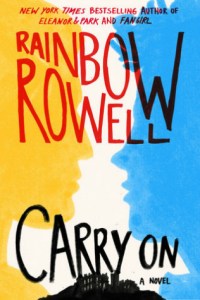
23734628Book: “Carry On” by Rainbow Rowell

Publishing Info: St. Martin’s Griffin, October 2015

Sometimes, comfort books are books that you want to revisit again and again because of the calming story, the promise of a happy ending, and the sweetness of the characters and the plot line. “Carry On” by Rainbow Rowell is one of those books, written as an offshoot to her book “Fangirl”. “Carry On” has origins in “Fangirl” as a popular “Harry Potter”-esque novel that the main character writes fan fiction for. But Rowell decided to give those fan fiction characters a completely new story of their own, where Simon Snow, the ‘chosen one’, starts to realize that his ‘enemy’ Baz may not be as bad as Simon thought. And as they grow closer, sparks start to fly. “Carry On” is a lovely romance and a bit of fluff that will make the reader swoon and smile, and while there are definitely some darkish elements in it, the relationship between Simon and Baz lifts the story up. Cuddle up with this book to get a jolt of happiness as you read. And keep an eye out for the sequel this fall, “Wayward Son”!

23398869Book: “Ana of California” by Andi Teran

Publishing Info: Penguin Books, June 2015

Finding comfort is sometimes all about finding the place that you belong, and many stories about people finding their place can be seen as good comfort reads because of this. A classic ‘finding your home’ story is “Anne of Green Gables”, and in 2015 Andi Teran decided to update that classic tale and set it in modern day California. Ana is a teenage girl who has found herself bouncing around the foster system, and she is at the end of the line. She has a choice: either go to a farm trainee program in Northern California, or go to a group home. When she arrives at Emmett Garber’s farm he isn’t sure that she will be the asset that his business needs, but Ana soon finds herself in a community that she has always wanted to be a part of. This fun update to a classic story makes the reader feel at home in the community, and no doubt they will fall in love with the familiar, but still unique, story and characters. It will give you the warm and fuzzy feelings of reading about someone who finally finds their home.

What comfort reads are some of your favorites? Let us know in the comments?

Serena’s Review: “The Blacksmith Queen”

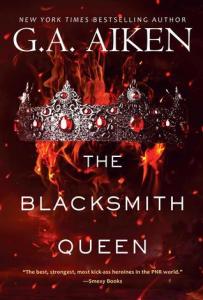
43129821._sx318_Book: “The Blacksmith Queen” by G.A. Aiken

Publishing Info: Kensington, August 2019

Where Did I Get this Book: NetGalley

Book Description: With the demise of the Old King, there’s a prophesy that a queen will ascend to the throne of the Black Hills. Bad news for the king’s sons, who are prepared to defend their birthright against all comers. But for blacksmith Keeley Smythe, war is great for business. Until it looks like the chosen queen will be Beatrix, her younger sister. Now it’s all Keeley can do to protect her family from the enraged royals. 
 
Luckily, Keeley doesn’t have to fight alone. Because thundering to her aid comes a clan of kilt-wearing mountain warriors called the Amichai. Not the most socially adept group, but soldiers have never bothered Keeley, and rough, gruff Caid, actually seems to respect her. A good thing because the fierce warrior will be by her side for a much longer ride than any prophesy ever envisioned …

Review: When every book is “The Something Queen” or another, it takes a bit for a title like that to draw my attention. But blacksmith. Huh, that was a new one! The description also sounded interesting. Something about a feud for the crown and…centaurs?

It all starts with a lot of death. First that of the King, and then the beginnings of a power struggle between his many sons, all vying for their right to wear the crown. Add to the mix a prophesy that a queen, not a king, shall be next to rule the land, and all sense of order goes out of the window. Keeley, a simple blacksmith, is happy enough to spend her days in her forge, blithely profiting from the sudden need for swords and war hammers. That is until her sister is drawn into it all, suspected of being the queen at the heart of the prophesy. A woman of action, Keeley is quick to jump to her sister’s aide, and grudgingly accepts the help of a band of wild warriors, among whom is the rough and tumble Caid, a man who is particularly intriguing.

What a bizarre story! Apparently the author has written other books focused on dragons, I think, that is set in the same world. But, typical me, I hadn’t read those going in. I don’t think it had a huge impact on my read of this story, and I was able to pretty quickly get a sense of the world and tone of the book. The thing that makes me refer to it as bizarre is the strange balance it seems to strike between urban fantasy and classic fantasy. Of the two, this would definitely lean towards the latter, given its medieval setting and such. There’s the fight over who will rule the kingdom, a magical prophesy, swords and warhammers.

But there were also tinges of urban fantasy in there with the style of writing and the sheer number of magical creatures all at once. There are demon wolves, witches, elves, dragons. And oh yeah, centaurs. This type of hodge podge assortment of classical fantasy creatures is often found in urban fantasy. Add to that the writing style that had a strong focus on humor and more than a little swearing, and it started to also feel very similar to a urban fantasy novel. And, of course, the brewing romance between a young woman and a man with some type of magical origins (typically vampires or werewolves, but we get something different here).

And of course, Keeley herself would fit right in amid most urban fantasy heroines. She’s badass, has a cool profession all of her own, and is loyal to the core, going to great lengths to protect those she loves. She’s also the sort of woman who easily inspires loyalty and camaraderie among those around her and wins over certain gruff men.

It was all…strange. I didn’t dislike it and there were definitely some laugh out loud moments. But it also didn’t fully connect as much as I would think it would. Everything that I just said above makes it sound like just my kind of thing. I think it was mostly the writing style. I struggled to reconcile the humorous, urban-fantasy-style writing with the type of story I was actually reading. And I’m not a stickler about language, but the swearing also started to feel like it was trying a bit too hard. There were also a sort of stilted feeling to some of the dialogue that made some of the characters sound almost childish at times.

Fans of urban fantasy and swords and staffs fantasy alike could find things to enjoy in this novel. If you like humor in your story, especially, than this is the book for you. The romance definitely takes a back seat to the rest of the story, however, so readers looking for more of that should take that into account.

Rating 7: A strange mix of two fantasy genres, but not quite mastering either.

Reader’s Advisory:

“The Blacksmith Queen” is on this Goodreads list: “Books about Blacksmithing.”

Find “The Blacksmith Queen” at your library using WorldCat!


Kate’s Review: “They Called Us Enemy”

42527866Book: “They Called Us Enemy” by George Takei, Justin Eisigner, Steven Scott, and Harmony Becker (Ill.)
Publishing Info: Top Shelf Productions, July 2019

Where Did I Get This Book: The library!

Book Description: A stunning graphic memoir recounting actor/author/activist George Takei’s childhood imprisoned within American concentration camps during World War II. Experience the forces that shaped an American icon — and America itself — in this gripping tale of courage, country, loyalty, and love.

George Takei has captured hearts and minds worldwide with his captivating stage presence and outspoken commitment to equal rights. But long before he braved new frontiers in Star Trek, he woke up as a four-year-old boy to find his own birth country at war with his father’s — and their entire family forced from their home into an uncertain future.

In 1942, at the order of President Franklin D. Roosevelt, every person of Japanese descent on the west coast was rounded up and shipped to one of ten “relocation centers,” hundreds or thousands of miles from home, where they would be held for years under armed guard.

They Called Us Enemy is Takei’s firsthand account of those years behind barbed wire, the joys and terrors of growing up under legalized racism, his mother’s hard choices, his father’s faith in democracy, and the way those experiences planted the seeds for his astonishing future.

What is American? Who gets to decide? When the world is against you, what can one person do? To answer these questions, George Takei joins co-writers Justin Eisinger & Steven Scott and artist Harmony Becker for the journey of a lifetime.

Review: When I was in grad school, one of our professors asked us how old we all were when we first learned about the Japanese American Internment during World War II. I was in sixth grade, but I remember that was on the early side of things in that straw poll. It is a shameful part of American History when our Government targeted innocent people based on their race, and shipped them off to internment camps based on bigotry and fear. I knew that actor and political activist George Takei and his family were sent to one of these camps when he was a little boy, but didn’t know his full story. “They Called Us Enemy” is him telling that story, but not only is it that, it’s connecting that experience and horrible government policy with more recent policies that are playing out in our country today.

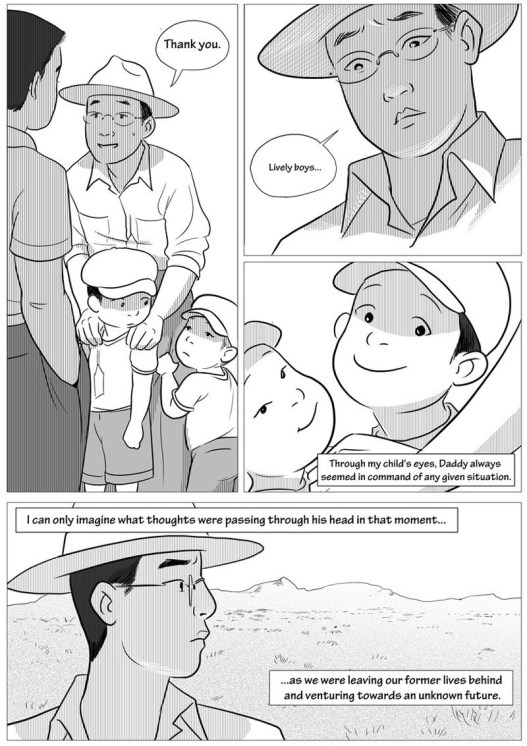
Takei weaves his own personal story together with the broader political climate and maneuvers that ultimately led to Executive Order 9066, which relocated over 100,000 Japanese Americans to internment camps during World War II. Takei was a little boy when this happened, and his memories are shaped by his age and perceptions at that time. I thought that it was especially effective to tell the stories of how he as a little boy perceived what was going on around him, and how looking back at how his parents were acting during that time now shows him the broader pain and injustice of what happened to their family. Moments like him and his little brother Henry playing on the train that was taking them to Camp Rohwer, where their natural curiosity made their mother nervous that they would get the negative attention of the guards, were especially chilling. He remembers having a fun time with Henry, but then also looks back and sees the unease his mother had regarding their safety, and it hits the point home that their innocence was being slowly chipped away at, even if they didn’t know it. I also liked that he would show other moments of childhood joy and innocence, like seeing their first snow or experiencing a visit from Santa at Christmas, but then would still reiterate that moments of happiness do not outweigh or negate the fact that he and his family were being imprisoned because of their heritage and race and not their actions.

Takei is also really good at presenting the political events and policies that surrounded the Japanese Internment, from putting forth the major players like FDR and Warren Berger in the spotlight to showing how the racism and fear meant more policies and more rules, and more distrust of those who were imprisoned. We see such policies play out on the larger scale, and then see how they impact the Takei family. His parents Takekuma and Fumiko are doing their best to keep their children safe, but as the policies become more restrictive their refusal to declare ‘loyalty’ to America, as to do so would be pledging loyalty to a country that had imprisoned them AND supposed that they were loyal to the Japanese Empire even though they did not live there and hadn’t for most of their lives. This, of course, led to consequences and the Takei family was sent to an even more restrictive camp called Tule Lake. We also see George Takei reflecting upon the conflict between older prisoners and younger prisoners, with older prisoners more likely to try to bow their heads and stay safe, and younger ones more willing to question and openly rebel. This is all seen through hindsight, as Takei has memories of, after the fact when he was a young adult, pushing against and deriding his father for not fighting back, and his father clearly still feeling caught between what was right and what would keep his family safe. It’s clear this still hurts Takei as he looks back on it.

Finally, Takei isn’t afraid to compare the Japanese Internment Camps and Policy to what we are seeing at the border with asylum seekers and the Muslim Travel Ban. The comparison has made some people uncomfortable and indignant, but Takei is more than game to show that the inhumanity of these policies is very reminiscent of what happened to Japanese Americans during World War II, and that they’re based similar fears and racism that Executive Order 9066 sprung from. It’s a wrenching comparison, and a hard reality to face that we’re falling into the same mistakes and injustices of our past.

The artwork by Harmony Becker is lovely to look at and fits the story well. It strikes a balance between realism, especially when talking about policy and world events, but also has cartoony moments that reflect childhood and childrens’ reactions to various events in their day to day lives.

4
(source)

“They Called Us Enemy” is a story that is upsetting and personal, and it is a familiar situation that many had hoped we had left in the past. George Takei opens up and shares this story with power and grace, and if you want to know more about the Japanese American Internment, this is a good place to start. Learn our history. We’re repeating it now and it’s atrocious.

Rating 9: A powerful, heartbreaking story that shows injustices of America’s past (and present), “They Called Us Enemy” is a stunning and personal graphic memoir by George Takei.

Reader’s Advisory:

“They Called Us Enemy” is included on the Goodreads lists “Japanese American Internment”, and “History Through Graphic Novels”.

Find “They Called Us Enemy” at your library using WorldCat!

Serena’s Review: “The Lady Rogue”

43822758Book: “The Lady Rogue” by Jenn Bennett

Publication Info: Simon Pulse, September 2019

Where Did I Get this Book: Edelweiss+

Book Description: Traveling with her treasure-hunting father has always been a dream for Theodora. She’s read every book in his library, has an impressive knowledge of the world’s most sought-after relics, and has all the ambition in the world. What she doesn’t have is her father’s permission. That honor goes to her father’s nineteen-year-old protégé—and once-upon-a-time love of Theodora’s life—Huck Gallagher, while Theodora is left to sit alone in her hotel in Istanbul.

Until Huck arrives from an expedition without her father and enlists Theodora’s help in rescuing him. Armed with her father’s travel journal, the reluctant duo learns that her father had been digging up information on a legendary and magical ring that once belonged to Vlad the Impaler—more widely known as Dracula—and that it just might be the key to finding him.

Journeying into Romania, Theodora and Huck embark on a captivating adventure through Gothic villages and dark castles in the misty Carpathian Mountains to recover the notorious ring. But they aren’t the only ones who are searching for it. A secretive and dangerous occult society with a powerful link to Vlad the Impaler himself is hunting for it, too. And they will go to any lengths—including murder—to possess it.

Review: I’m always up for a good Vlad the Impaler story. Pair that with what sounds like a romping adventure and an Amelia-Peabody-like heroine, but a teenager, and this book seemed right up my alley. I know the author is a favorite romance author for many people, but I hadn’t read any of her stories previously, so I was excited to see what this one had in store!

For all of her father’s overprotective ways, Theodora finds herself suddenly alone in Eastern Europe and now, he’s the one in trouble and she’s the one tracking his trail. Good thing she’s been preparing for this moment for her entire life. Less good thing that her father’s protege, the irresistible and annoying Huck, is on the trail as well. Together, they discover that her father has gotten himself caught up in matter way above any of their pay grade and those responsible for his disappearance may now be after Theodora and Huck as well.

While this book wasn’t an absolute hit for me, it was still a quite fun read. The author has definitely mastered a witty, style of writing and the dialogue was definitely her strength. From the very first page, I was laughing at Theodora’s descriptions of the troubles she gets herself in. And once Huck shows up, their verbal sparring was on point. You can definitely see the author’s romance writing roots in this, as I’ve always found that the best romance books depend most on the the strong dialogue that pulls together the hero and heroine. Anyone can writing a steamy scene, but the heart of romance writing is the characters themselves since there isn’t a lot of plot, often. Thus, they have to have an amazing inner voice and repartee.

I also enjoyed the adventure and action of this book. The story takes off running and never really lets up on the gas. Mysterious strangers hunt them across multiple countries and even aboard the Orient Express. As the mystery about her father’s disappearance and his connection with the infamous Vlad the Impaler comes to light, I enjoyed seeing Theodora put her own unique skills to the test to rescue him.

Huck, on the other hand, never really landed for me. As I said, the dialogue and witty banter between him and Theodora was engaging from the beginning, but for his own part, he was kind of bland. It was hard to completely buy the connection between him and Theodora since it often came across as having come about simply due to proximity growing up, rather than any particularly unique bond between the two. He also had a habit of tipping a bit too far over the arrogant line from “charming” to “kind of rude.”

Really, the romance was my problem with this book. Maybe if I hadn’t known the author was a romance novelist, my expectations would have been adjusted. But I really just found myself wishing, as I went along, that this had just been a regular, old adult novel. Age up the characters by a few years, increase the romance, and boom! Fun book! As it was, it felt like the author was continuously pulling her punches and the story was wobbling along, crippled by the need to be YA.

I had a fun enough time reading this book. But by the end of it, I mostly remembered it for some witty banter and a few fun action pieces. Nothing wrong with that, but it didn’t capture me the way I wanted and it’s unfortunately the kind of story I enjoyed once but will probably easily forget I ever read. I am interested in checking out the author’s adult romances, however! Fans of the author will probably enjoy this and if you’re looking for a good beach read, this is the book for you!

Rating 7: A fun, but forgettable, ride.

Reader’s Advisory:

“The Lady Rogue” is a new title so it isn’t on many relevant Goodreads books, but it should be on “Best Books Featuring Dracula.” 

Find “The Lady Rogue” at your library using WorldCat!

Kate’s Review: “The Babysitters Coven”

38856385Book: “The Babysitters Coven” by Kate Williams
Publishing Info: Delacourte Press, September 2019

Where Did I Get This Book: I received an eARC from NetGalley.

Book Description: Adventures in Babysitting meets Buffy the Vampire Slayer in this funny, action-packed novel about a coven of witchy babysitters who realize their calling to protect the innocent and save the world from an onslaught of evil.

Seventeen-year-old Esme Pearl has a babysitters club. She knows it’s kinda lame, but what else is she supposed to do? Get a job? Gross. Besides, Esme likes babysitting, and she’s good at it.

And lately Esme needs all the cash she can get, because it seems like destruction follows her wherever she goes. Let’s just say she owes some people a new tree.

Enter Cassandra Heaven. She’s Instagram-model hot, dresses like she found her clothes in a dumpster, and has a rebellious streak as gnarly as the cafeteria food. So why is Cassandra willing to do anything, even take on a potty-training two-year-old, to join Esme’s babysitters club?

The answer lies in a mysterious note Cassandra’s mother left her: “Find the babysitters. Love, Mom.”

Turns out, Esme and Cassandra have more in common than they think, and they’re about to discover what being a babysitter really means: a heroic lineage of superpowers, magic rituals, and saving the innocent from seriously terrifying evil. And all before the parents get home.

Review: Thanks to NetGalley for sending me an eARC of this book!

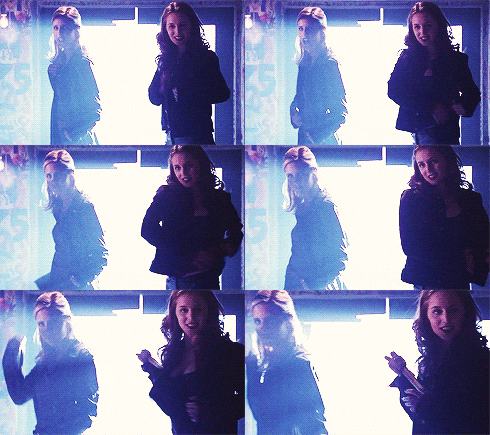
Once the weather turns from summer heat and sunshine to chilly breezes and longer nights, I immediately get into a full on Halloween mindset. True, Horrorpalooza 2019 is still a few weeks away, but we’re going to get into the spirit with a new YA book about witches! When I read the description of “The Babysitters Coven” by Kate Williams, I was totally on board. Teen girl babysitters with magical powers being snarky and protecting the world from evil? Now where have I seen this before?

giphy-6
I love them both but Faith was the goddamn best! (source)

I may have gone in with too high of hopes, because while I did mostly enjoy “The Babysitters Coven”, it fell into familiar traps that I’ve seen in YA paranormal fiction.

But, like always, we start with the positive. It’s hard to deny that “The Babysitters Coven” is an original and cheeky concept. For any other late 80s, early 90s kids like me, the homage to “The Baby-sitters Club” is charming as hell and really taps into a children’s literature nostalgia. As someone who wanted to be a part of the BSC, I was smiling whenever the implicit (and sometimes explicit) references to that series were made (though how dare Esme imply that Mary Anne was the lame person to be? MARY ANNE SPIER IS THE BEST!). On top of that, I did really like our protagonist Esme and her best friend Janis. Their friendship felt like a realistic and fun teen girl relationship, and I enjoyed that they were both kind of geeky and always up for making references to things that I enjoy. It made them all the more relatable when they would talk about the original “Halloween” or “Buffy the Vampire Slayer”, amongst other things from fandoms that I like. The backstory to Esme, her surprising supernatural abilities, and the abilities of the new girl Cassandra were well thought out and I liked how they were slowly revealed. I don’t want to give too much away, but what I will say is that there is a mythos here that has a lot of meat to it with more exploration to go.

But a few of these strengths do have flip sides to weaknesses. The first is that while there is a lot of exposition here, and mythology and magical system building, I felt like too much time was spent on the set up and not enough on the actual main conflict. Because of this, the big bad and final showdown felt like it jumped from zero to one hundred, with not enough build up in between. I know that this is the first in a planned series, so perhaps Williams wanted to spend most of this book setting up for future things. But the problem with that is that a balance needs to be struck between set up and conflict, and it definitely felt uneven. There was also the issue I had with the character of Cassandra, who never really grew from mysterious cool girl, even after she officially joined Esme and Janis’s group. I wish that we had more insight into who she was and more complexity, but as of right now I don’t really have a good sense of who she is, unlike Esme and Janis. And finally, “The Babysitters Coven” tends fall far too close to the dreaded ‘aggressively quirky’ tone that I really cannot abide in any kind of story. I’m sure that a lot of this has to do with trying to create a self insertion fantasy for the target reading demographic, which is admittedly not a woman in her mid thirties. And hey, that’s fine! Escapist power fantasies are all well and good and who am I to begrudge a teen girl from getting to enjoy such things? But for me, entertaining writing it does not make all by itself.

“The Babysitters Coven” has the potential to be a really fun new paranormal fantasy series, and its first book has its ups and downs. I think that while I may not move on to the next installation, there will be a lot of geeky, supernatural obsessed readers out there who will find it to be a joy to read!

Rating 6: A cute idea with some admittedly fun moments tends to get bogged down in exposition over plot, and edges towards the aggressively quirky.

Reader’s Advisory:

“The Babysitters Coven” is new and not on many specific Goodreads lists as of yet, but I think it would fit in on “Books With Supernatural Females”.

Find “The Babysitters Coven” at your library using WorldCat!

Book Club Review: “The Joy Luck Club”

7763._sy475_We are part of a group of librarian friends who have had an ongoing bookclub running for the last several years. Each “season” (we’re nerds) we pick a theme and each of us chooses a book within that theme for us all to read. Our current theme is ‘Books On Our To Read Shelf’, where we pick books that we’ve been meaning to read but haven’t gotten to.

For this blog, we will post a joint review of each book we read for book club. We’ll also post the next book coming up in book club. So feel free to read along with us or use our book selections and questions in your own book club!

Book: “The Joy Luck Club” by Amy Tan

Publishing Info: G.P. Putnam’s Sons, 1989

Where Did We Get This Book: Borrowed it from family; the library!

Book Description: Four mothers, four daughters, four families, whose histories shift with the four winds depending on who’s telling the stories. In 1949, four Chinese women, recent immigrants to San Francisco, meet weekly to play mahjong and tell stories of what they left behind in China. United in loss and new hope for their daughters’ futures, they call themselves the Joy Luck Club. Their daughters, who have never heard these stories, think their mothers’ advice is irrelevant to their modern American lives – until their own inner crises reveal how much they’ve unknowingly inherited of their mothers’ pasts. 

With wit and sensitivity, Amy Tan examines the sometimes painful, often tender, and always deep connection between mothers and daughters. As each woman reveals her secrets, trying to unravel the truth about her life, the strings become more tangled, more entwined. Mothers boast or despair over daughters, and daughters roll their eyes even as they feel the inextricable tightening of their matriarchal ties. Tan is an astute storyteller, enticing readers to immerse themselves into these lives of complexity and mystery.

Kate’s Thoughts

I first read “The Joy Luck Club” right after college, when I found it on my sister’s book shelf and decided to give it a go. It was around this time that I really started to devote my life to reading again, and I remember really enjoying the book in my early twenties. So when it was chosen for book club, I was interested to see if my thoughts and feelings would have changed as time passed. I found my Mom’s old school copy in their basement, and dove right back in.

Time and reading experience has definitely changed my perceptions, but not in a bad way, necessarily. I still liked how Tan portrayed the complicated relationships between mothers and daughters, sometimes because of the complex relationship between parents and children, and other times because of a culture clash between immigrants who grew up in one place and culture, and their children who grew up in a different place and different culture. We see their lives and personalities through various vignettes and experiences, and see how the hardships that the mothers had made them approach how they raised their daughters, and in turn how the daughters may or may not understand those approaches. Sometimes the relationships were touching and loving, and other times there would be conflicts that were hard to read. For me, the most effective vignettes mostly involved Suyuan Woo (the founder of the Joy Luck Club) and her daughter Jing Mei. Suyuan was living in China during the Japanese Invasion and the lead up to World War Two, and endured the tragedy of not only losing her husband, but having to abandon her twin daughters on the side of the road because she was too sick to carry them. Jing Mei always felt like she wasn’t good enough in her mother’s eyes, and when she finds out that the rest of the Joy Luck Club found out that her half sisters are alive, she has to decide if she’s going to pursue them. Her complicated relationship with her mother is filled with a lot of painful subtext and context, and while through my Western experience I had a hard time wrapping my mind around how Suyuan (and many of the other mothers) treated their daughters I did think that the stories of Suyuan and Jing-Mei had the most emotional oomph, and definitely made me tear up multiple times. Tan does a good job of not necessarily excusing some of the manipulative or cruel behaviors of her characters, but showing why they may be acting that way. Her writing is also gorgeous, as it flows well and brings out a lot of imagery in vibrant ways.

I can see how there are criticisms from some Chinese American authors and scholars when it comes to “The Joy Luck Club”, as for so long this seemed like the go-to book for Westerners when it comes to what Asian American stories are consumed. Hell, I am pretty sure that when I picked it up a decade or so ago it was one of the first books I’d read written by an Asian-American author about Asian and Asian-American characters. As time has gone on it’s important that more Asian and Asian-American authors have been able to tell stories of all kinds, and to show all kinds of experiences that don’t necessary reflect stereotypes that “The Joy Luck Club” may have contributed to, inadvertently or otherwise. But on the other side, this story definitely seems to be a very personal one for Tan, and therefore it’s hard to completely write it off or to say that it should be left behind completely. It’s a complex issue, and I don’t know what the right answer is when it comes to where “The Joy Luck Club” should be in the literary canon.

Reading “The Joy Luck Club” a second time was an interesting experience, and with older and wiser eyes I think that I got more from it. I’m glad that book club gave me the chance to read it again.

Serena’s Thoughts

This was a book that I only knew through vague familiarity with the title and the fact that it had been made into a movie in the early 90s that I may have caught bits and pieces of, here and there. So other than knowing that this type of literary fiction is typically my jam, I didn’t have many preconceived notions of the book going in.

Overall, I was right in my initial assessment that this wouldn’t be my type of book, but there were things that I did appreciate about it. I don’t know a lot of about China during the Japanese invasion and many of mother’s tales were an interesting (if tragic!) look into that time period and how these women came emigrate to America. I do wish there had been a bit more variation between the tales. While they were each distinctive enough, towards the end of the book, I kept waiting for the next mother’s tale to be the starkly contrasting tale to balance out the others. Instead, most of them were fairly similar at their heart, which leads to one of my main criticism.

I had a hard time keeping track of who was who and how each was related to the one who did what. Part of this comes down to the similarity between some of the stories. But there was also similarity between characters. Many of the daughters ended up married to varying levels of scumbag husbands who all also tended to blend together in my mind. The story was also broken up into chapters for the mothers and chapters for the daughters, but they are all scattered throughout the book in a way that forced me to always flip back to the chart in the front of the book and to previous chapters to try to figure out just who we were talking about how and how their story related to others’.

I think the way the book was laid out in this way had a detrimental effect even on one of the main messages the author was trying to get across, about how the mother’s lives effected how they interacted and raised their daughters, and vice versa. Every once in a while I’d be able to form a clear connection from one of the mother’s stories to how she interacted with her daughter. But I think there was also a lot I missed simply because I couldn’t keep track of who’s story was who’s. The book was originally written as a collection of short stories, and I almost think it would have been more successful had it been left as that. The attempt to draw it together as a novel is just enough to technically earn that description, but left me, the reader, more confused than I would have been had I just read the short stories seperately.

We had a really good book club discussion about identity, mother/daughter relationships, and whether or not immigration and 1st, 2nd, generation immigrants may have different experiences now, coming out of differing political climates in their home countries and into a different USA, too. So there’s still clearly a lot of good stuff to be found in this book. As a point of discussion, I really liked it. But as a read, it wasn’t really my thing.

Kate’s Rating 7: An emotional book with complex themes and issues, “The Joy Luck Club” was interesting to revisit, and for the most part still held up for me.

Serena’s Rating 7: An interesting point of entrance into a larger discussion about immigration, family, and culture, but still a bit hard to read for me.

Book Club Questions

  1. The story is broken into several different stories about the mothers and the daughters. Is there one that stands out to you and why?
  2. The story is focused largely on the challenging relationship between the mothers and daughters. What makes this relationship so challenging but also fulfilling? What about these depictions strikes you?
  3. Immigration is challenging issue right now. How does this book fit into the current narrative about immigrants and their experiences leaving their homes and coming to live in a new country?
  4. When Jing-Mei is talking with the other women of the Joy Luck Club about her mother, she says that she doesn’t feel like she knew who her mother was or anything about her. How much do you think we know about our own mothers? Do you think that Jing-Mei’s perceived lack of knowledge (And Suyuan’s privacy) could be generational? Cultural?
  5. The book is broken into several stories and jumps around from one to another. How did this structure affect your read?
  6. There are rumors of a sequel to this book (in film form). If there was to be a sequel to this story set in the modern day, what do you think it would cover? What relationships, what countries, what cultures?

Reader’s Advisory

“The Joy Luck Club” is included on the Goodreads lists “Immigrant Experience Literature”, and “Jezebel’s Books All Women Should Read”.

Find “The Joy Luck Club” at your library using WorldCat!

Next Book Club Book: “Gone” by Michael Grant.


Serena’s Review: “The Girl the Sea Gave Back”

42867937Book: “The Girl the Sea Gave Back” by Adrienne Young

Publishing Info: Wednesday Books, September 2019

Where Did I Get this Book: NetGalley

Book Description: For as long as she can remember, Tova has lived among the Svell, the people who found her washed ashore as a child and use her for her gift as a Truthtongue. Her own home and clan are long-faded memories, but the sacred symbols and staves inked over every inch of her skin mark her as one who can cast the rune stones and see into the future. She has found a fragile place among those who fear her, but when two clans to the east bury their age-old blood feud and join together as one, her world is dangerously close to collapse.

For the first time in generations, the leaders of the Svell are divided. Should they maintain peace or go to war with the allied clans to protect their newfound power? And when their chieftain looks to Tova to cast the stones, she sets into motion a series of events that will not only change the landscape of the mainland forever but will give her something she believed she could never have again—a home.

Review: Here’s another example of a cover that has a model but is still super cool to look at. Notably, she’s wearing clothes appropriate to her character and it depicts a scene that seems to connect with the title and description pretty well. Always love to see that! But, cover aside, I really decided to check this book out based on my enjoyment of the author’s previous book, “Sky in the Deep.” As I mentioned in the Highlights post, it’s always exciting to find standalone fantasy novels. And when you have an author who chooses to write multiple standalones, but in the same world, it’s like getting your cake and eating it, too.

Tova’s remembered life began alone, cold on the sea. It’s only through fate, it seems, that her small craft washes up on shore and she is taken in by a people who are both mystified and wary of her mysterious origins and the power she possesses. As a young woman, she is drawn into a brewing conflict, both internal and external, as the Svell people debate the merits of war. With two of the major tribes having joined together, the Svell see this as their time to rise. But Tova sees darkness ahead. Will they listen to their own mystic, or is she, and the young warrior Halvard from the opposing tribe, doomed to be caught up in another round of warfare?

Sadly, this book wasn’t as much of a hit for me as the first one. I think there are a few factors, but first I want to talk about the things I did like. I was again pleased to return to this world that Young has created. The Viking-like mythology is still intriguing, as is the way of life and cultures that are described for the various clans. The writing itself is still solid and I think she did a good job balancing out introducing new characters and themes, while also giving readers a few peaks at what is going on with beloved characters and arcs from the first book.

All of that said, however, I just wasn’t able to connect with this story the way I was able to with the first. Part of this might come down to the dueling narrators. Having two narrators means that the author needs to balance two characters’ worth of story, emotional motivation, and overall arc with only half the page time that one alone would have. There are obviously benefits in getting to see various characters’ differing perspectives, but it’s still quite challenging. Here, I think both main characters suffered for the lack of full devotion to either.

Halvard, to some extent, was better served in the fact that I at least was familiar with him from the first book and had a bit more emotional investment right off the bat. Tova, however, the titular “girl the sea gave back” always felt a bit bland. Her backstory is intriguing, and her life growing up as a powerful mystic but one who is still seen as an outsider in the clan that has adopted her is compelling. But for some reason, I struggled to fully invest in her story. In the end, both main characters lack the spark that gave life to the main character from the first book.

The plot was also incredibly predictable. To some extent, the same could be said of “Sky in the Deep,” but I think there was enough of a personal arc of her discovery of her brother in the midst of her enemy’s camp and the slow-burn enemies-to-lovers romance to keep the plot failings afloat. But, as discussed, with flat characters, the plot failings become much more apparent. Must of the story revolves around a discussion of fate and destiny. These themes can be compelling if taken apart and contrasted against free will and choice. But here they are simply wielded as clumsy explanations for why unlikely events occurred, hand-waving away coincidences one way and another.

“Destiny” also killed the romance of this story. For one, there was simply a lot less of one than there was in the first, which I personally found disappointing. But for two, what romance we were given was one meet-cute away from instalove, right down to the almost deadly brawl that somehow ends with a “connection.” With all of that destiny and intertwinedness to go around, the reader is never given a reason to root for these two, as we’ve been told from the start that it is simply meant to be. The characters don’t need to build up feelings for each other, they just know they’re there, even across time and space almost.

Overall, this was a very flat story for me. I struggled to find anything to connect to and by the end reading it felt more like a chore to get through. How disappointing, based on the strength of the first story and the fact that the author clearly has skills. In many ways, it almost feels like this would be the author’s first book, and that one the one she pulls out later in all of its more-polished glory. I’m not writing the author off completely, as I know she has good stories in her. This one just wasn’t one of them.

Rating 6: Fans of the first book should beware that this is in many ways “Sky in the Deep” lite.

Reader’s Advisory:

“The Girl the Sea Gave Back” is, weirdly, on this Goodreads list: “Summery vibes.”

Find “The Girl the Sea Gave Back” at your library using WorldCat!