Serena’s Rev-Up Review: “Fire”

Book: “Fire” by Kristin Cashore

Publish: Dial Books, 2009

Where Did I Get this Book: own it!

Book Description: It is not a peaceful time in the Dells. The young King Nash clings to his throne while rebel lords in the north and south build armies to unseat him. The mountains and forests are filled with spies and thieves and lawless men.

This is where Fire lives. With a wild, irresistible appearance and hair the color of flame, Fire is the last remaining human monster. Equally hated and adored, she had the unique ability to control minds, but she guards her power, unwilling to steal the secrets of innocent people. Especially when she has so many of her own.

Then Prince Brigan comes to bring her to King City. The royal family needs her help to uncover the plot against the king. Far away from home, Fire begins to realize there’s more to her power than she ever dreamed. Her power could save the kingdom.

If only she weren’t afraid of becoming the monster her father was.

Previously Reviewed: “Graceling”

Review: Unlike “Graceling,” I never got around to re-reading “Fire” closer to when I read it the first time. Not that I didn’t really enjoy it then, just that, like I said, the TBR list was just starting to get out of control around this time. So going into this re-read, I remembered even less about this book than that. That made it lots of fun to read now as it almost felt like an entirely new book, but one that I already knew I’d enjoy! Win win!

The Dells is a colorful land, marked by the bright, over-powering beauty of its monsters: blue horses, purple raptors, pink mice. But Fire is the only human monster after the death of her cruel father several years prior. Her extreme beauty inspires both wonder and hatred from those around her, so Fire’s life world has been small to stay safe. She also greatly fears the mind control abilities that come alongside her beauty. But when a prince arrives on her doorstep requesting her aide to save the king, Fire is obligated to venture out and put her abilities to the test.

While this is technically a prequel to “Graceling,” it most ways it stands a lone. We have one character (albeit an important one!) who crosses over, but their page time is limited so even there we’re left with mostly new material. I really loved the world-building that went into the Dells and the creativity around the native monsters and how their powers worked. The animals themselves are quite terrifying, especially the monster raptors that seem to constantly lurk in the sky. Though this was also the one point where I was confused. Are these regular raptors, like hawks and falcons that aren’t that big? Or are these some type of unique bird of prey that is bigger? They seemed to be discussed and treated as pretty severe threats to people which was confusing if we’re talking about smaller birds of prey. Not really a big deal, but it was something I kept getting caught up on throughout the story.

Fire herself is an incredible creation. It makes complete sense that extreme beauty would inspire both love and hatred, and seeing how this plays out in Fire’s every day existence was really intriguing. She has some strong abilities, but we also see how very vulnerable her monster looks are to her. She attracts monster animals who want to eat her, and humans aren’t much better, either becoming obsessed with her (often in the grabby, forceful kissing manner) or essentially go mad and want to kill her. Her life seems very challenging, full of fear and tension. This makes it all the more touching to see her begin to form real relationships with the other characters in this book, because we’ve been prepped to understand just how many challenges there are in this for Fire.

I really liked the romance in this book, perhaps even more than I did the one in “Graceling.” Everyone loves a good “enemies to lovers” romantic plot line, and as much as I liked Po, Brigan checked off more on my romantic hero wish list, like steady and a bit solemn. While Katsa and Po were all about the fiery drama, Fire and Brigan have a slow build that is beautiful to watch unfold.

This book was a bit slower than “Graceling,” and the villain(s) were also a bit underwhelming. We see the return of one evil character, and they’re good for the small amount of page time we get from them. But what accounts for the main antagonist and challenge was a bit to removed from the story to feel too invested in it. By the nature of her being, Fire’s work is mostly done from the safety of the castle and is largely passive with most of the action taking place off-page.

I really enjoyed re-reading this book. I really remembered very little of it, and I was pleased to find the romance, in particular, even better than I had remembered. Next up is “Bitterblue!”

Rating 9: A quieter, more introspective book than “Graceling,” but also a bit more heart-breaking (in a good way!) overall.

Reader’s Advisory:

“Fire” is on these Goodreads lists: Original Stories . . . a Breath of Fresh Air and Princes, Other Worlds and Future Lands.

Find “Fire” at your library using WorldCat!
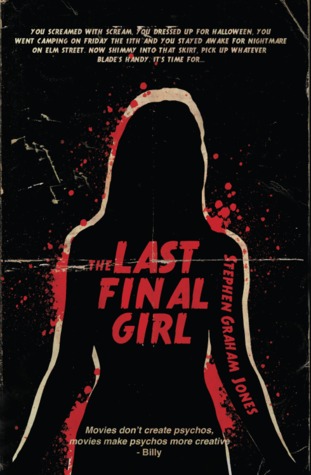
Kate’s Review: “The Last Final Girl”

Book: “The Last Final Girl” by Stephen Graham Jones

Publishing Info: Lazy Fascist Press, September 2012

Where Did I Get This Book: I own it.

Book Description: Life in a slasher film is easy. You just have to know when to die.

Aerial View: A suburban town in Texas. Everyone’s got an automatic garage door opener. All the kids jump off a perilous cliff into a shallow river as a rite of passage. The sheriff is a local celebrity. You know this town. You’re from this town.

Zoom In: Homecoming princess, Lindsay. She’s just barely escaped death at the hands of a brutal, sadistic murderer in a Michael Jackson mask. Up on the cliff, she was rescued by a horse and bravely defeated the killer, alone, bra-less. Her story is already a legend. She’s this town’s heroic final girl, their virgin angel.

Monster Vision: Halloween masks floating down that same river the kids jump into. But just as one slaughter is not enough for Billie Jean, our masked killer, one victory is not enough for Lindsay. Her high school is full of final girls, and she’s not the only one who knows the rules of the game.

When Lindsay chooses a host of virgins, misfits, and former final girls to replace the slaughtered members of her original homecoming court, it’s not just a fight for survival-it’s a fight to become The Last Final Girl.

Review: I’m sure it’s come up before, but I love slasher movies. There isn’t necessarily much depth to them, and there are certainly problematic elements to many of them, but I thoroughly enjoy sitting down and taking in the likes of “Friday the 13th”, “Sleepaway Camp”, “Halloween”, and “Nightmare on Elm Street”. And many, many others. High School Kate loved them because of The Final Girl trope, in which the nice, shy, virginal girl was ultimately the one to come out of it at the end, traumatized but alive and ready to fight another day, as there was a lot to relate to with that portrayal at the time. I still like The Final Girl idea, even if it, too, is a bit problematic, and the gang that includes Laurie Strode, Tree Gelbman, and Sidney Prescott (and MANY others) is a girls club that I love. Which brings me to Stephen Graham Jones and his book “The Last Final Girl”. Which is a love letter to the genre that I love that twists it all up into something wicked and fun.

You know I love a good subversion of a genre. (source)

“The Last Final Girl” is a meta, experimental narrative with shifting points of view, stage direction, a script like structure, and bucket after bucket of blood as a number of ‘final girls’ find themselves in a Thunderdome-like fight to the finish, all while a slasher killer in a Michael Jackson mask is picking them and others off. While I did find the narrative structure a bit jarring at first, once I eased into it and got used to it it was easier to follow. This is probably the biggest hurdle for this story, as everything else worked pretty damn well for me. “The Last Final Girl” is filled with oodles of slasher movie references, from characters sharing names with movie heroines and villains (characters with names like Ripley, or Baker, or my favorite Crystal Blake, as if you remove the B, what do you get?), to references to plot points, tropes, actors, actresses, what have you. It’s a major opus of taking so many things and blending them together into a story that’s part deconstruction, part satire, part gore-fest. I loved finding the little Easter Eggs sprinkled throughout, as I love a good game of ‘spot the reference’.

I also thought that Jones created some fun protagonists in our troop of Final Girls. Izzy, the weirdo misfit and main girl we follow, was particularly fun, as, like many of the characters, she’s aware that she’s in a slasher film scenario, and is doing her best to adjust to it and perhaps get through it until the end. And on top of all of that, Jones tweaks and toys with preconceived notions of slasher films, virginal final girls, and masked killers (though given the details that have come out more and more about Michael Jackson in the past year or so, what may have been a sly twist at the time now feels all the more ominous and icky). It never feels like these twists or subversions are trying to outdo the original source material; on the contrary, you definitely feel the affection that Jones has for the genre as a whole, even as he’s playing with it a bit. It feels more like “Behind The Mask: The Rise of Leslie Vernon” in that way as opposed to “Cabin in the Woods” when looking at deconstructing horror tropes. I felt that “Vernon” was parodying the genre with affection, with “Cabin” came off as feeling smugly superior to it (this is just my opinion, however).

I will say that if you aren’t well versed in the slasher genre, and if experimental writing styles confound you, “The Last Final Girl” is probably not going to be the book for you. I think that if I wasn’t so into the genre as a whole I would have been completely turned off by the narrative style, as the reason I kept going at first was because of the theme at hand. If it wasn’t a story by an author I really enjoy, and a genre homage that I hold close to my heart, I don’t know if I’d have been able to get past the experimental style choices. As mentioned above, I got into it as it went on. But it took a little adjustment.

Overall, I enjoyed “The Last Final Girl”. It made me want to have a full slasher movie marathon by the time I was done with it.

Rating 8: A brutal, fun, and funny love letter to slasher movies, though it may not translate as well if you’re unfamiliar with the topic.

Reader’s Advisory:

“The Last Final Girl” is included on the Goodreads lists “Slasher Fiction (No Novelizations”, and “Books About Small Towns”.

Find “The Last Final Girl” at your library using WorldCat, or a local independent bookstore using IndieBound!

A New Year: Books About Hope and Peace

2020 was…a lot. No part of life felt untouched by the complete upheaval that was life during a summer full of powerful protests, a fall made up of an ugly election cycle, and an entire year burdened by the challenges of the COVID-19 pandemic. 2021 has started with an insurrectionist attack in D.C., but will soon see a new president sworn into power. We could all use a little hope and peace looking forward, so here is a list of books with themes such as these at their core.

Serena’s Picks

Book: “The Lion, the Witch, and the Wardrobe” by C.S. Lewis

Not only is this just a good book to read during the winter any year, but it feels particularly apt now. Even though Christmas technically came, the general feeling of “always winter but never Christmas” definitely pervaded this last year. But at its heart, this is a story of hope in the midst of what feels like endless darkness. Even the part that is set in the real world, with the children sent to the country to escape the bombing in London during WWII. What could just be a grim war story turns into a magical adventure. And right next to the grand example of goodness and kindness set by Aslan himself, there are the smaller, quieter moments that stand out just as much. Mr. Tumnus inviting Lucy in for tea. The beaver family taking in the children and leading them across Narnia’s wintery forest. And while the cold of the White Witch is always present, it’s also impossible to miss the sense of peace and wonder that winter always brings with it as well. Especially when Christmas finally arrives.

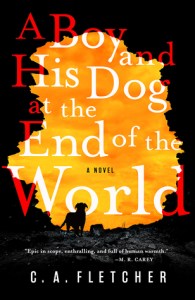
Book: “A Boy and His Dog at the End of the World”

Yes, the premise of this book doesn’t sound too peaceful or hopeful. The world has ended. But life goes on and even sort of peace has come along with it. That is until Griz’s beloved dog is stolen away. And so begins a trek across a barely recognizable world, but hope burns eternal and beauty can be found even amidst the destruction that remains. It’s a lovely story, with perhaps some sad bits, but a nice message at the end about the rewards waiting for those who persist in the face of unknowns and seemingly hopeless cases. This book probably goes down as one of my “most recommended” titles in the last several years. I feel like it’s the kind of story that appeals to almost all types of readers and it has hidden gems that surprise even the most savvy reader.

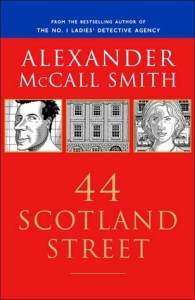
Book: “44 Scotland Street” by Alexander McCall Smith

This is actually a book recommendation from my husband who is also an avid reader, though he tends towards long, Russian novels much more than myself (much to his dismay as he knows I’ll probably never read any of them myself!). But I was talking about this book list and looking for peaceful, hopeful books and this was one of the first ones he thought of. Unlike the first two books on this list, this recommendation is based more on the peaceful feeling he described as having when reading it. The story is essentially just a character study of a small community in Edinburgh and all the quirks and foibles that make up the lives of the people in it. Strong on plot it may not be, but full of warmth and laughs, it definitely is!

Kate’s Picks

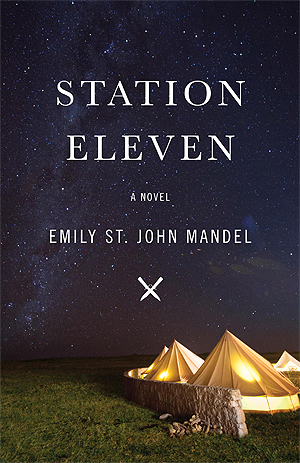
Book: “Station Eleven” by Emily St. John Mandel

So this may seem like an odd choice given that it takes place in a post-apocalyptic world after a devastating pandemic. But “Station Eleven” is, at its heart, about hope and the human will to keep going, and finding joy and peace in the things that are left. After a virus wipes out a majority of the world’s population, groups of people who survived are scattered about in the wild. One of these groups is a troupe of actors who travel around and put on plays for those that they meet, bringing reminders of the old world and joy through art. True, there is conflict, and true, we still see the pain of the world falling apart through flashbacks, but even with all of that “Station Eleven” is a very hopeful tale about human perseverance even in the worst of times, and how important the arts can be when they provide happiness and escape.

Book: “I Am Malala: The Story of a Girl Who Stood Up For Education and Was Shot by the Taliban” by Malala Yousafzai and Christina Lamb

It’s been almost ten years since education activist Malala Yousafzai was nearly murdered for her activism while she was living in Pakistan. After she survived the attack, and given that she was only a teenager at the time, she became a symbol of tenacity and hope in the face of violence and oppression. Her memoir “I Am Malala” is a very hopeful and powerful book about doing what’s right, standing up against injustice, and the sacrifices that sometimes have to be made for the greater good. What I loved most about this book is that Malala is not only a very powerful writer as she talks about her life and her activism, but it’s also very much a story about a teenage girl with a lot of the dreams and anxieties that you would see across the age group. It’s a book that not only gives hope to me for younger generations, but also gives hope that things can get better if you fight for it.

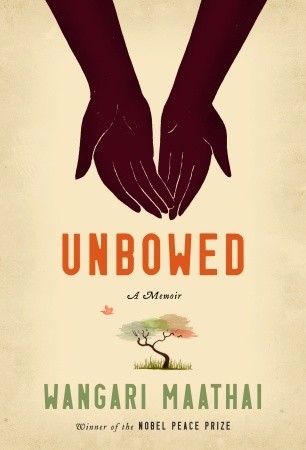
Book: “Unbowed” by Wangari Maathai

Wangari Maathai was a Nobel Peace Prize winner and environmental activist whose work had mostly been in Kenya, and her life story is written in this memoir, “Unbowed”. Her work in environmentalism as well as in feminism and political activism brought a number of positive changes to her home country. Not only did she help shift the Kenyan government system to a democracy (and then served in their Parliament), she also established the Green Belt Movement which encouraged the restoration of forests and trees, and put women in countryside communities at the forefront of the movement and action it took in the restoration efforts. While it’s true that she wasn’t without a little bit of controversy during her activism (there are questions about some remarks about HIV/AIDS conspiracy theories she was accused of saying, though she denied it and released her own statement HERE if you’re curious), her contributions to environmentalism and women’s rights cannot be overlooked, and her story is one that is filled with hope for what people of the world can do to make it a better place.

What books fill you with home and feelings of peace? Let us know in the comments!

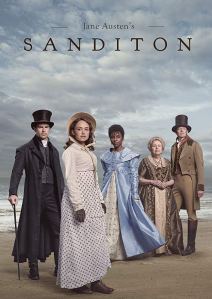
My Year with Jane Austen: “Sanditon” [2019]

I could probably continue on an entire extra year reviewing various adaptations and interpretations of Jane Austen’s works. There are plays, spin-off books, modern adaptations, the list goes on and on. Every year it seems there is a new version coming out in some form or another and this last year was no exception. Not only did we get a new feature film of “Emma” but the BBC also released an 8-part mini series of Austen’s unfinished work “Sanditon.” So I wanted to briefly touch on my thoughts of both those and to add in one other adaptation that has been a favorite of mine for quite a while, “Death Comes to Pemberley,” both the book and the 3-part mini series.

Mini-Series: “Sanditon”

I promise I’ll leave a positive review for one of these “extra” Jane Austen reviews that I’m doing in January. Alas, like “Emma” [2020], this is not one of them. Unlike “Emma,” however, I am more in-line with the general reception of this mini series. All and all, I think most Jane Austen fans were supremely disappointed by it, not least because of how it ends. Let’s dive into my complaints, shall we?

(NOTE: There will be spoilers in this review.)

The whole thing starts from a false premise: that there’s even a story here to adapt. Austen had only written eleven chapters of this story before her death. For reference, Emma has fifty-five chapters, so by comparison, eleven chapters is only scratching the surface of whatever story Austen had in mind. All we really get from these opening chapters is the introduction of our heroine, Charlotte, her relocation to an up-and-coming beach town called “Sanditon,” and the arrival of a potential love interest in the form of the fashionable Sidney Parker. Story-wise, it’s not much. There are the typical cast of side characters as well, but not much as far as clues to Austen’s overarching plot or themes. In most ways, she’s just finished setting the scene and not much else. It was always going to be a fool’s errand to try to expand that out into a mini series and to call it a “Jane Austen adaptation” is really pushing the limits of that term.

Perhaps in the right hands a compelling story could have been made. But sadly, this mini series ain’t that. It falls into too many traps that many modern adaptations risk and, at its heart, seems to miss the overall tone and heart that makes up all Jane Austen stories. To most fans’ chagrin, the story succumbs to the inane need of modern series to be “gritty” and “push the limits.” There are overtly sexual scenes in the very first episode (some of them even bizarrely going a very “Game of Thrones” route, none the less…). And many, if not most, of the characters introduced are supremely unlikable. For some reason, it seems that many directors and screenwriters often confuse writing a character with layers and depth with just writing supreme jerks, and we see plenty examples of it here. The romantic interest is immediately an a-hole to Charlotte, and not in the endearing, prideful “Darcy-esque” way that is the only acceptable form of this behavior in an Austen story.

Gone is the joy. Gone is the wit. And, worst of all, gone is the happy ending. It seems as if the director intentionally ended the series this way in a fit of over-confidence that the series would be picked up for a second season. Indeed, this is the only acceptable reason for ending an Austen story this way. There are plenty of historical fiction stories to be told where the happy, romantic conclusion is not a given. But those are not the stories that Austen wrote. She even said it herself, “let other pens dwell on guilt and misery.”

Every Austen fan who went into this series happily hoping to get one last shot at a new Austen story would have had this one, simple expectation: that the hero and heroine would end up together and happy at the end. Whatever happened from the start to the finish was open for exploration and interpretation. But this ending was a must. Instead, the series not only denies our hero and heroine this happiness, but it essentially resets the story by sending Charlotte back home where her future is once again limited and likely dull. I’ll be blunt: this ending is inexcusable for a Jane Austen adaption and, apart from any other stumbling blocks (of which there were many) would be enough to write this entire thing off on its own.

Unlike “Emma,” which I think I disliked for fairly subjective reasons but is sure to please many fans, this mini series really has nothing to recommend it, as far as I’m concerned. Perhaps for general historical fiction fans it would be an ok watch. But any fan of Jane Austen should simply steer clear, as “Jane Austen” this is not.

Kate’s Review: “Flamer”

Book: “Flamer” by Mike Curato

Publishing Info: Henry Holt and Co. BYR-Paperbacks, September 2020

Where Did I Get This Book: I own it.

Book Description: Award-winning author and artist Mike Curato draws on his own experiences in Flamer, his debut graphic novel, telling a difficult story with humor, compassion, and love.

I know I’m not gay. Gay boys like other boys. I hate boys. They’re mean, and scary, and they’re always destroying something or saying something dumb or both.

I hate that word. Gay. It makes me feel . . . unsafe.

It’s the summer between middle school and high school, and Aiden Navarro is away at camp. Everyone’s going through changes—but for Aiden, the stakes feel higher. As he navigates friendships, deals with bullies, and spends time with Elias (a boy he can’t stop thinking about), he finds himself on a path of self-discovery and acceptance.

Review: I never did the whole summer camp thing as a kid. As far as I got was the YMCA Day camp program, but I was such an anxious kid with separation anxiety issues like whoa, overnight sleep away camp was NEVER going to work. I do feel like I missed something, especially since my sister did do one and really enjoyed it. So I do like reading stories that take place at summer camp. I stumbled upon “Flamer” by Mike Curato on Goodreads, and the themes sounded very much in my wheelhouse.

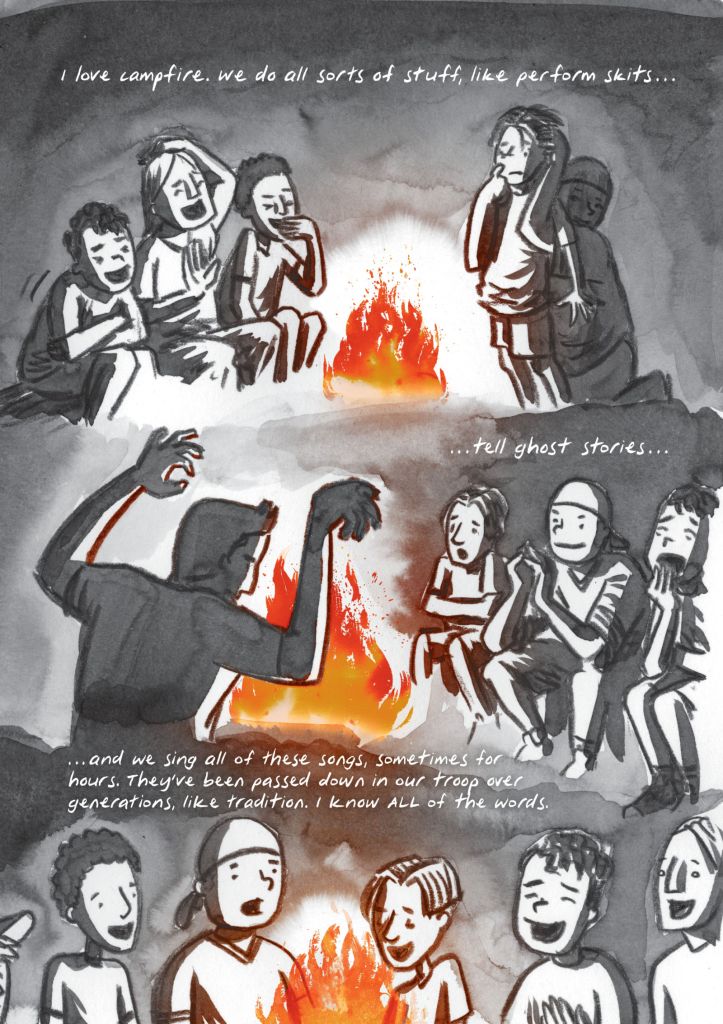
In some ways, “Flamer” feels a bit like the graphic memoir “Honor Girl” in that it has a teenager at camp struggling with their sexuality in the mid 90s. But for me the difference is that Aiden, our main character and fictionalized portrayal of Curato, has a lot more self loathing and and a lot more fear about his sexuality. Aiden is an outsider already, in that he’s bi-racial, he’s on the chubbier side, and he’s an easy target at his middle school, as well as for his emotionally abusive father. So while he has usually felt like he fits in at Scout Camp, his burgeoning sexuality starts to drive his anxiety up, especially as the micro aggressions and flat out bigotry of the time start to become more and more apparent. The story is mostly the last week at Scout Camp, as his safe space starts to feel less safe, and he moves towards an unknown future of high school and self discovery. Curato doesn’t shy away from the ugliness that Aiden has to deal with, be it because of his heritage, because of how he presents as more femme than his fellow Scouts, and how these stresses and the bullying is taking a toll on him and driving him to dark places. Aiden could be a mirror for many kids who are dealing with their own identity discoveries, and how the world around them can make those discoveries hard. The cruelty isn’t limited to fellow Scouts, but also pops up with Leaders who seem supportive, but have their own prejudices that they are harboring and that aren’t as hidden as they may think.

There is also a prevalent theme about Aiden’s Catholic Faith, and how he has always been drawn to certain aspects of the religion and the rituals. I know VERY little about Catholicism, but I thought that Curato really evoked the appreciation that Aiden has, from being an Alter Boy to having a favorite Saint that he relates to, to the struggles he has with his sexuality because of what he believes his religion says about LGBTQIA people. It’s a really fine line that Curato walks in that he definitely condemns the bigotry of those who may practice the religion, but never points fingers at the religion itself, nor does he say that the religion is ‘bad’ in this situation. I think that it would be easy to either condemn the religion as a whole, or to let it and all of its adherents off. but Curato finds a balance in the middle, and it works very well, and makes some of the moments near the end of the story all the more heartbreaking and powerful.

Along with those aspects, Curato also has a great author’s note in the back, as well as a list of resources for kids who may be dealign with the same things that Aiden is dealing with. I love it when books do this, and it feels like a really great resource to have in this story in particular.

And finally, the art work. LOVED it. It’s black and white, but there are splashes of color, specifically those of reds, oranges, and yellows. All of those work for passion, for fire, for anger, for love, and it makes the moments they are used pop and all the more powerful.

“Flamer” is a bittersweet and hopeful graphic novel that I hope people get in kids hands. You never know who is going to need a story like this.

Rating 8: Evocative, emotional, and necessary reading, “Flamer” is a touching and hopeful story about learning to love and accept yourself.

Reader’s Advisory:

“Flamer” is included on the Goodreads lists “Summer Camp Teens”, and “Guides and Scouts”.

Find “Flamer” at your library using WorldCat, or a local independent bookstore using IndieBound!

Serena’s Rev-Up Review: “Graceling”

Book: “Graceling” by Kristin Cashore

Publishing Info: Harcourt, October 2008

Where Did I Get this Book: own it!

Book Description: Katsa has been able to kill a man with her bare hands since she was eight—she’s a Graceling, one of the rare people in her land born with an extreme skill. As niece of the king, she should be able to live a life of privilege, but Graced as she is with killing, she is forced to work as the king’s thug.

She never expects to fall in love with beautiful Prince Po.

She never expects to learn the truth behind her Grace—or the terrible secret that lies hidden far away . . . a secret that could destroy all seven kingdoms with words alone.

Review: I read this book right around when it came out and instantly loved it. I went on to re-read it a few times in the next couple of years. But as my list of re-read favorites grew and grew, after those first few years, I never got back around to this one. So now it’s probably been about ten years since I last read it. Then when I saw that Cashore was returning to her “Graceling” world after so many years with the release of “Winterkeep” later this month, I knew that now was the time and this was the perfect excuse! So in anticipation of this new book, I will be re-reading all three of the “Graceling” books that came before, starting out with this, the first and my favorite.

In a world dotted with individuals with extraodinary powers, marked by their duel colored eyes, Katsa’s unparalleled ability to fight and kill just about anything is frightening to the extreme. Not the least of all to her. Under the thumb of her cruel uncle the king, for years, Katsa has served as his unwilling enforcer. To protect her own sanity and the safety of those she can, Katsa’s also built up an underground life of small rebellions and resistence. During one of these missions she meets Prince Po, another Graceling and one who finally opens her eyes to the opportunities before her. When the two begin to uncover a lurking darkness in the far reaches of the kingdom, they set out to unravel an increasingly malicious tangle. And while they do, they begin to discover there is more to Katsa’s Grace than just killing after all.

There’s a lot to love about this book. I but I think most people can agree that one of its biggest selling points is its main character herself. I can think of a number of books that have attempted an all-powerful, badass female character like this before and bungled it up so badly that the book becomes practically unreadable. So it’s a testament to Cashore’s ability that her main character not only avoids pulling the book down with her but actually turns out to be one of its biggest selling points.

Katsa’s biggest strengths, her seemingly endless ability to excel at practically anything, is just what makes her such a challenging character to write. She arrives on page one seemingly capable of easily handling anything that the story throws out her. So where’s the plot to go? What type of development can you give a character like this? Well, instead of physical limitations, Cashore dives deep into the psychological damage and challenges that a character with these abilities would face. Katsa’s fear of her own strength hinders her ability to trust and form friendships, probably the low hanging fruit as far as personal struggles for this type of character goes.

But Cashore goes even deeper. Because Katsa operates alone so much of the time and has a deep-seated fear, verging on hatred, for herself, her interactions with those around her can be quite toxic at times. She’s rash and prone to striking out. She also struggles to recognize the limitations of others and will push people (and horses!) past their breakingpoint. From this starting point, Cashore weaves together a beautiful character arc that focuses on themes like trust, self-acceptance, and self-control. And throughout this all, Katsa’s very brashness and inability to pick up on the most basic of social cues makes her an incredibly endearing lead character.

Beyond Katsa, the story excels in several areas. While it takes a bit to get started, once it does, there are bunch of fantastic action set-pieces and challenges that are posed to our seemingly unstoppable heroine. And the story quickly moves past the more straightforward aspect of her Grace that would just be one fight scene after another. I also really like the romance in this story. Unlike a lot of other YA books, here the romance establishes itself about halfway through the book. Of course, as any romance novel author will tell you, getting your characters together is only half of the story, and I really appreciate that Cashore left room to dive into the later stages of a romantic storyline. Things like facing losses together, going through fights, figuring out how to be a couple while also maintaining your sense of individuality, making decisions about your future.

I also really like the villain we have here. The build up to the reveal successfully creates a lot of tension that is only compounded upon once the reader discovers what is really going on. The villain is also a great foil for Katsa, being appropriately powered but not in a way that feels like their abilities were created specifically with her in mind (a failing of many archvillains, in my opinion.) My only complaint is that there isn’t more page time with this individual. But, then again, given the nature of the villain, there’s not really a very good way to include more scenes with them that doesn’t hurt the story overall.

So, given my ravings above, it’s pretty obvious that I found this book just as enjoyable ten years later as I did the first time I read it. I’m excited to read the next two books as well since, unlike this one, I never re-read either of those and remember very little about them.

Rating 10: Definitely deserves its place in the YA fantasy ranks as one of the bests.

Reader’s Advisory:

“Graceling” is on these Goodreads lists: Best “Strong Female” Fantasy Novels and Magic, Adventure, Romance.

Find “Graceling” at your library using Worldcat!

Kate’s Review: “Concrete Rose”

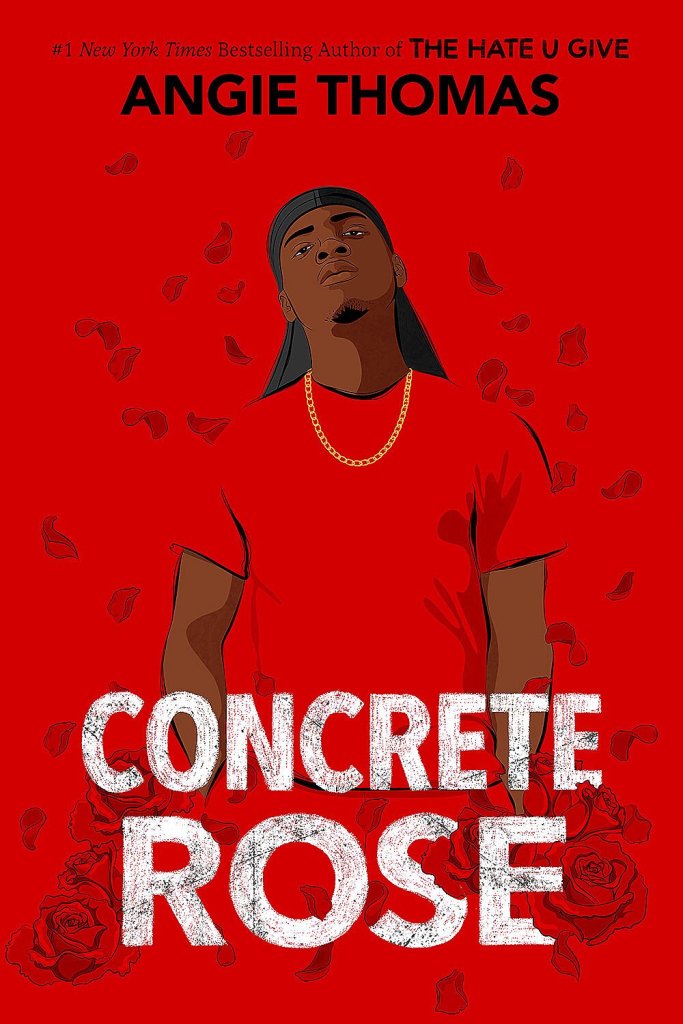
Book: “Concrete Rose” by Angie Thomas

Publishing Info: Balzer + Bray, January 2021

Where Did I Get This Book: I received an eARC from NetGalley.

Book Description: International phenomenon Angie Thomas revisits Garden Heights seventeen years before the events of The Hate U Give in this searing and poignant exploration of Black boyhood and manhood.

If there’s one thing seventeen-year-old Maverick Carter knows, it’s that a real man takes care of his family. As the son of a former gang legend, Mav does that the only way he knows how: dealing for the King Lords. With this money he can help his mom, who works two jobs while his dad’s in prison.

Life’s not perfect, but with a fly girlfriend and a cousin who always has his back, Mav’s got everything under control. Until, that is, Maverick finds out he’s a father.

Suddenly he has a baby, Seven, who depends on him for everything. But it’s not so easy to sling dope, finish school, and raise a child. So when he’s offered the chance to go straight, he takes it. In a world where he’s expected to amount to nothing, maybe Mav can prove he’s different.

When King Lord blood runs through your veins, though, you can’t just walk away. Loyalty, revenge, and responsibility threaten to tear Mav apart, especially after the brutal murder of a loved one. He’ll have to figure out for himself what it really means to be a man.

Review: Thank you to NetGalley for providing me with an eARC of this novel!

Back in 2019 when Angie Thomas’s “On The Come Up” made my Favorite Read list for the year, I promised myself that even though her genre isn’t usually one I cover, I would make exception for her books. Both that one and “The Hate U Give” made my lists, so when “Concrete Rose”, her newest novel, was announced I knew that it would be the first to keep the promise. I was STUNNED when I saw that it was available for request on NetGalley, but took advantage of that and downloaded it. We were finally going to get the backstory for Maverick Carter, Starr’s compelling father in “The Hate U Give”. And I was very interested to see where that backstory went.

While her previous works have tackled social justice themes and Black girlhood, “Concrete Rose” now has a focus on that of Black boyhood, and the difficulties it can entail in a racist society. When we met Maverick in “The Hate U Give”, he is a loving father and very well respected member in his community of Garden Heights. In “Concrete Rose” he’s seventeen, he’s a member of the King Lords (the gang his father was a high ranking member of), and he’s just found out that he’s the father of a three month old baby that had previously been believed to be his best friend’s (you may remember King from THUG). It’s a lot of change and a lot of pressure, and Maverick doesn’t know how to tell his girlfriend Lisa about the baby, and doesn’t want to sell weed anymore now that he is a father who needs to be there. Thomas, unsurprisingly, captures Maverick’s voice very well, as he feels like an authentic teenager who can make bad decisions, but has a lot of heart and determination. We also see the barriers that he has to face due to systemic and societal racism and the poverty that his community is dealing with. He wants to support his son, and stay in school, AND go straight so that he doesn’t end up like his own incarcerated father, but there are few opportunities, and dealing, though dangerous, feels like the only way to be successful. It’s a very empathetic look at why decisions are made to join gangs and to deal, as for Maverick, when things get really hard, it feels like the only support system he has. While I don’t think that it connected with me as much as THUG and “On the Come Up”, I do think that “Concrete Rose” will connect with other readers, especially boys who see themselves in Maverick.

In terms of being a prequel to “The Hate U Give”, “Concrete Rose” does stand well enough on its own. There are certainly a couple of references to the other book with characters and some other plot points that are mentioned, but if you go into this one without any knowledge you aren’t going to feel like you’re missing anything. I really like that Thomas decided to look more at Maverick, as he was definitely one of my favorite characters in THUG. I loved seeing Mav and Lisa’s relationship as well, as in THUG they are Starr’s parents, but in “Concrete Rose” they are a burgeoning teenage couple with ups and downs. As someone who used to dabble in fiction writing, and as someone who ALSO found herself wanting to go back and explore characters that were supposed to be supporting characters only, I definitely LOVE that we got to see Mav and Lisa go through these ups and downs with the spotlight on the two of them. Some reviews I’ve seen has questioned whether this love story needed to be explored, but so what if it didn’t ‘need’ to be? It’s a great story regardless of ‘need’.

“Concrete Rose” is another well done book by Angie Thomas, whose voice and skills are undeniable and so, so important to YA fiction right now. I’ll be curious to see what comes next. While I wouldn’t mind a whole new tale, this book proves that she could go back and explore other characters and give them rich and emotional back stories.

Rating 8: A heartfelt and emotional prequel to one of the most important YA novels of the 21st Century, “Concrete Rose” gives a great backstory to a compelling character.

Reader’s Advisory:

“Concrete Rose” is included on the Goodreads lists “YA Books for BLM Movement”, and “Contemporary Books with Black Leads”.

Find “Concrete Rose” at your library using WorldCat, or at a local independent bookstore using IndieBound!

Book Club Review: “Sailor Moon Eternal Edition (Vols 1 and 2)”

We are part of a group of librarian friends who have had an ongoing bookclub running for the last several years. Each “season” (we’re nerds) we pick a theme and each of us chooses a book within that theme for us all to read. Our current theme is “Outside the Genre Box”, in which we each picked a book from a genre or format that we don’t usually read.

For this blog, we will post a joint review of each book we read for book club. We’ll also post the next book coming up in book club. So feel free to read along with us or use our book selections and questions in your own book club!

Book: “Sailor Moon Eternal Edition (Vols 1 & 2)” by Naoko Takeuchi

Publishing Info: Kodansha Comics, September 2018/November 2018

Where Did I Get These Books: I own them.

Genre/Format: Manga

Book Description: The guardians in sailor suits return in this definitive edition of the greatest magical girl manga of all time! Featuring an extra-large size, premium paper, and an all-new translation and cover illustrations by creator Naoko Takeuchi!

Teenager Usagi is not the best athlete, she’s never gotten good grades, and, well, she’s a bit of a crybaby. But when she meets a talking cat, she begins a journey that will teach her she has a well of great strength just beneath the surface and the heart to inspire and stand up for her friends as Sailor Moon! Experience the Sailor Moon manga as never before in these extra-long editions.

Kate’s Thoughts

Though I have read some manga here and there and have watched a fair number of anime series (I actually just started watching “Death Note” for the first time, and I’m DIGGING it!), I never go into “Sailor Moon”. I had friends in high school who liked it, but by the time I did get into anime and ‘Magical girl’ stories, I pretty much just went with “Princess Tutu” and left it at that. So when our new Book Club session started up and one of our members wanted to read the first two books in “Sailor Moon”, I figured that now was as good a time as any to read one of the most influential Magical Girl mangas.

I think that had I been in a very specific time frame when reading “Sailor Moon” for the first time (perhaps after grade school but before I entered my ‘I’m not like other girls and too cool for girly shit’ punk and Goth phase in high school) I would have probably appreciated it more than reading it now. That isn’t to say that I don’t get why “Sailor Moon” is such a phenomenon. I liked the mythology of the Sailor Scouts, and I liked how we slowly got to meet each one and the different things that they all bring to the table. I also can tell that there is a LOT of mythology we haven’t even gotten to yet, and that as Usagi and her friends/teammates go forward there will be a lot more to learn regarding their identities, how Tuxedo Mask (the mysterious love interest) fits into it all, and how Usagi will balance this with her normal life as a teenage girl. In the first volume there is a lot of this kind of set up, while the second volume there is more solid adventuring and conflict that escalates. It was also pretty neat to see that things weren’t afraid to get dark as the plot arcs went on in Volume 2, and there were some pretty high stakes involved for Usagi and the others, as well as some legitimate peril to wrangle with. But at the end of the day Usagi herself was hard to connect with because there is a lot of effort to make her super imperfect to contrast with the amazing Sailor Moon alter ego that she has inside of her. But at the end of the day, these stories are not written for me as the intended audience, and because of that this is definitely a ‘your mileage may vary’ situation, as I DEFINITELY get the appeal in theory. Just not in my own practice.

I now feel like I have a better understanding of a story that has a very firm and well earned place in pop culture. It may not be for me, but I love that it is a story for teenage, fantasy loving girls who want their own kind of power fantasy. My hat does off to that and to them.

Serena’s Thoughts

Unlike Kate, I did read a lot of magical girl fantasy right around when this was coming out. But, unlike Kate in general, I’ve never really gotten into reading Manga or graphic novels much at all. As an adult, I’ve discovered more graphic novels that I enjoy, but it’s still not a go-to type of reading for me, even within my preferred genres. And as a middle school girl, I think I just associated any/all graphic novels with comic books and filed them away under “boring boy stuff.” I went on to have a complicated relationship with “Sailor Moon” in high school due to my on again off again boyfriend’s love of the series and my suspicion that he only wanted to date me initially based on my name being the same as the Americanized version of the main character’s. I was pleased to find that on reading the series now the main character’s name has been reverted back to the original, thus reducing my flashbacks to teenage years and highschool love letters between Serena and “Tuxedo Mask” (yes, he would sign off like that!)

With that little jaunt down memory lane out of the way, I had a lot of similar impressions to Kate. I can definitely see the appeal of this story and understand how it came to have such a far-reaching fanbase. The characters are all intriguing, the magic is fun, and the story is willing to engage with some darker themes. It also has much of the drama and awkwardness that teenagers enjoy, with Sailor Moon’s teenage identity providing a stark contrast to her magical girl persona.

Like Kate said, the second volume had more to work with after the first one spent much of its time laying down the foundation for the series. But even in the second one, it was clear that the story was just scratching the surface of all the stories it wanted to tell with these characters. I was pleased to see it go a bit deeper than the first volume did.

Overall, this also wasn’t really my thing. But I think that’s probably mostly due to my age and my generally picky approach to graphic novels and Manga. I picked up a “Pride and Prejudice” Manga at ALA a few years ago, and even that wasn’t really my jam. So this one had a steep hill to climb. But I definitely see the appeal for fans of the format and fantasy lovers in general, especially teenagers.

Kate’s Rating 6: Definitely ground breaking and assuredly appealing to magical girl fantasy fans, but not really my cup of tea at the end of the day.

Serena’s Rating 6: Approachable and fun for those who fit its audience type; unfortunately that wasn’t me.

Book Club Questions

  1. Have you read any manga before this? If so, what manga have you read and how does it compare to “Sailor Moon”? If not, what did you think of this first foray into the format?
  2. What did you think of the structure of the story as a stream of consciousness path that Usagi is taking? Did you like learning things as she did, or do you wish there had been a more organic way to explore the mythology?
  3. Did any of the Sailor Scouts appeal to you more than the others? If so, who, and why do you think that is?
  4. What did you think of the relationship between Sailor Moon/Usagi and Tuxedo Mask?
  5. Which elements, if any, of the ‘magical girl’ genre did you find most appealing?

Reader’s Advisory

“Sailor Moon Eternal Edition” Vols 1 and 2 (in other formats) are included on the Goodreads lists “Magical Girl Manga”, and “Fandom Origins”.

Find “Sailor Moon Eternal Edition” Vols 1 and 2 at your library using WorldCat, or a local independent bookstore using IndieBound!

Next Book Club Book: “The Widows of Malabar Hill”

My Year with Jane Austen: “Emma” [2020]

I could probably continue on an entire extra year reviewing various adaptations and interpretations of Jane Austen’s works. There are plays, spin-off books, modern adaptations, the list goes on and on. Every year it seems there is a new version coming out in some form or another and this last year was no exception. Not only did we get a new feature film of “Emma” but the BBC also released an 8-part mini series of Austen’s unfinished work “Sanditon.” So I wanted to briefly touch on my thoughts of both those and to add in one other adaptation that has been a favorite of mine for quite a while, “Death Comes to Pemberley,” both the book and the 3-part mini series.

Movie: “Emma” [2020]

While I didn’t get to have the “in theater” experience that I wanted to honor the release of a new version of one of my favorite Austen books, I made quite sure to watch it as soon as possible at home. I had made sure to avoid reading any reviews or commentaries about the movie, though I did have the impression that it was generally very well received by Austen fans and the general public. So I went in optimistic.

Unfortunately, this one didn’t hit home for me. It wasn’t a complete flop by any means, and there were new interpretations and takes on the story that I genuinely appreciated. I thought it was really interesting how focused the movie was on the oddness of life for the super rich in this time period. We have Emma pointing out flowers to be cut by a maid following meekly behind her. And we even have Mr. Knightley, arguably the most self-sufficient character we’re given in the entire story, sitting around being intimately dressed by servants. It’s both incredibly awkward but also humorous in just how absurd it feels.

But I also really struggled with several aspects of this film. For one, I didn’t fall in love with the cast. Anya Taylor-Joy is clearly a talented actress, but for me, she came across as too cold for Emma. Because of Emma’s repeated mistakes and blunders, her immediate charm and appeal are crucial to forming a strong attachment between the audience and the character. For me, Taylor-Joy’s version was simply too aloof and distant-feeling to really capture that immediate sense of sympathy that is necessary to make Emma a character you want to root for. I also struggled with Johnny Flynn’s Knightley, though this was mostly because he simply looked to young and to close to Emma’s age more than anything having to do with his actual acting.

From there, I mainly struggled with some strange story choices that movie made. I didn’t like the weird scene after the ball where Knightley runs after Emma, seemingly on the verge of confessing feelings (feelings that she, too, seems to be expecting to hear about when waiting at home). It doesn’t go anywhere, but the scene itself really messes with the progression of this relationship as it implies that Emma is aware of Knightley’s feelings (and returns them to some extent) much earlier in the story. Plus, Mr. Knightley may be an active sort of gentleman, but he doesn’t literally run around town chasing after a woman.

I also really didn’t like the final romantic scene with the nose bleed. This movie was largely praised for how comedic it was, but this scene highlighted just how wrong I think this approach was. Yes, “Emma” is a comedy and any good adaption will hone in on the humorous aspects of the story. But what I absolutely DON’T want is to have that humor intrude on and break up the big romantic climax of the story. The tone during this scene is all over the place and seems to be deliberately cutting the legs out from under the romance that is supposed to be the culmination of a slow build developed throughout the entire movie up to this point. It was incredibly frustrating and resulted in me ending the entire movie with a fairly sour taste in my mouth.

My husband actually really likes “Emma,” (the 2009 version, at least) so there’s a good chance I’ll end up re-watching this version with him at some point. I’m curious to see if my experience of the film will be different with my expectations set a bit lower. I don’t see it ever replacing my beloved 2009 version, but I’d like to see if I can discover what appealed to so many others with a re-watch. If you enjoyed it, please share your thoughts in the comments (or if you didn’t like it, too, of course!)

In two weeks, I’ll review “Sanditon.”

Kate’s Review: “Harrow Lake”

Book: “Harrow Lake” by Kat Ellis

Publishing Info: Dial Books, August 2020

Where Did I Get This Book: Ebook from the library!

Book Description: Things I know about Harrow Lake: 1.It’s where my father shot his most disturbing slasher film. 2.There’s something not right about this town.

Lola Nox is the daughter of a celebrated horror filmmaker–she thinks nothing can scare her.

But when her father is brutally attacked in their New York apartment, she’s quickly packed off to live with a grandmother she’s never met in Harrow Lake, the eerie town where her father’s most iconic horror movie was shot. The locals are weirdly obsessed with the film that put their town on the map–and there are strange disappearances, which the police seem determined to explain away.

And there’s someone–or something–stalking her every move.

The more Lola discovers about the town, the more terrifying it becomes. Because Lola’s got secrets of her own. And if she can’t find a way out of Harrow Lake, they might just be the death of her.

Review: Even though I generally have my finger on the pulse of upcoming horror fiction, it does happen that I miss titles here and there. Because of that, I like to see various lists of horror and thriller titles that are in the pipeline. “Harrow Lake” by Kat Ellis ended up being one of those titles, as I hadn’t heard of it before I saw it on a YA horror list. I was rather bummed that I missed it, as the elements of a slasher movie, a secretive small town, and an urban legend check a lot of boxes for my horror fiction jollies. Luckily the wait wasn’t too long for the eBook hold list, and I got “Harrow Lake” in a timely manner.

As mentioned, “Harrow Lake” has a lot of potential when it comes to hitting many a thing that I like in horror fiction. Our protagonist, Lola, is the daughter of a notorious slasher film director, so we get a fun and extensive look into a fictional filmography of splatter gore flicks that sound like a hoot. We also have the small town of Harrow Lake that has some strange inhabitants, a reputation because of the movie Lola’s Dad filmed there (where he met her mother, who disappeared from her life when she was little). The eeriness of the town was palpable and built slowly, which was a nice way to build unease as well. The biggest factor in the strangeness is the urban legend of Mister Jitters, a being that sounds like he has chattering teeth and who keeps haunting Lola at every turn as she finds herself stranded in Harrow Lake with her maternal grandmother after her father is attacked and hospitalized. I loved the lore of Mister Jitters, the kind of small town monster story that I never got to experience as a child given my upbringing in a bustling urban area, and I thought that Ellis really captured it well. Her writing style was also interesting, giving me a good feel for the town itself and the reasons why it was the way it was.

But as the book kept going, it became pretty clear that “Harrow Lake” wasn’t living up to the potential that was oozing from its description. Lola is an unreliable narrator in a lot of ways, but I didn’t really find myself connecting with her even as the story went on. It does start to make sense as to why she is the way that she is, but even that reveal and explanation didn’t quite make up for a cliched personality and uninteresting characterization. The ways that her background was slowly pulled out felt a little garbled in some ways, with the sudden appearance of an imaginary friend feeling abrupt while other ways that addressed her mental state not feeling well explored. I could see a few of the twists coming from a mile away, and there were a few plot points that built up mysteries that didn’t really pay off for me. And I don’t want to spoil anything for those who do want to go on and read it, but let’s just say that Mister Jitters didn’t live up to all that I had hoped for him. Ultimately the pay off wasn’t that scary, and I had gone in with high hopes of urban legend scares.

At the end of the day, I felt like there were a lot of missed opportunities in this book, and that was really too bad. It may be that this book will connect with other people who give it a try, but for me it was a bit of a miss. I could see myself trying again with Ellis as her writing style was intriguing, but this one didn’t work.

Rating 5: There was a lot of interesting potential here, but “Harrow Lake” never quite clicked with me.

Reader’s Advisory:

“Harrow Lake” isn’t on many specific Goodreads lists, but it would fit in on “Small Towns with Secrets“.

Find “Harrow Lake” at your library using WorldCat, or a local independent bookstore using IndieBound!