Kate’s Review: “Linghun”

This post may contain affiliate links for books we recommend.  Read the full disclosure here.

Book: “Linghun” by Ai Jiang

Publishing Info: Dark Matter INK, April 2023

Where Did I Get This Book: I received an eARC from the author.

Where You Can Get This Book: Amazon | Dark Matter INK

Book Description: WELCOME HOME.

Follow Wenqi, Liam, and Mrs. in this modern gothic ghost story by Chinese-Canadian writer and immigrant, Ai Jiang. LINGHUN is set in the mysterious town of HOME, a place where the dead live again as spirits, conjured by the grief-sick population that refuses to let go.

Review: Thank you to Ai Jiang for sending me an eARC of this novella!

I had been seeing “Linghun” on my social media feeds on and off before it ended up in my inbox, and there was a lot about it that caught my eye. The cover design was one aspect, as was the promise of a Gothic horror story. But it wasn’t until I really dug into the first few pages that I realized that “Linghun” was not only going to be a creepy Gothic horror story, but also a very emotional exploration of grief. I love a story like that, but I also have to steel myself for a story like that. And boy oh boy was it not pulling any punches. I love a ghost story that can take on deeper layers, and this one is less about the ghosts and more about the people who are aching to see those ghosts again.

Man did this one really get to me. It’s not a particularly long book, definitely novella status not even clocking it at one hundred pages, but in those pages Jiang has crafted such a bleak, disturbing, and haunting tale about how grief can drive people to completely upend their lives if there is just ONE chance of getting to reconnect with a dead loved one. This is mostly through the eyes of Wenqi, a Chinese Canadian teenage girl whose family left China after the death of her older brother when he was six and she was three. Her mother, so consumed by her grief, convinces her family to move to HOME, a weird small town where people’s dead loved ones can manifest in one of the much sought out houses (so sought out that other people, called lingerers, camp out in hopes of securing an open home). Wenqi never knew her brother, but at the same time he is all she’s known because her mother has been so unable to process her grief and move on, that Wenqi is just an afterthought. Watching Wenqi have to become even more and more of an afterthought as her brother’s presence appears, and her mother is only interested in trying to keep his presence around, is heartbreaking for Wenqi, and very, very distressing to watch unfold as her mother becomes more and more obsessive and overcome.

And then on the flip side is Liam, a teenage boy in Wenqi’s neighborhood whose family has been a group of lingerers, desperate to get a house in HOME and who have stopped their lives and have resorted to camping out and hoping for a stroke of luck. Liam and Wenqi have similar frustrations of being the ones emotionally left behind while their parents are in deep grief, but it’s interesting seeing Liam on the other side of the coin, as his family is desperate to even have the opportunity, when it is not even a guarantee that they will have success. It was the portrayals of the lingerers that really messed with my head, as Jiang has one scene in particular that shows the lengths that the lingerers will go to try and have the chance to see those they loved again, even when it has all but ruined their lives and the lives of those that they brought with them. BUT AT THE SAME TIME, part of me wonders what I would do should I lose someone I love so fiercely and maybe have that opportunity. How far would I go? It’s a path I don’t want to think about too much. Which means it is SO PERFECT for a horror story.

“Linghun” is an effective and very eerie novella that is up there with other meditations on grief with a horror backdrop. If that kind of not so cheerful premise is your jam, this is a story you definitely need to check out.

Rating 8: A strange and melancholy story about grief and loss and how it can cling to a person until obsession has taken over.

Reader’s Advisory:

“Linghun” isn’t included on any Goodreads lists yet, but I think that similar horror stories about grief like “Pet Sematary”, “Ghost Eaters”, and “Horns” would be good fits.
Kate’s Review: “The Whispering Dead”

This post may contain affiliate links for books we recommend.  Read the full disclosure here.

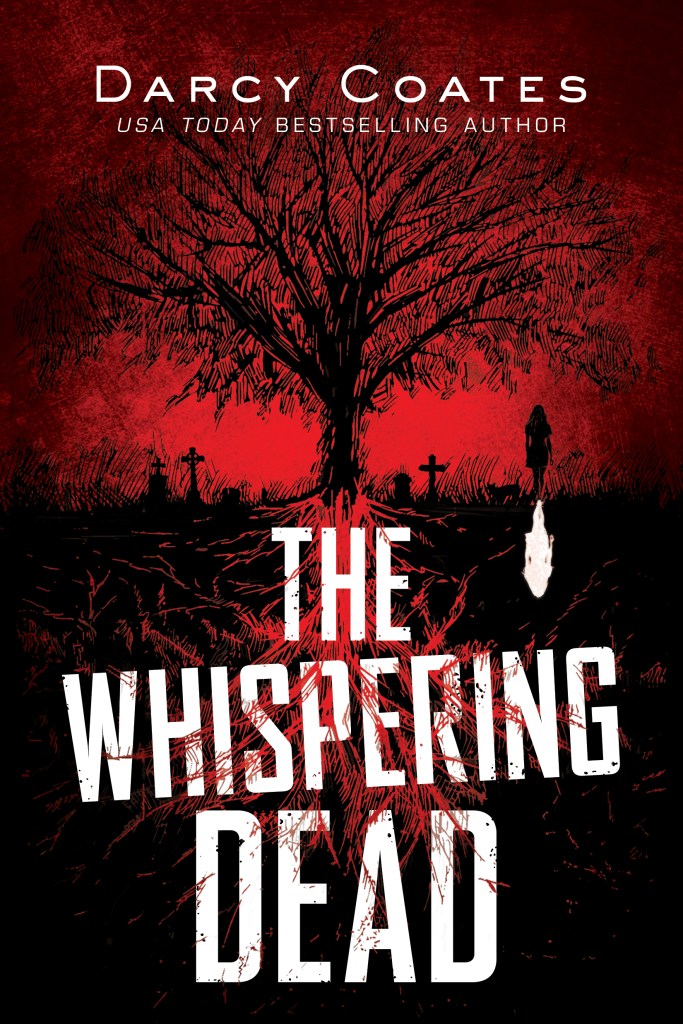
Book: “The Whispering Dead (Gravekeeper #1)” by Darcy Coates

Publishing Info: Poisoned Pen Press, May 2021

Where Did I Get This Book: I received a paperback copy from the publisher.

Where You Can Get This Book: WorldCat | Amazon | Indiebound

Book Description: Homeless, hunted, and desperate to escape a bitter storm, Keira takes refuge in an abandoned groundskeeper’s cottage. Her new home is tucked away at the edge of a cemetery, surrounded on all sides by gravestones: some recent, some hundreds of years old, all suffering from neglect.

And in the darkness, she can hear the unquiet dead whispering.

The cemetery is alive with faint, spectral shapes, led by a woman who died before her time… and Keira, the only person who can see her, has become her new target. Determined to help put the ghost to rest, Keira digs into the spirit’s past life with the help of unlikely new friends, and discovers a history of deception, ill-fated love, and murder.

But the past is not as simple as it seems, and Keira’s time is running out. Tangled in a dangerous web, she has to find a way to free the spirit… even if it means offering her own life in return.

Review: Thank you to Poisoned Pen Press for sending me a copy of this novel!

Up until this point I had read two Darcy Coates novels, both of which were SUPER scary and unrelenting in their horror themes. So when Poisoned Pen Press approached me asking if I was interested in reading more of her work, I leaped at the chance to do so. So for the next few weeks I am going to read and review her “Gravekeeper” Series, which involve a young woman named Keira, who wakes up in a strange cemetery with no memory of who she is, and realizes that she can see ghosts. The first in the series is “The Whispering Dead”, and while I thought I knew what to expect from Coates, it caught me off guard with a difference in tone and imagery. And this is overall a good thing.

Being the first in the series, “The Whispering Dead” has to set the stage, and I thought that it did, for the most part. I did enjoy the ghostly heart of the story, as well as the mystery of why Keira is seeing the ghost of a forlorn woman that wanders the cemetery grounds she is now calling home, AND the mystery of who she is given her lack of memories before waking up in said cemetery. I’m so used to Coates having really scary moments in her books, so the more dark fantasy vibe of this one was a surprise, though it was definitely a welcome one. While there are certainly creepy and spooky moments, be it ghosts wandering a cemetery and looking through windows, or building suspense in seemingly abandoned buildings and landscapes, Coates has some horror-esque elements that are pretty accessible to not just die hard horror fans, but also those who may like ghost stories but perhaps not the really scary stuff that can come with it. I was pretty invested in the reasons as to why Keira can see ghosts, and why there is a specific ghost that keeps popping up and how that ties to the town’s history. I am also interested in just what the deal is with Keira’s memory loss, and who she was before she suddenly woke up with no recollections of who she is. This book lays a lot of groundwork, and my guess is that it’s going to be a multi-book arc.

And I also mostly liked the characters at hand. I’ve seen this series compared to the “Buffy the Vampire Slayer” Scooby Gang as well as other horror/dark fantasy friend groups, and I think it’s pretty accurate. Keira is a good leader/protagonist, and I also like seeing her growing friendships with med student Mason (who may also be a romantic interest? I’m on board!), and with Pastor Adage, who has let her take up residence in the abandoned cemetery groundskeeper cottage. There is also weirdo Goth girl Zoe, who I am warming up to for the most part, but the problem is that she is VERY much a conspiracy theorist and while I know it’s supposed to be kooky and charming, these days conspiracy theorists generally leave a bad taste in my mouth due to the Q stuff and a lot of the racist and anti-Semitic building blocks that create a lot of conspiracies. I don’t think Zoe is that at all! But it just feels a bit uncomfortable. OH, and there is also a cat named Daisy, and we all know how much I love a feline companion. Overall it’s a well rounded cast that complements the tone of the story, and I think it’s charming.

I will be going forth in the series, with “The Ravenous Dead” up next week. I am eager to see what more Keira finds out about her mysterious past, and what ghosts are in store for her visions and second sight. “The Whispering Dead” is a good start to a series I look forward to continuing!

Rating 7: A spooky set up to a series with a quirky cast of characters, “The Whispering Dead” is some horror lite and perfect for people who want to explore Darcy Coates without being scared out of their minds!

Reader’s Advisory:

“The Whispering Dead” is included on the Goodreads lists “2021 Horror Novels Written by Women and Non-Binary Femmes”, and “Bring On the Creepy!”.

Kate’s Review: “Lone Women”

This post may contain affiliate links for books we recommend.  Read the full disclosure here.

Book: “Lone Women” by Victor LaValle

Publishing Info: One World, March 2023

Where Did I Get This Book: I received an eARC of this novel from the publisher via NetGalley.

Where You Can Get This Book: WorldCat | Amazon | Indiebound

Book Description: Blue skies, empty land—and enough room to hide away a horrifying secret. Or is there? Discover a haunting new vision of the American West from the award-winning author of The Changeling.

Adelaide Henry carries an enormous steamer trunk with her wherever she goes. It’s locked at all times. Because when the trunk is opened, people around her start to disappear

The year is 1914, and Adelaide is in trouble. Her secret sin killed her parents, and forced her to flee her hometown of Redondo, California, in a hellfire rush, ready to make her way to Montana as a homesteader. Dragging the trunk with her at every stop, she will be one of the “lone women” taking advantage of the government’s offer of free land for those who can cultivate it—except that Adelaide isn’t alone. And the secret she’s tried so desperately to lock away might be the only thing keeping her alive.

Told in Victor LaValle’s signature style, blending historical fiction, shimmering prose, and inventive horror, Lone Women is the gripping story of a woman desperate to bury her past—and a portrait of early twentieth-century America like you’ve never seen.

Review: Thank you to One World for sending me a link to an eARC of this novel on NetGalley!

Rejoice, horror fans, for we are once again blessed with a stunning new horror story by Victor LaValle. It has been awhile since I’ve dived into a LaValle book, and I was very, very stoked when “Lone Women” ended up in my inbox. And I was even MORE thrilled when Book of the Month had it as a choice for March, because I DO LOVE A PRINT COPY OF A GREAT HORROR NOVEL! I had high expectations for this novel, following a Black woman named Adelaide who decides to try and homestead in Montana in the early 20th Century, and who has a mysterious steamer trunk she just needs to keep an eye on and keep closed. Because that premise alone is VERY enticing, and when you throw in LaValle, you know it’s going to be even moreso. This man knows how to craft a well done horror tale with lots of subversions, after all.

I can’t really talk too much about the horror aspects of this novel, as I really don’t want to spoil too much because I do think that part of the appeal is the slow reveal and the surprises that come with it. What I will say is that LaValle has once again taken something that we’ve seen before, but turned it on its head and made it feel fresh, unique, and tragic on top of the scary. Adelaide is running from a violent moment that has changed the course of her life, and she is bringing with her the literal baggage that comes with that violent moment, and we have no clue as to what it is. But what we do know is that she is desperate to keep that baggage contained, whether it is the actual bag that she has brought with her, or the trauma that has been inflicted upon her and her family due to the circumstances that fell upon them all. I loved the slow tension of the trunk with the lock, and I also loved the slow burn horror elements that were more steeped in realism. I was just as nervous of Adelaide when she was surrounded by suspicious people whose motives we had no clue about as I was worried about just what it was that she was lugging around in the trunk. And I REALLY loved what exactly it was what was in said trunk, as it reminded me of a specific story that I had enjoyed at one point, but have turned my back on as of late due to questions of ethical consumption of it. And that’s all I will say.

And I won’t tell so as not to ruin it. (source)

But it is also the very gritty and realistically bleak historical fiction aspects of this book that jump off the page. LaValle weaves together a tapestry of not only the American imperialist ideals of Manifest Destiny, but also the way that the American Government would use this to its own advantage, and how it could appeal to a group of Othered women. Whether it is Adelaide due to her race as well as her horrific burden, or neighbor Grace and her son Sam who are functioning as a single mother and child trying to make it together, or Miss Bertie and Fiona Wong who are not only women of color but also two lesbians who have to hide who they are, the idea of being ‘lone women’ and trying to make a life in isolation, as well as while carrying various secrets that may keep them emotionally isolated, was profound as hell. The grim realities of trying to make it in an unfamiliar place with harsh winters, the danger of being a woman alone with strangers passing through, the way that the haves will try and take advantage of the have nots, all of it feels very real and unromantic takes on the idea of the West. This book absolutely feels like a Western, but it doesn’t make it seem like a charming simpler time you may find in a John Wayne movie. It highlights the misogyny, colonialism, and racism of that ideal. And I loved that.

“Lone Women” is another fantastic novel by Victor LaValle that takes on horror themes and tweaks them to feel more resonant and poignant than one may expect. I always love LaValle’s horror works, and this one is, I think, my favorite of the lot.

Rating 9: Breathtaking horror and gritty historical fiction rolled into one, “Lone Women” shows the tenacity of outsider women with secrets, some of which are otherworldly.

Reader’s Advisory:

“Lone Women” is included on the Goodreads lists “The Best Historical Horror Novels”, and “Horror to Look Forward To in 2023”.

Kate’s Review: “Codex Black (Book 1): A Fire Among Clouds”

This post may contain affiliate links for books we recommend.  Read the full disclosure here.

Book: “Codex Black (Book 1): A Fire Among Clouds” by Camilo Moncada Lozano & Angel Di Santiago (Colorist)

Publishing Info: IDW Publishing, April 2023

Where Did I Get This Book: I received an eARC from the publisher.

Where You Can Get This Book: WorldCat | Amazon | Indiebound

Book Description: Navigate through monsters, mysteries, and the will of the gods with two young extraordinary adventurers in fifteenth-century Mesoamerica as they search for a missing father.

Donají is a fearless Zapotec girl who, even though she’s only fifteen, is heralded as a hero by her village. In Codex Black, Donají sets out on an adventure–accompanied by the god that lives inside of her poncho–to find her missing father. Along the way, she meets an 18-year-old winged Mexica warrior named Itzcacalotl, and over time their temporary partnership blooms into an incredible friendship.

The search brings the young pair closer to danger and deeper into mystery than either could have predicted. What exactly was Donají’s father involved with? And how did a simple search for a missing relative lead Donají and Itzcacalotl into a fight with a terrifying bat monster to defend an entire village?!

Review: Thank you to IDW Comics for sending me an eARC of this graphic novel!

I told myself that I was going to try and do more graphic novels this year, as I felt like 2022 was a bit more sparse than it should have been. And with that goal I’ve found some pretty fun reads, some of which have been suggested to me or offered up, and were therein probably not been on my radar without the outside help. And that’s really worked out in my favor! The most recent of these is “Codex Black (Book 1): A Fire Among Clouds”, a young adult fantasy graphic novel that takes place in a pre-Columbian Mesoamerica, and involves two teenagers who have found themselves with magical abilities and powers. The premise alone sounded awesome, and when I saw the artwork I was even more eager to dive in!

“Codex Black: A Fire Among Clouds” is a really enjoyable first volume in the series. It has a lot it has to do in terms of setting up time and place, as well as a cast of characters, AS WELL as building a fantasy world within a historical context. We meet our two protagonists and see where they fit into the story, and Lozano does a great job of not only introducing them and making them connect, we also get a great sense for who they are. The first is Donají, a Zapotec teenage girl from a mountain village, is determined to find her father, a man who left their village and never returned, but did leave behind a poncho that houses the God Chicahualizteotl, who is there to assist her on her journey. The second is Itzcacalotl, a teenage Mexica boy who, while on a caravan with warriors, falls into a cavern and is gifted with crow wings. These two teens eventually come together and begin a journey of fantastical proportions, as Donají looks for her missing father and Itzcacalotl comes along for the ride and stumble upon thieves, monsters, and historical figures. I really loved both Donají and Itzcacalotl and their characterizations, and how Lozano slowly peels back and explores their personalities, strengths, and flaws. Dojaní is feisty and strong willed, while Itzcacalotl is a bit more reserved but also very determined to prove himself, and together they make an endearing team. I loved seeing them start to realize the powers that they both are wielding, be it the protectiveness of Donají’s poncho or Itzcacalotl’s wings, and how they interacted with friends, foes, historical figures (like Cosijoeza, one of the last coquitaos of the Zapotec people), and monsters from Mesoamerican lore and myth.

But what stood out to me most in this graphic novel was the VERY well presented historical context and information that was provided at the back of the book. As a woman who went to an American high school at the turn of the 21st century, I have VERY little working knowledge about Mesoamerican/Pre-Columbian civilizations and cultures (outside of a grade school unit on the Mayans). I’ve learned bits here and there through other books I’ve read, but it’s not extensive. So I LOVE that Lozano has such a great, accessible, and thorough historical notes section at the end of the book. It talks about the various myths of these different groups of people, and also gives historical notes and context to the events that were going on in Mexico during the time of this book before European imperialism started to take over. Given that I had been opening multiple tabs on my browser to look up some of this context, finding a good deal of it at the end of the PDF was really refreshing.

And finally, the artwork. I like Lozano’s style, with clear influence by manga and anime, with all the intricate details that harken to the cultures and styles of the people that the story is about. It’s varied and unique and I really liked it.

(Source: IDW Comics)

I will definitely be going forward in the “Codex Black” series. It’s so unique and filled with so much heart, I really can’t wait to see where it goes next.

Rating 8: Filled to the brim with fantastical mythology, engaging and well presented history, enjoyable characters, and lots of heart to spare, “Codex Black: A Fire Among Clouds” is a great introduction to a fun fantasy adventure!

Reader’s Advisory:

“Codex Black (Book 1): A Fire Among Clouds” would fit in on the Goodreads list “Mesoamerican Mythology in YA and MG Fiction”.

Kate’s Review: “Lore Olympus: Volume 3”

This post may contain affiliate links for books we recommend.  Read the full disclosure here.

Book: “Lore Olympus: Volume 3” by Rachel Smythe

Publishing Info: Del Rey, October 2022

Where Did I Get This Book: I own it.

Where You Can Get This Book: WorldCat | Amazon | Indiebound

Book Description: All of Olympus–and the Underworld–are talking about the God of the Dead and the sprightly daughter of Demeter. But despite the rumors of their romance, Hades and Persephone have plenty to navigate on their own.

Since coming to Olympus, Persephone has struggled to be the perfect maiden goddess. Her attraction to Hades has only complicated the intense burden of the gods’ expectations. And after Apollo’s assault, Persephone fears she can no longer bury the intense feelings of hurt and love that she’s worked so hard to hide.

As Persephone contemplates her future, Hades struggles with his past, falling back into toxic habits in Minthe’s easy embrace. With all the mounting pressure and expectations–of their family, friends, and enemies–both Hades and Persephone tell themselves to deny their deepest desires, but the pull between them is too tempting, too magnetic. It’s fate.

This full-color edition of Smythe’s original Eisner-nominated webcomic Lore Olympus brings Greek mythology into the modern age in a sharply perceptive and romantic graphic novel.

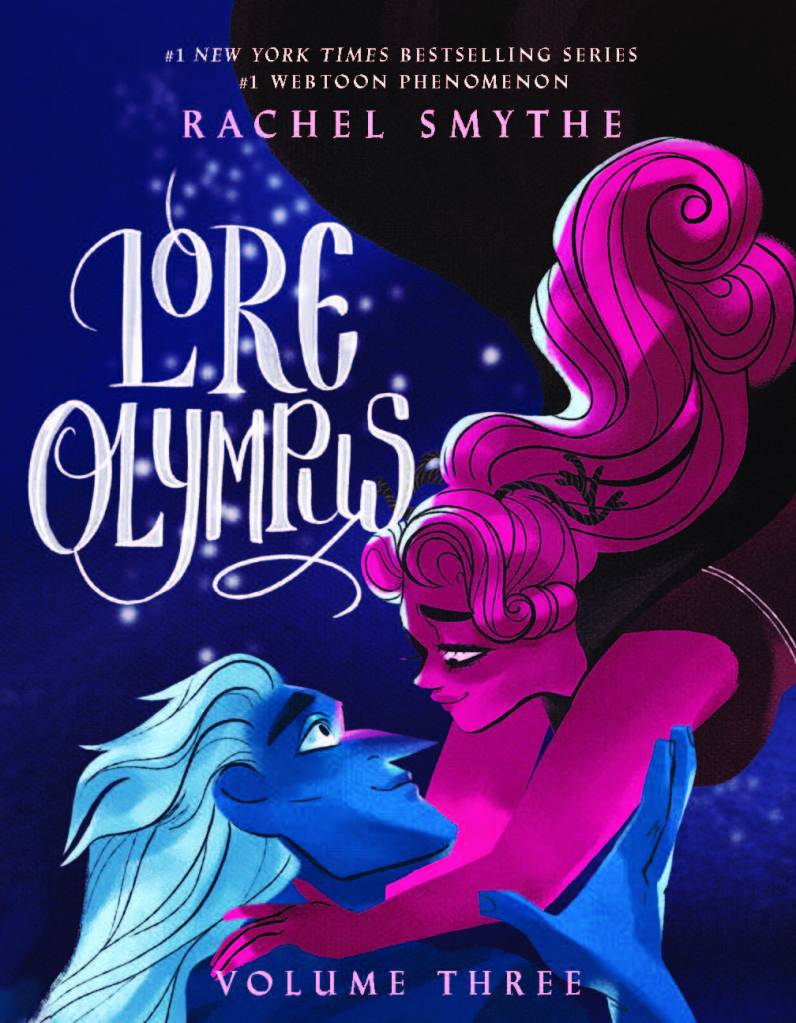
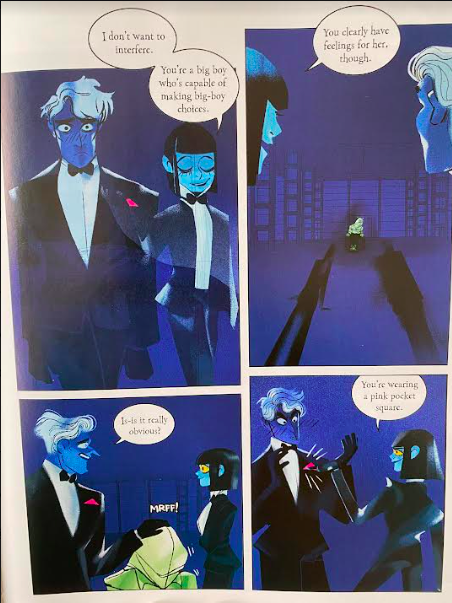
Review: We are back to my favorite deity filled soap opera/love story “Lore Olympus”, this time diving into the third volume. This story has been taking over our book club as almost everyone has at least started it, and I cannot stop fawning over it because of every single beat it hits that just work for me. And “Volume Three” keeps the streak going, as, once again, I loved this.

Now let’s get into why! THIS IS GOING TO BE LONG! (source)

Both Persephone and Hades have some huge emotional summits they are starting to climb in this volume, and it’s still fairly separate outside of them being at work in the Underworld together. As Persephone has started her first job, Hades is trying to remain professional and emotionally disconnected, and she is trying to find her footing while dealing with a lot of feelings she needs to sort out. We still don’t really know a lot about Persephone’s time in the Mortal Realm before all of this, all we know is that she has been given a scholarship by The Goddesses of Eternal Maidenhood to go study in Olympus so long as she commits to remaining celibate. We finally get to explore how she started this journey in this volume, as we see how she was approached by Hestia, how she got paired up with Artemis as roommates, and how she may be a little hesitant about the whole thing. But then there is something else that is being hinted at. Something about Persephone’s nature, and how there is perhaps something else that she is trying to leave behind, and how Demeter is trying to cover something up. Smythe starts laying out these clues in a more earnest nature this time around, with hints towards a more fiery temperament, hints towards Demeter changing her mind on a dime about Persephone’s place in the mortal realm, and hints about a destiny to be fulfilled. Seeing all of this in tandem with Persephone’s anxieties about fitting in at school, anxieties about working at a strange job, and anxieties about her crush on Hades makes for a VERY compelling character arc, and I just love what Smythe is doing with her.

Hades, too, is dealing with his own inner battles, mostly with trying to avoid Persephone as he feels like his feelings for her are inappropriate and that he’s reading far too much into it. So of course he’s decided to make it official with Minthe, the scheming and manipulative (but also very much hurting and damaged) nymph that works for him and has been is on again, off again girlfriend for a long time. But as Hecate finds more and more reasons to try and push him and Persephone together, he starts to wonder if perhaps he has a connection to her that has been in place even before he saw her at that party. Hades as a guy who is doing his best to not be a creep and doing his best to repress his feelings, because of his fear of hurting her but also because of a hinted at past trauma (if you know the broader mythology you can probably guess it), is a bit refreshing, as it puts a lot of the agency on Persephone, which is a VERY good thing in reimaginings of this tale. He also isn’t left totally off the hook when it comes to how he is probably using Minthe, while also conceding that in some cases BOTH parties can be very, very bad for each other. It all leads to a very heartbreaking sequence for the both of them. Arg, complexity when portraying the character getting in between my ship? How very dare you, Rachel Smythe?!

But the biggest stand out for me this volume was Eros. (There will be mild spoilers here because I need to spoil to talk about why I loved this!) Eros is a figure that happens to be at the center of my second favorite Greek Myth (that of him and Psyche), and while we are getting some hints that we are moving in that direction for his plot, his main function as of now is to be a kick ass and supportive friend to Persephone as she starts to come to terms with her rape by Apollo. I think that it would be an easy out to make Eros a very flamboyant and over the top romance fiend, because Eros, BUT Smythe instead makes him, yes, a bit of a drama llama, but also SO in touch with love and appropriate ways to show love and boundaries. His reaction to Persephone’s reveal was so, so perfect for the character, and it hit me right in the feels. We are also getting a little more insight into his own background and baggage, specifically about Psyche, and how something he did has put Aphrodite into a tenuous position, and it makes him all the more complicated and interesting. I just love the role he’s playing, and very much look forward to seeing his role continue to grow and evolve as the series goes on.

Oh and also there is a lot of interesting Hera stuff here too in that she knows that something happened to Persephone, she thinks she knows that Apollo is involved, and when she tries to investigate further Zeus decides to sweep it all under the rug because PATRIARCHY. I really love what Smythe is doing with Hera too, because again, she could have just been a shrewish wife to Zeus as she seems to be portrayed in the original myths. But in this we get to see why she is so damn frustrated and weary, and it’s because she is having to remain by the side of a man that she doesn’t REALLY like who won’t even give her a modicum of respect, or really any respect to ANY women. I’m always for calling out Zeus, but I especially love it when Hera gets leeway while still being complicated.

So obviously I’m still all about “Lore Olympus” and “Volume Three” is continuing the love. It’s just so well done. I’ve pre-ordered “Volume Four”, so you know that when it comes out this summer I will be back on my fan girl bullshit.

Rating 10: Oh be still my heart, so many feelings this time around. You’re killing me, Greek Gods and Goddesses! In the best, best way.

Reader’s Advisory:

“Lore Olympus: Volume 3” is included on the Goodreads lists “Greek Mythology Retellings!”, and “Hades and Persephone”.

Previously Reviewed:

Kate’s Review: “The London Séance Society”

This post may contain affiliate links for books we recommend.  Read the full disclosure here.

Book: “The London Séance Society” by Sarah Penner

Publishing Info: Park Row, March 2023

Where Did I Get This Book: I received an eARC from NetGalley.

Where You Can Get This Book: WorldCat | Amazon | Indiebound

Book Description: 1873. At an abandoned château on the outskirts of Paris, a dark séance is about to take place, led by acclaimed spiritualist Vaudeline D’Allaire. Known worldwide for her talent in conjuring the spirits of murder victims to ascertain the identities of the people who killed them, she is highly sought after by widows and investigators alike.

Lenna Wickes has come to Paris to find answers about her sister’s death, but to do so, she must embrace the unknown and overcome her own logic-driven bias against the occult. When Vaudeline is beckoned to England to solve a high-profile murder, Lenna accompanies her as an understudy. But as the women team up with the powerful men of London’s exclusive Séance Society to solve the mystery, they begin to suspect that they are not merely out to solve a crime, but perhaps entangled in one themselves

Review: Thank you to NetGalley for sending me an eARC of this novel!

I was very enamored with Sarah Penner’s previous novel “The Lost Apothecary”, as it told the story of women who had to take their lives and sense of justice into their own hands during a time when there were so few options granted to them should they be abused by powerful men. Talk about cathartic! So I knew that when she came out with a new historical thriller/mystery I would definitely want to check it out. You can probably guess that when I saw that her new book was called “The London Séance Society”, I was VERY excited. Not only was Penner doing another woman centric historical thriller with a feminist bent, but she was also maybe bringing in GHOSTS! Or at the very least the ideas of ghosts, mediums, and séances from the Victorian Spiritualism movement!

(source)

The thriller and dark fantasy elements of this book worked really well together, branching out from her previous genre that’s steeped in non-supernatural themes and doing so with success. I really loved the mystery as renowned medium Vaudeline and her apprentice Lenna are pulled into the mysterious death of Vaudeline’s friend Mr. Volckman, who was the head of the men’s only spiritualist group The London Séance Society, and how both women have their reasons for wanting to find the truth about him and his group. For Vaudeline, she is trying to keep the reputation of spiritualism untainted, and the LSS is rumored to be a bit suspect. For Lenna, it’s that her sister Evie (a former student of Vaudeline and aspiring medium) was murdered, and Lenna is trying to figure out what happened to her, while realizing that she, too, may have gifts that she doesn’t really believe in.

We had a couple perspectives, the first being a third person perspective of Lenna as she tries to solve her sister’s murder. Lenna is skeptical and grief stricken, but is also finding herself growing more attracted to Vaudeline as they prepare to conduct a séance with the LSS. The other perspective is that of Mr. Morley, one of the high ranking members of the LSS, and his is in the first person and generally in the past. With both these perspectives we get the pieces of the two puzzles, and we start to wonder who can be trusted and what is real and what is not. I did find myself questioning the motives and perspectives of a few of the characters, and I was surprised by a few of the reveals. It’s a well done mystery with some moments of true suspense, as well as some solid supernatural bits and elements that worked well. I liked Lenna enough, I REALLY liked Vaudeline, and most of the characters had interesting moments and felt pretty grounded in reality given the time, the place, and their motives. I also liked that from the jump we know that while Lenna is skeptical, Vaudeline has a very real gift and talent, and that the ghost aspects of this book were leaned into and made for an interesting fantasy angle.

I really do have to gush about the setting of this story, as the Victorian Era has something of a special place in my heart due to the fact I used to work as an interpreter in a Victorian mansion in St. Paul. Penner hits the nail on the head with the historical tidbits when it comes to spiritualism, séances, gender and class divisions, and superstitions of the time period, and uses it all to create a well conceived mystery with it’s fair share of timeless themes. I loved that our protagonists Vaudeline and Lenna are two women mediums who are trying to solve the murders of Volckman and Evie, but are coming up against a men’s only group that has taken the skills of women mediums, twisted them for monetary gains, and has banned women from the group altogether while creating fraudulent practices that endanger the reputations of real spiritualists like Vaudeline. I mean, how freaking typical (and also true! The LSS is based on the actual Ghost Club from that time period, and no, women were NOT allowed even thought it was women who were the pioneers of the spiritualism movement, fraudulent as it was). There is also a very handy historical note at the back of the book that puts a lot of this into context AND has recipes for a couple refreshments of the time period AND has a candle making guide! This is my total jam and it was a fun surprise at the end of the book.

I enjoyed “The London Séance Society”, and Sarah Penner has started a streak of engaging historical thrillers. I cannot wait to see what she comes up with next!

Rating 8: A compelling mystery that puts women mediums at the forefront and explores spiritualism, misogyny, and an obsession with the dead during the Victorian Era.

Reader’s Advisory:

“The London Séance Society” is included on the Goodreads lists “Bone Book Club” and “Can’t Wait Sci-Fi/Fantasy of 2023”.

Kate’s Review: “Piñata”

This post may contain affiliate links for books we recommend.  Read the full disclosure here.

Book: “Piñata” by Leopoldo Gout

Publishing Info: Tor Nightfire, March 2023

Where Did I Get This Book: I received an eARC from NetGalley.

Where You Can Get This Book: WorldCat | Amazon | Indiebound

Book Description: A Head Full of Ghosts meets Hereditary in Piñata, a terrifying possession tale by author and artist Leopoldo Gout.

Carmen Sanchez is back in her home country of Mexico, overseeing the renovation of an ancient cathedral into a boutique hotel. Her teen daughters, Izel and Luna, are with her for the summer, and left to fill their afternoons unsupervised in a foreign city.

The locals treat the Sanchez women like outsiders, while Carmen’s contractors openly defy and sabotage her work. After a disastrous accident at the construction site nearly injures Luna, Carmen’s had enough. They’re leaving.

Back in New York, Luna begins acting strange, and only Izel notices the chilling changes happening to her younger sister. But it might be too late for the Sanchez family to escape what’s been awakened

Piñata is a bone-chilling story about how the sinister repercussions of our past can return to haunt us.

Review: Thank you to NetGalley for providing me with an eARC of this novel!

I love it when a horror novel really gets under my skin. The kind that I can’t really shake while I’m reading it, and the kind that just sits on my consciousness when I’m doing other things or when I have finished it. When I saw “Piñata” by Leopoldo Gout on my various timelines and Goodreads feeds, I decided to request it because it sounded fairly promising. Sure, it was a possession story, which tend to be hit or miss for me, but I do love a good social commentary in my horror, and this one sounded like it had some good potential for thoughtful take downs of colonialism. So I started it, thinking it would be interesting at least. And almost immediately after starting this book, I was deeply, deeply unsettled, and knew I wasn’t going to shake this one for awhile. And it’s not even the supernatural beings in this that did that to me.

For someone who doesn’t usually gel with possession stories, “Piñata” is one of those stories that absolutely works for me because it makes it feel unique, or at least turns it a bit on its head. I really liked following Carmen and her daughters Izel and Luna as they spend time in Mexico, and I loved seeing the slowly building unease as Luna starts to behave strangely after an accident at the Church site on a restoration project that Carmen was working on. From Luna not quite acting right, to weird hallucinations of butterflies and a strange old woman, to ghastly imagery of rage filled demons that torment Carmen and those around her, Gout really knows how to create a visceral horror moment. I also loved the subversion of the more traditional Western possession stories and how it incorporates pre-Columbian folklore and mythology, as it feels less about the Christian idea of demons and more about otherworldly beings with a score to settle.

I’m still very much into reading horror novels that take on greater social themes, and “Piñata” may be one of the more harrowing and upsetting ones that I’ve read. The theme here is that of colonialism, and the way that Indigenous people in Mexico (and the greater Americas) were victimized, abused, and destroyed by Western invaders, and in this book it is specifically the Spanish and the Catholic Church. The prologue alone had me floored and shaking with abject horror and rage, as it really sets up the story of angry spirits in a Mexican church that find themselves awakened and hellbent on revenge. Gout doesn’t shy away from the atrocities that the Spanish and the Church perpetuated against Indigenous groups, and it makes for unrelenting horrors as we see the long lasting effects of the colonizers, not just through a possessed child but also through violence in Mexico, dangerous situations at the border, and racism and colorism. It’s upsetting and it should be upsetting.

The one thing that took me out of this book, however, was the uneven pacing of it. I love a slow burn and slow build in my horror, especially when the slow burn knows how to tap into anxiety and to ratchet up the tension until it is practically at the breaking point. I liked the way that Gout carefully builds up the tension regarding Luna’s possession as well as the visions that our characters are seeing. The problem is that when it all comes to a head, and a LOT has to come to a head, a great majority of it happens practically in the last fourth of the book. And it feels like a lot of whiplash as all the action starts to barrel forth and almost in an out of control way. It then leads to a wrap up climax that almost felt too quick on top of all the REALLY fast things leading up to it. It doesn’t ruin the story by any means, it just makes it feel disjointed.

Uneven pacing aside, I thought that “Piñata” was a disturbing read with a lot of really good themes about colonization and the damage it has done and continues to do. Gout just devastated me out the gate and found the horrors within history and applied it to a modern story, and I really enjoyed it.

Rating 9: So many intense moments and such great commentary about the destruction that Colonialism brought to the Americas. While there are some pacing issues, overall “Piñata” is scary and mesmerizing.

Reader’s Advisory:

“Piñata” is included on the Goodreads lists “Latinx Horror/Fantasy”, and “Men of Color Dark Fiction Writers”.

Kate’s Review: “The Girl from Rawblood”

This post may contain affiliate links for books we recommend.  Read the full disclosure here.

Book: “The Girl from Rawblood” by Catriona Ward

Publishing Info: Poisoned Pen Press, March 2023

Where Did I Get This Book: I received a print copy from the publisher.

Where You Can Get This Book: WorldCat | Amazon | Indiebound

Book Description: At the turn of England’s century, as the wind whistles in the lonely halls of Rawblood, young Iris Villarca is the last of her family’s line. They are haunted, through the generations, by “her,” a curse passed down through ancient blood that marks each Villarca for certain heartbreak, and death.

Iris forsakes her promise to her father, to remain alone, safe from the world. She dares to fall in love, and the consequences of her choice are immediate and terrifying. As the world falls apart around her, she must take a final journey back to Rawblood where it all began and where it must all end

From the sun dappled hills of Italy to the biting chill of Victorian dissection halls, The Girl from Rawblood is a lyrical and haunting historical novel of darkness, love, and the ghosts of the past.

Review: Thank you to Poisoned Pen Press for sending me a print copy of this novel!

Even though I hadn’t heard of Catriona Ward until I read “The Last House on Needless Street”, that was hardly her first literary and horror story rodeo. Her actual debut novel is “The Girl from Rawblood”, an award winning Gothic ghost story that is now being re-released. I was fortunate enough to receive a copy of the new edition just in time for an out of country trip that ended up with me sitting on an unplanned layover in Phoenix, as I needed reading material to get through the injustice of it all. I do love going back and seeing previously overlooked debuts of authors I like, as usually it’s fun to see the growth. Well in this case, there wasn’t much growth to be had, and I mean that in the good way. In many ways this doesn’t read like a debut, it reads like a seasoned Gothic author.

The brightest bit was the slow build up and world building of ‘her’, the curse that has been tormenting and killing the Villarca Family of Rawblood for generations. I love a rage filled ghost, and this one was giving me serious “The Haunting of Bly Manor” Lady in the Lake vibes. Ward really does have a talent for really freaky and tragic imagery in her stories, and I really liked just how creepy this curse was, mostly because we do get some is it real or is it not unreliability due to flashbacks of the frantic and frenzied Alonso, Iris’s father who has sheltered her in hopes of saving her, when his isolation of her seems just as terrible in her mind. In true Gothic fashion we are left to wonder if perhaps it’s Alonso’s madness due to generational trauma, romantic loss (more on that soon!) and grief that is the real culprit. But ah, this is Catriona Ward, so ultimately this is, indeed, a haunted house story. But there can be many hauntings, both of the past and ghostly kinds.

There is a lot of time jumping and historical fiction genre exploration in this as well, and that is ultimately what bogged the story down for me just a bit. Firstly, though, the good: I do love a historical Gothic novel with lots of melodrama and angst, and lord knows this book is frothing with it. This is Ward’s debut novel, and in a lot of ways it is a VERY impressive debut, as she has a lot going on and generally knows how to juggle all of it. But it is also a bit bloated, at least for me, in how much we are finding ourselves exploring. We have Iris’s story as she tries to push back against her father’s pleas to never fall in love, but we also go back to see Alonso and his medical school friend/forbidden love interest Charles try to approach this curse as though it is hereditary and more illness based, and see how their relationship grows and deteriorates and ends in, you guessed it, horrible tragedy. And THEN we also jump back to previous Villarcas and family members who have lived in Rawblood and the terrible fates that befell them, and I think that the out of order and abrupt jumps and shifts were a bit too jarring for me.

But having said that, it’s great that “The Girl from Rawblood” is being rereleased, because Ward was showing literary prowess with this as her debut, and prowess as a horror author at that. It all started here.

Rating 7: An eerie premise and an unsettling ghost story, “The Girl from Rawblood” is a chilling historical Gothic tale, though at times the jumps in time dragged a bit.

Reader’s Advisory:

“The Girl from Rawblood” is included on the Goodreads lists “Gothic Historical Fiction”, and “Dual Time Mysteries”.

Kate’s Review: “My Dear Henry: A Jekyll & Hyde Remix”

This post may contain affiliate links for books we recommend.  Read the full disclosure here.

Book: “My Dear Henry: A Jekyll & Hyde Remix” by Kalynn Bayron

Publishing Info: Feiwel Friends, March 2023

Where Did I Get This Book: I received an eARC from NetGalley.

Where You Can Get This Book: WorldCat | Amazon | Indiebound

Book Description: London, 1885. Gabriel Utterson, a 17-year-old law clerk, has returned to London for the first time since his life— and that of his dearest friend, Henry Jekyll—was derailed by a scandal that led to his and Henry’s expulsion from the London Medical School. Whispers about the true nature of Gabriel and Henry’s relationship have followed the boys for two years, and now Gabriel has a chance to start again.

But Gabriel doesn’t want to move on, not without Henry. His friend has become distant and cold since the disastrous events of the prior spring, and now his letters have stopped altogether. Desperate to discover what’s become of him, Gabriel takes to watching the Jekyll house.

In doing so, Gabriel meets Hyde, a a strangely familiar young man with white hair and a magnetic charisma. He claims to be friends with Henry, and Gabriel can’t help but begin to grow jealous at their apparent closeness, especially as Henry continues to act like Gabriel means nothing to him.

But the secret behind Henry’s apathy is only the first part of a deeper mystery that has begun to coalesce. Monsters of all kinds prowl within the London fog—and not all of them are out for blood

Review: Thank you to NetGalley for providing me with an eARC of this novel!

I first read “Strange Case of Dr. Jekyll and Mr. Hyde” in college in my favorite class of all time: “Monsters, Robots, and Cyborgs”. Thank goodness for an unofficial Cultural Studies and Comparative Literature minor! We looked at horror, fantasy, and science fiction stories of the past and present and what they said about cultural and societal anxieties, so of course “Jekyll and Hyde” is ripe for the picking. Think about it: a somewhat obsessive scientist creates a potion that can change him from mild mannered academic to a brutish, cruel, uninhibited psychopath, talk about a great way to talk about the complexities of humankind while creating a suspenseful mystery to explore that. So when I saw that one of the “Remixed Classics” books was going to take on this story, I was VERY excited to see how it was going to be reimagined with newer themes and a more diverse perspective for modern young adult audiences. Suffice to say, “My Dear Henry” by Kalynn Bayron was an anticipated read. And in a lot of ways it lived up to my anticipation.

Bayron reimagines the classic tale of a personified split identity and the calamities that follow, by making our protagonists Henry Jekyll and narrator Gabriel Utterson young adults, Black, and queer, and setting them in a Victorian London that will hold those identities against them. This was immediately resonant and very incisive, and it works so well for the themes of the source material while expanding upon them to make them even more complex. It’s especially clever because there are, indeed, questions as to Robert Louis Stevenson’s sexuality and whether these themes were also hidden in his original “Jekyll and Hyde” idea. To expand upon that and to make Hyde less of a symbol for the uninhibited ‘evil’ of man and instead to make it a symbol of uninhibited ability to be oneself is poignant as hell. As Gabriel and Henry are drawn to each other and fall for each other, the cultural mores at the time makes it so that they have to hide their feelings from others, and when they ARE found out it leads to the path of Jekyll to Hyde, and leads to lots of poignancy and pathos. It makes the “Jekyll and Hyde” story all the more tragic, as this Hyde isn’t a violent madman, he’s a manifestation of love that was criminalized and feared. And to make it even more complex, our main characters are Black, and having Black characters set in Victorian England is a great choice for a few reasons. The first is that it makes the marginalization of Gabriel and Henry even deeper, as the racism in English society has already made them vulnerable, just as it has made their fathers, especially Jekyll Sr. (as he is the one we see more of), all the more intent on stifling their sons because of their already targeted identities. The other is that it is so common to see Black narratives in this time and place ignored or questioned, as if Black people didn’t exist in England during this time period, so to counteract this erasure within this story was really, really enjoyable.

And since it is a remix of an old tale, I do want to talk about how effective of a retelling it was. And I thought that in a lot of ways it succeeded, and in a couple ways it didn’t quite capture it. In terms of successes, it does have the characters and the plot points of the original story, either tweaked, reimagined, or adapted to suit the newer narrative and thematic ideas, and it does this really well. You are definitely reading the Jekyll and Hyde story at the heart of the book, when I’ve seen adaptations that just slap on the idea of a reimagining without actually doing the work to make the new ideas coexist with the old. But I do think that one thing that did let me down about this book was that while it is definitely Jekyll and Hyde, it does give it a whole new flavor that kind of takes the suspense and thrills of the original out of it. It’s very possible that because this story is SO old hat that maybe there aren’t really ways to be held in suspense by it anymore, but I wonder if there could have been a way to make it feel like a thriller and to mine a new kind of suspense? I’m unsure.

Overall, I did enjoy “My Dear Henry” and I liked the directions that Bayron took this classic horror story of identity and repression. It’s an effective reimagining and brings out new ideas from a timeless tale.

Rating 8: A clever remix of “The Curious Case of Dr. Jekyll and Mr. Hyde” that takes on the dualities of identity in a society that doesn’t accept certain people for who they are, though it doesn’t capture the suspense that the original had.

Reader’s Advisory:

“My Dear Henry: A Jekyll & Hyde Remix” is included on the Goodreads lists “Black Queer 2023 Releases”, and “Jekyll and Hyde Retellings”.

Kate’s Review: “Lore Olympus: Volume 2”


This post may contain affiliate links for books we recommend.  
Read the full disclosure here.

Book: “Lore Olympus: Volume 2” by Rachel Smythe

Publishing Info: Del Rey, July 2022

Where Did I Get This Book: I own it.

Where You Can Get This Book: WorldCat | Amazon | Indiebound

Book Description: Persephone was ready to start a new life when she left the mortal realm for Olympus. However, she quickly discovered the dark side of her glamorous new home—from the relatively minor gossip threatening her reputation to a realm-shattering violation of her safety by the conceited Apollo—and she’s struggling to find her footing in the fast-moving realm of the gods. Hades is also off-balance, fighting against his burgeoning feelings for the young goddess of spring while maintaining his lonely rule of the Underworld. As the pair are drawn ever closer, they must untangle the twisted webs of their past and present to build toward a new future.

This full-color edition of Smythe’s original Eisner-nominated webcomic Lore Olympus features a brand-new, exclusive short story, and brings Greek mythology into the modern age in a sharply perceptive and romantic graphic novel.

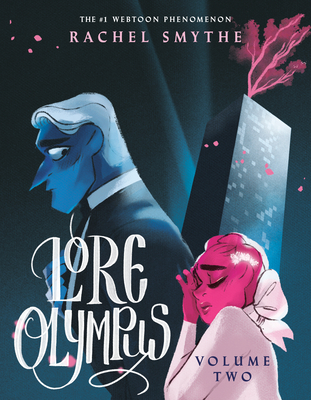
Review: We are back for more Greek Mythology soapy romantic goodness, everybody! It has been awhile since I have had a full blown content obsession, but “Lore Olympus” has really snagged me but good. Greek myths! Humor! A favorite ship! LOTS OF PATHOS! It all comes together in this series and we are starting to parse out the various complications that are facing Persephone, Hades, and more Greek Gods and Goddesses in “Volume Two”. Our star crossed would be lovers, Persephone and Hades, are trying to find their footing after their chance meeting has set them both a little off kilter, and while that could just be a lot of pining and wallowing in angst, Rachel Smythe takes the opportunity to build up more backstory and more characterization, and it is for the better. “Volume Two” is keeping the series going strong. But yes, there is still some lovely Hades angst, and given that I LOVE to be emotionally wrecked by fiction, I say bring it on.

SAD BOYS FOR THE WIIIIIIIN. (source)

One of the most rewarding things about “Lore Olympus” is that Smythe is taking her time to set groundwork, characterizations, and background. We start this volume off with Persephone starting her schooling with her scholarship from The Goddesses of Eternal Maidenhood while silently grappling with the sexual assault she endured at the hands of Apollo. She loves being away from her doting mother’s eyes, but given she’s drawn to Hades she is feeling that perhaps joining TGOEM isn’t what she really wants. Meanwhile, Hades is stewing about his feelings for her and trying to keep his distance, and to make matters worse a tabloid has shown innocuous pictures of them and spinning them to seem scandalous, which threatens Persephone’s reputation. Throw in Hera’s suggestion that Persephone take on an internship in the Underworld (as she secretly wants Hades to be happy and thinks that this would help that), and the two would be lovers are being shoved into some fun forced proximity!

But these very common tropes feel fun and new in this story, and it means that we can carefully explore their budding friendship while also exploring them as individuals who are dealing with a lot of baggage on their own. I thought that Smythe is really careful but also powerful when exploring the aftermath of Persephone’s rape, and does a good job of portraying the shame, the fear, and the apprehension, especially since her abuser is inserting himself in her life vis a vis his clueless sister Artemis, whom Persephone is living with. It’s tackled in a way that feels real, but doesn’t feel melodramatic or exploitative. I’m hoping that it stays that way and isn’t used for man pain or anything like that, but I trust Smythe to continue to be mindful. We also have a lot of other facets to Persephone’s growth as she tries to make sense of what she has been told she wants from life, and what she actually wants from life. There have also been hints about some darkness involving her backstory and her nature, which is VERY interesting to say the least…

Okay now we talk about what I loved most in this book. HECATE IS HERE!!! I’ve talked about how Persephone is my favorite Greek deity, and Hades is definitely number two? Well Hecate, the goddess of witchcraft, is third. I love Hecate. So I was very interested to see how Smythe depicted her, and I was NOT disappointed, as she is Hades’s COO and number two in command, who calls him out on all his nonsense and bullshit while trying to support him in other ways. She is THE BEST, and also very competent at keeping things in the Underworld running. In this the Underworld is a very necessary, non-evil place that has to be run efficiently, and having Hades and Hecate as co-runners feels very Eric and Pam from “True Blood” (without any of the clichéd longing on her part). It’s also really cool to see the depiction of the Underworld here, as we’ve seen the Mortal Realm as fields and vastness, and Olympus as an upperclass city scape. The Underworld feels a bit more hardboiled with a corporate undertone, and I love seeing how it is run, and how the various workers fit in, like Thanatos, who escorts souls to the Underworld, and Minthe the nymph (who just so happens to be in an on again off again/toxic relationship with Hades and she’s also kind of the worst but also seems pretty damaged so she isn’t just a girl to get in the way, HOW REFRESHING!).

And I’m still in love with the artwork. The designs of all these characters are perfection. I mean LOOK AT MY GIRL HECATE!

Source: Random House Worlds

I’m still obsessed with “Lore Olympus”. There isn’t much else to say, I’m head over heels.

Rating 9: Still loving this. What a fresh, soapy, emotional and sometimes hilarious take on Greek Mythology!

Reader’s Advisory:

“Lore Olympus: Volume 2” is included on the Goodreads lists “Greek Mythology Retellings!”, and “Hades and Persephone”.

Previously Reviewed: