
This post may contain affiliate links for books we recommend. Read the full disclosure here.
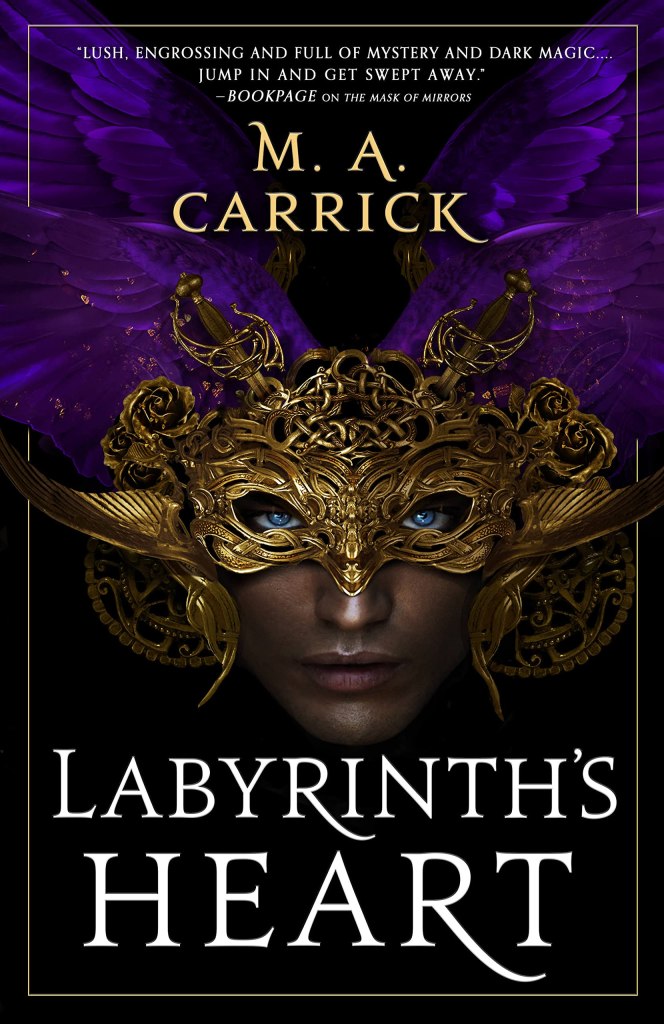
Book: “Labyrinth’s Heart” by M. A. Carrick
Publishing Info: Orbit, Aug. 2023
Where Did I Get this Book: from the publisher!
Where Can You Get this Book: WorldCat.org | Amazon | IndieBound
Book Description: Ren came to Nadežra with a plan. She would pose as the long-lost daughter of the noble house Traementis. She would secure a fortune for herself and her sister. And she would vanish without a backward glance. She ought to have known that in the city of dreams, nothing is ever so simple.
Now, she is Ren, con-artist and thief. But she is also Renata, the celebrated Traementis heir. She is Arenza, the mysterious pattern-reader and political rebel. And she is the Black Rose, a vigilante who fights alongside the legendary Rook.
Even with the help of Grey Serrado and Derossi Vargo, it is too many masks for one person to wear. And as the dark magic the three of them helped unleash builds to storm that could tear the very fabric of the city apart, it’s only a matter of time before one of the masks slips—and everything comes crashing down around them.
Previously Reviewed: “The Mask of Mirrors” and “The Liar’s Knot”
Review: This will be another tough review to write, but for different reasons than I usually experience. I’ve absolutely loved this trilogy so far. In hindsight, I almost want to go back and give both of the other books 10 ratings! They’re the kind of stories that have characters who stick with you, popping up in my mind long after I’ve turned the last page. So it’s a weird situation to now finish up the trilogy and…just like it, not adore it! The struggle in writing up my thoughts, then, is that I may come across as more critical than the book deserves on its own merits. It’s still an excellent book in the end!
I’ll start with the unequivocal good parts. The writing. Across the board, all three books have been so incredibly well written. Natural dialogue, vivid descriptions, and a steady hand at the wheel throughout, never losing a sense of tone or place, even while balancing a million characters, cultures, and magic systems. It’s even more impressive that two authors worked together to write this! It’s absolutely seamless, and I have to wonder how they even pulled it off.
Beyond that, the world-building continues to impress. This is a fully-formed world, complete with various cultures and peoples, all with long histories that we see impacting the choices made today. Further, there are no purely good or purely evil sides to many of the complicated situations that arise. The authors carefully navigate the concepts of necessary revolution while equally condemning wanton violence or the easy slip into simply swapping positions, leaving the wrong-doing still present, if now in different hands. Extremism is rightfully identified and denounced, no matter the histories involved, and instead a focus on working together and living alongside those who are different is clearly emphasized.
The story also started out just as strong as the rest. Indeed, for the first third of the book, I was convinced that this would also end up as a 9 or 10 level read for me. This section had all the hallmarks of what I loved from the first two books: a clever Ren, a morally grey Vargo, and an emphasis on characterization, giving the reader ample opportunity to see even small moments play out between all the characters we’ve come to love so thoroughly. It was only as the book continued that I began to have problems, and it really came down to two things: Ren’s character arc (to lesser extent, Vargo as well), and the attempt to wrap up every loose thread.
To tackle the characters stuff first, while the story started out strong, character-wise, as we got more into the thick of the resolutions to the various plot lines, the characterization began to fall through the cracks. I remember mentioning in my review of the second book that I was beginning to have minor quibbles with the character arch of Ren and Vargo, both having to do with the wavering of their characterization from the first book. Unfortunately, that was doubled-down on here. For his part, Vargo pretty much lost all of his moral ambiguity, instead reacting with nothing but love and understanding to almost every reveal sent his way. Which, sure, I want him to get all the found family connections he ultimately ends up with, but it was all just so…easy, no conflict to speak of.
For her part, Ren became the most special of all the special snowflakes by the end of this book. She was still a well-written character, unlike many characters who end up with this nickname given to them, but the problem remained. By the end of the book, a character joking introduces her listing off all the unique, important roles that she now inhabits. And while it’s played for laughs, it also unintentionally highlights the problem. Ren was at her best when she was a con woman, deftly navigating numerous roles and goals while also trying to balance the deeper feelings and connections she was developing with those around her. Here, after that first third of the book is done, we pretty much lose all of the cleverness or greyness of this character. Again, someone makes a joke at one point that Ren “saves the world through talking.” And it’s true! And that’s bad!! Especially because, for a character like Ren, if she was going to solve problems through talking, it should be through clever manipulation and schemes. Instead, the book devolves into numerous speeches about togetherness and understanding that miraculously solve pretty much every problem or conflict.
Further, some of the joy of the first two books was seeing Ren slowly learn to expand her understanding of family to characters like Vargo, Grey and the Traementis family. Well, here, that’s all blown out of the water by the absolute deluge of family units Ren finds herself apart of. The reason the ties between Ren, Vargo, Grey, and Traementis family worked was due to the sheer amount of page time devoted to developing them. These later connections don’t have that and also worked against these established characters, as we spent less time between the ones we care about, as Ren was overrun by the various family groups that now surround her.
And lastly, this book suffers from a severe case of “Return of the King” syndrome. You know what I’m talking about: a story that ends up with numerous, seemingly endless, endings. And here, it feels like the endings start up near the half way point! There was a lot that needed to be wrapped up in this book already. But the authors didn’t help themselves by adding new characters and new histories on top of what they already had to deal with.
Beyond that, there seemed to be an almost compulsive need to wrap up every ill that ever befell this world. And look, I don’t love grimdark fantasy, and I honestly think that the fantasy genre as a whole, and particularly epic fantasy, needs to come out of the haze inflicted upon it by “Game of Thrones,” the idea that a fantasy story isn’t “serious” if it isn’t full of horribleness and tragedy. So I applaud the authors for proving that this needn’t be the case.
Unfortunately, it feels like they went too far in the other direction! The main plots lines being wrapped up well? Great! But then it began to feel as if every character was being neatly paired up, every historical ill-doing was magically made right, and any point of character conflict was easily resolved with a few short words and a hug. And the magic system was totally abused in the service of this goal! Need some past wrong figured out? Something something magic! It all began to feel like too much. And with everything so, SO neatly resolved, it started to feel unrealistic, undercutting the real pain and heartache that was at the heart of all of the characters’ motivation, up to this point.
I think one of the strangest take aways from this book was the feeling that it was both too long and too short. Too long, because numerous scenes and plot points didn’t seem to go anywhere and could have easily been lifted (even while keeping the strong scenes between members of the core cast!). And too short because a full half of the book had to be devoted to wrapping up the entire trilogy with ending after ending coming in quick succession. Instead, had this been split into two books, some of these ending could have been dealt with in one book, leaving the others to the final book.
Wow, so this ended up being way longer than I had intended, but it turns out I had a lot to say! Overall, however, I still loved Ren, Grey, and Vargo. The love story between Grey and Ren is one of my favorites in a long time, and the writing across the entire trilogy was excellent. This one may trip a bit at the end, but it by no means undercuts the strength of the entire trilogy and my emphatic recommendation of it to all fantasy fans!
Rating 8: Too many endings and some wobbly characterization brought this one down a bit, but it was still a satisfying conclusion to an excellent trilogy!
Reader’s Advisory:
“Labyrinth’s Heart” can be found on these Goodreads lists: Renaissance and Tudor Fantasy and Genius Protagonists ( who DEMONSTRATE actual thinking in intricate plots).
 The Library Ladies