
This post may contain affiliate links for books we recommend. Read the full disclosure here.
We are part of a group of librarian friends who have had an ongoing book club running for the last several years. Each “season” (we’re nerds) we pick a theme and each of us chooses a book within that theme for us all to read. Our current theme is Centuries, where we were given a random century and had to pick a book based during that time period. For this blog, we will post a joint review of each book we read for book club. We’ll also post the next book coming up in book club. So feel free to read along with us or use our book selections and questions in your own book club!
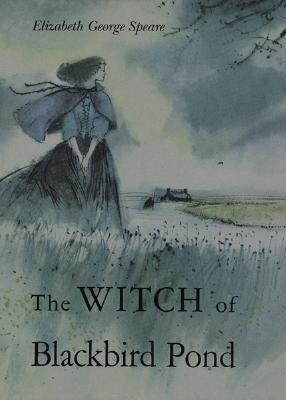
Book: “The Witch of Blackbird Pond” by Elizabeth George Speare
Publishing Info: Houghton Mifflin, 1958
Where Did We Get This Book: The library!
Where You Can Get This Book: WorldCat.org | Amazon | Indiebound
Century: 17th
Book Description: Orphaned Kit Tyler knows, as she gazes for the first time at the cold, bleak shores of Connecticut Colony, that her new home will never be like the shimmering Caribbean island she left behind. In her relatives’ stern Puritan community, she feels like a tropical bird that has flown to the wrong part of the world, a bird that is now caged and lonely. The only place where Kit feels completely free is in the meadows, where she enjoys the company of the old Quaker woman known as the Witch of Blackbird Pond, and on occasion, her young sailor friend Nat. But when Kit’s friendship with the “witch” is discovered, Kit is faced with suspicion, fear, and anger. She herself is accused of witchcraft!
Kate’s Thoughts
I read “The Witch of Blackbird Pond” in grade school, but I hadn’t ever revisited it and I can’t even tell you why, because I remember that I enjoyed it. I think that it was always in the back of my mind when it comes to children’s literature, but as time went on it just kind of fell further and further back. So when it was the choice for the 17th Century for our book club theme, I was eager to go back and re-read a book that I read as a ten year old through the eyes of an almost forty year old. And I’m happy to report that it holds up pretty well! But then, that’s probably because some things haven’t really changed, either from the McCarthy Era, when the book was written, or the times of witchcraft panic, when the book takes place.
I think that Speare did a really good job of laying out some pretty heavy topics, like prejudice, Othering, religious panic, and misogyny, in a way that is easily digestible for a middle grade audience. I found Kit to be an interesting heroine that is easy for a young reader to relate to, and her story of befriending a Quaker in a Puritan community who is rumored to be a witch (because OH NO SHE’S A QUAKER) is engaging, and at times quite suspenseful, given that the town starts to think that both Kit and Hannah (the so called witch) are up to no good and devilry, all because they are different and therein seen as untrustworthy outsiders. As mentioned above, this was initially written as a metaphor for McCarthyism and the Red Scare, where people were turning on and accusing others of being Communists and blacklisting them. But it’s so typical that we see this over and over in American history, and are seeing a form of it play out again right now with LGBTQIA+ people, and immigrants, and other marginalized groups. Some things never change, and hate towards the Other is one of those things. But that just makes the book relevant still, and it’s written with a keen eye that makes it all the stronger.
“The Witch of Blackbird Pond” is another classic children’s lit book that is still timely and interesting, and I am happy that book club gave me the push to give it another go!
Serena’s Thoughts
Like Kate, I read this one as a upper grade schooler/middle schooler. But I’ve also read it several times since. I believe I read it again during high school at some point. And then in my mid-twenties when I was building up my book collection, I stumbled upon a copy of this book on the “free” shelf at my local library, so I grabbed it and, of course, read it again right away! So, while it’s probably been a decade since my last re-read, I’m fairly familiar with the overall story. And given that I’ve somehow managed to read it across every decade of my life so far, I think it’s safe to say that both A.) I like it, and B.) it’s the kind of book that has a lot of cross-over appeal, no matter the age of the reader!
A few things stood out to me in this re-read. Like Kate mentioned, there’s a universal appeal to this story. Not only is Kit the sort of protagonist who will always speak to teens and younger readers (her combination of spunk as well as frustration with the rules around her), but the story talks on perennial struggles of humanity and society. Kate already talked about the Other-ing of those who are different, and the ways in which groups of people can spiral out of control into fear and desperation quite quickly and completely irrationally. But one aspect that I had focused less on in the past were the book’s secondary themes of capital “A” acceptance. In that, while the story is very much focused on the “witches” and the typical sorts of “others” that we know have been feared and hated throughout history (and whose counterparts are easy to spot today as well), it also subtly draws attentions to the sorts of judgements that we make at everyday moments, judgements that often reduce people to their worst characteristics without touching on the rest of their being, their context, or their priorities in life.
First of all, we see this in Kit herself, the heroine and “good guy” of our story, but also a character who grew up with slaves and very much has not thought about the realities of this horror until it is bluntly pointed out to her. This is, of course, very much of the time. And while the story doesn’t excuse Kit, it also presents this flaw of hers alongside all of the elements that still make her the heroine. She learns, and to learn, it requires others to see her flaws and, instead of shunning and shaming, to help her grow.
Further, we also see this in Kit’s uncle, a character who can be incredibly unlikable for much of the story. But as the plot progresses, we see Kit’s estimation of him slowly adjust as she’s exposed to more and more of his core personality, seeing what he cares about most and how that shapes his views. By the end, she recognizes him as the flawed individual he is, but also someone who loves his family and is doing what he thinks is best, even if there are choices that Kit doesn’t agree with or understand. So, while I think the core theme around witches and Other-ing is just as important as ever, in this re-read, I appreciated the time and care the book took to look as these lesser versions of similar judgements and how important it is to humanize those we don’t understand.
Kate’s Rating 8: A classic in children’s literature that feels as timely as ever, “The Witch of Blackbird Pond” is a powerful book about being Othered and ostracized by those who fear things that are different.
Serena’s Rating 8: For a short-ish, young adult book, this story still packs a powerful punch regarding themes of acceptance, Other-ing, and the ways in which people can let fear drive their life.
Book Club Questions
- There are several different women characters in this book. If you were living in this time period, which of these characters would you like to trade places with if only for a moment?
- What are your thoughts on Puritan Society as portrayed in this book?
- There are a few mentions of the slave trade and slavery in this book, as Kit comes from a plantation on Barbados. What were your thoughts on how it was addressed? Do you think it reflects the time that it was written?
- There were multiple romantic relationships in this story. Did you have a favorite couple?
- Are there any more modern books with similar settings or themes to this book that you have enjoyed? What were they? What made them different from this one? How are they similar?
- What did you think about the conclusion of the story? Did it feel realistic to you?
Reader’s Advisory
“The Witch of Blackbird Pond” is included on the Goodreads lists “Teen Historical Fiction”, and “Wise Women, Witches, Midwives, Healers, and Strong Girls!”.
Next Book Club Pick: “What The Wind Knows” by Amy Harmon
 The Library Ladies
Jayne’s Digital Grimoire — Ritual-Based Spiritual Transformation
https://d144d9-isyen1t2k7nz7kotz1m.hop.clickbank.net
LikeLike