Kate’s Review: “You Know What You Did”

This post may contain affiliate links for books we recommend.  Read the full disclosure here.

Book: “You Know What You Did” by K.T. Nguyen

Publishing Info: Dutton, April 2024

Where Did I Get This Book: I received an eARC from NetGalley.

Where You Can Get This Book: WorldCat.org | Amazon | Indiebound

Book Description: In this heart-pounding debut thriller for fans of Lisa Jewell and Celeste Ng, a first-generation Vietnamese American artist must confront nightmares past and present…

Annie “Anh Le” Shaw grew up poor but seems to have it all now: a dream career, a stunning home, and a devoted husband and daughter. When Annie’s mother, a Vietnam War refugee, dies suddenly one night, Annie’s carefully curated life begins to unravel. Her obsessive-compulsive disorder, which she thought she’d vanquished years ago, comes roaring back—but this time, the disturbing fixations swirling around in Annie’s brain might actually be coming true.

A prominent art patron disappears, and the investigation zeroes in on Annie. Spiraling with self-doubt, she distances herself from her family and friends, only to wake up in a hotel room—naked, next to a lifeless body. The police have more questions, but with her mind increasingly fractured, Annie doesn’t have answers. All she knows is this: She will do anything to protect her daughter—even if it means losing herself.

With dizzying twists, You Know What You Did is both a harrowing thriller and a heartfelt exploration of the refugee experience, the legacies we leave for our children, and the unbreakable bonds between mothers and daughters.

Review: Thank you to NetGalley for providing me with an eARC of this novel!

It’s been a little bit since I’ve tackled a straight unreliable narrator thriller on the blog, though that isn’t super surprising because of all the tantalizing horror novels that have been coming out this Spring. But we are finally firmly back in this genre, and this time with a debut that caught my eye awhile back! “You Know What You Did” by K.T. Nguyen has been patiently sitting on my NetGalley for awhile now, and like I almost always do with my NetGalley books this was because I wanted to read it closer to the release date. By the time I came to it it had been kind of simmering on my book back burner, and I was eager to dive in.

As far as a thriller and as a mystery, I generally enjoyed this one. It has a unique hook and a unique voice, as we follow Annie, the daughter of a Vietnamese refugee who has tried to maintain a complete control over her life and identity in the face of a difficult upbringing and OCD diagnosis. After her mother dies, Annie starts having a potential relapse of her disgust driven OCD, and starts to question her reality and the things that she is, or maybe isn’t, doing. It’s a pretty solid device that is meant to deepen the mystery of what is going on with Annie (more on that below), as well as what involvement she may or may not have when one of her clients goes missing, and her erratic behaviors ramp up. In terms of the straight up mystery of Annie’s role in the combustion of her sanity and her potential propensity towards violence that she can’t recall, I had a pretty good guess from the jump as to what was going on. That isn’t to say that Nguyen didn’t have a well thought out mystery, as she did. The puzzle pieces were placed very well and it all came together seamlessly. The suspense about Annie’s mental state was also well done, as I was definitely worried about her. But if you look past the various red herrings, the truth of it all was fairly easy to predict.

And while I am generally apt to kind of side eye thrillers that have mental illness as a plot device to propel the conflict, I thought that “You Know What You Did” did a VERY good job with these themes. It almost certainly helps that Nguyen has an author’s note about her own experiences with OCD, and how that helps contextualize the symptoms and the thought processes that Annie has which intrude upon her every day thinking, and adds to her unreliability. Her OCD makes her fixate on things and makes it so she has a hard time potentially knowing what is real and what isn’t, and as strange and at times violent things happen in her vicinity, it makes for questions about how much is due to her own actions, even if she doesn’t realize it. But it also never paints it as a grotesque caricature of the condition, which can be a trap when various mental illnesses are used to drive the conflict of a thriller. I also appreciated that this doesn’t just apply to Annie, but also as we peel back the layers of her emotionally distant and abusive mother. When we start learning about Annie’s mother, we see a woman who is a hoarder, who does little more but insult her daughter, and who has decimated her self worth to make her dependent on her and within her control. But we also explore what made her this way, by learning about the trauma and loss as a refugee in the years after the Vietnam War. It doesn’t make excuses, but shows how generational trauma and untreated mental illness can have far reaching consequences, and how we don’t always know the full picture of things, be it a person or a thriller novel.

I am definitely eager to see what K.T. Nguyen brings next, because “You Know What You Did” was entertaining as hell.

Rating 7: A unique and well plotted thriller that succeeds in using mental illness as a plot device without being exploitative, this mystery is entertaining, though perhaps easier to untangle than I was expecting.

Reader’s Advisory:

“You Know What You Did” is included on the Goodreads lists “Mystery & Thriller 2024”, and “Female Psychological Thrillers/Suspense Written by Women”.
Serena’s Review: “Dragonfruit”

This post may contain affiliate links for books we recommend.  Read the full disclosure here.

Book: “Dragonfruit” by Makiia Lucier

Publishing Info: Clarion Books, April 2024

Where Did I Get this Book: from the publisher!

Where Can You Get this Book: WorldCat.org | Amazon | IndieBound

Book Description: In the old tales, it is written that the egg of a seadragon, dragonfruit, holds within it the power to undo a person’s greatest sorrow. An unwanted marriage, a painful illness, and unpaid debt … gone. But as with all things that promise the moon and the stars and offer hope when hope has gone, the tale comes with a warning.

Every wish demands a price.

Hanalei of Tamarind is the cherished daughter of an old island family. But when her father steals a seadragon egg meant for an ailing princess, she is forced into a life of exile. In the years that follow, Hanalei finds solace in studying the majestic seadragons that roam the Nominomi Sea. Until, one day, an encounter with a female dragon offers her what she desires most. A chance to return home, and to right a terrible wrong.

Samahtitamahenele, Sam, is the last remaining prince of Tamarind. But he can never inherit the throne, for Tamarind is a matriarchal society. With his mother ill and his grandmother nearing the end of her reign. Sam is left with two to marry, or to find a cure for the sickness that has plagued his mother for ten long years. When a childhood companion returns from exile, she brings with her something he has not felt in a very long time – hope.

But Hanalei and Sam are not the only ones searching for the dragonfruit. And as they battle enemies both near and far, there is another danger they cannot escape…that of the dragonfruit itself.  

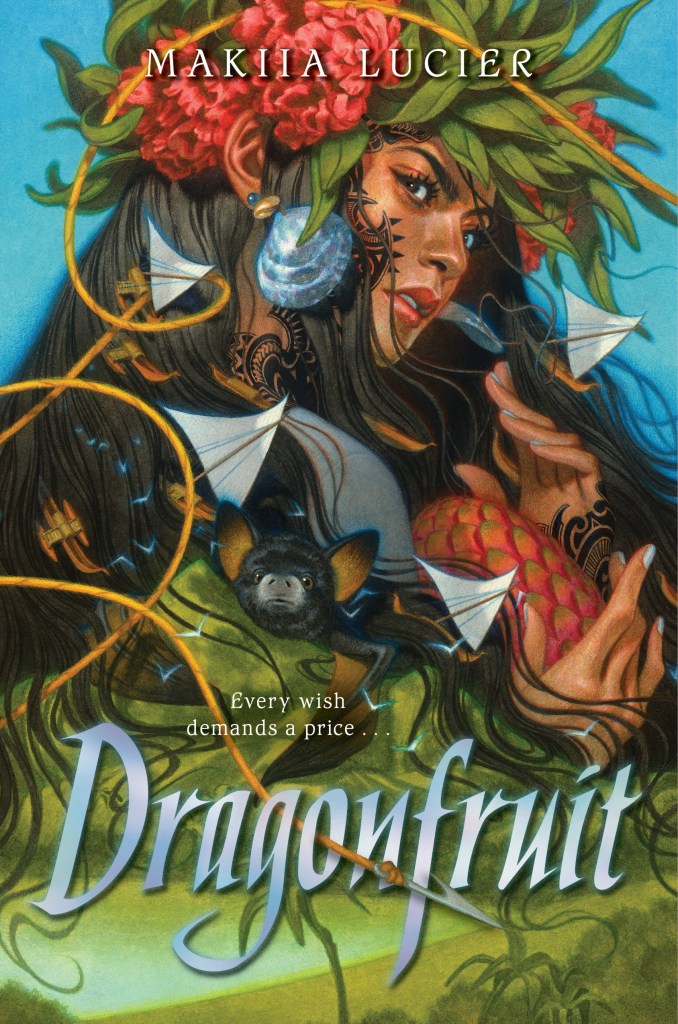
Review: I always am interested in a book about dragons! But while I’ve read a million and one (still love them though) stories about European-style dragons, I’ve read fewer based on Eastern cultures. And I was particularly intrigued that this story was drawing from Pacific Island mythology, of which I know very little. Plus, the colorful, vibrant cover is very distinct from the other YA fantasy stories out there! I always appreciate it when publishers buck trends in cover art and produced unique covers that actually fit the specific story within!

I really enjoyed this book! Right from the start, the story begins with a bang and never really slows down for the entirety of the story. The world-building, with its history of dragon hunters, dragons, and the magical and rare dragonfruit they produce is all neatly divvied out whenever there’s a break in the action. We quickly learn about our main character Hanalei and the way in which dragonfruit has shaped her life to this point. She was both saved by it, but also estranged from her home country and branded a traitor, losing family, friends, and home all in one swoop. However, as the story continues, we see that Hanalei’s past is not viewed the same by those around her, and when she finally makes her way back home, these old ties come back in surprising ways. I enjoyed the general arch of her character, especially the contradictory feelings she has towards dragons and dragonfruit. More than most others, she understands not only the magic of the dragonfruit, but also the costly price. Even more importantly, she sees what many do not, that this cost is not only born by the humans touched by a curse, but by the dragons themselves, hunted for their young.

This in particular stood out to me, the way in which the dragons were handled. They were very much presented as majestic, wild animals, with that coming all of the beauty and horror of nature. They are wonderous, yes, but they also hunt people, and the book doesn’t shy away from the human cost that exists in a world with natural predators as mighty as these dragons. There is also a strange balance of tone that this brings to the story. As far as as Hanalei and Sam’s story goes, this book can read as a very cozy YA fantasy, with their romance coming across as very sweet and innocent. But on the other hand, there is so much tragedy with the dragons. If you’re bothered by violence towards animals, this one might be a struggle. I do think it was important that the book put to the page some of these scenes, to properly highlight the challenging choices faced by our characters, but there’s also just a lot of it. I definitely shed tears more than once.

I will say that by the end I was left wanting a bit more, especially with regards to the morality of dragonfruit. I appreciated that the author simply laid out these scenes before the reader and trusted that they could come to the correct judgement about the horror of using dragonfruit for wishes, but I wish there had been a bit more acknowledgement of this situation spoken about on the page between the characters. By the end, the reader has a good understanding of things, and you feel that the characters do, too, but there still seemed to be at least one or two important conversations needed to make it feel well-rounded.

On the same note, some of the cozy vibes of this story (which I very much appreciated on the whole!) seemed to coincide with a few almost cartoonish depictions of the books’ villains. There were a few characters, especially in the beginning, who were of the sort where you simply love to hate them. And that is all well and good, but, again, by the end of the story, I was left wanting a bit more depth to all of these characters. I will say that one of these did end up having an interesting arc, though I also felt this was fairly predictable past a certain point.

Overall, however, I very much enjoyed this book! It was a fast read, and I completed it in two sittings. The main characters, especially, were incredibly relatable and I loved their heart-warming romance. I also really loved the dragons of this world, they were an integral part to the story and they did not let me down! If you’re looking for a breath of fresh air in the YA dragon books arena, definitely give this one a shot! Just have some tissues on hand!

Rating 8: Full of heart and tragedy, this is a YA dragon book for all those looking for a fresh entry into a tried-and-true subgenre!

Reader’s Advisory:

“Dragonfruit” can be found on these Goodreads lists: Obscure Books Worth Considering and YA Novels of 2024.

Kate’s Review: “Immortal Pleasures”

This post may contain affiliate links for books we recommend.  Read the full disclosure here.

Book: “Immortal Pleasures” by V. Castro

Publishing Info: Del Rey, April 2024

Where Did I Get This Book: I received an eARC from NetGalley.

Where You Can Get This Book: WorldCat.org | Amazon | Indiebound

Book Description: An ancient Aztec vampire roams the modern world in search of vengeance and love in this seductive dark fantasy from the author of The Haunting of Alejandra.

Hundreds of years ago, she was known as La Malinche: a Nahua woman who translated for the conquistador Cortés. In the centuries since, her name has gone down in infamy as a traitor. But no one ever found out what happened to La Malinche after Cortés destroyed her people.

In the ashes of the empire, she was reborn as Malinalli, an immortal vampire. And she has become an avenger of conquered peoples, traveling the world to reclaim their stolen artifacts and return them to their homelands. But she has also been in search of something more, for this ancient vampire still has deeply human longings for pleasure and for love.

When she arrives in Dublin in search of a pair of Aztec skulls—artifacts intimately connected to her own dark history—she finds something else: two men who satisfy her cravings in very different ways.

For the first time she meets a mortal man—a horror novelist—who is not repelled by her strange condition but attracted by it. But there is also another man, an immortal like herself, who shares the darkness in her heart. Now Malinalli is on the most perilous adventure of all: a journey into her own desires.

Review: Thank you to NetGalley for providing me with an eARC of this novel!

V. Castro is one of my favorite horror authors, and I had been waiting patiently (maybe not so patiently) for her to take on a vampire story. So when I saw the announcement for “Immortal Pleasures” and that it not only was going to be a vampire story that centers on La Malinche, but that the cover looked like a full on “From Dusk Til Dawn” aesthetic, I rejoiced. Of all of the V. Castro books I’ve looked forward to, this was up there with “The Haunting of Alejandra” (which I also loved). So I dove into “Immortal Pleasures”, eager and filled with anticipation.

So, first thing’s first. I am absolutely going to praise the praiseworthy things about this book, and there are lots of things that I really, really liked. For starters, the concept of the woman who was La Malinche being turned into a vampire with the name Malinalli, and using her immortality to reappropriate the items and objects from the Nahua culture back from Western clutches is PHENOMENAL (especially since Cortés is ALSO a vampire now and they are on a path to run afoul each other again). I am so thrilled that there has been more discussion about the Spanish conquest/invasion in Central and South America in fiction as of late, as I’ve seen this in multiple horror novels in the past couple of years, and what a neat idea to take the figure of La Malinche, the Nahua woman who worked as a translator and advisor for Hernán Cortés during his bloodthirsty mission, and to give her a voice and to give her something of a redemption arc when as of late she has been vilified for her role in advising and enabling Cortés (if you want some background on La Malinche, take a look HERE). Castro is game to dive into the themes of the colonial violence and genocide that the Spanish committed during their invasion and conquest, and to show La Malinche, now Malinalli, as a victim who wants to atone for the role she played, even if it was a role forced upon her as an enslaved woman. So yes, I absolutely love her as a reborn vampire who is traveling the Western world to bring pre-Columbian Meso- American cultures’ artifacts back from museums, universities, and collectors. It makes her powerful, it makes her redemptive, and it makes her complex. I also really like that she is finally in charge of her own sexuality, as when she was alive she was absolutely a victim of rape and sex trafficking as an enslaved woman forced into the role of Cortés’s accomplice. As Malinalli she is able to have agency in her sexuality. And given that there are many sex scenes in this book between her and a horror writer, as well as her and another vampire (whose twist of an identity made me SCREAM with both glee and also confusion but in a good way, I assure you), she takes control of her sexual narrative repeatedly. Also, very explicitly.

But here are the roadblocks that made this book a harder read for me, and it’s mostly a narrative choice in how the story is told. This is not only a first person narrative, with Malinalli telling the reader her story both in past and in present, but it is also done in a way that makes it feel very matter of fact and conversational, which means that the flow is almost ALL telling and very little showing. It felt to me like Castro was going for an Anne Rice “Interview with the Vampire” vibe, which I absolutely appreciate because that’s iconic. But I think that the problem was that it just made for a less interesting narration because again, it was more telling and less showing. I also didn’t feel nearly as much connection to the modern story of Malinalli trying to retrieve two skulls in the United Kingdom as I did to the historical story of her as La Malinche and her start as a vampire. I almost wonder if it’s because her modern story has the meandering paths of her relationship with Colin, the aforementioned horror writer, and the many many sex scenes she has with him. Some bordering on the ludicrous. I like to think that I’m not a prude in any way shape or form, and again, I LOVE giving Malinalli the agency she has in her sex life. But man, there were a LOT of sex scenes that felt superfluous. And oddly written. And Colin himself just wasn’t super interesting to me, and I couldn’t figure out why she was interested in him to begin with. Though that said, she drops him like a hot potato REALLY fast once she meets fellow vampire Alex, but that also felt rushed and hastily resolved. It just felt like a pacing issue, or indecisiveness on what to focus on.

So, overall, “Immortal Pleasures” wasn’t what I wanted it to be. There were aspects I liked, but it felt like a rare stumble from V. Castro in a lot of ways.

Rating 6: The themes and ideas of this book worked so well for me, but the narrative voice and the choices that came with it were a bit too stilted for me.

Reader’s Advisory:

“Immortal Pleasures” is included on the Goodreads list “Horror to Look Forward to in 2024”.

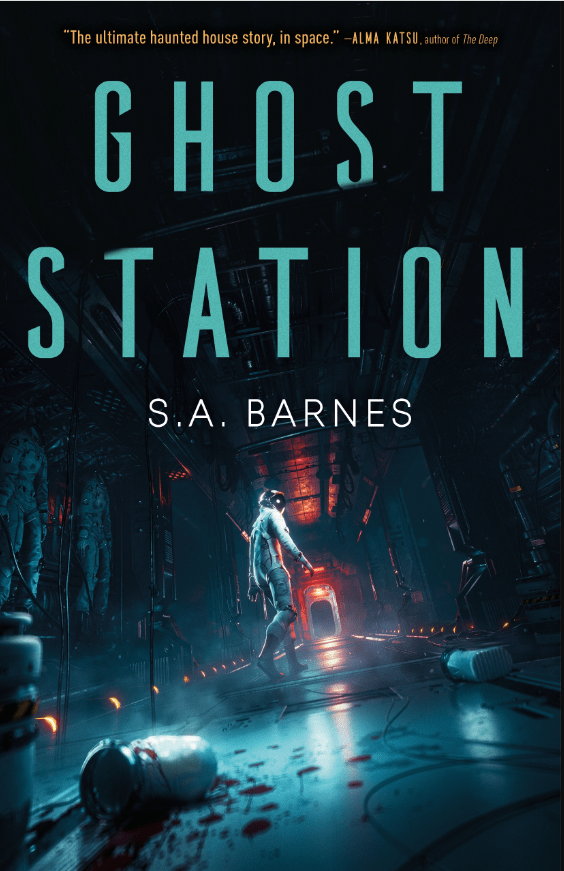
Joint Review: “Ghost Station”

This post may contain affiliate links for books we recommend.  Read the full disclosure here.

Book: “Ghost Station” by S.A. Barnes

Publishing Info: Tor Nightfire, April 2024

Where Did We Get This Book: NetGalley;

Where You Can Get This Book: WorldCat.org | Amazon | Indiebound

Book Description: A crew must try to survive on an ancient, abandoned planet in the latest space horror novel from S.A. Barnes, acclaimed author of Dead Silence.

Space exploration can be lonely and isolating.

Psychologist Dr. Ophelia Bray has dedicated her life to the study and prevention of ERS—a space-based condition most famous for a case that resulted in the brutal murders of twenty-nine people. When she’s assigned to a small exploration crew, she’s eager to make a difference. But as they begin to establish residency on an abandoned planet, it becomes clear that crew is hiding something.

While Ophelia focuses on her new role, her crewmates are far more interested in investigating the eerie, ancient planet and unraveling the mystery behind the previous colonizer’s hasty departure than opening up to her.

That is, until their pilot is discovered gruesomely murdered. Is this Ophelia’s worst nightmare starting—a wave of violence and mental deterioration from ERS? Or is it something more sinister?

Terrified that history will repeat itself, Ophelia and the crew must work together to figure out what’s happening. But trust is hard to come by… and the crew isn’t the only one keeping secrets.

Kate’s Thoughts

When Serena approached me asking if I’d be interested in doing another Joint Review of an S.A. Barnes book, I was game. I liked getting both our perspectives on “Dead Silence”, as it is both Sci-Fi and Space horror, and therefore in both our wheelhouses. I enjoyed “Dead Silence”, and reading up on “Ghost Station” was just as intriguing to me based on the description.

If I was mentally comparing “Dead Silence” to “Aliens” and “Event Horizon”, “Ghost Station” read like the sci-fi horror film “Prometheus” to me, with a crew getting in way over their head on a mysterious planet that has sinister secrets. In terms of the things I liked, I really enjoyed Ophelia as our protagonist, as she is both unreliable in a number of ways, but is also very driven for very personal reasons in connection to a dangerous mental disorder known as ERS. I liked not really knowing what her deal was beyond one straight forward incident, and an anxiety and shame about being a part of a notorious corporate family with immense wealth and unscrupulous morals. We slowly get to peel back her layers, and as she and the crew find themselves in a situation that keeps getting more tense and more dangerous, her secrets and their secrets combine to make for a good deal of suspense and mysteries revealed. There is also some nice space horror bits here, and some beats that really unsettled me. Particularly the way that Barnes shows a slow decay of various crew members sanity, for reasons that may not be as obvious as Ophelia would like it to be.

But all that said, this one felt like it was a bit heavier on the Sci-Fi elements this time around, and even though I enjoy Space Horror as a Sci-Fi sub-genre, if you tread a bit too far into the Sci-Fi, my brain just shuts off (this actually happened with “Prometheus” as well). There is no question that this book does have a lot of suspenseful and scary moments in it that worked for me, but they felt a little few and far between. This isn’t to be a criticism of this book because I imagine that this will work very well for the target audience of Sci-Fi aficionados (let’s see what Serena says!), but it just got into the Sci-Fi weeds a bit too much for me as a person who isn’t a fan of that genre.

“Ghost Station” will probably satisfy Sci-Fi fans who like space horror, but for this horror fan who doesn’t usually mess with that genre, it didn’t hit as hard as I’d hoped it would.

Serena’s Thoughts

While I liked this one more than Kate did (probably no surprise, as science fiction is a much-loved genre of mine on its own right, and the horror side of things was the more experimental thing), I also agree with many of her criticisms. For the most part, I enjoyed the science fiction elements we had here. Many of them are fairly standard fair as far as futuristic technology goes, but I thought they were presented and used in interesting ways.

I also thought the horror elements were good. There was definitely the slow build up of dread as Ophelia and the other members of the crew explore and piece together the mystery of what had happened before them. There were some legitimately creepy moments, but not enough to make the book unapproachable to more casual horror readers. That said, I think the horror aspects of the first by this author that we joint read, “Dead Silence,” hit me harder, some even popping up in my head at inconvenient times days later. Whereas with this book, moments were a bit freaky, but it didn’t stay with me in the same way.

I also struggled a bit with the pacing and character development in this one. While I think the slower nature of the building dread worked well on the spooky front, the pace overall seemed to drag, especially in the beginning. I kept wanting to rush ahead for things to start happening, and it seemed to take quite a long time to get to anything substantial. And, while I enjoyed discovering more about Ophelia, who she was and why she made the decisions she did, I also found myself more frustrated by some of her decisions and inner monologues than I did with the lead character in “Dead Silence.”

Overall, I thought this was was a serviceable science fiction horror story, though I don’t think it quite lived up to the high that was the author’s previous work.

Kate’s Rating 6: There are definitely solid horror moments, but this was a little too heavy on the Sci-Fi for me.

Serena’s Rating 7: A bit slow with regards to pacing, but an approachable book overall, especially for the more casual horror/science fiction readers.

Reader’s Advisory

“Ghost Station” is included on the Goodreads lists “Horror to Look Forward to in 2024”, and “Can’t Wait Sci-Fi/Fantasy of 2024”.

Kate’s Review: “The House on Biscayne Bay”

This post may contain affiliate links for books we recommend.  Read the full disclosure here.

Book: “The House on Biscayne Bay” by Chanel Cleeton

Publishing Info: Berkley, April 2024

Where Did I Get This Book: I received an eARC from NetGalley.

Where You Can Get This Book: WorldCat.org | Amazon | Indiebound

Book Description: As death stalks a gothic mansion in Miami, the lives of two women intertwine as the past and present collide in New York Times bestselling author Chanel Cleeton’s atmospheric new novel.

With the Great War finally behind them, thousands of civilians and business moguls alike flock to South Florida with their sights set on making a fortune. When wealthy industrialist Robert Barnes and his wife, Anna, build Marbrisa, a glamorous estate on Biscayne Bay, they become the toast of the newly burgeoning society. Anna and Robert appear to have it all, but in a town like Miami, appearances can be deceiving, and one scandal can change everything.

Years later following the tragic death of her parents in Havana, Carmen Acosta journeys to Marbrisa, the grand home of her estranged older sister, Carolina, and her husband, Asher Wyatt. On the surface, the gilded estate looks like paradise, but Carmen quickly learns that nothing at Marbrisa is as it seems. The house has a treacherous legacy, and Carmen’s own life is soon in jeopardy . . . unless she can unravel the secrets buried beneath the mansion’s facade and stop history from repeating itself.

Review: Thank you to NetGalley for providing me with and eARC of this book!

At the beginning of the month my family and I went to Florida so that my four year old could experience the joy and chaos that is Disney World, and the nostalgia factor for me (outside of being burnt out to hell by the end of all of it) was ample. Being back in the Sunshine State reminded me of my family trips there when I was little, specifically to, yes, Disney, but also to visit my family in Miami. While Florida is a state that I have a lot of opinions about, I do have a place in my heart for Miami thanks to the time spent there as a kid (as well as a trip in 2017 for my cousin’s wedding celebration). Because of this nostalgia, I was very interested in “The House on Biscayne Bay” by Chanel Cleeton. Not only was it touted as a Gothic mystery, it also had the setting of first half 20th Century Miami. What a combination! I went in with high expectations. And was somewhat disappointed.

First, of course, the things I did like. I absolutely adored the time and place in this book, as well as the descriptions of Marbrisa itself. I so rarely read stories set during the time period that is during or adjacent to World War I, so when it is a timeframe in a book I’m already interested because of the opportunities it opens. In spite of my family connections to Miami, my knowledge of its history is pretty limited, and I really liked the descriptions that Cleeton had about the town as it was growing and the challenges that presented the culture shock, the isolation, the alligators!). And when looking at the timeline that Carmen, Carolina, and Asher are in, I liked the way that the house had changed and transformed and had built up a reputation throughout Miami, and how that was affecting those living there. I also did enjoy our two protagonists across these two timelines we are following, Anna and Carmen. For Anna, I liked that she is a high society woman and wife of a New York businessman, Robert Barnes, and how she is expected to be grateful and thrilled about him building her this house, but instead finds herself trapped and stifled because of being plucked from her comfortable life and plunked down into a whole new community. Without any say. Seeing her have to grapple with this, as well as suspicions about her husband after a death happens at their estate, was really interesting. And for Carmen I liked the perspective of yet another woman being plucked from all she knows (this time her home in Havana after her parents die unexpectedly) and put in a whole new setting with sister Carolina, whom she has a contentious relationship with, and brother in law Asher, who is practically a stranger. And then when Carolina is murdered, she is suddenly alone with strangers in a strange house, possibly with a killer. I really enjoyed Carmen’s resilience and her verve.

But while I did like the melodrama and the way that both Anna and Carmen were maneuvering in their presents in Marbrisa, the two mysteries in both their timelines didn’t grab me the way I had hoped they would. For Anna, the death of a woman named Leonora at their first (and only) lavish party to show off the house has led her to wonder if the drowning was accidental, or something more sinister. For Carmen, there is not only the sudden death of her sister Carolina, but also the lingering question about what happened to Anna, who disappeared years prior. I wasn’t totally swept into the mysteries because, in the case of Leonora, I had a pretty good idea as to what happened from the jump, and in the case of Carolina, while the twists and surprises were well done, I just wasn’t invested in that outcome because I wasn’t as invested in Carolina. I WAS invested in Carmen and worried about her, but that would have been the case even without the mystery. I DID like the Anna Barnes mystery, but one out of three isn’t a resounding average.

“The House on Biscayne Bay” had some really well done historical beats and felt Gothic in all the right ways, but it wasn’t as thrilling as I had hoped it would be. That said, for historical fiction I will be looking into more Chanel Cleeton!

Rating 6: I liked the historical drama and I liked our two protagonists, but for whatever reason the mysteries at hand didn’t capture my attention.

Reader’s Advisory:

“The House on Biscayne Bay” is included on the Goodreads lists “Anticipated Literary Reads for Reader’s of Color 2024”, and “Mystery and Thriller 2024”.

Serena’s Review: “The Hemlock Queen”

This post may contain affiliate links for books we recommend.  Read the full disclosure here.

Book: “The Hemlock Queen” by Hannah Whitten

Publishing Info: Orbit, April 2024

Where Did I Get this Book: ARC from the publisher

Where Can You Get this Book: WorldCat.org | Amazon | IndieBound

Book Description: The corrupt king August is dead. Prince Bastian has seized the throne and raised Lore—a necromancer and former smuggler—to his right hand side. Together they plan to cut out the rot from the heart of the sainted court and help the people of Dellaire. But not everyone is happy with the changes. The nobles are sowing dissent, the Kyrithean Empire is beating down their door, and Lore’s old allies are pulling away. Even Prince Bastian’s changed. No longer the hopeful, rakish, charismatic man Lore knows and loves, instead he’s reckless, domineering and cold. 

And something’s been whispering in her ear. A voice, dark and haunting, that’s telling her there’s more to the story than she knows and more to her power than she can even imagine. A truth buried deep that could change everything. 

With Bastian’s coronation fast approaching and enemies whispering on all sides, Lore must figure out how to protect herself, her prince, and her country before they all come crumbling down and whatever dark power has been creeping through the catacombs is unleashed.

Previously Reviewed: “The Foxglove King”

Review: While “The Foxglove King” wasn’t a perfect read for me, it did solidly set up the series in all of the ways that mattered. The world seemed interesting. The characters drew me in. The ending set up a bigger conflict to come. And, best of all, I wasn’t completely turned off by the love triangle being set up (truly a rare thing). On top of that, Whitten has yet to truly let me down with any of her books, even if I’ve liked some more than others. So it was with great eagerness that I finally got to this book when going through my TBR pile!

This was an incredibly interesting second book in this series. On one hand, I do think it’s the kind of sequel that asks its readers to put a lot of trust in the author and the over-arching plot of the trilogy as a whole. Its’ definitely a middle book, setting up a lot of moving pieces that will not see a conclusion in this story. As well, in the first third to even half of the book, several of the characters read very differently from how they appeared in the first book. Lore, our feisty survivor, spends much of the beginning of this story in a very passive, reactive role. So much so, that we see her willfully sticking her head in the sand about what is going on around her and becoming distrusted to reliably act by those close to her. But, as the story progresses, I really enjoyed the character reflection that this brought about. In the first book, we see a Lore who will fight to survive. But much of survival is also endurance and remaining out of the way in dangerous situations, and in this book we see a Lore who knows how to adapt quickly to whatever circumstances she finds herself in, prioritizing her day-to-day existence over radically challenging anything around her. This is a much less sexy side of survival, but I think there’s a case to be made that this trait is even more important than “fighting.”

I also enjoyed the nice parallels between Lore’s awakening to the reality of her own situation alongside the stirrings of the old gods themselves. We get so much great information and backstory for these gods and the story twisted and turned in many exciting ways. There were tons of reveals, but by the end, I still felt like I had barely scratched the surface of what is currently going on with the gods and what had happened between them in the past.

Returning to the “trusting the author” theme, Bastian, too, was a character who read very different at times in this book than he had in the first. Here, I feel like the explanation/understanding of what was going on was fairly easy to predict early on, thus assuaging any fears of fans. But I have still seen several disappointing Goodreads reviews where readers essentially DNF’d this early saying that Bastian had gotten the “Tamlin treatment” from ACOTAR. This book just goes to show how readers need to give stories a chance to develop before jumping to conclusions and potentially missing out on an excellent story.

As for the third member of our group, we see a lot less of Gabe in this book than in the first, which was my biggest disappointment. I did like the scenes we had with him, but he very much felt like a background character for much of the story. This makes sense as far as the story goes, especially with Lore’s own character arc of slowly accepting the truth about their situation, but it does leave him with a much-reduced plot from what we saw in the first.

As far as the romance goes, I feel like the author has to be setting up more of a throuple situation at this point than a true love triangle. If anything, I found Lore’s repetitive thoughts about “why can’t I have both” to be a bit too on the nose, especially given how often she reflected on this point. Now, I don’t love throuple stories personally, but I will say, this is by far the best variation on this type of romance that I’ve read. While it’s not my preference, Whitten has laid down excellent groundwork building up strong relationships between all three characters. There’s also the very real possibility that this will all end in tears. Who knows!

Overall, I thought this was an incredibly successful sequel. The story is slow to start and asks the readers to trust that the characters will work through their challenges, but once it gets going, boy does it move! There is a ton of world-building included in this one, and I also enjoyed the greater scope of the political situation, with other countries now nipping at the heels of a seemingly weakened new King. The story also ends on a fairly massive cliffhanger, so readers beware as far as that goes! But, if you enjoyed the first book this series, definitely check this one out!

Rating 8: A sense of dread slowly simmers to build to a climatic crescendo that will leave readers aching for the next book in the series!

Reader’s Advisory:

“The Hemlock Queen” can be found on these Goodreads lists: Most Anticipated Adult Romances of 2024 and Epic High Fantasy/Romance/Mythology in 2024

Kate’s Review: “This Wretched Valley”


This post may contain affiliate links for books we recommend.  
Read the full disclosure here.

Book: “This Wretched Valley” by Jenny Kiefer

Publishing Info: Quirk Books, January 2024

Where Did I Get This Book: I own it.

Where You Can Get This Book: WorldCat.org | Amazon | Indiebound

Book Description: Four ambitious climbers hike into the Kentucky wilderness. Seven months later, three mangled bodies are discovered. Were their deaths simple accidents or the result of something more sinister? This nail-biting, bone-chilling survival horror novel is inspired by the infamous Dyatlov Pass incident, and is perfect for fans of Alma Katsu and Showtime’s Yellowjackets.

This is going to be Dylan’s big break. Her friend Clay, a geology student, has discovered an untouched cliff face in the Kentucky wilderness, and she is going to be the first person to climb it. Together with Clay, his research assistant Sylvia, and Dylan’s boyfriend Luke, she is going to document her achievement on Instagram and finally cement her place as the next rising star in rock climbing

Seven months later, three bodies are discovered in the trees just off the highway. All are in various states of decay: one body a stark, white skeleton; the second emptied of its organs; and the third a mutilated corpse with the tongue, eyes, ears, and fingers removed. But Dylan is still missing. Followers of her Instagram account report seeing disturbing livestreams, and some even claim to have caught glimpses of her vanishing into the thick woods, but no trace of her—dead or alive—has been discovered

Were the climbers murdered? Did they succumb to cannibalism? Or are their impossible bodies the work of an even more sinister force? Is Dylan still alive, and does she hold the answers? 

This page-turning debut will have you racing towards the inevitable conclusion.

Review: It’s been a bit since I’ve read a balls to the wall survival/wilderness horror story, which is a shame because I legitimately love this trope and sub-genre with every fiber of my being. “The Blair Witch Project” is my favorite horror movie of all time, and there are plenty of other movies and books and just real life moments of having to survive in a terrifying wilderness that deeply resonate with me. Because of this, I was SUPER interested in reading “This Wretched Valley” by Jenny Kiefer, a debut horror novel that has a team of researchers and climbers going into the wilds of Kentucky for a project, and then are surrounded and tormented and picked off by a mysterious force that dwells within it. Like holy SHIT this is SO MY KINDA THING!

(source)

As far as survival horror goes, this book really checks a lot of boxes for me. As stated above, I love this sub-genre, and this one has so many hints of “The Blair Witch Project” and “The Descent” throughout its DNA that I was absolutely amped. And yes, lots of harkening to the Dyatlov Pass Incident, though I do tend to fall in the ‘it was probably some kind of avalanche’ camp in that regard. Anyway, as our group of campers/researchers/climbers go deep into a mysterious valley in the Kentucky wilderness in hopes of researching the geology of this pristine rock face that has seemingly just appeared out of nowhere. Our scientists are grad student Clay and his research assistant Sylvia, and our climbers are aspiring influencer Dylan and her boyfriend Luke and their dog. So we already have a group that is going in with a greater purpose of differing degrees of fame in mind, and when weird stuff turns to dangerous stuff turns to nightmarish stuff, the paranoia, terror, and desperation starts to tear them all apart. The idea of being lost in the wilderness scares the living daylights out of me, and Kiefer captures that fear and ratchets it up as our group can’t seem to find their way out, as people get hurt, tempers flare, and they all start seeing things that shouldn’t be there, and shouldn’t be possible. Were this a slow burn lost in the wilderness without supernatural elements it would be terrifying on its own, but then the supernatural stuff does enter into it and it is SO well described and SO damn scary. This is one of the gorier horror novels I’ve read as of late, and Kiefer doesn’t hold back so much when it comes to the violence and the visceral imagery. I was both tearing through the pages to find out what happened, but also having to set it down occasionally because of a particularly gross or super messed up moment.

I did have a couple of issues with the book, however. The first is that while I absolutely appreciate Kiefer wanting to keep things a but unknown in terms of what exactly is going on, I think that, interestingly enough, we get into the same pitfall that “Blair Witch” (the requel from a few years ago) fell into. That is, there is SO MUCH WEIRD STUFF going on, but none of it gets even a hint at an explanation. I don’t need full explanations as to everything that is going on in a story like this, on the contrary I generally LIKE ambiguity because sometimes that makes a scary story that much scarier. But this ambiguity didn’t feel focused, and just brushes upon multiple different potential culprits. Nothing is really explained or even hinted at as to what is causing this, and it feels less narratively satisfying and more haphazard and indecisive. The other issue is more to do with the marketing of this book and not with the story itself. The description of the novel mentions that Dylan’s body wasn’t found, and her followers are reporting weird lives from her social media and weird sightings from people in the area, making it sound like this plays a large(ish?) role in the story at hand. In reality, it doesn’t really. I went in thinking there would be some really fun found media themes, but there wasn’t a lot, and that was disappointing. Again, that’s less to do with Kiefer’s story itself and a marketing issue.

So some good things, some not as good things, but overall I did find “This Wretched Valley” to be very disturbing and to be very engrossing. Survival and wilderness horror fans will find a lot to love, and maybe people who are more comfortable with not knowing much about cause in a horror tale will be able to look past the things I had a more difficult time with. I will definitely be looking into more books from Jenny Kiefer in the future!

Rating 7: A gory and deeply disturbing survival horror story that was a page turner, but sometimes a bit too ambiguous for my tastes in some ways, and didn’t really deliver what the description was promising.

Reader’s Advisory:

“This Wretched Valley” isn’t on many Goodreads lists as of now, but it would fit in on “Best Wilderness Horror Stories”.

Serena’s Review: “The Familiar”

This post may contain affiliate links for books we recommend.  Read the full disclosure here.

Book: “The Familiar” by Leigh Bardugo

Publishing Info: Flatiron Books, April 2024

Where Did I Get this Book: Edelweiss+

Where Can You Get this Book: WorldCat.org | Amazon | IndieBound

Book Description: In a shabby house, on a shabby street, in the new capital of Madrid, Luzia Cotado uses scraps of magic to get through her days of endless toil as a scullion. But when her scheming mistress discovers the lump of a servant cowering in the kitchen is actually hiding a talent for little miracles, she demands Luzia use those gifts to better the family’s social position.

What begins as simple amusement for the bored nobility takes a perilous turn when Luzia garners the notice of Antonio Pérez, the disgraced secretary to Spain’s king. Still reeling from the defeat of his armada, the king is desperate for any advantage in the war against England’s heretic queen—and Pérez will stop at nothing to regain the king’s favor.

Determined to seize this one chance to better her fortunes, Luzia plunges into a world of seers and alchemists, holy men and hucksters, where the line between magic, science, and fraud is never certain. But as her notoriety grows, so does the danger that her Jewish blood will doom her to the Inquisition’s wrath. She will have to use every bit of her wit and will to survive—even if that means enlisting the help of Guillén Santangel, an embittered immortal familiar whose own secrets could prove deadly for them both.

Review: I’ve had a mixed past reading Leigh Bardugo’s books. I started out really enjoying the first book in her original Grisha trilogy, “Shadow and Bone.” But then I disliked the way the love triangle was handled so much that I was pretty much hate-reading the series by the time I got to the final book. Sure, I liked the ending, but I was pretty put off by the entire experience. Then, however, I picked up the “Six of Crows” duology and absolutely loved it! On top of that, while I haven’t read “Ninth House,” Kate gave it a 10 in her review a few years ago. Sooo, when I saw this book coming out, I thought now was the time to revisit her work. It helps that this book is disconnected from the Grishaverse entirely and was set in a place and time period that I’ve rarely seen tackled in fantasy fiction. And now that I’m finished…well, consider me converted! If this is what Bardugo is producing currently, I’m all in!

There is so much to love about this book that I barely know where to start! But let’s start with something I’m always on the look out for when reading books like this: how well does it blend genres? Here, Bardugo is not only writing a fantasy story, but she’s attempting to blend it into a real time and place in our own world. With that comes a lot of challenges, but when done right, like here, it can be the best of both world. And while Luzia’s magic and the magical competition she finds herself entrenched within drive much of the plot of the story, I think it’s truly the historical setting that breathes life into this book.

This story is rich with all of the intricate details that one looks for from a historical fiction book: the lush descriptions of fashion and architecture, the political maneuvering driving a country’s leaders, the cultural norms and restrictions placed on its people. And central to it all, Luzia’s precarious place in a culture that demonizes “unholy” magic as well as her own Jewish heritage. All of this and more is woven in so neatly alongside fantastical events that it truly begins to feel believable that this was simply a lost element of the historical record. In this way, it very much reminded me of reads like “The Golem and the Jinni” where the historical setting and commentary felt as if they played a more primary role to its fantasy elements.

I also really enjoyed the characters, but especially Luzia herself. She’s a fully formed, complicated character with all of the joys and struggles that come alongside that. Early in the story, numerous characters warn her about the dangers of her own ambitions, and I was truly impressed by the delicate manner in which this was handled. Restricted to a life as a scullery maid, Luzia’s dreams of basic comforts, safety, and the recognition and appreciation of her power are all understandable, especially to the modern reader. She’s never demonized for wanting more. That said, the book never loses sight of the time period and place during which it is taken place. There are no easy solutions to the realities of the world around her; no magical wand-waving that can re-form the world into one where Luzia’s dreams of her future can be easily made true. This is not a story of revolution or grand sweeting changes to a real-world historical time line. Instead, it is a careful exploration of the very real lives that people, especially women, lead. That said, it’s not all doom and gloom.

Woven throughout the story was one of my favorite slow-burn romances that I’ve read in quite some time. Like Luzia, Santangel is a complicated, imperfect being. His story is slowly revealed over the course of the book, and we learn of the backstory that lead him to be who he is now and understand the choices he makes. For much of the book, I was truly concerned about how this love story was going to be resolved, given the restrictions on his character. But, like everything else, this all fell neatly in line by the end of the book, leaving us with a bittersweet, but satisfying ending. And for those concerned, I’d say it veers closer to the “sweet” than the “bitter.” Take from that what you will.

The fantasy elements were also fantastic. It starts off slowly, but the story eventually builds to full-scale, action-packed magical scenes. Honestly, I was kind of surprised by just how far into the fantasy aspect the book leaned at certain points. There were some truly suspenseful scenes, and I enjoyed the way Luzia’s magic was used. There were enough restrictions on what she could do that there was sufficient tension and conflict building throughout the story, but there was also a sense of whimsy, that anything could be possible if it could be dreamed.

Truly, I can’t say enough good things about this book. The writing was incredibly sharp, the character work was deep and complicated, and there was an excellent balance between the increasing danger and stakes of Luzia’s situation and the sweet, slow-burn romance building between her and Santangel. Fans of Bardugo’s work are sure to love this one, and I would also highly recommend it to any fantasy readers, especially those who enjoy historical fiction, as well.

Rating 10: A masterpiece of historical fantasy fiction, with “The Familiar” Bardugo has proven once again why she’s one of the most exciting authors writing in the genre today.

Reader’s Advisory:

“The Familiar” can be found on these Goodreads lists: Jewish Fantasy Genre and Historical Fiction With a Dash of Magic.

Kate’s Review: “The Darkness Rises”

This post may contain affiliate links for books we recommend.  Read the full disclosure here.

Book: “The Darkness Rises” by Stacy Stokes

Publishing Info: Viking Books for Young Readers, April 2024

Where Did I Get This Book: I received an eARC from the publisher.

Where You Can Get This Book: WorldCat.org | Amazon | Indiebound

Book Description: A gripping speculative thriller perfect for fans of Lauren Oliver and Ginny Myers Sain, about one girl with the power to see death before it happens–and the terrible consequences she faces when saving someone goes wrong.

SOMEONE WANTS REVENGE

Whitney knows what death looks like. Since she was seven, she’s seen it hover over strangers’ heads in dark, rippling clouds. Sometimes she can save people from the darkness. Sometimes she can’t. But she’s never questioned if she should try. Until the unthinkable happens—and a person she saves becomes the perpetrator of a horrific school shooting.

Now Whitney will do anything to escape the memory of last year’s tragedy and the guilt that gnaws at her for her role in it. Even if that means quitting dance—the thing she loves most—and hiding her ability from her family and friends. But most importantly, no one can know what really happened last year.

Then Whitney finds an ominous message in her locker and realizes someone knows her secret. As the threats pile up, one thing becomes clear—someone wants payback for what she did. And if she’s going to survive the year, she must track down whoever is after her before it’s too late.

Review: Thank you to Kaye Publicity Inc. for sending me an eARC of this book!

I will forever and always be a complete sucker for a supernatural tale that involves a psychic character who is trying to cope with their powers. That has been my absolute jam for a VERY long time, and therefore if any book has a hint of that and ends up in my radar, I’m going to be on board. So it’s no surprise that I was totally in when “The Darkness Rises” by Stacy Stokes ended up in my mailbox. A teenage girl dealing with a psychic gift which has led to uncertainty and guilt, and has led to a mysterious stalker going after her for the perceived part she played in a tragedy. OH, YES PLEASE.

As a supernatural thriller, this very much falls into the category of Young Adult in a number of ways. Our main character, Whitney, is a teenager, and she has pretty expected teenage problems (a scummy ex boyfriend, an ex friend who has become an antagonistic rival, a strained relationship with her mother, the list goes on), but is also someone who can predict a person’s death due to being able to see a dark cloud over their heads that no one else is privy to. She struggles to keep this to herself, as she wants to help people, but it has bitten her in the ass a number of times. In more mundane ways it has made her seem weird and creepy when she tells someone to go to the doctor or not to drive a certain way, only to find an illness or to narrowly miss a car accident. But in the biggest way, she once stopped the school weirdo from jumping off a building… and a few days later he brought a gun to the school football game and opened fire, killing eight and wounding many others. When someone starts hinting that they know her secret, and that they are going to expose her, or worse. The mystery was pretty easy to figure out from the get go, and while I liked Whitney and liked how complex she was, her detective work, as well as some side plots involving her nemesis and a new boy at school that she has feelings for, were in a lot of ways pretty well worn territory for the young adult age group. This isn’t a bad thing by any means, and it works for the audience at hand. It just means that it wasn’t doing much outside of the box in the thrills department.

But there is absolutely something that elevated “The Darkness Rises” from what could have been a run of the mill YA thriller, and that was the frank and realistic way that Stokes tackled the topic of gun violence in schools and how the trauma reverberates through everyone who is touched by it. While we have a clear conflict of Whitney feeling guilty for saving the shooter from suicide in the days before his rampage, we also have the conflict of how Whitney feels like she should have done more in the moment once it was clear what was happening, and her survivor guilt is couched in with the guilt of saving him as if doing so made the shooting and all the deaths her fault. At first I was thinking ‘oh come on, Whitney, he’s the one who pulled the trigger, he’s the one who killed these people’, but thinking about it, I imagine that trauma, survivor’s guilt, and grief would probably twist one’s perceptions in this way, even if you take the supernatural elements out. I liked that Stokes was able to address these themes without sounded like she was checking boxes of necessary things to say, and that it felt natural and flowed well, and grounded in the harsh realities of gun violence in this country. And as an author’s note she had a good section about resources, statistics, and facts about school shootings and gun control measures. I really appreciated the way she approached it as a plot point.

“The Darkness Rises” is a speculative thriller that makes darker subject matter easy to parse through without diluting it. Fans of YA Thrillers absolutely should check it out.

Rating 7: A pretty typical YA thriller is elevated with a stark and intense take on gun violence.

Reader’s Advisory:

“The Darkness Rises” isn’t on any Goodreads lists as of yet, but it would fit in on “Psychic Heroes in Mysteries and Thrillers”.

Book Club Review: “The Cabinets of Barnaby Mayne”

This post may contain affiliate links for books we recommend.  Read the full disclosure here.

We are part of a group of librarian friends who have had an ongoing book club running for the last several years. Each “season” (we’re nerds) we pick a theme and each of us chooses a book within that theme for us all to read. Our current theme is Centuries, where we were given a random century and had to pick a book based during that time period.  For this blog, we will post a joint review of each book we read for book club. We’ll also post the next book coming up in book club. So feel free to read along with us or use our book selections and questions in your own book club!

Book: “The Cabinets of Barnaby Mayne” by Elsa Hart

Publishing Info: Minotaur Books, August 2020

Where Did We Get This Book: The library!

Where You Can Get This Book: WorldCat.org | Amazon | Indiebound

Century: 18th

Book Description: London, 1703. In a time when the old approaches to science coexist with the new, one elite community attempts to understand the world by collecting its wonders. Sir Barnaby Mayne, the most formidable of these collectors, has devoted his life to filling his cabinets. While the curious-minded vie for invitations to study the rare stones, bones, books, and artifacts he has amassed, some visitors come with a darker purpose.

For Cecily Kay, it is a passion for plants that brings her to the Mayne house. The only puzzle she expects to encounter is how to locate the specimens she needs within Sir Barnaby’s crowded cabinets. But when her host is stabbed to death, Cecily finds the confession of the supposed killer unconvincing. She pays attention to details—years of practice have taught her that the smallest particulars can distinguish a harmless herb from a deadly one—and in the case of Sir Barnaby’s murder, there are too many inconsistencies for her to ignore.

To discover the truth, Cecily must enter the world of the collectors, a realm where intellect is distorted by obsession and greed. As her pursuit of answers brings her closer to a killer, she risks being given a final resting place amid the bones that wait, silent and still, in ‘THE CABINETS OF BARNABY MAYNE’.

Kate’s Thoughts

When I worked at the Science Museum of Minnesota, my main gallery was known as the Collections Gallery, which was kind of a mish mash of items on display that didn’t really fit in anywhere else in the museum. We had artifacts from around the world, a few taxidermied animals, some rocks and minerals and sands on display, some items from quack medical practices, and a literal mummy. I loved working in this gallery and a few of my best friends were people who worked there with me. So with my affection for this kind of collection oddity made me very interested in reading “The Cabinets of Barnaby Mayne”, as the idea of a weird collector with a bunch of cabinets filled with random stuff is very much my wheelhouse.

Well, sadly this book didn’t really gel with me. I am not sure what went wrong, as the collection of oddities is great, I love a historical mystery, and I am always game to read a story in a time period I’m not as familiar with (early 1700s? I can’t think of any other books off the top of my head that I have read that are set during that time frame). I am pretty certain that it is just a matter of Your Mileage May Vary, or just not being in the right mind space, but combining some of the more ‘in time period’ language and the cast of suspects all being pretty similar and not very interesting to me, I wasn’t as enthralled with this book. I did like the banter between Cecily and her friend Meacan, and having two women being the main investigators was also enjoyable. But I think that the mystery itself just didn’t catch my attention too well.

If you like cozy mysteries and you like period pieces that perhaps aren’t as covered as much in the genre, this could be a good fit for you! It just didn’t do much for me.

Serena’s Thoughts

I’m much more the sort of reader who would go for this sort of book than Kate, so it’s probably not a surprise that I enjoyed it a bit more. That said, I also didn’t enjoy it as much as I wanted to, so we have a bit of a mixed bag review headed your way. On one hand, I’m very into historical mysteries like this and there were a lot of aspects of this novel that felt fresh when compared to other entries in this subgenre. For example, while I’ve read a million and one Victorian or Regency period historical mysteries, I haven’t read one set in the early 1700s before. That being the case, I enjoyed the exploration of this tenuous point in history in which much of natural science was still very recent and felt almost as mystical as magic itself. I also enjoyed the two main characters, and this was another point in this book’s favor. Not only have the previous books I’ve read that are similar to this all feature a man/woman duo (often with romantic tension of some sort), but here we had two women who were simply friends and nothing more. It was nice to see a different kind of relationship put at the forefront, and like Kate, I enjoyed the interactions between these two the most of anything during my reading experience.

That said, I also agree with some of her criticisms. Like any good mystery, there were a whole host of potential suspects. The problem was that many of them began to run together in my mind, feeling indistinct from each other and each struggling to capture my attention. I also felt that the pacing of the mystery itself was a bit off. More than once, the plot seemed to offer up convenient answers right away to whatever questions our heroines were currently struggling to answer. It felt less like they were solving a mystery and more like they were simply following a very clear breadcrumb trail to its inevitable conclusion.

Overall, I thought this book was ok. It delivers on the core concepts that readers of this subgenre are often looking for, and even brings in a few new areas of interest. However, nothing really rose to the top for me as I read. The heroines, the villains, the mystery itself: serviceable, but not necessarily very memorable.

Kate’s Rating 5: I liked the concept of an oddity collection and I liked exploring this time period, but for whatever reason this one didn’t really click with me.

Serena’s Rating 7: With some interesting new concepts, this will likely appeal to historical mystery readers, though I do think their is room for growth with regards to characterization and the pacing of the mystery itself.

Book Club Questions

  1. This book takes place in the English countryside in the early 1700s. Did the setting feel authentic to you?
  2. What were your thoughts on the portrayals of a society that is just starting to delve into the scientific process?
  3. Did Cecily’s motivation to solve the murder of Barnaby Maybe seem plausible?
  4. Did you like Meacan as a foil to Cecily?
  5. What were your thoughts on the motivations revealed by various players for their various actions throughout the story? How about the motivations of the murderer?
  6. What did you think of Alice’s character?
  7. Do you buy into the Agatha Christie comparisons to this novel? Do you agree or disagree?

Reader’s Advisory

“The Cabinets of Barnaby Mayne” is included on the Goodreads list “Historical Mystery 2020”.

Next Book Club Pick: “The Witch of Blackbird Pond” by Elizabeth George Speare