This post may contain affiliate links for books we recommend. Read the full disclosure here.
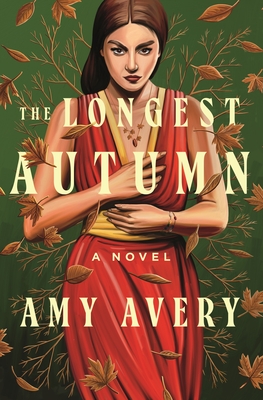
Book: “The Longest Autumn” by Amy Avery
Publishing Info: Flatiron Books, January 2024
Where Did I Get this Book: ARC from the publisher!
Where Can You Get this Book: WorldCat.org | Amazon | IndieBound
Book Description: Tirne is one of four humans rigorously selected to usher the turn of the seasons into the mortal world. Every year, she escorts the taciturn god Autumn between the godly and human realms. Autumn’s seasonal stay among mortals brings cooler weather, changing leaves, and the harvest of apples and gourds until Winter takes his place.
This year, the enchanted Mirror that separates their worlds shatters after Tirne and Autumn pass through, trapping both of them in the human realm. As the endless autumn stretches on, crops begin to fail and the threat of starvation looms. Away from the magic of the gods’ home, Tirne’s debilitating headaches return with a vengeance. Worse, Autumn’s extended stay in the human realm turns him ever more mortal and vulnerable, stirring a new, forbidden attraction to Tirne.
While the priesthood scrambles to find a way to reassemble the Mirror, Tirne digs into the temple’s secrets and finds an unlikely ally—or enemy—in the enigmatic sorcerer and master of poisons, Sidriel. Thrown into a world of mystery, betrayal, and espionage as she searches for the truth, might Tirne lose her morals, her hard-earned position, and the illicit spark between her and Autumn?
Review: I have to say, I barely made it past the cover on this one. I don’t know what it is, but it doesn’t read “fantasy” to me. Instead, it looks more like some sort of historical, literary fiction type book (nothing wrong with those, just not my preference!). But once I actually looked at the book description itself, it definitely sounded like something up my alley! I’ll be curious to see if other readers had similar feelings. We all say not to judge a book by its cover, but in reality, that’s the first thing a perspective readers sees and, try or not, they make a lot of assumptions about the type of book it will be based on this initial glance. And, while this book wasn’t a perfect book for me, I do think there are a good number of fantasy readers who will enjoy this, and I’d hate for them to miss it simply because the cover looks like what you’d find for another book entirely.
When thinking back on my reading experience of the book, I find myself coming away with the thought that I still liked the overall idea of the book more than the actual thing itself. In that, I thought the world, magic, and characters all sounded interesting. There was almost the feeling of it being a re-telling of some ancient Greek myth (though it isn’t). It had nice nods to the struggle of chronic pain, and the approach to romance was more realistic than you often see. However, all of these things still never quite came together the way I liked.
For one thing, I found Tirne to be a very passive character, spending much of her time dealing with her chronic migraines and simply reacting to and trying to survive the various challenges thrown at her. And while I think this kind of representation of chronic pain is useful, it also began to feel as if it was Tirne’s only character trait. Beyond this, it seemed that much of the story’s plot and mystery was hung on Tirne’s struggles to deal with these debilitating headaches. I found myself increasingly wanting more not only from Tirne as a character but also from the story itself. Representation of chronic pain, no matter how good, is not a story in and of itself.
And, while I appreciated some of the nods towards more realistic romances, I also felt mislead on this front by the book’s overall description. I was expecting the love story to play a more important role in the book, but instead I found myself feeling rather adrift, not knowing who I was meant to be rooting for or whether the romance was actually going to be important to the story at all. Things ended in a satisfactory way, but not necessarily in the way that most romance readers will be looking for. So, again, kind of like the cover art, I’m concerned that this book won’t easily find its way to the readers who will most appreciate it. Instead, readers looking for a romantic fantasy story may find themselves a bit disappointed by the love story that is presented here.
I also never felt myself becoming overly invested in any of the side characters. The book is written in first person which can sometimes run into this problem. And its unfortunate that Tirne felt as passive as she did, since establishing a solid main character is the primary strength of this style of writing. But the weaknesses that can be found do often come down to the portrayal of side characters, as we only have the limitations of the main character’s perceptions of them to really paint any sort of picture. This was definitely the case with this book, as I can’t point to a single side character who really stood out to me.
Overall, this book was fine. It was a fast, easy read, but it wasn’t exactly the story I was looking for when I picked it up. Fantasy readers who are less interested in the romance may find themselves enjoying it more. And those looking for a heavy focus on chronic pain may also find this to be a good match for them.
Rating 7: A bit lackluster with its main character, and I felt like there was a bait-and-switch in the overall concept of the book as presented in the description.
Reader’s Advisory:
“The Longest Autumn” isn’t on any Goodreads lists yet, but it should be on Best Books To Read In Autumn.
 The Library Ladies