
 Book: “Supergirl: Being Super” by Mariko Tamaki, Joelle Jones (Ill).
Publishing Info: DC Comics, June 2018
Where Did I Get This Book: The library!
Book Description: She’s super-strong. She can fly. She crash-landed on Earth in a rocket ship. But for Kara Danvers, winning the next track meet, celebrating her 16th birthday and surviving her latest mega-zit are her top concerns. And with the help of her best friends and her kinda-infuriating-but-totally-loving adoptive parents, she just might be able to put her troubling dreams–shattered glimpses of another world–behind her.
Until an earthquake shatters her small town of Midvale…and uncovers secrets about her past she thought would always stay buried.
Now Kara’s incredible powers are kicking into high gear, and people she trusted are revealing creepy ulterior motives. The time has come for her to choose between the world where she was born and the only world she’s ever known. Will she find a way to save her town and be super, or will she crash and burn?
Caldecott Honor and Eisner Award-winning writer Mariko Tamaki (This One Summer) and Eisner Award-nominated artist Joëlle Jones (Lady Killer) combine forces for this incredible coming-of-age tale! This is the Girl of Steel as you’ve never seen her before.
Review: Kara Danvers, aka Supergirl, has recently had something of a pop culture renaissance. The success of the CW show “Supergirl” has had a huge hand in that, as it has brought Kara to the forefront for the past few years. I enjoy “Supergirl” for the most part, and I think that it does do Kara justice, but what we didn’t get from that show was Supergirl’s teenage years, instead putting her solidly in her early twenties when it began. I think that part of the appeal of Supergirl initially was that she is a teenager, and therefore has the usual trials and tribulations that a teenage girl would have (though back when she was first created a lot of that was steeped in sexism of the time). So while I’ve enjoyed the TV version of Kara, and the “Bombshells” version of her as well, I was really hoping to get a new take on a teenage Kara eventually. And my hopes were answered thanks to Eisner Award Winner Mariko Tamaki, who wrote the mini series “Supergirl: Being Super”.
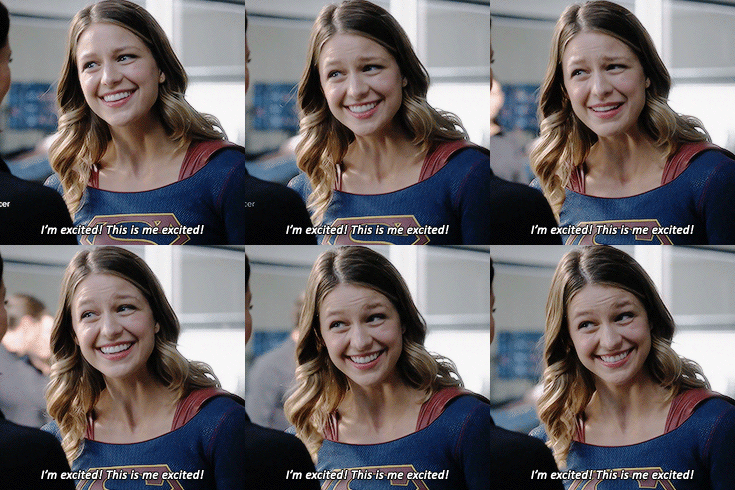
Mariko Tamaki has been at the graphic novel game for awhile, with one of her more notable books being “This One Summer”. This story is about early teenage girls spending the summer at a cabin, and focuses on coming of age themes as well as learning about some sad truths about the world. It’s a quiet and emotional story, and therefore Tamaki is the perfect person to helm a Supergirl origin story. This version of Kara has loving family and good friends, but her powers have been kept secret from most people in her life. While she understands why they need to be kept secret, we’re told in bits and pieces the cost of hiding her identity from those around her has had in her life. Life is hard enough when you’re a teenager trying to find yourself, it’s even harder when you don’t know where you came from, you don’t know why you are the way you are, and you have to keep it inside. Much like “This One Summer”, “Supergirl: Being Super” has a lot of heartbreaking and poignant themes and moments, with Kara going through loss and and identity crisis at the heart of the story. After a horrific trauma happens to her and the rest of the town, and someone close to her dies, Kara begins to spiral. The pain that she is going through, as well as seeing her parents trying to help her get through it while letting her know her pain is valid and real, led to many a teary eyed moment as I read this book. Kara is flawed and angsty, but she is also bright and friendly and very real, and I loved the arc that she followed in this story.
Tamaki also created a lovely cast of characters to be in Kara’s life. From her parents to her mentors and her friends, the supporting characters are all well rounded and add depth and vibrancy to the story. The two who I would argue are the most important are her two best friends, Liz and Dolly. They are all on the track team together, and their conversations and interactions were all very true to life and familiar to me, as someone who was a teenage girl once. Additionally, I liked that while they are all best friends with similar interests, they are also pretty different as well, having their own unique personalities that contribute different things. And even the antagonists in this book (and there are a few) are so well structured and characterized that the reader can see where they are coming from, and why they do the things that they do, even if they are ultimately terrible things.
And do not worry. Krypton plays a large role in this story too, even if Kara is well beyond her time on that doomed planet. It isn’t a Superman or Supergirl story unless Krypton is involved, and Tamaki made it feel fresh and original.
The artwork is done by Joelle Jones, who I have reviewed here for her “Ladykiller” series. I love Jones’s artwork and style, and I think that she brings such vibrant detail to these characters, as well as making them all so original and unique.
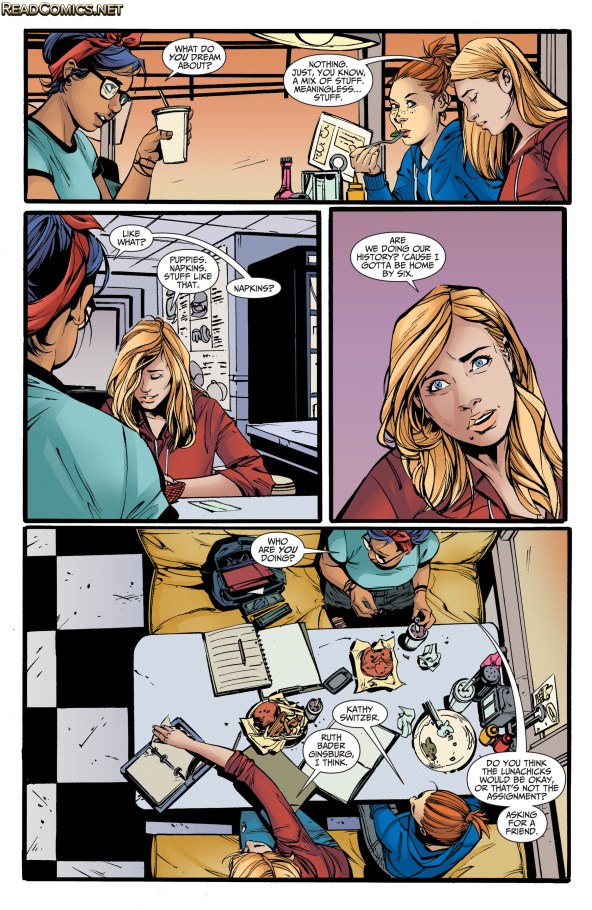
I cannot recommend “Supergirl: Being Super” enough. I love the story that Tamaki and Jones have given Kara, and while I know that there are no official plans for Tamaki to continue the story I am holding out hope that DC will beg her to come back and give us more.
Rating 9: A wonderful and fresh origin story for Supergirl, “Supergirl: Being Super” is a great story for fans of Supergirl of all ages.
Reader’s Advisory:
“Supergirl: Being Super” is (maddeningly) not included on many Goodreads lists, but I think that it would fit in on “Comics and Graphic Novels by Women”, and “Comics for Teen Girls (that are not Japanese Manga)”.
Find “Supergirl: Being Super” at your library using WorldCat!
 The Library Ladies
Awesome! I reserved a library copy for my almost 13-year old daughter. Thanks for the review!
LikeLiked by 1 person
I hope she likes it! It’s such a lovely story. -k
LikeLiked by 1 person
Supergirl; Being Super
The mold of Disappointment.
I already knew what I was getting into when I found out this was written by Mariko Tamaki, Canadian YA novel Fanfic-ster, but everyone can exert a little hope that even the most generic story is fun, exciting, satisfying, or even just fine. But this series crushes your expectations with each chapter, usually in the worst way possible.
Basically, if you’ve never read a comic book before, or a regular book before, or if you don’t understand subtext and themes, then this series is a phenomenal slam dunk in good art and emotional relatability… and nothing else. However, if you have ever been a teenager before, or if you’ve talked to other people with different opinions than you own, then a lot of things about Supergirl: being super don’t sit right with you. Like, at all.
Let’s start with the story. Stop me if you heard this before. A “young adult” experiences life as a normal person in school with her friends, but secretly, there’s something unique and special about her, which she thinks is (great/confusing) so she becomes (confident/angsty) about herself. Something happens that causes someone to die, making the “young adult” more angsty than she was two issues ago. Suddenly, she stumbles upon a conspiracy surrounding her, and she discovers why she’s so special. Also, men are the bad guys, so a random guy threatens the special girl, she beats him, and he leaves, so they may one day clash again. Special girl realizes she’s part of a race of special white people, she looks into that. Bad guys plot. Every side character is left behind like wet garbage. The end.
See, the fun part about using a cliched generic plot is NOT making an effort to make it unique and fun, with action to break up the dozens of pages of monotony.
Next, the characters… Don’t matter. Aside from Supergirl, did we actually understand what anyone was going through? The perspectives and opinions of other people? At most, we got a minor glimpse of it, a mad scientist going on about renewable energy, Supergirl’s grandparents being afraid of her. I think Supergirl’s parents should’ve given us the biggest picture on how her life works being a Kryptonian on Earth. But man, that would get in the way of the Highschool fantasy fulfillment! Plus, Tamiko would have to depict her father as an actual emotionally invested human being and that just isn’t a realistic thing to do for her. Better add some amnesia, then make her parents quiet and barely relevant outside of filler pieces. Now Supergirl is, like, a totally normal teenage, obviously. Did I mention the dialogue is bad?
No, Tan On isn’t worth talking about. There is no conceivable reason why he’s on Earth, nor does the story suggest he’s here from the beginning. He literally is just here to be the bad guy, probably meant to fulfil some desire to act like unstoppable superior race without real drawbacks. He escapes, by the way.
As for the lesson in all this, there isn’t one? I mean, it’s a coming-of-age story. Supergirl embraces her powers and will one day be as powerful and kickass as Superman. But in this story, what is the point of all this? Why is Supergirl so slow to action? Why does Tan On assume the worst of humanity? Why does Dr. Stone obsess over renewable energy and power? What does all of this mean? Simple, it’s a coming-of-age story, so it doesn’t mean anything. All those ideas and thoughts are meant to be poorly constructed steppingstones to the ultimate goal escaping the ‘paradise of being a teenager’ that Mariko Tamaki describes. Unfortunately for her, that’s not how narratives work, especially when you put too much of yourself in one.
What I see from the story’s lesson is little like this; Some people like Supergirl were just born special, cut from a different cloth of the normals. And those normals can get jealous, they want to take advantage of that specialness. People like Supergirl, and you the reader, must always be on guard, put ourselves above the normals, be with our own people if we can, even if some are extremist. They can’t understand how special we are, but we must bear the burden of showing them our greatness, so they can one day see that we aren’t queer, we’re perfection.
Supergirl: Being Super is a extremely generous three stars out of five. for a YA novel. which is still considered a low bar. It a cannibalized origin story that goes nowhere and stinks of the arrogance of a soap box author. It is literally longer than it needs to be and isn’t improved by the constant self-pity, hollow comforting and crying, and the far too little, feverishly too late action following the inexcusable amount of filler anyone had to sift through. Everyone literally has not a single good or meaningful thing to say about this series outside of the artwork and I dare even one person anywhere to describe it positively, without insisting I’m attacking women or feminism. This book doesn’t even represent either of those things.
Supergirl: being super is a waste of time, chapters of disappointment creeping in with each half-baked sentiment, the most exhausting story about a girl losing her superpowers over and over again, watching people die in front of her, and never truly stopping the bad guy or saving the day. Clearly, she’s not so super after all.
LikeLike